
Lecture
When designing complex structures and facilities, one often resorts to so-called laboratory design. In this approach, a model of the structure (facility) under consideration is built in the laboratory, water (or another liquid) is passed through it, and various quantities (pressures, velocities, etc.) are measured. The values thus obtained for the model are then transferred to the actual structure.
In carrying out this kind of work, a number of questions arise: how should the model be built in the laboratory (what dimensions should be given to it,
what wall roughness the model should have, etc.); what values of V and Q should be assigned to the model if it is a certain number of times smaller than the actual structure; and how the data obtained in the laboratory for the model should be transferred to the actual structure.
These are the questions addressed by the theory of physical modeling of hydraulic phenomena.
The basis of this modeling (which pertains to fluid mechanics) is the so-called theory of similarity, which relies on the theory of dimensionality of physical quantities.
In the physical modeling of hydraulic phenomena, geometric, kinematic, and dynamic similarity are distinguished.
1. Geometric similarity. Two hydraulic systems (two hydraulic phenomena) are geometrically similar if a constant ratio exists everywhere between corresponding dimensions of these systems:
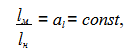 (2.41)
where ln — a certain dimension of the actual structure (prototype); ln — the corresponding dimension of the model; al, — the length scale.
For geometrically similar systems
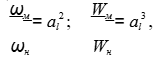 (2.42)
where ωn , Wn — a certain area and a certain volume belonging to the actual structure; ωn , Wn — the corresponding area and volume of the model.
2. Kinematic similarity. Two hydraulic systems are kinematically similar if:
a) the trajectories described by corresponding fluid particles of both systems are geometrically similar and identically oriented with respect to the boundaries of these systems;
b) the velocities U and accelerations w at corresponding points, at corresponding instants of time, are everywhere related by constant ratios:
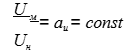 (throughout the entire volume); (2.43)
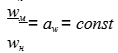 (throughout the entire volume). (2.44)
It should be emphasized that kinematically similar systems are always geometrically similar systems.
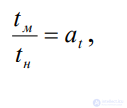
In connection with kinematic similarity, the concept of the time scale arises
 (2.45)
where tn and tm — time intervals during which the corresponding phenomena occur in the prototype and in the model.
For kinematically similar systems
at=const (throughout the entire volume).(2.46)
3. Dynamic similarity. Two hydraulic systems are dynamically similar if:
a) at any pair of corresponding points, forces of the same kind act; b) the ratio of the magnitudes of the corresponding forces is, for any pair of corresponding
points, the same throughout the entire volume of both hydraulic systems under consideration, i.e., the force scale:
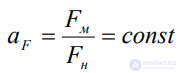 (throughout the entire volume), (2.47)
where F denotes any force acting on the fluid;
c) the forces acting on the first hydraulic system are oriented relative to one another and relative to the boundaries of the system in the same way as the forces acting on the second hydraulic system.
It can be said that dynamically similar systems are those for which the vector fields of forces acting on the fluid are formed by forces of the same kind, these fields being geometrically similar and identically oriented relative to the boundaries of the systems.
Dynamic similarity can occur only in the presence of kinematic, and consequently geometric, similarity. As can be seen, dynamic similarity presupposes the existence of kinematic similarity. Therefore, dynamically similar systems are mechanically similar systems.
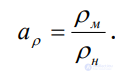
In connection with the question of dynamic similarity, the concept of the fluid density scale arises:
 (2.48)
Judging the dynamic similarity of two systems (see item «c» above) by measuring and comparing the forces acting on these systems is practically inconvenient and even impossible. At the same time, it is easy to see that the ratio of the forces acting in the prototype and in the model can be established indirectly: from the available scales of length, velocity, and fluid density, i.e., from the ratio of quantities that are readily measurable.
Adopting this indirect method of assessing dynamic similarity, we make use of the so-called criteria of dynamic similarity.
In the general case, the following forces act on a moving incompressible viscous fluid:
1) the bulk external force of gravity G;
2) the surface (external and internal) forces of hydrodynamic pressure P;
3) the surface (external and internal) forces of friction (viscosity) T. The geometric sum of these forces, according to d'Alembert's principle, can be represented as
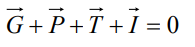 (2.49)
where I — is the force of inertia,
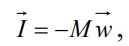 (2.50)
where M — is the mass of the selected fluid volume, w — the acceleration. For given boundary conditions, it can be assumed that at a given point of the
fluid the pressure force P is entirely determined by the forces G, T and I:
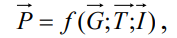 (2.51)
therefore (2.49) can be rewritten as:
 (2.52)
For various particular cases, the equation of motion (2.52) can be simplified because some of the forces included in it turn out to be either equal to zero or negligibly small compared with the other forces. For example, in the case of steady parallel-flow motion, the inertial force I = 0. In the case of pressurized flow in a pipeline, the effect of the fluid's own weight G of the volume under consideration is negligible compared with the effect of the pressure forces P, and therefore the force G can be excluded from equation (2.52). In the case of laminar flow, the forces I can often turn out to be negligibly small compared with the forces T, and so on.
Let us first consider the simplest cases, in which only a single system of governing forces (not counting inertial forces) acts on the fluid under study; here we shall confine ourselves to considering only those flow conditions in which the inertial forces are comparable in magnitude to the forces of gravity or the forces of internal friction.
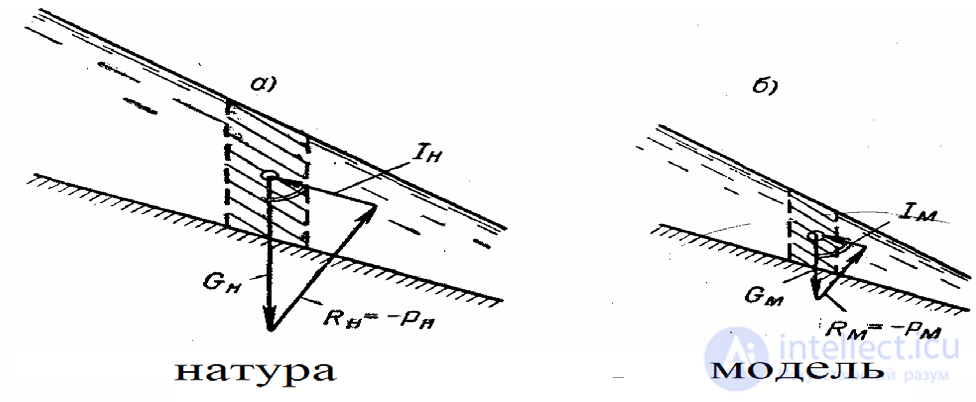
1. The case in which only gravitational forces act on the fluid. In this case, only the force G and the inertial force I appear in equation (2.52).
To achieve dynamic similarity of two systems (the prototype and the model),
shown in the figure, it is necessary to require that the triangles of forces shown in diagrams a and b be geometrically similar.
To ensure the similarity of these triangles of forces, the following is necessary: a) kinematic similarity of the two systems under consideration, since it is precisely
this condition that ensures the equality of the angles formed by the forces G and I in figures a and b; recall that, by requiring kinematic similarity, we thereby also require geometric similarity;
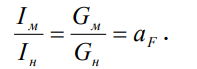
b) satisfaction of the equality
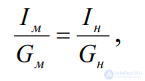 (2.53)
or, equivalently,
 (2.54)
As can be seen, the force scale in this case is equal to the ratio of the inertial forces calculated for the model and for the prototype.
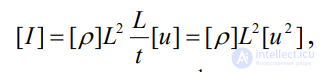
According to (2.50),
 (2.55)
where L and t — are the symbols of length and time.1
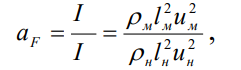
Therefore, the force scale aF, ensuring dynamic similarity, in this case will be2
 (2.56)
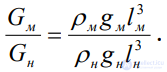
The dimension of the force of gravity can be represented as
 (2.57)
consequently
 (2.58)
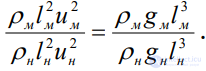
Taking into account relations (2.56) and (2.58), we can write, according to (2.54),
 (2.59)
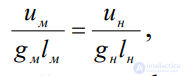
As can be seen, to achieve dynamic similarity when only the force G (together with the inertial force I) acts on the fluid, it is necessary to require, besides the satisfaction of kinematic similarity, also the satisfaction of equality (2.59), which can be rewritten as
 (2.60)
where u — is the velocity at the given point; l — some linear dimension; g — the acceleration of gravity.
1The square brackets in relation (2.55) and elsewhere indicate that we are interested here not in the numerical value but in the dimension of the corresponding quantities.
2For two dynamically similar systems, the validity of the transition from relation (2.55) to relation (2.56), where the quantities themselves are substituted in place of the symbols expressing the dimension of the individual quantities, can be rigorously justified (this justification is not given here).
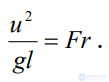
Let us introduce the notation
 (2.61)
It should be emphasized that the quantity Fr is dimensionless and represents a measure of the ratio of inertial forces to gravitational forces. This quantity is customarily called the Froude number.
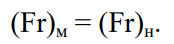
Thus, when only gravitational forces act on the fluid, dynamic similarity will hold if geometric and kinematic similarity exist and if the Froude number, calculated for any point of the model, turns out to be equal to the Froude number calculated for the corresponding point of the prototype,
 (2.62)
2. The case in which only friction (viscosity) forces act on the fluid. Here, for dynamic similarity to hold, the expression defining the force scale must remain the same [see equality (2.56)].
Assuming that the friction forces obey Newton's law (1.6), we can write
 (2.63)
from which we obtain
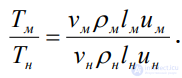 (2.64)
Equating (2.64) to relation (2.56), we obtain
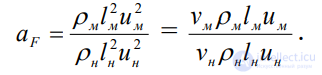 (2.65)
As can be seen, to achieve dynamic similarity in the case where the force T and the inertial force I act on the fluid, it is necessary to require, besides kinematic similarity, the satisfaction of equality (2.65). This last equality can be rewritten as
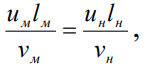 (2.66)
where u — is the velocity at the given point; l — some linear dimension, for example the pipe diameter D or the hydraulic radius R etc.; v— the kinematic viscosity coefficient of the fluid.
It should be emphasized that the quantity
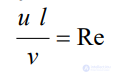 (notation) (2.67)
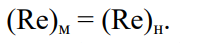
is dimensionless and represents a measure of the ratio of inertial forces to friction forces. We have encountered this quantity before and called it the Reynolds number.
Thus, when only friction forces act on the fluid, dynamic similarity will hold if geometric and kinematic similarity exist and if the Reynolds number, calculated for any point of the model, turns out to be equal to the Reynolds number calculated for the corresponding point of the prototype:
 (2.68)
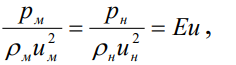
3. The case in which only pressure forces act on the fluid. Reasoning and carrying out transformations analogous to items 1 and 2, one can obtain a quantity called the Euler number.
 (2.69)
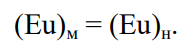
Thus, when only pressure forces act on the fluid, dynamic similarity will hold if geometric and kinematic similarity exist and if the Euler number, calculated for any point of the model, turns out to be equal to the Euler number calculated for the corresponding point of the prototype:
 (2.70)
Similarity criteria. As can be seen, to achieve dynamic similarity between the model and the prototype, each system of forces acting on the fluid requires the equality, at corresponding points of the model and the prototype, of some number of its own (the Froude number, the Reynolds number, etc.).
These dimensionless numbers (Froude, Reynolds, Euler, Weber, Cauchy, etc.), whose equality at corresponding points of the model and the prototype indicates the presence of similarity between the model and the prototype, are called similarity criteria.
In the general case, when several different systems of forces act on the fluid simultaneously, in order to obtain dynamic similarity between the model and the prototype, it is necessary to require the simultaneous satisfaction of the equality of the corresponding similarity criteria at corresponding cross-sections.
If, for example, when conducting hydraulic experiments it is necessary to take into account both gravitational forces and friction forces, then to achieve dynamic similarity between the model and the prototype one must, besides kinematic and geometric similarity, simultaneously maintain two more conditions:
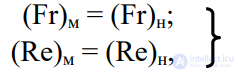
and these conditions must apply to all corresponding cross-sections of the model and the prototype.
In various branches of physics there are quantities that are independent. Quantities are considered dependent if the dimension of one of them can be represented as a combination of the others. An example of dependent quantities
are, for instance, velocity, length, and acceleration, since the dimension of acceleration can be expressed by means of velocity and length (V2/L).
In mechanics there are three independent quantities. Thus, for SI, the independent quantities are length L (meter), time T (second), and mass M (kilogram).
The remaining quantities are derived, expressed through the independent ones in the form of a power monomial  , where x, y, z — are algebraic numbers.
Suppose that, from some considerations or experimental studies, a physical relationship has been obtained in the form
a = f(a1,a2,…,ak,…, an)
where a1,a2,…,ak,…, an — are numerical values, dependent on the units of measurement, of certain functions, the first k of which are independent. Let us take them as the characteristic dimensions. If the structure of the function f expresses a law that does not depend on the choice of the system of units of measurement, then it can be reduced to the form
π = f(1,1,1,…,π1, π2, …, πn-k) (2.71)
This result, called the π-theorem, asserts (we omit the proof) that the functional relationship among n + 1 dimensional quantities a1,a2,…,ak,…, an, independent of the choice of the system of units of measurement, has the form of a relation among n + 1 - k dimensionless combinations of the n + 1 dimensionless quantities. The number of units (1,1, ...) in (2.71) equals k.
As a second example of the application of the π-theorem, let us give the Darcy formula (9.1) for head losses in pipes, taking the resistance per unit length of pipe in the form 
Theoretical and experimental data suggest the following form for this formula:
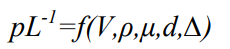 (2.72)
where V - is the mean velocity of the fluid in the pipe cross-section; L — the length of the pipe; ∆ — the wall roughness; ρ — the density; μ — the viscosity of the fluid; I the hydraulic gradient.
Here n = 5, k = 3; hence there will be 5 + 1 — 3 = 3 dimensionless complexes.
Let us take V,ρ,d as the independent quantities among these. Then π = f(1, 1, 1, π1,π2), where

or

The dimensionlessness conditions will be:
for π
x + y −3z = −2, y = 2, z =1;
for π1
x1 + y1 −3z1 = −1, y1 =1, z1 =1;
for π2
x2 + y2 −3z2 =1, y2 = 0, z2 = 0;
Solving these three systems of equations together, we find:
x =1, y = 2, x1 = x2 = y1 = z = z1 =1, y2 = z2 = 0
From this we obtain
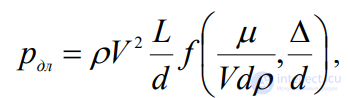
or the Darcy formula
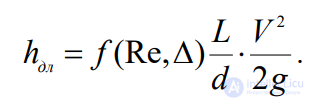
The function f (Re,∆ d) = λ is called the Darcy coefficient, see formula (3. ).

Comments