
Lecture
Fluid mechanics is a branch of mechanics that studies the behavior of liquids (and sometimes gases) at rest and in motion. Fluid mechanics is an applied branch of continuum mechanics that studies the motion of a fluid, the conditions of its equilibrium, and its interaction with various solid bodies, surfaces, or obstacles that it wets or flows around.
The subject of fluid and gas mechanics is a model of a continuous flowing medium with physical properties attributed to it.
The methods of studying fluid mechanics are mathematics and experiment. Fluid mechanics studies the general laws of mechanical motion and equilibrium of liquids and gases. A related science that deals with more specific questions of the motion and equilibrium of flowing media is «Hydraulics». Hydraulics deals with solving practical problems, while fluid mechanics deals with—
general theoretical questions of the motion of flowing media.
Studies forces and motion in liquid media.
It is divided into hydrostatics (fluid at rest) and hydrodynamics (fluid in motion).
It also includes the concepts of internal friction (viscosity), pressure, drag forces, turbulence, and others.
The solution of various technical problems related to issues of
fluid motion in open and closed channels, as well as issues of
the force effect of a fluid on the walls of vessels or on solid
bodies immersed in the flow, led to the creation of an extensive science
called fluid mechanics, which is divided into two sections: technical
fluid mechanics and theoretical mechanics of liquids and gases (Fig. 1.1).
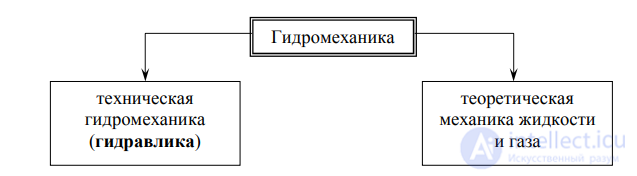
Fig. 1.1. Branches of fluid mechanics
Hydraulics (technical fluid mechanics) – the applied part of
fluid mechanics that uses various assumptions to solve
practical problems. It has relatively simple calculation methods
compared to theoretical fluid mechanics, where
a complex mathematical apparatus is used. However, hydraulics provides
a sufficiently accurate description of the phenomena under
consideration for technical applications.
Fluid mechanics is a subdivision of continuum mechanics, as shown in the following table.
| Continuum mechanics The study of the physics of continuous materials. |
Solid mechanics The study of the physics of continuous materials with a definite rest shape. |
Elasticity Describes materials that return to their original shape after the applied stresses are removed. |
| Plasticity Describes materials that deform irreversibly once a sufficient applied stress is reached. |
Rheology — the study of materials possessing both solid and liquid properties. |
|
| Fluid mechanics The science of the physics of continuous materials that deform under the action of force. |
Non-Newtonian fluid Does not undergo deformations proportional to the applied shear stress. |
|
| Newtonian fluids undergo deformation at a rate proportional to the applied shear stress. |
From a mechanical standpoint, a fluid is a substance that cannot sustain shear stress; therefore a fluid at rest takes the shape of the vessel that contains it. A fluid at rest has no shear stress.
Historically, hydraulics is one of the most ancient sciences in the
world. Archaeological research shows that as early as 5000 years
before our era, in China, and later in other countries of the ancient world,
descriptions of various hydraulic structures have been found,
presented in the form of drawings (the first blueprints). Naturally,
no calculations of these structures were made, and they were all
built on the basis of practical skills and rules.
The first indications of a scientific approach to solving hydraulic
problems date back to 250 BC, when Archimedes discovered the law of
Fluid mechanics
technical
fluid mechanics
(hydraulics)
theoretical
mechanics of liquids
and gases
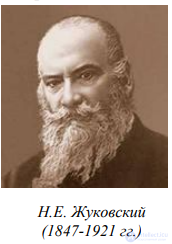
N.E. Zhukovsky
(1847-1921)
the equilibrium of a body immersed in a fluid. After that, for about 1500 years
hydraulics underwent no particular changes. Science at that time hardly
developed at all, and a kind of stagnation set in. Only in the XVI-XVII
centuries AD, in the era of the Renaissance, as historians call it,
did the works of Galileo, Leonardo da Vinci, Pascal, and Newton appear,
which laid a serious foundation for the further
development of hydraulics as a science.
However, only the fundamental works of
academicians of the St. Petersburg Academy of Sciences, Daniel
Bernoulli and Leonhard Euler, who lived in the XVIII century,
created a solid foundation on which
modern hydraulics is based. In the XIX-XX
centuries, a significant contribution to hydrodynamics was made by
the «father of Russian aviation» Nikolai Yegorovich
Zhukovsky.
A special contribution to the development of hydrodynamics was made by L. Euler, who in 1755 introduced systems of differential equations for the equilibrium and motion of fluids. The theoretical works listed laid the groundwork for the rapid development of experimental hydraulics in the works of Chézy, Dubuat, Venturi, Bazin, and Reynolds.
The emergence of applied interest in the problems of modern fluid mechanics has been documented since antiquity. For example, the Greek scientist Archimedes, in his treatise on floating bodies, formulated the first principles of hydrostatics.
In the middle of the XV century, the Italian inventor Leonardo da Vinci studied the flow of water in channels through weirs and openings. This body of work laid the foundation for experimental methods in hydraulics. The Italian Galileo Galilei and the Frenchman Blaise Pascal devoted much attention to questions of hydrostatics, effectively developing the ideas of Archimedes. The Italian mathematician Evangelista Torricelli created and substantiated a mathematical expression for the velocity of a fluid flowing out of an opening — Torricelli's formula. The English physicist Isaac Newton formulated principles concerning internal friction in a moving fluid flow. Thanks to the efforts of the Swiss physicist Daniel Bernoulli and the German mathematician Leonhard Euler, equations of motion for an ideal fluid of general form were created, which in effect marked the beginning of theoretical fluid mechanics. However, at that time attempts to apply these equations gave acceptable results only for a narrow range of problems.
At the end of the XVIII century, thanks to the experimental efforts of many engineers and researchers, a large number of empirical formulas appeared, which widened the gap between the practical and theoretical parts of hydrodynamics. However, research into the structure of fluid flow led, by the end of the XIX century, to the formation of new approaches to the study of fluid flow, which made it possible to reduce these contradictions. A significant amount of work on detailed experiments with internal friction in laminar fluid motion was carried out by the Russian military scientist Nikolai Petrov. Research by the British physicist Osborne Reynolds made it possible to expand the understanding of the transition process from laminar to turbulent flow and to understand the phenomenon of hydraulic resistance.
Following this, the body of work by the Russian mechanician Nikolai Zhukovsky and the German physicist Ludwig Prandtl raised the understanding of a number of fundamental problems to a new level. In particular, their efforts made it possible to create the so-called semi-empirical theories of turbulence, which gained worldwide recognition and practical application.
The role of hydraulics in modern
mechanical engineering can hardly be overestimated. Any
automobile, aircraft, or ship cannot
do without hydraulic systems.
Add to this the construction of dams, dikes, pipelines, canals,
and spillways. In manufacturing, one simply cannot do without hydraulic
presses capable of developing enormous forces. Here is an interesting
fact from the history of the construction of the Eiffel Tower. Before
finally setting the multi-ton metal structure of the tower on its
concrete foundations, it was brought into a strictly vertical position with
the help of four hydraulic presses installed under each
support.
Hydraulics follows a person everywhere: at work, at home, at the dacha, in
transport. Nature itself suggested to humans the design of hydraulic
systems. The heart is a pump, the liver is a filter, the kidneys are safety
valves, blood vessels are pipelines, whose total length in the
human body is about 100,000 km. A person's heart pumps
about 300 liters of blood per hour!
In hydraulics, a fluid is defined as a physical body capable of
changing its shape under the action of arbitrarily small forces.
Two types of fluids are distinguished: droplet (liquid) fluids and
gaseous fluids (Fig. 1.2). Droplet fluids are
liquids in the ordinary, commonly accepted sense of the word (water, oil,
kerosene, oil, etc.). Gaseous fluids – gases, which under normal conditions
are gaseous substances (air, oxygen, nitrogen,
propane, etc.).
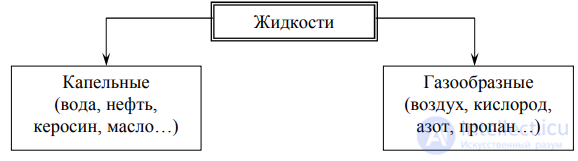
Fig. 1.2. Types of fluids
The main distinguishing feature of droplet and gaseous
fluids is their ability to compress (change volume) under
the action of external forces. Droplet fluids (hereinafter simply
liquids) are difficult to compress, while gaseous fluids (gases)
compress quite easily, i.e., under the action of small forces they
are able to change their volume several times over (Fig. 1.3).
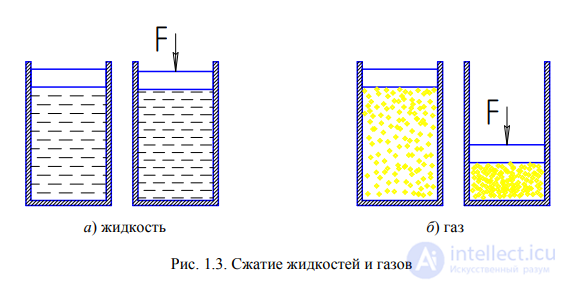
Fig. 1.3. Compression of liquids and gases
Hydraulics considers real and ideal fluids.
An ideal fluid, unlike a real fluid, has no
internal friction, nor friction against the walls of vessels and pipelines
through which it moves. An ideal fluid also has
absolute incompressibility. Such a fluid does not exist in
reality, and was conceived to facilitate and simplify a number of
theoretical derivations and studies.
A fluid is constantly acted upon by external forces, which are
divided into body (mass) forces and surface forces.
Fluids
Droplet
(water, oil,
kerosene, oil…)
Gaseous
(air, oxygen,
nitrogen, propane…)
Body (mass) forces: gravity and inertia. Gravity under terrestrial
conditions acts on the fluid constantly, while the force of inertia acts only when
the volume of fluid is given acceleration (positive or
negative).
Surface forces: caused by the action of neighboring volumes of
fluid on the given volume, or by the action of other bodies.
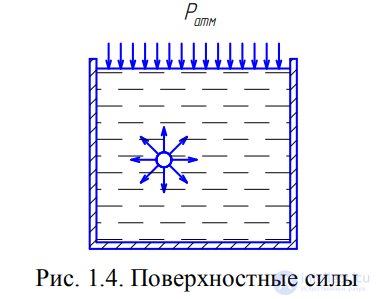
Fig. 1.4. Surface forces
Consider a vessel filled with
a fluid. If we isolate within it
an infinitesimally small volume of fluid,
then this volume will be acted upon by
forces from the neighboring
infinitesimally small volumes
(Fig. 1.4). In addition, the free
surface of the fluid is acted upon by
the force of atmospheric pressure Patm and
by forces from the walls of the vessel.
If some external force acts on a fluid, the fluid is said to
be under pressure. The pressure of a fluid caused by the action of
surface forces on it is usually determined by
the formula
 , (N/m2) or (Pa), (1.1)
where F – the force acting on the fluid, N (newtons);
S – the area over which this force acts, m2 (square meters).
If pressure P is measured from absolute zero, it is called
absolute pressure Pabs. If pressure is measured from atmospheric pressure,
it is called gauge pressure Pgauge. Atmospheric pressure is constant
Pa = 103 kPa (Fig. 1.5).
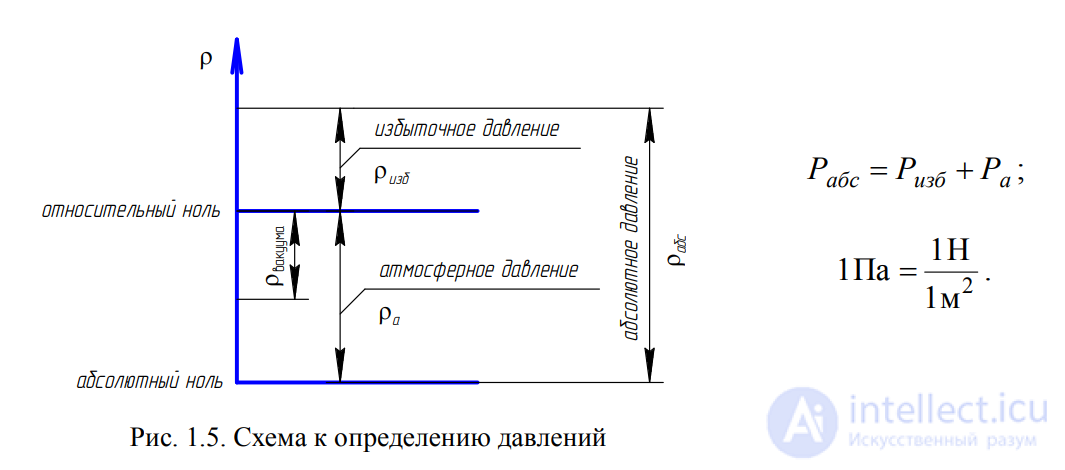
Fig. 1.5. Diagram for determining pressures
The unit of pressure in the International System of Units (SI) is the
pascal – the pressure produced by a force of 1 N, uniformly distributed over a
surface of area 1 m2 normal to it
:

The dimension of pressure is denoted as «Pa» (pascal), «kPa»
(kilopascal), «MPa» (megapascal). In engineering, the MKGSS system of units
continues to be used, in which the unit of
pressure is 1 kgf/m2
.

Basic mechanical characteristics
One of the main mechanical characteristics of a fluid is
its density. The density of a fluid is the mass of fluid
contained in a unit volume.
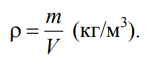 (1.2)
(1.2)
The specific weight is the weight of a unit volume of fluid, which
is determined by the formula:
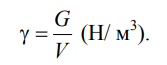 (1.3)
(1.3)
As temperature increases, the specific weight of a fluid decreases.
Basic physical properties
1. Compressibility – the property of a fluid to change its volume under
the action of pressure. The compressibility of a fluid is characterized by
the coefficient of volumetric compression, which is determined by the formula
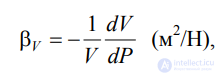 (1.4)
(1.4)
where V – the initial volume of fluid, dV – the change in this volume
when the pressure increases by dP.
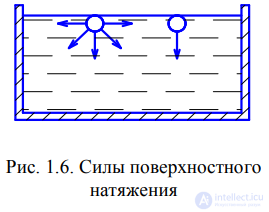
Fig. 1.6. Surface tension forces
The reciprocal of βV is called the bulk modulus of elasticity
of the fluid:
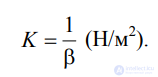 (1.5)
(1.5)
The bulk modulus of elasticity is not constant and depends on pressure and
temperature. In hydraulic calculations, the compressibility of a fluid
is usually neglected and fluids are considered practically incompressible.
The compression of fluids is mainly due to the compression of gas
dissolved in them.
Compressibility reduces the stiffness of a hydraulic drive, since
energy is expended on compression. Compressibility can cause
self-oscillations in a hydraulic system, and creates a delay in the
response of hydraulic equipment and actuators.
Sometimes the compressibility of fluids is useful – it is used in
hydraulic shock absorbers and springs.
2. Thermal expansion – the relative change in the volume of
a fluid when the temperature increases by 1°C at P = const.
It is characterized by the coefficient of thermal expansion
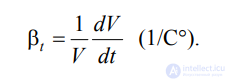 (1.6)
(1.6)
Since for droplet fluids the coefficient of thermal
expansion is negligibly small, it is not taken into account in
practical calculations.
3. Resistance to tension. Special physical experiments
have shown that a fluid at rest (in particular, water, mercury) is sometimes
able to resist very large tensile forces. But under
ordinary conditions this does not occur, and therefore it is considered that
a fluid is unable to resist tensile forces.
4. Surface tension forces – these forces tend to give a
fluid a spherical shape. Surface tension forces are
caused by surface forces and are
always directed inward within the volume under
consideration, perpendicular to the free
surface of the fluid. Consider
an infinitesimally small volume of fluid at the
free surface. It will be
acted upon by forces from neighboring
volumes. As a result, if we add up the vectors of
all the forces acting on the volume under consideration, the resultant
force will be directed perpendicularly inward into
the volume under consideration.
5. Fluid viscosity – the property of a fluid to resist
sliding or shear of its layers. Its essence lies in the occurrence of
an internal friction force between moving layers of fluid, which
is determined by Newton's formula
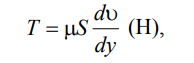 , (1.7)
where S – the area of the fluid layers or of the wall in contact with the
fluid, m2
, μ is the dynamic viscosity coefficient, or the force of
viscous friction, dν/dy – the velocity gradient perpendicular to the
shear surface.
From this the dynamic viscosity is equal to
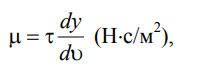 , (1.8)
where τ - the shear stress of the fluid, τ = T/S.
When a viscous fluid flows along a solid wall, deceleration of the
flow occurs, caused by viscosity (Fig. 1.7). The velocity ν
decreases as the distance y from the wall decreases. At
y = 0, the velocity ν drops to zero (ν = 0), while between the layers
slipping occurs, accompanied by the appearance of shear
stresses τ.
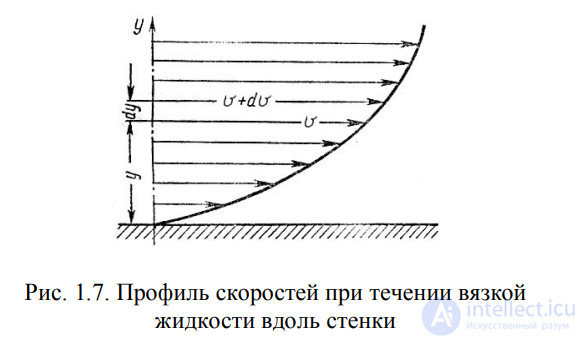
Fig. 1.7. Velocity profile for the flow of a viscous fluid along a wall
The reciprocal of the dynamic viscosity coefficient (1/μ)
is called the fluidity of the fluid.
The ratio of the dynamic viscosity coefficient to the density of the
fluid is called the kinematic viscosity coefficient:
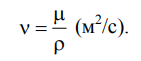 (1.9)
(1.9)
The quantity ν (pronounced "nu"), equal to 1 cm2/s, is called a stoke (St), and 0.01 St – a centistoke (cSt).
The process of determining viscosity is called viscometry, and
the instruments used to determine it are called viscometers. In addition to assessing
viscosity using dynamic and kinematic coefficients,
conventional viscosity – degrees Engler (E) – is also used. Viscosity
expressed in degrees Engler is the ratio of the outflow time of
200 cm3
of the test fluid through a d = 2.8 mm capillary to the outflow
time of the same volume of water at t = 20°C
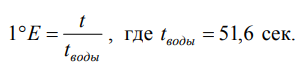 (1.10)
This instrument is called an Engler viscometer. To convert degrees
Engler to stokes for mineral oils, the following formula is used
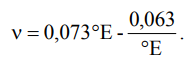 (1.11)
Thus, three quantities can be used to assess the viscosity of a fluid,
which are related to each other
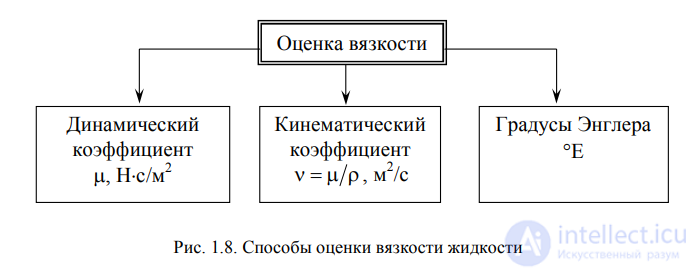
Fig. 1.8. Ways of assessing fluid viscosity
Fluid viscosity depends on temperature and pressure. As
temperature increases, the viscosity of a fluid decreases, and vice versa. For
gases, the opposite phenomenon is observed: as temperature increases, viscosity
increases, and as temperature decreases – it decreases.
6. Foaming. The release of air from a working fluid as
pressure drops can cause foaming. The intensity of
foaming is affected by the water contained in the working
fluid: even a negligible amount of water (less than 0.1% by mass of the working
fluid) causes stable foam to form. The formation and stability of foam
depend on the type of working fluid, its temperature, and bubble size,
as well as on the materials and coatings of the hydraulic equipment. Foaming is
particularly intense in contaminated fluids and fluids that have been
in service. At a fluid temperature above 70°C,
rapid foam collapse occurs.
7. Chemical and mechanical stability. This characterizes the
ability of a fluid to retain its original physical
properties during use and storage.
Oxidation of a fluid is accompanied by the precipitation of resins and
sludge from it, which are deposited on the surfaces of hydraulic drive components
as a solid coating. Viscosity decreases and the color of the fluid changes.
Oxidation products cause corrosion of metals and reduce the
reliability of hydraulic equipment operation. The coating causes jamming of
moving joints, plunger pairs, and throttling orifices,
and causes seal failure and depressurization of the hydraulic system.
8. Compatibility. The compatibility of working fluids with
structural materials, and especially with sealing materials,
is very important. Petroleum-based working fluids
are compatible with all metals used in hydraulic machine building,
and are poorly compatible with seals made of synthetic
rubber and leather. Synthetic working fluids are poorly compatible with
certain structural materials and are not compatible with
seals made of oil-resistant rubber.
9. Volatility of the fluid. Volatility is characteristic of all
droplet fluids, however the intensity of evaporation differs among
different fluids and depends on the conditions it is in: on
temperature, evaporation area, pressure, and on the velocity of motion
of the gaseous medium above the free surface of the fluid (wind).
10. The solubility of gases in fluids is characterized by the volume
of dissolved gas per unit volume of fluid and is determined by
Henry's law:
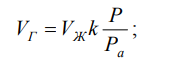 (1.12)
where VG – the volume of dissolved gas; VL – the volume of fluid;
k - the solubility coefficient; P – pressure; Pa – atmospheric pressure.
The coefficient k has the following values at 20°C: for water
0.016, kerosene 0.13, mineral oils 0.08, AMG-10 fluid – 0.1.
As pressure decreases, dissolved gas is released from the fluid.
This phenomenon can negatively affect the operation of hydraulic systems.

Comments