
Lecture
Geopolitics (geographical politics, from Ancient Greek γῆ — earth, πολιτική — state or public affairs) is a strand of political thought, a concept concerned with control over territory and with the patterns governing the distribution and redistribution of spheres of influence (centers of power) among various states and interstate associations. There is no consensus in the scholarly community regarding the status of geopolitics as a science.
A distinction is drawn between traditional geopolitics, new geopolitics (geoeconomics), and the newest geopolitics (geophilosophy). Traditional geopolitics emphasizes a state's military-political power and the dominant role of geographical factors in the seizure of foreign territories, functioning (in Haushofer's terms) as the state's "geographic mind." Geoeconomics, unlike traditional geopolitics, emphasizes a state's economic power. The newest geopolitics, in which strength of spirit dominates over military and economic power, helps overcome traditional geographic and economic determinism by expanding the basic factors that determine states' behavior in international relations.
For contemporary geopolitical theory, of great importance is the study of forms of control over space, taking into account the technological capabilities possessed by states (forms of such control include the political, military, economic, civilizational, communicational, demographic, and informational).
The concept of geopolitics arose at the end of the 19th and beginning of the 20th century; the earliest works used the expression "political geography." The term "geopolitics" was introduced by the Swedish political scientist and constitutional theorist Rudolf Kjellén, under the influence of the German geographer Friedrich Ratzel, who in 1897 published the book "Political Geography" (German: Politische Geographie). Kjellén first used the term in 1899, but it gained wide currency only after the publication of his book "The State as a Form of Life" (1916). Alongside Kjellén, the classics of geopolitical science are considered to include the British geographer and politician Halford Mackinder, the American naval-strategy historian A. Mahan, the German geographer and founder of political geography F. Ratzel, the German researcher K. Haushofer, and the American international-relations scholar N. J. Spykman.
Geopolitics continued and developed the ideas of geographical determinism that had existed in various socio-political conceptions for many centuries. The importance of geographical conditions for the foreign and domestic policy of states was already noted by the ancient Greek thinkers Plato, Aristotle, and Polybius. This tradition was carried on in Roman political thought by Cicero and Strabo. In the modern era, French political thinkers such as Jean Bodin and Charles de Montesquieu drew attention to the connection between geography and politics. The transition from ideas of geographical determinism to geopolitics proper is usually associated with the work of the German political geographer Friedrich Ratzel.
From the second half of the 20th century, the subject matter of geopolitics came to include, above all, such phenomena and concepts of strategic geography as the Cold War and military-strategic parity, and later also globalization and a multipolar world, while such notions as superpower, great power, regional power, nuclear power, space power, economic power, and sporting power came into wide use with reference to states that stood out by a combination of characteristics, or by a single characteristic, and that had influence on other countries.
The main object of study in geopolitics is the geopolitical structure of the world, represented by a multitude of territorial models. Studying the mechanisms and forms of control over territory is one of the principal tasks of geopolitics. The historical core of geopolitics is geography, which places at the forefront the study of the direct and reciprocal links between the properties of territory and the balance (rivalry or cooperation) of world forces. The methodological core of geopolitics, in this respect, is "modeling" at the planetary level, although within this scholarly discipline there also exist regional and local subfields — for example, the study of borders, disputed territories, and interstate conflicts, and so on. Nevertheless, regional and local problems can be successfully studied only within the context of this methodological core, that is, by proceeding from the general to the particular.
In academic circles, geopolitics involves the geographical, historical, and sociological analysis of questions related to politics and territorial structures at various levels (from the state to the international).
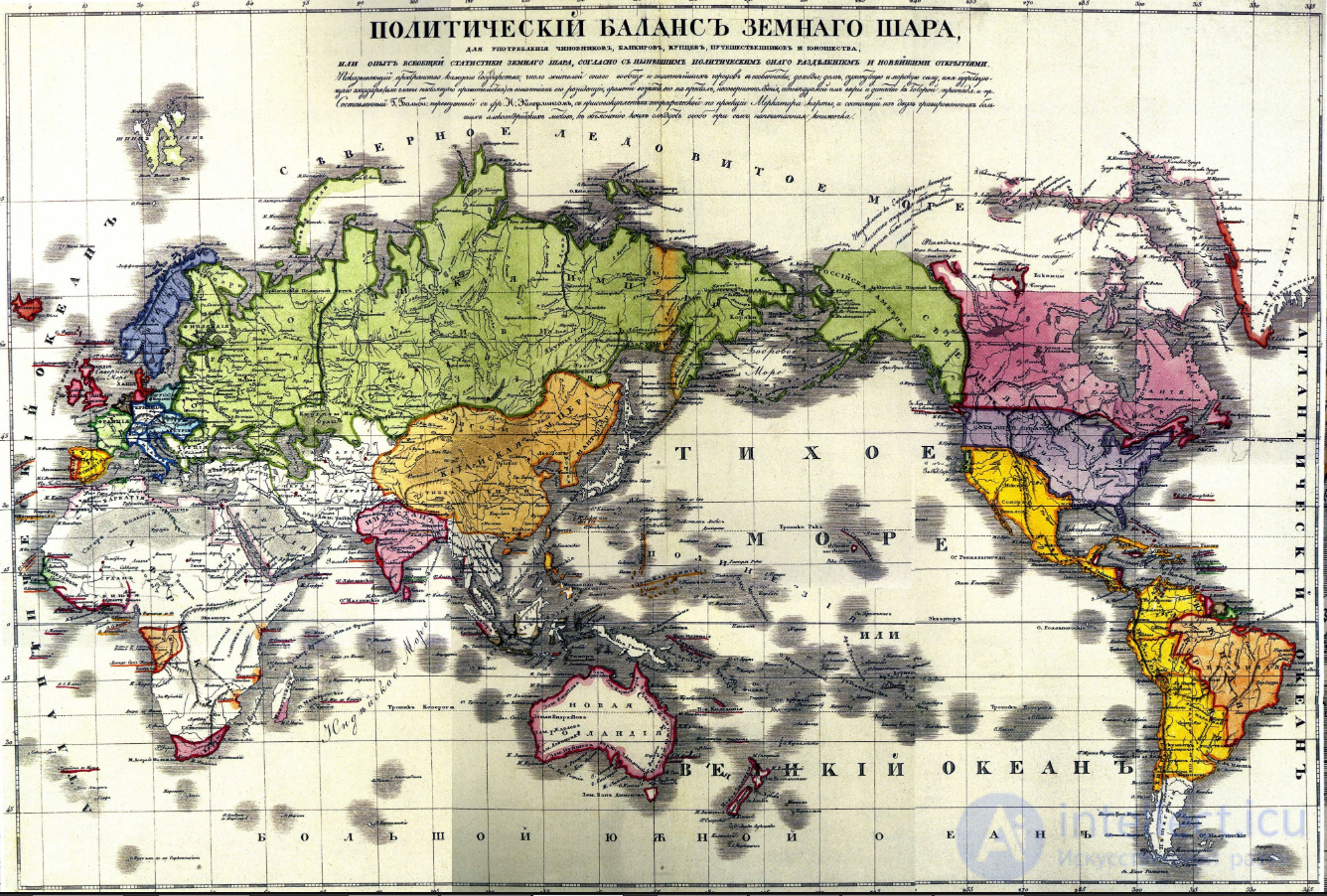
"Political Balance of the Globe," 1830. The first Russian political map of the world
Among Russian authors, the term "geopolitics" first came into use in the 1920s among representatives of the Eurasianist movement. By the late 1920s it had also appeared in the USSR. In this connection, some contemporary historians consider these years to be the time when the Russian geopolitical school emerged. Earlier thinkers who addressed geopolitical questions are, in this context, regarded either as forerunners or as researchers standing outside the general national geopolitical school.
At various periods of its existence, the Soviet Union pursued a varying, at times ambivalent, geopolitical policy and practice. Aiming to spread socialism throughout the world in general and, where possible, to expand its own territory in particular, the pre-war USSR, on the one hand, contrary to its real capabilities, did not annex the adjoining people's-revolutionary states of Mongolia, Tannu Tuva, and Gilan, yet, on the other hand, supported the unsuccessful attempt to form a Chinese Soviet Republic, and also divided Eastern Europe with Nazi Germany under the Molotov-Ribbentrop Pact. Of the territories thus assigned to its sphere of influence, the USSR annexed the formerly Polish Western Ukraine and Western Belarus, as well as the Baltic states, Bessarabia, and Northern Bukovina, but, encountering fierce resistance from Finland when attempting to apply the Baltic-style annexation scenario there, was able to annex only a small part of it.
During the Second World War and immediately afterward, the USSR sharply strengthened its influence in the world, acquired several satellite socialist states ("countries of people's democracy"), and also directly annexed some new territories to itself — East Prussia, a small part of Northern Finland, Transcarpathia, Southern Sakhalin and the Kuril Islands, and Tannu Tuva. However, the USSR did not act on some other opportunities, such as the annexation of Bulgaria in line with its unofficial proposal (rejected on the formal grounds of its territory being an exclave), or drawing into its sphere of influence — following the scenario of establishing socialism in Eastern Europe and creating the German Democratic Republic through the partition of Germany — the Chinese regions of Eastern Turkestan and Manchuria, as well as the temporarily occupied Northern Iran and Eastern Austria, and the Japanese island of Hokkaido, which had been planned for occupation. The USSR supported the ultimately unrealized creation, in Southern Europe, of a "little USSR" out of Bulgaria, Yugoslavia, Albania, and possibly Romania and Greece.
In the second half of the 20th century, the USSR became one of two superpowers alongside the USA. It also headed the second of the most powerful military-political blocs, the Warsaw Pact, and achieved a balance of power with the US and NATO through military-strategic parity. Without openly declaring detailed geopolitical concepts beyond parity and "containing American hegemony and neocolonialism," the USSR in effect shared geopolitical control over the planet, acting in the political, military (including naval), economic, scientific, and sporting spheres. The USSR possessed the largest military-industrial complex and armed forces, which were indirectly involved, among other things, in conflicts with the US in local wars. Like the American school, Soviet geopolitics widely operated with the concepts of an opposing "world of capitalism" and "world of socialism." Although socialist Yugoslavia and Albania, along with an increasingly powerful China, broke away from the Soviet military-political bloc (the "world socialist system"), the USSR as a whole continued to strengthen its influence in the world, actively and in most cases successfully supporting not only its Warsaw Pact allies but also several dozen countries of socialist orientation, as well as national-liberation movements.
A Soviet specialist in domestic geopolitics was Professor A. L. Narochnitsky, who studied Russian geopolitics of the 19th century; scholarly-documentary historical works on this subject came from his pen.
After the collapse of the USSR, its political successor state, Russia — despite the loss of its former (relative to the USSR) standing on the international stage, a small GDP (in the second half of the world's top ten), backwardness in science, a significant reduction of its strategic nuclear forces, high poverty among the population and corruption, outdated infrastructure, a systemic domestic economic crisis, and a difficult demographic situation — is nonetheless regarded [by whom?] as a recovering potential superpower. Russia was for a time a full member of the "Group of Eight" (G8), and, together with other rising powers, formed the BRICS community. The current Russian leadership and certain politicians actively champion the rejection of a unipolar world and of the US as the sole superpower, and argue for the need to establish a multipolar world with an ever-growing role for potential superpowers and regional powers and associations. China, having in effect drawn close to superpower status, agrees with Russia on this point.
In the 1990s, geopolitical research was conducted by Vadim Tsymbursky, a senior researcher at the Institute of Philosophy of the Russian Academy of Sciences, who proposed the term "Island Russia" and is also known for his concept of the Great Limitrophe.
A prominent Russian geopolitician of the early 21st century is Colonel General (ret.) L. G. Ivashov, who heads the Academy of Geopolitical Problems, which analyzes the international situation and the situation within the country, and whose experts develop a Geopolitical Doctrine. Colonel General L. G. Ivashov previously headed the Main Directorate for International Military Cooperation. In that post he firmly and consistently defended Russia's national interests, opposing NATO's eastward expansion, the aggressive foreign policy of the US and the West in general, and the construction of a unipolar world. By that time he already had behind him training at a Military School and a Military Academy and impeccable service in the motorized rifle forces in various command positions. The construction of a unipolar world dominated by the West runs counter to the national interests of the Russian Federation, and the further expansion of NATO threatens Russia's national security.
In recent times, new schools and directions of geopolitics have been actively developed in Russia. V. V. Karyakin, a researcher at the Center for Defense Studies of the Russian Institute for Strategic Studies (RISS), drawing on non-traditional approaches and new challenges, proposed the term "Third-Wave Geopolitics." This interdisciplinary approach is based on the principles of synergetics, post-non-classical science, in the context of socio-political dynamics and strategies of indirect action.
The Russian geopolitical school is divided into two camps, the conservatives and the liberals, who hold different points of view. L. G. Ivashov, L. P. Reshetnikov, A. K. Pushkov, N. A. Narochnitskaya, and M. L. Shevchenko belong to the conservative camp. Lieutenant General L. P. Reshetnikov, a candidate of historical sciences, previously served in the Foreign Intelligence Service (SVR). He knew German, French, Serbian, and Bulgarian. He now heads the Russian Institute for Strategic Studies, whose specialists analyze and forecast the international situation and study the causes of armed conflicts and political crises. RISI's favorite discipline is geopolitics. Experts at this institute oppose further expansion of NATO and the EU and the construction of a unipolar world, a view shared by specialists at the AGP. In all his public statements, L. P. Reshetnikov regarded Serbia, Greece, Moldova, and Bulgaria as fraternal peoples and strategic partners of Russia with many shared ties, including the Orthodox faith, while the West, he argued, had throughout its history always sought to eradicate Orthodoxy and destroy unruly peoples. Among Russian geopoliticians of the conservative camp, there is a widespread view of a clash between Western Christian and Eastern Islamic civilizations. Orthodox theologian A. I. Osipov, a professor at the Moscow Theological Academy, refuted this theory in one of his interviews, arguing that the West had long since departed from its Christian foundations. L. G. Ivashov is a proponent of a multipolar world and the strengthening of Russia, and actively advocates cooperation with all countries of the world on mutually beneficial terms.
Social philosopher N. S. Rozov notes that Russian geopolitics lacks genuinely scientific concepts, and that in the works of Russian authors geopolitics is associated with political realism, social Darwinism, and the justification of expansionism; however, none of this negates geopolitics as a discipline whose purpose is to scientifically study the patterns, mechanisms, and other issues of territorial control by political entities.
For centuries Japan remained an autocratic country with weak central statehood. However, Japanese geopolitics went through a brief period of sharp development and practical application during the Second World War. Like Nazi Germany, militarist Japan attempted during the war to become a new superpower. Japan temporarily acquired a navy comparable in strength to the American Pacific Fleet, held numerous de facto colonies in Asia (including the largest country, China), and had plans, coordinated with its European ally Germany, for expansion into Soviet territory as far as the Urals, into Australia, and, under favorable circumstances, into India. In theory and formally, Japan's claims were framed as the Greater East Asia Co-Prosperity Sphere, which encompassed all the Japanese colonies and satellite puppet states it had acquired. During the war the Japanese Empire was defeated, and afterward Japan, having renounced war as a means of resolving international disputes, focused on becoming one of the most powerful economic and scientific-technological powers on the planet — a goal it successfully achieved.
The American geopolitical school formed under the influence of the ideas of naval historian Admiral Alfred Mahan. In his works "The Influence of Sea Power upon History, 1660–1783" and "The Interest of America in Sea Power," Mahan advanced the concept of "sea power" as a factor guaranteeing absolute geopolitical superiority. It is a country's supply of naval bases and merchant fleet, together with the strength of its navy, that make it a great power capable of deciding the fate of the world, and maritime civilization provides more favorable conditions for development. Seeing in history a confrontation between sea powers and land powers, Mahan proposed using the "Anaconda principle" as a global geopolitical strategy — strangling the enemy by means of a naval blockade of its strategic assets.
Alfred Thayer Mahan (1840–1914) was a frequent commentator on matters of global naval strategy and diplomacy. Mahan believed that national greatness was inseparable from the sea, and especially from its commercial use in peacetime and its control in wartime. Mahan's theoretical foundation came from Antoine-Henri Jomini, and he emphasized that strategic locations (such as narrow passages, canals, and coaling stations), together with measurable levels of fleet combat power, contribute to control of the sea. He proposed six conditions necessary for a country to possess sea power:
Mahan identified a key region of the world in the Eurasian context, namely the central zone of Asia, lying between 30° and 40° north latitude and stretching from Asia Minor to Japan. In this zone, independent countries still remained — Turkey, Persia, Afghanistan, China, and Japan. Mahan regarded these countries, situated between Britain and Russia, as being caught, so to speak, between "Scylla and Charybdis." Of the two monsters — Britain and Russia — it was the latter, in Mahan's view, that posed the greatest threat to the fate of Central Asia. Mahan was struck by Russia's transcontinental scale and its strategically advantageous position for expansion southward. He therefore considered it necessary for the Anglo-Saxon "sea power" to stand opposed to Russia.
Homer Lea, in "The Day of the Saxon" (1912), argued that the entire Anglo-Saxon race faced a threat from German (Teutonic), Russian (Slavic), and Japanese expansionism: the "fatal" relationship among Russia, Japan, and Germany "had now, through the urgency of natural forces, taken the form of a coalition directed against the survival of Saxon supremacy." This was the "terrible Dreibund." Lea believed that while Japan advanced into the Far East and Russia into India, the Germans would strike at England, the center of the British Empire. He believed the Anglo-Saxons faced certain catastrophe at the hands of their belligerent adversaries.
Mahan's formula: navy + merchant fleet + naval bases = sea power.
Looking ahead, Mahan predicted the union of the major maritime states — the United States, Great Britain, Germany, and Japan — into a single bloc directed against the largest continental powers, Russia and China. In the coming global conflict between "land" and "ocean," the maritime powers, in Mahan's view, were bound to have the advantage.
Nicholas Spykman's concept combined the ideas of Mahan and Mackinder. Developing geopolitics within the framework of the concept of U.S. strategic security, he put forward the principle of "integrated control over territory," which America was to exercise worldwide in order to prevent its geopolitical rivals from growing stronger. While holding to the idea of a confrontation between sea and land (the USSR and America), Spykman, however, considered the geopolitical axis of the world to be not the immobile Heartland but the zone of confrontation known as the Rimland — the border zone between Land and Sea, stretching along the borders of the Heartland through Europe, the Near and Middle East, India, and China. The Heartland power exerts pressure on this zone, trying to unite it under its control, while the United States must pursue a policy of containment and "strangulation" of the continental power, saturating the Rimland with its military bases and forming military-political alliances there. Spykman's formula: "Who controls the Rimland rules Eurasia; who rules Eurasia controls the destinies of the world." Spykman's concept influenced the principles of American foreign policy, and especially Cold War strategy, above all in the 1950s–1960s (the Truman Doctrine and so on). It was precisely along the Rimland that numerous American military bases were located, which helped the United States actually make use of its nuclear weapons as an instrument of pressure on the Soviet Union. Evidently, it was not geopolitics that lay at the root of the global conflict that split the world into two large camps. But geopolitical theory supplied arguments to justify the political and military strategy that flowed from that conflict.
After the Second World War, having escaped destruction and other serious losses and, on the contrary, having a strengthened economy and science, the United States became the planet's first superpower and also led the largest military-political bloc, NATO. The development of intercontinental ballistic missiles and the USSR's breakout from its "ring of encirclement," its gains in Cuba, Africa, and elsewhere, led to a reinterpretation of American geopolitical concepts along the lines of "dynamic containment," pursued across the entire geopolitical field, while the growing power of Third World countries led to a gradual retreat from rigid dualism in American foreign policy.
Under the influence of Saul Cohen's ideas, the concept of regional geopolitics developed, based on a hierarchical principle. He identified four geopolitical hierarchical levels:
The collapse of the USSR and the end of the rigid confrontation between Land and Sea led to the destabilization of the world system and its regionalization. Integration is proceeding within regions, and they are gradually becoming the leading geopolitical level, forming a multipolar world. However, this multipolar world is increasingly stratified by levels of development, and to differentiate among them Cohen proposed using the concept of entropy — the degree of chaos and uncertainty. Regions with low entropy include the countries of the West and, in part, the Heartland and the Middle East; regions with high entropy include Africa and Latin America. According to Cohen, it is the low-entropy regions that shape the world's geopolitical balance, while the high-entropy regions serve as a constant source of problems and instability.
Cohen's concept offers two possibilities for its further development.
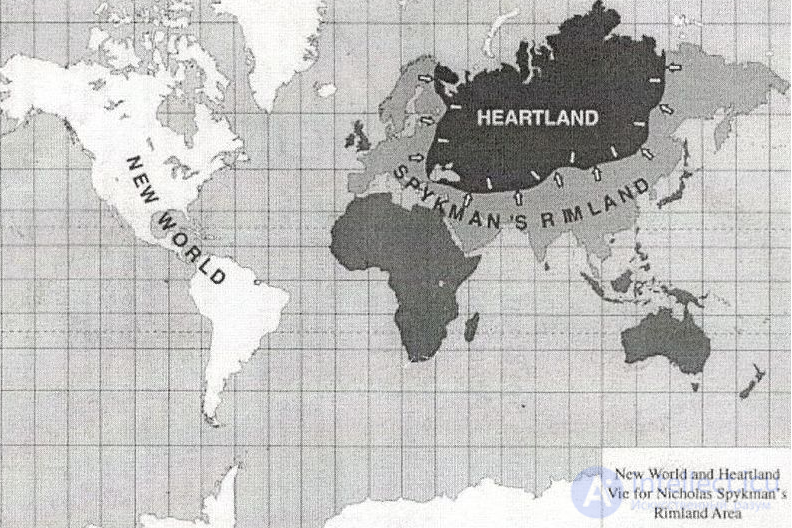
The Heartland and Rimland according to Nicholas Spykman: a world map showing the Heartland and Rimland concepts.
Two Cold War-era national security advisers, Henry Kissinger and Zbigniew Brzezinski, argued that the United States needed to continue its geopolitical focus on Eurasia, and Russia in particular, despite the collapse of the Soviet Union and the end of the Cold War. Both continued to influence geopolitics after the end of the Cold War by writing books on the subject in the 1990s — "Diplomacy" and "The Grand Chessboard: American Primacy and Its Geostrategic Imperatives." The classical Anglo-American geopolitical theories were thereby revived.
Kissinger objected to the view that with the collapse of the USSR hostile intentions had ceased and traditional foreign-policy considerations no longer applied. "They would argue... that Russia, regardless of who governs it, sits astride the territory that Halford Mackinder called the geopolitical heartland, and is the heir to one of the most powerful imperial traditions." The United States therefore had to "maintain a global balance of power vis-à-vis a country with a long history of expansionism."
After Russia, the second geopolitical threat was Germany and, as Mackinder had feared ninety years earlier, its partnership with Russia. During the Cold War, Kissinger argues, both sides of the Atlantic understood that "if America is not organically involved in Europe, it will later be forced to intervene under circumstances far less favorable to both sides of the Atlantic. This is even more true today. Germany has become so strong that existing European institutions cannot on their own establish a balance between Germany and its European partners. Nor can Europe, even with Germany's help, manage [...] Russia" on its own. Thus Kissinger believed that no country's interests would be served if Germany and Russia were ever to form a partnership in which each country regarded itself as the senior partner. They would raise fears of a condominium. Without America, Britain and France would not be able to cope with Germany and Russia; and "without Europe, America could turn into... an island off the shores of Eurasia."
Nicholas J. Spykman's vision of Eurasia was convincingly confirmed: "Geopolitically, America is an island off the shores of the great Eurasian landmass, whose resources and population far exceed those of the United States. The domination of a single power over either of the two main spheres of Eurasia — Europe and Asia — remains a good definition of strategic danger for America, Cold War or not. Such a grouping would have the capacity to surpass America economically and, ultimately, militarily. This danger would have to be confronted even if the dominant power appeared benevolent, because if its intentions ever changed, America would find its capacity for effective resistance greatly diminished and itself increasingly unable to influence the course of events." The chief interest of American leaders is maintaining the balance of power in Eurasia.
Having turned from an ideologue into a geopolitician, Kissinger retrospectively interpreted the Cold War in geopolitical terms — an approach that had not been characteristic of his work during the Cold War itself. Now, however, he focused on the beginning of the Cold War: "The goal of moral opposition to communism merged with the geopolitical task of containing Soviet expansion." Nixon, he added, was more a geopolitical than an ideological Cold Warrior.
Three years after Kissinger's "Diplomacy," Zbigniew Brzezinski followed his example, publishing "The Grand Chessboard: American Primacy and Its Geostrategic Imperatives," and three years after that, "The Geostrategic Triad: Living with China, Europe, and Russia." "The Grand Chessboard" described America's Cold War triumph in terms of control over Eurasia: for the first time a "non-Eurasian" power had emerged as the key arbiter of "Eurasian" power relations. The book states its purpose: "The formulation of a comprehensive and integrated Eurasian geostrategy is thus the purpose of this book." Although the configuration of power had undergone revolutionary change, Brzezinski affirmed three years later, Eurasia remained a mega-continent. Like Spykman, Brzezinski acknowledges that "in aggregate, Eurasia's power vastly exceeds that of America."
Using Spykman's classic terminology, Brzezinski formulated his geostrategic "chessboard" doctrine for Eurasia, whose purpose is to prevent this mega-continent from uniting.
"Europe and Asia are politically and economically powerful... It follows that... American foreign policy must... use its influence in Eurasia in such a way as to create a stable continental equilibrium, with the United States as the political arbiter.... Eurasia is thus the chessboard on which the struggle for world primacy continues, and this struggle involves geostrategy — the strategic management of geopolitical interests... But at the same time it is critically important that no Eurasian rival emerge capable of dominating Eurasia and thereby also challenging America... For America, the main geopolitical prize is Eurasia... and America's global primacy depends directly on how long and how effectively its preeminence on the Eurasian continent is maintained."
In practice, American geopoliticians are forced to take new realities into account. The United States has adopted a wary attitude toward the European Union, which is potentially approaching confederation status, is considered a rising potential superpower, and has a single currency, the euro, which already competes fiercely with the dollar, formerly the world's sole currency. Because China has, since the beginning of the 21st century, de facto approached superpower status, American geopoliticians have begun paying it increased attention. In the 2010s, voices from the American establishment floated to the Chinese leadership the idea of forming a "Big Two" of superpowers (G2) out of the United States and China; however, China has so far remained committed to the concept of a multipolar world and rejected the proposal, seeing in it above all a means of sharing responsibility for dominant American foreign policy actions with which it often disagrees.
The spread of new communications technologies has also affected geopolitical approaches. Leonid Savin, editor-in-chief of the journal "Geopolitika," proposed the term "cyber-geopolitics" to describe the new sphere of political activity and the features of the geographic localization of this transboundary phenomenon. In one article on this topic, Leonid Savin writes that the neologism cyber-geopolitics should be understood "simultaneously as a new discipline studying what happens through the human-machine interface in the context of politics and geography, including but not limited to the interactive engagement of social networks, virtual space, and Web 2.0 diplomacy, as well as ongoing activity that touches on and incorporates the principles of feedback in the social, political, and military sectors, and where the imperative is to establish and spread power, albeit by more sophisticated means."
It is believed that the Austro-Hungarian historian Emil Reich (1854–1910) was the first to introduce this term into English usage as early as 1902, and later published it in England in 1904 in his book "Foundations of Modern Europe."
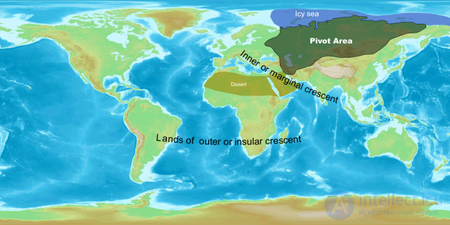
Sir Halford Mackinder's concept of the Heartland, showing the position of the "pivot area" as established in the Heartland Theory. He later revised it, designating Northern Eurasia as the pivot area while retaining the area described above as the Heartland.
Sir Halford Mackinder's Heartland theory initially attracted little attention outside the world of geography, but some thinkers have argued that it subsequently influenced the foreign policy of world powers. Those scholars who view Mackinder through a critical lens regard him as an organic strategist who tried to construct a vision of British foreign policy through his Eurocentric analysis of historical geography. His formulation of the Heartland theory was set out in his article titled "The Geographical Pivot of History," published in England in 1904. Mackinder's geopolitical doctrine included concepts diametrically opposed to Alfred Thayer Mahan's notion of the significance of navies (he coined the term "sea power") in world conflict. He regarded the navy as the foundation of the Columbian-era empire (roughly 1492 to the 19th century) and predicted that the 20th century would belong to land power. The Heartland theory held that a vast empire would arise in the Heartland — one that would not need to use coastal or transoceanic transport in order to remain whole. The basic concepts of Mackinder's doctrine include treating the Earth's geography as divided into two parts: the World-Island, or core, comprising Eurasia and Africa; and the peripheral "islands," comprising the Americas, Australia, Japan, the British Isles, and Oceania. The periphery was not only markedly smaller than the World-Island, but also necessarily required a great deal of maritime transport in order to function at the technological level of the World-Island, which contained sufficient natural resources for an advanced economy.
Mackinder argued that the industrial centers of the periphery were necessarily located far apart from one another. The World-Island could send its fleet to destroy each of them in turn, and could locate its own industry in a region more distant from the periphery (so that they would have to fight longer to reach it, and would face a well-equipped industrial bastion). Mackinder called this region the Heart of the World. In essence, it comprised Central and Eastern Europe: Ukraine, Western Russia, and Mitteleuropa. The Heart of the World held Ukraine's grain reserves and many other natural resources. Mackinder's notion of geopolitics was summed up when he said:
Who rules East Europe commands the Heartland. Who rules the Heartland commands the World-Island. Who rules the World-Island commands the world.
Nicholas J. Spykman was both a follower and a critic of the geostrategists Alfred Mahan and Halford Mackinder. His work rested on assumptions similar to Mackinder's, including the unity of world politics and the world's oceans. He extends this to include the unity of the air. Spykman accepts Mackinder's division of the world, renaming some of its parts:
According to Spykman's theory, the Rimland separates the Heartland from ports usable year-round (that is, not frozen in winter). Spykman suggested that this required preventing the states of the Heartland (Russia in particular) from seizing ports in the Rimland. Spykman modified Mackinder's formula on the relationship between the Heartland and the Rimland (or inner crescent), stating that "who controls the Rimland rules Eurasia; who rules Eurasia controls the destinies of the world." This theory can be traced to the origins of containment, the U.S. policy of preventing the spread of Soviet influence after the Second World War (see also the Truman Doctrine).
Another follower of Mackinder was Karl Haushofer, who called Mackinder's "Geographical Pivot of History" "a scholarly treatise of genius." He commented on it: "Never have I seen anything greater than these few pages of geopolitical masterwork." Mackinder placed his pivot, according to Haushofer, on "one of the earliest solid, geopolitically and geographically impeccable maps, presented at one of the earliest scholarly forums on the planet — the Royal Geographical Society in London." Haushofer accepted both Mackinder's thesis on the Heartland and his view of a Russo-German alliance — the powers that Mackinder considered the main contenders for control of Eurasia in the twentieth century. Following Mackinder, he proposed an alliance with the Soviet Union and, going a step further than Mackinder, added Japan to his projected Eurasian bloc.
In 2004, on the centenary of "The Geographical Pivot of History," historian Paul Kennedy wrote: "Now, with hundreds of thousands of American soldiers stationed on the fringes of Eurasia, and the administration constantly explaining why it must stay the course, one gets the impression that Washington takes Mackinder's prescription for securing control over the geographical pivot of history quite seriously."
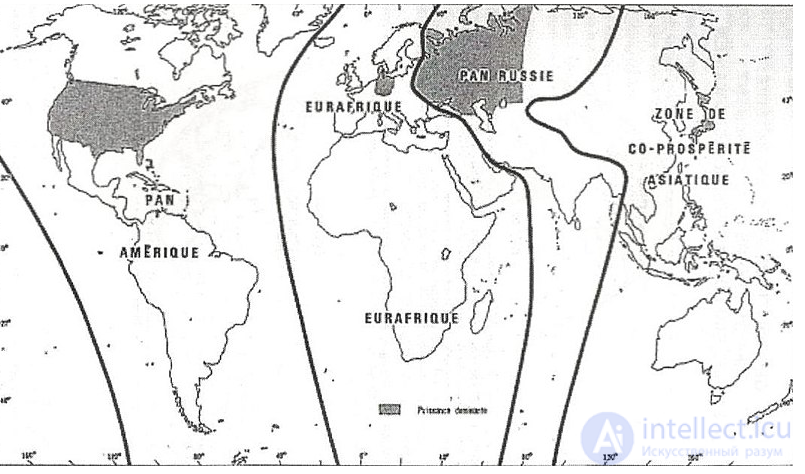
Division of the world according to Karl Haushofer's pan-regional doctrine
The British geopolitical school, before its marginalization following Britain's loss of imperial status, proposed a global geopolitical concept. It was formulated in 1904, in the work "The Geographical Pivot of History," by the English geographer and politician Halford Mackinder. The concept subsequently evolved under the influence of the world wars, in the works "Democratic Ideals and Reality" (1919) and "The Round World and the Winning of the Peace" (1943). Mackinder proceeded from the notion of the world as a geographic and political whole in which, especially after the "Columbian era" of the Great Geographic Discoveries and Europe's global expansion, the confrontation between land and sea powers is the key factor.
The main tenets of Mackinder's geopolitical concept can be summarized as follows:
Mackinder distinguishes two macro-geographic zones of the planet — the oceanic hemisphere (the Western Hemisphere and the British Isles) and the continental hemisphere, or World-Island — Eurasia and Africa, the primary zone of human settlement. The central zone of the World-Island is the Heartland — a zone that is practically inaccessible to seaborne penetration (the Russian Plain, Western Siberia, and Central Asia). The Heartland is a source of concentrated "continental power," capable of controlling the entire World-Island by seizing control of the inner crescent — the areas of the Island accessible to sea invasion and serving simultaneously as a protective buffer for the Heartland and as a target of expansion for sea powers.
The sea powers themselves rely on the outer crescent, which includes the Americas, Britain, Japan, and South Africa. The practically invulnerable "middle state" located within the Heartland is a solid but low-mobility structure, around which a more lively political "circulation" of the countries of the inner and outer crescents takes place. In subsequent modifications of Mackinder's theory, the motif of fear of the threat posed to the sea powers by the state of the Heartland, usually identified with Russia, was retained. Mackinder therefore built up a concept of global domination in which control of the Heartland provides any power with unconditional geopolitical advantage. Within Western geopolitics, the development of the theme of limiting expansion out of the Heartland and establishing control over it occupies an enormous place, above all in the work of the American geopolitical school.
Mackinder's formula: "Who rules East Europe commands the Heartland; who rules the Heartland commands the World-Island; who rules the World-Island commands the world."
During the Second World War, British geopoliticians were the first to introduce the concept of the superpower. Although Britain is an active member of the NATO military-political bloc, its attitude toward the geopolitical concept and practice of a "United Europe" has been reserved — it joined the European Union but did not consider it possible to adopt its constitution or the single euro currency.
Friedrich Ratzel (1844–1904), influenced by thinkers such as Darwin and the zoologist Ernst Haeckel, contributed to "Geopolitik" by expanding the biological concept of geography beyond a static notion of borders. Believing that states were organic and growing entities, and that borders represented merely a temporary halt in their movement, he held that the extent of a state's borders reflected the health of the nation — meaning that static countries were in decline. Ratzel published several articles, among them the essay "Lebensraum" (1901) on biogeography. Ratzel laid the foundation for the German variant of geopolitics, Geopolitik. Influenced by the American geostrategist Alfred Thayer Mahan, Ratzel wrote of the drive for German naval reach, agreeing that sea power was self-sustaining, since the profits of trade would pay for the merchant fleet, unlike land power.
Ratzel's geopolitical theory was criticized as overly broad, and his interpretation of human history and geography as overly simplistic and mechanistic. Crucially, he also underestimated the importance of social organization in the development of power.
After the First World War, the ideas of Rudolf Kjellén and Ratzel were taken up and expanded by a number of German authors, such as Karl Haushofer (1869–1946), Erich Obst, Hermann Lautensach, and Otto Maull. In 1923 Karl Haushofer founded the Zeitschrift für Geopolitik (Journal of Geopolitics), which was later used in Nazi German propaganda. The key concepts of Haushofer's Geopolitik were Lebensraum, autarky, pan-regions, and organic borders. Haushofer argued that states had an indisputable right to seek natural borders that would guarantee autarky.
Haushofer's influence within the Nazi party has been called into question, given that Haushofer failed to incorporate Nazi racial ideology into his work. Popular views of the role of geopolitics in the Nazi Third Reich suggest a fundamental significance for geopoliticians in the ideological orientation of the Nazi state. Bassin (1987) shows that these popular views are largely misleading and mistaken.
Despite numerous similarities and kindred features between the two doctrines, geopolitics always aroused suspicion among National Socialist ideologues. This is understandable, since the philosophical orientation of geopolitics did not match that of National Socialism. Geopolitics shared Ratzel's scientific materialism and geographic determinism and held that human society was shaped by external influences, in the face of which the innate qualities of individuals or groups became less significant or insignificant altogether. National Socialism, in principle, rejected both materialism and determinism, and elevated innate human qualities in the form of a hypothetical "racial character" to the status of the most important factor in the constitution of human society. These differences led, after 1933, to friction and, ultimately, to open condemnation of geopolitics by Nazi ideologues. Nevertheless, German geopolitics was discredited by its (mis)use in the Nazi expansionist policy of the Second World War and never again achieved a status comparable to that of the pre-war period.
The resulting negative association, especially in American academic circles, between classical geopolitics and Nazi or imperialist ideology rests on weak grounds. This has been noted in particular by critics of contemporary academic geography and by proponents of "neo-classical" geopolitics. Among them are Haverluk and others, who argue that the stigmatization of geopolitics in academic circles is unhelpful, since geopolitics as a field of positivist research retains the potential to investigate and address pressing, often politicized issues such as conflict resolution and prevention, as well as mitigation of the effects of climate change.
The negative associations attached to the term "geopolitics" and its practical application, stemming from its connection to the Second World War and pre-war German scholars and students of geopolitics, are largely characteristic of the field of academic geography, and especially of subdisciplines of human geography such as political geography. However, this negative association is not as strong in disciplines such as history or political science, which make use of geopolitical concepts. Classical geopolitics is an important element of analysis for military history, as well as for subdisciplines of political science such as international relations and security studies. This difference in disciplinary perspectives is examined by Bert Chapman in "Geopolitics: A Guide to the Issues," in which Chapman notes that academic and professional journals in international relations are more receptive to the study and analysis of geopolitics, and classical geopolitics in particular, than are contemporary academic journals in political geography.
In disciplines outside geography, geopolitics is not viewed negatively (as it often is among geography scholars such as Carolyn Gallaher or Klaus Dodds) as a tool of imperialism or as something connected to Nazism, but is rather regarded as a valid and consistent way of assessing basic international geopolitical circumstances and events, not necessarily connected to armed conflict or military operations.
The German school of geopolitics emphasized the role of geographic factors in political development.
All German geopoliticians sought to justify Germany's claim to the status of the leading "continental" power, one destined to succeed Great Britain. Thus, the ultimate goal of the German school, just as of the Anglo-American one, was to define the conditions under which Germany could establish dominance over Europe, and then over the world. Its chief representative was Karl Haushofer, publisher of the journal "Zeitschrift für Geopolitik" and author of numerous monographs and articles. He developed the concept of "living space" (Lebensraum), proposed by Ratzel, in application to interwar Germany, whose truncated borders seemed to him unnatural and a disfigurement of German national life. Haushofer sought to instill in Germans the conviction that revising Germany's borders was just and necessary. He did this by means of a concept he introduced, the "probable map" (over two decades he printed numerous such maps, showing territorial changes desirable from the standpoint of German interests). Sufficient space for Germany could be found in "Mitteleuropa" (Central Europe), a concept already proposed by Ratzel. From Haushofer's point of view, Germany's chief adversary was Great Britain, and consequently the task of German geopolitical strategy was to form a unified anti-British bloc. Haushofer, expanding the scope of Germany's geopolitical claims, put forward the idea of "pan-regions" — large spaces into which the world was divided along a "meridional" principle, with each region's center in the Northern Hemisphere and its periphery in the Southern. At first Haushofer identified three pan-regions — the Americas, centered on the United States; Europe–Middle East–Africa, centered on Germany; and East Asia and the Pacific region, centered on Japan; later he also "carved out" a zone for Russia — the Russian Plain and Siberia, Persia, and India. Adapting to the needs of Nazi foreign policy, Haushofer moved to the concept of a "continental bloc" among Germany, the USSR, and Japan against the sea powers.
However, in its preparations and during the Second World War, Nazi Germany did not adhere fully to this theory. Although the Soviet Union was initially invited to join the Tripartite Pact, the objects of Germany's living space and expansion, besides Europe and Africa, came to include Soviet territory up to the Urals (while Siberia was allotted to the Far Eastern ally, Japan). Embodying its claims to hegemony, Germany temporarily established almost complete control over Europe during the war. Apart from the territories of its Axis allies and Great Britain, the remaining countries became either de facto colonies or puppet satellite states. German geopolitics, having provided justification for Nazi military expansion, was practically dismantled after the war under the banner of denazification. Karl Haushofer himself was always an opponent of conflict with the USSR, regarding it as ruinous in its consequences, and later tried to prevent a two-front war. As a result, his relations with the Nazi regime cooled, ending with his imprisonment in the Dachau concentration camp. After the end of the war, overwhelmed by Germany's crushing defeat, Karl Haushofer took his own life.
The successor to the German geopolitical school, though now without its militarist component, was the intellectual movement of the European "New Right," significantly influenced by the philosopher and jurist Carl Schmitt, who wrote a series of essays on the "nomos of the earth" — a principle integrating the territorial geopolitical organization of space with the particular features of its state structure, legal system, and social and spiritual makeup. Schmitt contrasts the "traditional," military, imperial, and ethical ordering of the "nomos of the land," symbolized by the House, with the "modernist," commercial, democratic, and utilitarian ordering of the "nomos of the sea," symbolized by the Ship. Thus the geopolitical opposition of Sea and Land is elevated to the level of a broad historiosophical generalization.
French geopolitical doctrines generally stand opposed to German Geopolitik and reject the idea of fixed geography. French geography focuses on the evolution of polymorphic territories resulting from human action. It also relies on the consideration of long time spans by declining to take specific events into account. This method was theoretically grounded by Professor Lacoste according to three principles: Representation; Diachrony; and Diatopy.
In "The Spirit of the Laws," Montesquieu set out the view that climate influences man and society. He believed that a hotter climate produces quick-tempered people, and a colder climate produces detached ones, while France's mild climate is ideal for political systems. Considered one of the founders of French geopolitics, Élisée Reclus is the author of a work regarded as a reference work in modern geography (Nouvelle Géographie universelle). Like Ratzel, he views geography through a global lens. However, in complete contrast to Ratzel's vision, Reclus believes that geography is not immutable; it must evolve in step with the development of human society. His marginal political views led to his rejection by academic circles.
The French geographer and geopolitician Jacques Ancel (1879–1936) is considered the first theorist of geopolitics in France. He delivered a notable series of lectures at the European Centre of the Carnegie Endowment for International Peace in Paris and published the book "Géopolitique" in 1936. Like Reclus, Ancel rejects the German deterministic view of geopolitics (including Haushofer's doctrines).
Braudel's broad view drew on ideas from other social sciences, employed the concept of the longue durée, and downplayed the importance of specific events. This method was inspired by the French geographer Paul Vidal de la Blache (who, in turn, had been influenced by German thought, in particular the thought of Friedrich Ratzel, whom he met in Germany). Braudel's method consisted of analyzing the interdependence between people and their environment. [35] Vidal's geopolitics is grounded in various forms of cartography and in possibilism (based on a social approach to geography — that is, on the principle of polymorphic spaces dependent on many factors, among them humanity, culture, and ideas), as opposed to determinism.
Because of the influence of German Geopolitik on French geopolitics, the latter was long banished from academic scholarship. In the mid-1970s, Yves Lacoste — a French geographer directly inspired by Ancel, Braudel, and Vidal de la Blache — wrote "La géographie, ça sert d'abord à faire la guerre" (Geography's first use is to wage war) in 1976. This book symbolizes the birth of this new school of geopolitics (if not the first French school of geopolitics, since Ancel was quite isolated in the 1930s–40s). Initially associated with the Communist Party, he evolved toward a less orthodox approach. In the late 1980s he founded the Institut Français de Géopolitique (French Institute of Geopolitics), which publishes the journal Hérodote. Rejecting the generalizations and broad abstractions used by the German and Anglo-American traditions (and by the new geographers), this school focuses on the spatial dimension of geopolitical affairs at different levels of analysis. This approach emphasizes the importance of multilevel (or multiscale) analysis and maps, in contrast to critical geopolitics, which avoids such tools. Lacoste suggested that every conflict (whether local or global) can be examined from a perspective based on three assumptions:
Associated with this school and a former member of Hérodote's editorial board, the French geographer Michel Foucher developed a long-term analysis of international borders. He introduced various neologisms, including: Horogenesis, a neologism describing the concept of studying the birth of borders; and Dyad, a border shared by two neighboring states (for example, U.S. territory has two land dyads: one with Canada and one with Mexico). This researcher's principal book, "Fronts et frontières" (Fronts and Borders), first published in 1991, remains untranslated into English, with no equivalent. Michel Foucher is an expert on borders for the African Union.
Stéphane Rosière, more or less connected to this school, can be cited as editor-in-chief of the online journal L'Espace politique; this journal, founded in 2007, has become, together with Hérodote, the best-known French journal of political geography and geopolitics.
The dispositif of the French philosopher Michel Foucault, introduced for the purposes of biopolitical inquiry, has also been adopted within the field of geopolitical thought, where it now plays a certain role.
Even in antiquity, various ancient Roman and ancient Greek philosophers expressed their own geopolitical ideas. Precursors to the theory of the conquering spirit of maritime states can be found in the ancient Greek thinker and statesman Thucydides, who was elected strategos during the Peloponnesian War. He emphasized the importance of proximity to the sea and a strong fleet for a state's faster development, and considered the possession of maritime territories a necessary advantage for a state's successful military operations.
In his "Histories," Herodotus analyzes the causes of conflicts among nations throughout the history of humankind up to his time. He arrives at a conviction of the world's duality, and his views on the causes of wars fit within the concept of dividing countries into "land countries" and "sea countries." In addition, the thinker was also convinced that the confrontation between East and West was an essential precondition of military conflict.
Aristotle also contributed to the formation of fundamental geopolitical theory. He not only argued that "sea" and "continental" states were different, but also attempted to describe these differences. Thus he criticized the thalassocratic model of the state. The thinker identified such shortcomings of it as the weakness of the institution of private property, corruption, and the virtual absence of democracy and democratic elections.
Besides Aristotle, Plato too was able to examine this dualism within the world's space. His reflections on the warlike maritime states and the corruption-weakened land states were built on a comparison between the island of Crete, one of the strong democratic powers of ancient Greece, and Lacedaemon, or Sparta.
In ancient Rome, thinkers likewise identified the dichotomy between states described above. The ancient Roman
продолжение следует...
Часть 1 Geopolitics: Essence, Schools, and National Characteristics
Часть 2 Criticism - Geopolitics: Essence, Schools, and National Characteristics

Comments