
Lecture
Geostrategy (geographic strategy) — a political science that determines the means and methods for achieving the geopolitical goal of a state or group of allied states — the preservation and increase of the power of the state or union of states, and in the unfavorable conditions of a crisis — the minimization of damage and the restoration of the original pre-crisis condition.
Geostrategy, a subfield of geopolitics, is a type of foreign policy based on geographic factors, since they inform, constrain, or influence political and military planning. Like all strategies, geostrategy is concerned with the reconciliation of means and ends. Strategy is as closely linked to geography as geography is to statehood, or, as Colin S. Gray and Geoffrey Sloan assert, «[geography] — is the mother of strategy».
It operates with the categories of society, economy, politics, national culture, military power, and other strategic elements not only of the client state or client — a union of states, but also studies and takes into account the strategic potential of other states, dividing them in general terms into potential allies, adversaries, or neutrals.
It always takes into account the strategic properties of the geographic environment in which it is implemented.
It is an instrument of national geopolitics, and in a union of states — of allied geopolitics. In the hierarchy of political sciences it occupies a subordinate position in relation to politics and geopolitics. The essential and integral components of geostrategy are national strategy and strategic geography.
To obtain reliable information about the outside world, it makes use of strategic intelligence.
Most of the definitions of geostrategy given below emphasize the merging of strategic considerations with geopolitical factors. While geopolitics, at first glance, is neutral — studying the geographic and political features of various regions, especially the influence of geography on politics — geostrategy encompasses comprehensive planning, the allocation of means for achieving national goals, or securing assets of military or political significance.
The term «geostrategy» was first used by Frederick L. Schuman in his 1942 article «Let Us Learn Our Geopolitics». It was a translation of the German term « Wehrgeopolitik », used by the German geostrategist Karl Haushofer . Earlier attempts at translation included, for example, « defensive geopolitics ». Robert Strausz-Hupé coined and popularized « military geopolitics » as another alternative translation.
[G]eostrategy — is the exercise of power over particularly important spaces on the surface of the Earth; the creation of political presence within the international system. It is aimed at strengthening one's own security and prosperity; at making the international system more prosperous; at shaping, rather than being shaped. Geostrategy — is securing access to certain trade routes, strategic chokepoints, rivers, islands, and seas. It requires an extensive military presence, usually coinciding with the establishment of overseas military stations and the construction of warships capable of deep-water power projection. It also requires a network of alliances with other great powers that share your goals, or with smaller «anchor states» located in regions you consider important.
— James Rogers and Luis Simon, «Think Again: European Geostrategy»
[T]he words geopolitical, strategic, and geostrategic are used to convey the following meanings: geopolitical reflects the combination of geographic and political factors that determine the condition of a state or region, and emphasizes the influence of geography on politics; strategic refers to the comprehensive and systematic application of measures to achieve a central goal or vital assets of military significance; while geostrategic combines strategic considerations with geopolitical ones.
— Zbigniew Brzezinski , The Grand Chessboard (emphasis in the original)
For the United States, Eurasian geostrategy implies the purposeful management of geostrategically dynamic states and cautious handling of geopolitically catalytic states, in accordance with America's dual interests in the short-term preservation of its unique global power and in the long-term transformation of it into an increasingly institutionalized global cooperation. To use terminology that recalls a more brutal era of ancient empires, the three great imperatives of imperial geostrategy consist in preventing collusion and maintaining security dependence among vassals, keeping tributaries pliant and protected, and keeping the barbarians from coming together.
— Zbigniew Brzezinski, The Grand Chessboard
Geostrategy — is the geographic direction of a state's foreign policy. More precisely, geostrategy describes where a state concentrates its efforts, projecting military power and directing diplomatic activity. The basic assumption is that states have limited resources and are unable, even if willing, to pursue an all-azimuth foreign policy. Instead, they must concentrate, in political and military terms, on certain regions of the world. Geostrategy describes this foreign-policy direction of a state and does not concern itself with motivation or decision-making processes. Thus, a state's geostrategy is not necessarily motivated by geographic or geopolitical factors. A state may project power onto a particular location for ideological reasons, interest groups, or simply at the whim of its leader.
— Jakub J. Grygiel , Great Powers and Geopolitical Change (emphasis in the original)
It is acknowledged that the term "geostrategy" is more often used in contemporary works in a global context, denoting the consideration of the global distribution of land and sea, distances, and accessibility, among other geographic factors, in strategic planning and action... Here, the definition of geostrategy is used within a more limited regional framework, where a set of geographic factors interacts to influence or give an advantage to one adversary, or to intervene so as to alter strategic planning as well as political and military action.
— Lim Joo-Jock, Geostrategy and the South China Sea Basin (emphasis in original)
A science called "geostrategy" would have been unimaginable in any period of history other than our own. It is a characteristic product of the turbulent world politics of the twentieth century.
— Andrew Gyorgy, Geopolitics of War: Total War and Geostrategy (1943).
"Geostrategy" — a word of uncertain meaning — ... was avoided.
— Stephen B. Jones, "Views of the Political World"
Geostrategy is the geographic orientation of a state's foreign policy. More precisely, geostrategy describes where a state concentrates its efforts in projecting military power and directing diplomatic activity. The underlying assumption is that states have limited resources and are unable, even if willing, to pursue an all-azimuth foreign policy. Instead, they must focus politically and militarily on particular regions of the world. Geostrategy describes this foreign-policy orientation of a state and does not deal with motivation or decision-making processes. Thus, a state's geostrategy is not necessarily motivated by geographic or geopolitical factors. A state may project power toward a particular place for ideological reasons, interest groups, or simply at the whim of its leader.
— Krishnendra Meena, "Munesh Chandra asked: What is the difference between geopolitics and geostrategy?"
As a science, or a scientifically grounded political practice, geostrategy makes use of factual and empirical analysis; theoretical formulations in geostrategy generally rely heavily on an empirical basis, although the relationship between facts and values, or the conclusions drawn, are viewed differently by different and/or competing geostrategic approaches. Geostrategic concepts derived from theory become the foundation for the foreign and international policy of countries. Geostrategic concepts have also historically been acquired, or even inherited, from one country to another owing to shared history, relations between countries, culture, and even propaganda.
The geostrategy of location includes river valleys, inland seas, the world ocean, world islands, and so on. For example, the beginning of Western civilization was located in the river valleys of the Nile in Egypt and the Tigris and Euphrates in Mesopotamia. The Nile, the Tigris, and the Euphrates not only provided fertile soil for growing crops, but also brought floods that tested the ingenuity of the inhabitants. The climate of this area favored an existence based primarily on agriculture. Rivers also provided trade routes in an era when human muscle and the winds of heaven were the driving force of ships. River valleys became a unifying factor in the political development of peoples.
As far back as the time of Herodotus, observers believed that strategy was largely dependent on the geographic position of the actors involved. In his "Histories," Herodotus describes the clash of civilizations among the Egyptians, Persians, Scythians, and Greeks — all of whom, in his view, were strongly influenced by their physical-geographic position.
Dietrich Heinrich von Bülow proposed a geometric science of strategy in 1799 in "The Spirit of the Modern System of War." His system predicted that larger states would absorb smaller ones, resulting in eleven major states. McCubbin Thomas Owens notes the resemblance between von Bülow's predictions and the map of Europe after the unification of Germany and Italy.
Between 1890 and 1919, the world became a paradise for the geostrategist, leading to the formulation of the classical geopolitical theories. The international system included rising and declining great powers, many of which had global reach. There were no new frontiers left for the great powers to explore or colonize — the entire world had been divided among empires and colonial powers. From that point on, international politics would consist of a struggle of state against state.
Two currents of geopolitical thought gained prominence: the Anglo-American school and the German school. Alfred Thayer Mahan and Halford J. Mackinder set out the American and British conceptions of geostrategy, respectively, in their works "The Problem of Asia" and "The Geographical Pivot of History." Friedrich Ratzel and Rudolf Kjellén developed the organic theory of the state, which laid the foundation for the distinctive German school of geostrategy.
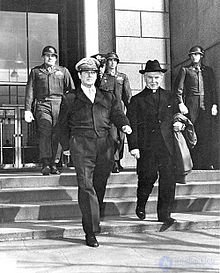
Father Edmund A. Walsh, SJ
The most prominent German geopolitician was General Karl Haushofer. After the Second World War, during the Allied occupation of Germany, the United States investigated many officials and public figures to determine whether they should be charged with war crimes at the Nuremberg trials. Haushofer, primarily an academic, was interrogated by Father Edmund A. Walsh, a professor of geopolitics at Georgetown's School of Foreign Service, at the request of U.S. authorities. Despite his role in creating one of the justifications for Nazi aggression, Father Walsh ruled that Haushofer should not stand trial.
After the Second World War, the term "geopolitics" fell into disrepute because of its association with Nazi geopolitics. Almost no book published between the end of the Second World War and the mid-1970s used the words "geopolitics" or "geostrategy" in its title, and geopoliticians did not call themselves or their works by those names. The German theories prompted a number of critical studies of geopolitics by American geopoliticians such as Robert Strausz-Hupé, Derwent Whittlesey, and Andrew Gyorgy.
When the Cold War began, Nicholas Spykman and George F. Kennan laid the foundations of the U.S. policy of containment, which would dominate Western geostrategic thought for the following forty years.
Alexander de Seversky argued that aviation had fundamentally changed geostrategic considerations, and accordingly proposed an "air geopolitics." His ideas had some influence on the administration of President Dwight D. Eisenhower, but the ideas of Spykman and Kennan carried greater weight. Later, during the Cold War, Colin Gray firmly rejected the idea that aviation had changed geostrategic considerations, while Saul B. Cohen explored the idea of a "shatterbelt," which ultimately underlay domino theory.
After the end of the Cold War, states began to favor low-cost management of space over its expansion by military force. The use of military force to secure space not only imposes a great burden on countries but also draws serious criticism from the international community, since interdependence among countries is constantly growing. As a way of governing space anew, countries either create regional space-related institutions or establish issue-specific regimes to regulate intervention in space. Such mechanisms allow countries to exercise indirect control over space. Indirect governance of space reduces the required capital while at the same time providing justification and legitimacy for governance, so that the countries involved do not face criticism from the international community.
The geostrategists listed below played an important role in creating and developing the major geostrategic doctrines in the history of the discipline. Although there were many other geostrategists, these were the most influential in shaping and developing the field as a whole.
Alfred Thayer Mahan was a U.S. Navy officer and president of the Naval War College. He is best known for his series of books "The Influence of Sea Power upon History," which argued that naval supremacy was the decisive factor in great-power war. In 1900, Mahan's book "The Problem of Asia" was published. In this volume he set out the first geostrategy of the modern era.
The Problem of Asia divides the continent of Asia into 3 zones:
The debated and debatable zone, Mahan noted, included two peninsulas at both ends (Anatolia and Korea), the Suez isthmus, Palestine, Syria, Mesopotamia, two countries marked by their mountain ranges (Persia and Afghanistan), the Pamir Mountains, the Tibetan Himalayas, the Yangtze valley, and Japan. Within this zone, Mahan argued, there were no strong states capable of resisting external influence or even of maintaining stability within their own borders. Thus, while the political situation to the north and south was relatively stable and settled, the middle remained "debated and debatable territory."
North of the 40th parallel, the vast expanses of Asia lay under the rule of the Russian Empire. Russia occupied a central position on the continent and had a wedge-shaped projection into Central Asia, bounded by the Caucasus mountains and the Caspian Sea on one side and the mountains of Afghanistan and western China on the other. To prevent Russian expansionism and the attainment of predominance on the Asian continent, Mahan believed that pressure on the flanks of Asia might be the only viable strategy for the sea powers to pursue.
South of the 30th parallel lay areas dominated by the sea powers — Great Britain, the United States, Germany, and Japan. For Mahan, the United Kingdom's possession of India was of key strategic importance, since India was best suited to exert counterbalancing pressure on Russia in Central Asia. Britain's predominance in Egypt, China, Australia, and the Cape of Good Hope was likewise considered important.
The strategy of the sea powers, in Mahan's view, should be to deprive Russia of the benefits that maritime trade provides. He noted that both the Turkish and Danish straits could be closed off by a hostile power, thereby denying Russia access to the sea. Moreover, this disadvantageous position would strengthen Russia's tendency toward expansionism in pursuit of wealth or warm-water ports. The natural geographic targets for Russian expansionism seeking access to the sea would thus be the Chinese coast, the Persian Gulf, and Asia Minor.
In this contest between land power and sea power, Russia would find itself allied with France (a natural sea power, but in this case necessarily acting as a land power), arrayed against Germany, Great Britain, Japan, and the United States as sea powers. In addition, Mahan envisioned a single modern state comprising Turkey, Syria, and Mesopotamia, possessing an effectively organized army and navy, to serve as a counterweight to Russian expansion.
Further, dividing the map along geographic lines, Mahan stated that the two most influential dividing lines would be the Suez and Panama canals. Since most developed countries and resources lie above the North-South divide, politics and trade north of the two canals would carry far greater significance than those occurring south of the canals. Thus, the great course of historical development would flow not from north to south, but from east to west, in this case leading toward Asia as a place of advancement.
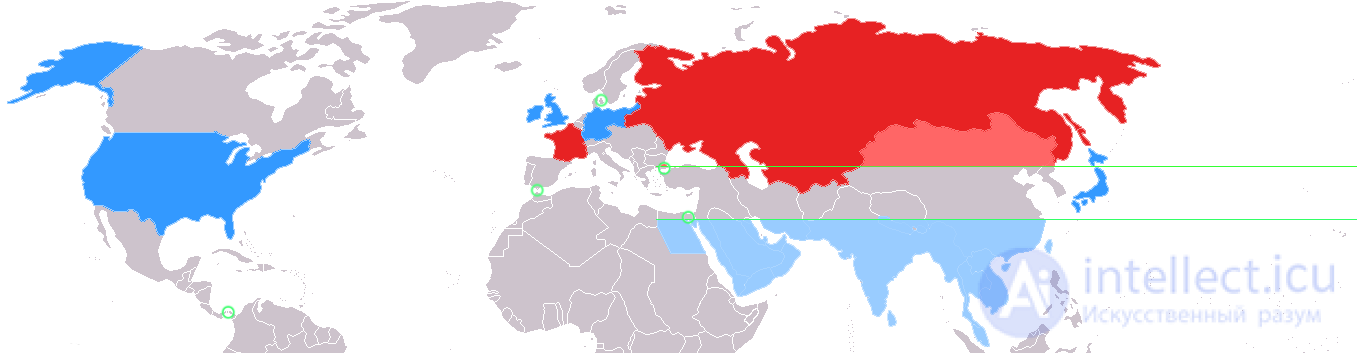
This map depicts the world as divided by the geostrategist Alfred Thayer Mahan in his 1900 work "The Problem of Asia." Asia is divided along the 30th and 40th parallels north, represented here by green lines. Between the 30th and 40th parallels lies what Mahan called the "debated and debatable land," an object of competition between land and sea powers.
Halford J. Mackinder's major work, "Democratic Ideals and Reality: A Study in the Politics of Reconstruction," appeared in 1919.[12] It presented his Heartland theory and argued that the Paris Peace Conference needed to take geopolitical factors fully into account, while also contrasting (geographic) reality with the idealism of Woodrow Wilson. The book's most famous line reads: "Who rules East Europe commands the Heartland; who rules the Heartland commands the World-Island; who rules the World-Island commands the World."
This message was crafted to convince the world's statesmen at the Paris Peace Conference of the decisive importance of Eastern Europe, since the strategic route to the Heartland was interpreted as requiring a belt of buffer states to separate Germany and Russia. These were established by the peace negotiators but proved to be ineffective bulwarks by 1939 (although this can be viewed as a failure of other, later statesmen during the interwar period). The main purpose of his work was to warn of the possibility of another great war (a warning also issued by the economist John Maynard Keynes).
Mackinder was an opponent of the Bolsheviks, and, as British High Commissioner in southern Russia in late 1919 and early 1920, he emphasized the need for Great Britain to continue supporting the White Russian forces, which he tried to unite.
Mackinder's work paved the way for the establishment of geography as a distinct discipline in the United Kingdom. His role in promoting the teaching of geography is probably greater than that of any other British geographer.
While Oxford did not appoint a professor of geography until 1934, the University of Liverpool and the University of Wales at Aberystwyth established chairs of geography in 1917. Mackinder himself became a full professor of geography at the University of London (the London School of Economics) in 1923.
Mackinder is often credited with introducing two new terms into the English language: "manpower" and "heartland."
The Heartland theory was enthusiastically taken up by the German Geopolitik school, in particular by its chief proponent, Karl Haushofer. Geopolitics was later adopted by the German Nazi regime in the 1930s. The German interpretation of the Heartland theory is referenced explicitly (without mentioning its connection to Mackinder) in "The Nazis Strike," the second in Frank Capra's American wartime propaganda film series "Why We Fight."
The Heartland theory, and classical geopolitics and geostrategy more broadly, exerted an enormous influence on the shaping of U.S. strategic policy during the Cold War.
Confirmation of Mackinder's Heartland theory can be found in the works of the geopolitician Dimitri Kitsikis, in particular in his geopolitical model of the "Intermediate Region."
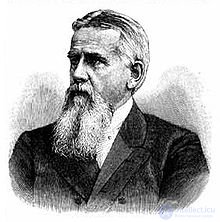
Friedrich Ratzel.
Influenced by the works of Alfred Thayer Mahan, as well as of the German geographers Carl Ritter and Alexander von Humboldt, Friedrich Ratzel laid the foundations of geopolitics — the distinctive strand of German geopolitics.
Ratzel wrote of a natural division between land and sea powers, agreeing with Mahan that sea power was self-sustaining, since the profits of trade would support the development of a merchant fleet. However, his key contribution was the development of the concepts of Raum and the organic theory of the state. He advanced the theory that states were organic and growing entities, and that borders were merely temporary, representing pauses in their natural movement. Raum was the land spiritually bound to the nation (in this case, to the German peoples), from which people could draw sustenance, find neighboring lesser nations that would support them, and which would be fertilized by their Kultur (culture).
Ratzel's ideas influenced the work of his student Rudolf Kjellén, as well as of General Karl Haushofer.
Rudolf Kjellén was a Swedish political scientist and student of Friedrich Ratzel. He was the first to introduce the term "geopolitics." His writings played a decisive role in influencing the geopolitics of General Karl Haushofer and, indirectly, the future foreign policy of the Nazis.
His writings centered on five key concepts that formed the basis of German geopolitics:
Karl Haushofer's geopolitics expanded on the theory of Ratzel and Kjellén. While the latter two understood geopolitics as the state-as-organism-in-space, placed in service of the leader, Haushofer's Munich school specifically studied geography in its connection to war and to imperial projects. Thus the rules of conduct of earlier geopoliticians were transformed into dynamic normative doctrines for action within living space and world power.
Haushofer defined geopolitics in 1935 as "the duty to defend the right to soil, to land in the broadest sense, not only land within the borders of the Reich, but also the right to more extensive national and cultural lands." Culture itself was regarded as the most favorable element for dynamic expansion. Culture provided guidance on the best areas for expansion and could make expansion secure, whereas purely military or commercial force could not.
For Haushofer, the existence of a state depended on living space, the pursuit of which was to serve as the basis for all policy. Germany had a high population density, while the old colonial powers had much lower densities: an actual mandate for German expansion into resource-rich areas. A buffer zone of territories or minor states along the borders would serve to protect Germany.
Closely related to this need was Haushofer's assertion that the existence of small states was evidence of political regression and disorder in the international system. The small states surrounding Germany were to be incorporated into the vital German order. These states were regarded as too small to sustain practical autonomy (even if they retained large colonial holdings), and would be better served by protection and organization within Germany. In Europe he cited Belgium, the Netherlands, Portugal, Denmark, Switzerland, Greece, and the "crippled union" of Austria-Hungary as support for his claim.
Haushofer and the Munich school of geopolitics ultimately expanded their concept of living space and autarky far beyond the restoration of Germany's 1914 borders and "a place in the sun." They set as their goals a New European Order, then a New Afro-European Order, and, ultimately, a Eurasian Order. This concept became known as the pan-region, drawn from the American Monroe Doctrine and the idea of national and continental self-sufficiency. This was a far-reaching reinterpretation of the pursuit of colonies, which geopoliticians viewed not as an economic necessity but rather as a matter of prestige and of exerting pressure on the old colonial powers. The main driving force was not economic but cultural and spiritual.
Beyond the economic concept, pan-regions were also a strategic concept. Haushofer recognized the strategic concept of the Heartland put forward by Halford Mackinder. If Germany could control Eastern Europe, and then Russian territory as well, it could control a strategic area that a hostile sea power would be unable to penetrate. An alliance with Italy and Japan would further strengthen Germany's strategic control over Eurasia, since these states would become naval powers protecting Germany's island-like position.
Nicholas J. Spykman was a Dutch-American geostrategist known as the "godfather of containment." In his geostrategic work "The Geography of the Peace" (1944), he argued that the balance of power in Eurasia directly affected the security of the United States.
N. J. Spykman based his geostrategic ideas on Sir Halford Mackinder's Heartland theory. Spykman's key contribution was to change the strategic assessment of the Heartland relative to the "Rimland" (a geographic area analogous to Mackinder's "Inner or Marginal Crescent"). Spykman does not view the Heartland as a region that will be unified by powerful transport or communications infrastructure in the near future. Thus it would be unable to compete with the sea power of the United States, despite its uniquely defensive position. The Rimland possessed all the key resources and population — its domination was the key to control of Eurasia. His strategy was for the offshore powers, and possibly Russia as well, to resist the consolidation of control over the Rimland by any single power. A balanced distribution of power would lead to peace.
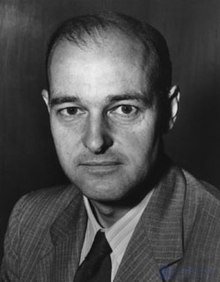
George F. Kennan
George F. Kennan, U.S. ambassador to the Soviet Union, set out the foundational geostrategy of the Cold War in his "Long Telegram" and "The Sources of Soviet Conduct." He introduced the term "containment," which became the guiding idea for U.S. grand strategy for the following forty years, although the term came to mean something substantially different from Kennan's original formulation.
Kennan advocated what came to be called "strongpoint containment." In his view, the United States and its allies needed to protect the world's productive industrial areas from Soviet domination. He noted that of the world's five centers of industrial power — the United States, Great Britain, Japan, Germany, and Russia — the only contested territory was Germany. Kennan was concerned with preserving the balance of power between the United States and the USSR, and in his view only these few industrial areas mattered.
Here Kennan differed from Paul Nitze, whose foundational Cold War document, NSC 68, called for "undifferentiated or global containment" alongside a massive military buildup. Kennan saw the Soviet Union as an ideological and political adversary rather than a genuine military threat. There was no reason to fight the Soviets across all of Eurasia, since these regions were not productive, and the Soviet Union was already worn down by the Second World War, which limited its ability to project power abroad. Kennan therefore disapproved of U.S. involvement in Vietnam and later spoke out critically against Reagan's military buildup.
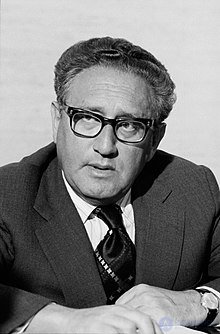
Henry Kissinger.
Henry Kissinger pursued two geostrategic goals while in power: a deliberate move to change the polarity of the international system from bipolar to tripolar; and the designation of regional stabilizing states in connection with the Nixon Doctrine. In chapter 28 of his extensive work "Diplomacy," Kissinger discusses the "opening to China" as a deliberate strategy to shift the balance of power in the international system by exploiting the rift within the Sino-Soviet bloc. The regional stabilizers were pro-American states that received substantial U.S. aid in exchange for taking on responsibility for regional stability. Among the regional stabilizers designated by Kissinger were Zaire, Iran, and Indonesia.
Zbigniew Brzezinski set out his most significant contribution to post-Cold War geostrategy in his 1997 book "The Grand Chessboard." He identified four regions of Eurasia and the way in which the United States should shape its policy toward each region in order to preserve its global preeminence. The four regions (echoing Mackinder and Spykman) are:
In his subsequent book "The Choice," Brzezinski updates his geostrategy in light of globalization, September 11, and the six years that had passed between the two books.
In his journal article titled "America's New Geostrategy," he discusses the need to change America's geostrategy in order to avoid a large-scale collapse of the kind many scholars predict. He points out that:
Strategy, as a set of measures of an economic, commercial, social, political, ideological, diplomatic, and military character in the life of a state organism — of a tribe, a union of tribes, a principality, a kingdom, a khanate, a sultanate, an empire, a constitutional monarchy, a republic, and so on — has always been realized within geographic space and real time.
The formulation of a current strategy relied on prior experience (history), the present state of affairs (politics and strategic intelligence), and planning and forecasting.
In the theoretical scholarly sphere, it happened that the theory of geography and the theory of strategy developed in parallel for the sake of analytical convenience. In the practical activity of specific historical figures endowed with broad economic, social, political, diplomatic, and military authority, geography and strategy merged organically and were inseparable owing to their natural character.
By the mid-19th century, as a result of the generalization and analysis of accumulated knowledge, strategy and geography had fully taken shape as scientific-theoretical disciplines necessary for study and further practical application. Military geography emerged as the original counterpart of narrowly specialized strategic geography applied to military affairs.
War, defined by Clausewitz as "the continuation of politics by other means," ceased to be an improvisation of talented commanders and statesmen, and the study of this phenomenon revealed certain regularities. Politics, likewise accumulating practical experience, became a "science" subject to study and instruction. The late 19th and early 20th centuries were a time of broad theoretical generalization by thinkers of a number of countries, looking back at the past, at the current state of the world's political map, and offering a number of successful and accurate forecasts of historical and political events. A clear theoretical recognition that events depend not only on the will, desire, experience, and talent of a politician, religious leader, diplomat, or military commander, but also on the properties of the geographic environment in which human activity takes place, led to the concept of "geographic strategy."

Comments