
Lecture
External control of a state by other states is a mechanism of control and influence exercised through various political, economic and military instruments. The methodology of external control includes the use of diplomatic pressure, economic sanctions, financial dependency, as well as support for opposition movements and control over key state institutions. Soft power is often applied, expressed in the spread of cultural and ideological values and in the management of information flows.
External control of states by other states — is a complex phenomenon that involves the use of various methods to influence political, economic and social processes within the target country. Methods of external control can range from diplomatic pressure and economic sanctions to the provision of financial aid, consulting and military interventions. The goal of such control is often to secure control over resources, strengthen influence in a region, change a political regime, or stabilize the situation in the interests of the external actor.
One of the key methods of external control is "soft power", which involves promoting culture, ideology and values through diplomatic and public channels. For example, international aid programs, cultural exchanges and educational initiatives can serve as tools for creating a favorable image and influencing public opinion in the target country. At the opposite end of the spectrum is "hard power", which includes military interventions and economic measures such as sanctions or trade restrictions.
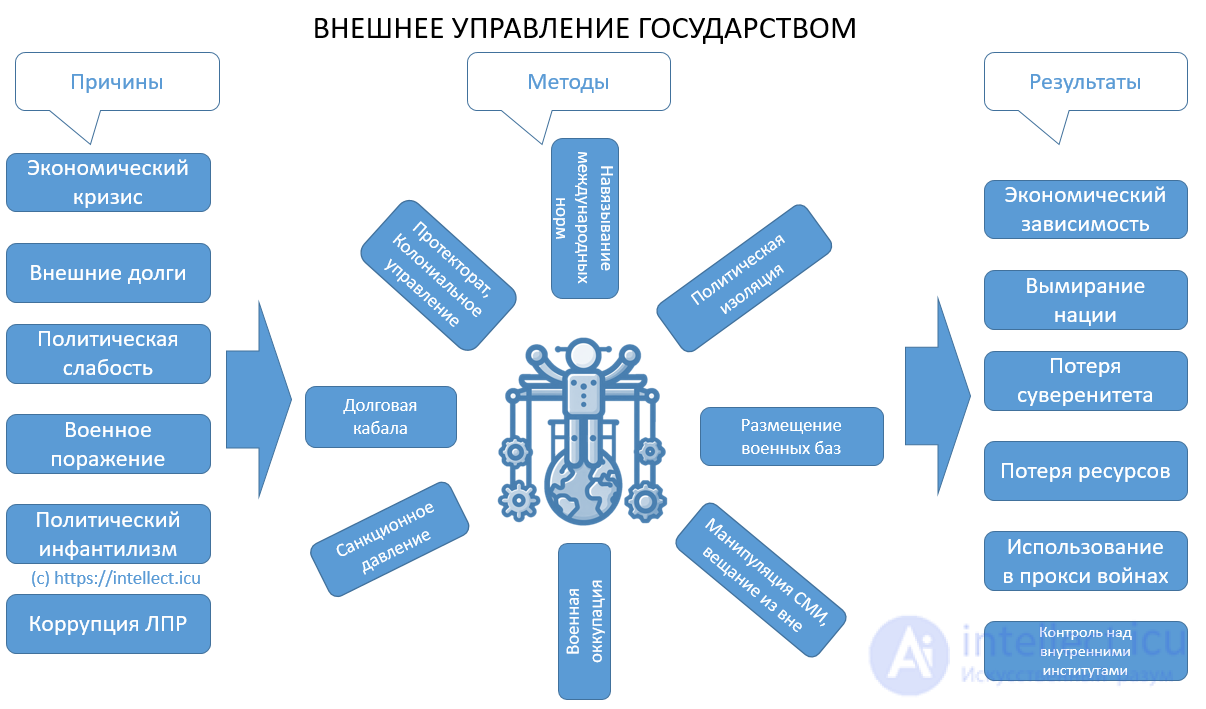
External control of states can be classified according to various criteria, such as methods, degree of intervention and subjects of influence.
Here are the main types:
Protectorate – partial control of one state over another, usually in exchange for military protection.
Puppet state – a formally independent country whose policy is fully controlled by an external power.
Colonial administration – direct dependence of a territory on a metropole, often with administrative control.
Protectionism through international organizations – pressure exerted through structures such as the UN, IMF, WTO, where dominant countries advance their interests.
Financial dependency – providing loans, subsidies and economic aid with conditions favorable to the creditor.
Monopolization of key industries – control over strategic enterprises (energy, communications, transport).
Debt bondage – imposing terms of external debt repayment that limit a country's independence.
Sanctions pressure – applying economic sanctions to force a state to change its policy.
Military occupation – direct control of a territory through armed forces.
Deployment of military bases – control over a region through the presence of foreign troops.
Military alliances – dependence of military policy on a dominant state (for example, NATO).
Media manipulation – spreading favorable information through television channels, social networks and the press.
Propaganda and ideological influence – instilling desired narratives through education, culture and social movements.
Cyber interference – attacks on state systems, manipulation of public opinion via the internet.
Imposition of international norms – pressure through courts (for example, the Hague Tribunal, WTO, European Court).
Political isolation – blocking diplomatic contacts, exclusion from international organizations.
Treaty dependencies – agreements that limit a country's sovereignty.
The goals of external control vary depending on the interests of the controlling party. Among the main objectives are establishing a favorable regime, advancing economic interests, controlling natural resources, containing geopolitical rivals and weakening the sovereignty of the controlled state. In some cases it is aimed at preventing instability and ensuring security in the region.
Signs of external control of a state can be divided into several categories:
Lack of independence in decision-making – key state decisions are coordinated with or dictated by external forces.
Influence of foreign advisors – foreign specialists occupy high government posts or advise the authorities.
Imposition of a foreign ideology – adoption of a political model or course promoted by another state or international organizations.
Restriction of sovereignty – subordination to international norms and treaties that limit independence.
Financial dependency – a significant part of the budget is formed from foreign loans, grants or investments.
Control over strategic industries – key enterprises and resources belong to foreign companies or are under their control.
Imposition of economic policy – requirements of international financial organizations (IMF, World Bank) in exchange for loans.
Sanctions pressure – a country is forced to change its policy under the threat of economic sanctions.
Presence of foreign military bases – permanent stationing of troops of other states without full control by local authorities.
Dependence on military aid – defense capability is provided by foreign supplies of weapons and equipment.
Military operations without a country's consent – interference in internal affairs through the armed forces of other states.
Media manipulation – dominance of foreign media and social networks influencing public opinion.
Imposition of values and culture – active spread of foreign cultural standards and ideologies.
Cyber interference – attacks on state information systems or manipulation of elections via the internet.
Priority of international law over national law – mandatory compliance with the decisions of foreign courts or organizations.
Political isolation – restriction of diplomatic ties under pressure from external forces.
Coercion into international agreements – conclusion of treaties that infringe on national interests.
If a state exhibits several of these signs simultaneously, it is likely under external control.
Examples of external control can be found in various historical and contemporary situations.
One well-known case is the reconstruction of Germany and Japan after World War II under Allied control, which led to democratization and economic recovery. Another example — the intervention in Libya in 2011, which caused long-term political and social problems in the region. World Bank and IMF programs can also be regarded as forms of external control, since they are often accompanied by conditions affecting the domestic economic policy of beneficiary countries.
Another of the most well-known cases is the influence of the United States on Latin American countries through economic pressure, military interventions and support for friendly regimes. Another example is the policy of the European Union toward Eastern European countries, where the provision of financial aid is accompanied by demands for reforms. One can also recall the control over post-war Germany by the Allies, which included strict restrictions in the economic and military spheres. Modern examples include the management of developing countries' economies by international financial institutions through debt obligations and structural reform programs.
The first puppet states in the modern sense were the «daughter republics» of France during the period of the revolutionary and Napoleonic wars: the Batavian Republic, established in the territory of the Netherlands, the Cisalpine Republic and the Ligurian Republic in Italy, the Helvetic Republic in Switzerland, and others. Alongside the puppet republics, France also had dependent states in a different status — vassal kingdoms and protectorates.
In the late 19th and first half of the 20th century, the Empire of Japan set a course toward building in Southeast Asia the so-called «Greater East Asia Co-Prosperity Sphere» under its own leadership. The struggle for dominance reached its peak during World War II. In the course of this struggle a number of puppet states and governments were created, and in founding them Japan presented itself as a civilizing force and liberator of the peoples of Asia from the colonial domination of Britain and France. Examples of such dependent regimes include:
Among other unrealized projects was the creation of an independent Indonesia (then called the Dutch East Indies).
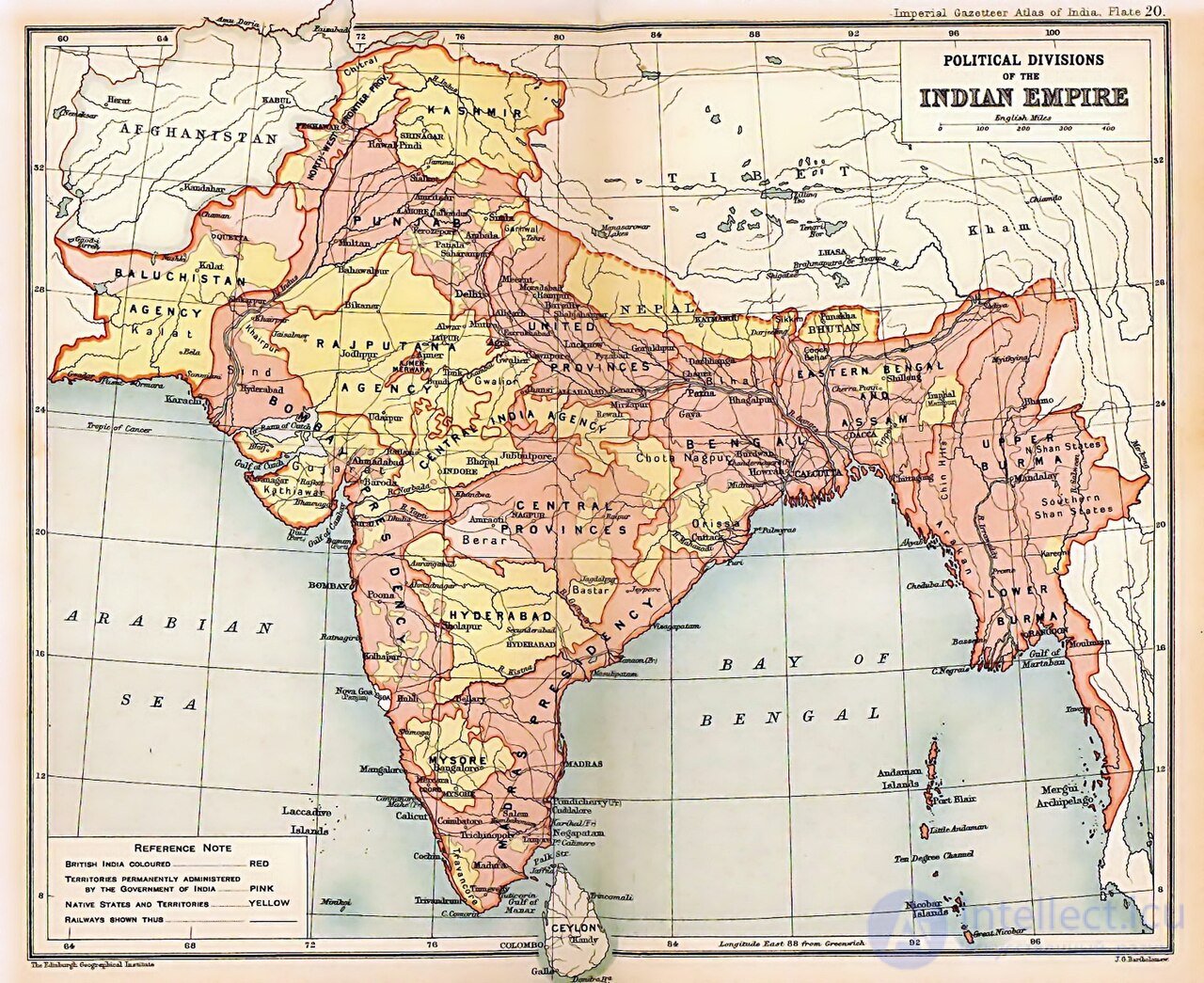 Map of the British Indian Empire, on which the princely states are marked in yellow.
In 1896, Great Britain created a state on Zanzibar.
All of Germany's allies in World War II are often called puppet regimes. An argument in favor of this view is the fact that Germany sought to limit independent contacts between its allies and to bring their relations under its own control. There is also a viewpoint that applying the term «puppet state» to any degree of dependence on a stronger power (in the context of World War II — primarily on Germany and Japan) is an emotional negative judgment, and that the term should be applied only to states that are formally recognized as independent but are completely deprived of the ability to pursue an independent policy, both foreign and domestic. Such states differ from colonies only in that independence is declared. Examples of regimes with varying degrees of dependence on Germany include:
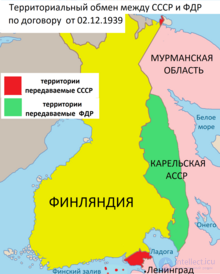
Map of the Finnish Democratic Republic (1939-40)
Examples of regimes with varying degrees of dependence on Soviet Russia and the USSR include:
Indonesia created the Provisional Government of East Timor after invading East Timor in December 1975.
Examples of regimes with varying degrees of dependence on the USA include:
 The Wa State – the de facto independent Wa State in Myanmar is considered a puppet state linked to China.
The results of external control can be either positive or negative. On the one hand, it can contribute to economic modernization, the development of democratic institutions and an improved standard of living. On the other hand, it often leads to political instability, weakening of national sovereignty, dependence on external donors and a deepening social divide.
The results of external control depend on a range of factors, including the political stability of the target country, its level of economic development and the degree of support for external control among the local population. For example, in some cases international aid helps restore a devastated economy or prevent humanitarian crises. In other situations, external control can provoke resistance, intensify internal conflict or lead to a loss of sovereignty.
Thus, external control of a state is a complex, multilevel process that can have either a positive or a destructive effect on the controlled country, depending on the methods, goals and conditions of its application.

Comments