
Lecture 3 min.
In today's digital world, intellectual products are created, distributed, and used every day. Literary works, photographs, musical compositions, software, brand designations, and other results of creative activity need legal protection. To inform users that such rights exist, special conventional symbols are used: ©, ℗, ®, ™, as well as the symbols of Creative Commons licenses.
Each of these marks has its own meaning and scope of application. Some indicate the existence of copyright, others show that a trademark is registered or define the conditions for using a work. A correct understanding of these symbols helps authors protect their rights and helps users use intellectual property lawfully.
The purpose of this article is to examine the main symbols used in the field of copyright and intellectual property, explain their meaning and features of use, and describe their practical role in the modern legal system.
Several main symbols are used in copyright and intellectual property.
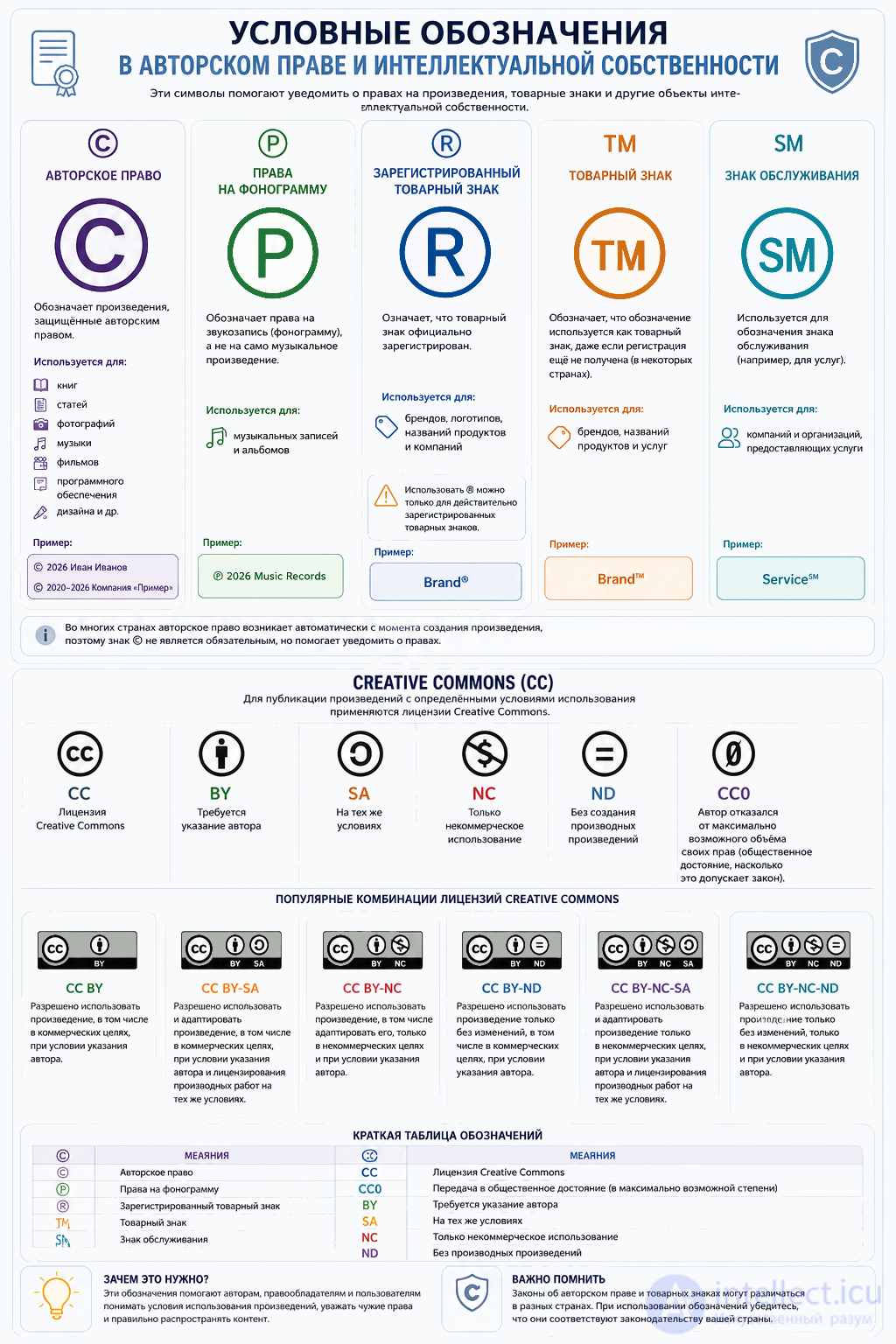
Symbol: ©
Used to mark works protected by copyright:
It is usually formatted like this:
© 2026 Ivan Ivanov
or
© 2020–2026 Company "Example"
In many countries, copyright arises automatically at the moment a work is created, so the © symbol is not mandatory, but it helps to give notice of rights.
Symbol: ℗
Used to indicate rights in a sound recording (phonogram), rather than in the musical work itself.
Example:
℗ 2026 Music Records
Symbol: ®
Means that the trademark is officially registered.
Example:
Brand®
The ® symbol may be used only for trademarks that are actually registered.
Symbol: ™
Indicates that the designation is used as a trademark, even if registration has not yet been obtained (in some countries).
Example:
Brand™
Symbol: ℠ or the text SM
Used to designate a service mark (for example, for services).
To publish works under certain conditions of use, Creative Commons licenses are used.
Main icons:
Combinations:
| Symbol | Meaning |
|---|---|
| © | Copyright |
| ℗ | Phonogram rights |
| ® | Registered trademark |
| ™ | Trademark |
| ℠ | Service mark |
| CC | Creative Commons license |
| CC0 | Dedication to the public domain (to the fullest extent possible) |
| BY | Attribution required |
| SA | Under the same terms |
| NC | Non-commercial use only |
| ND | No derivative works |
Conventional symbols in the field of copyright and intellectual property are an important element of legal culture and an effective means of informing people about rights in the results of intellectual activity. Using the symbols ©, ℗, ®, ™ and the Creative Commons license marks makes it possible to determine the legal status of works, trademarks, and other objects, and to set the conditions for their use.
Although in most countries copyright arises automatically at the moment a work is created, using the appropriate symbols helps prevent infringement, raises users' legal awareness, and makes it easier to protect the interests of rights holders. Knowing the meaning of these symbols is especially relevant in an age of rapid development of digital technologies, global information exchange, and the wide distribution of content on the Internet.
Thus, understanding and properly using these symbols is a necessary condition for complying with intellectual property law, respecting the rights of authors, and building a civilized practice of using the results of creative work.
Sign in and the lectures you have studied will be marked in this list.
Choose a course
Comments