
Lecture
The history of copyright begins with the rights and privileges granted to authors of artistic literary works in the Middle Ages, with the system developing and being refined further over several centuries.
In the Middle Ages the forerunners of copyright were the so-called "privileges". A privilege was granted by the monarch personally to an author at the latter's request. As a rule, privileges were granted for artistic literary works, and the practice was rare. Many scholars and people of the arts held the view that their works were not an act of creation; they were merely "conduits" of divine knowledge, which they expressed as best they could. Accordingly, to claim rights in one's works was pointless and sinful.
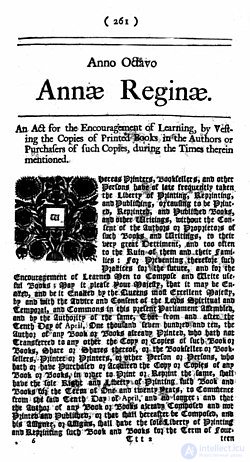
The Statute of Anne
The history of copyright begins with the early privileges and monopolies granted to book publishers. The British Statute of Anne of 1710, whose full title is "An Act for the Encouragement of Learning, by Vesting the Copies of Printed Books in the Authors or Purchasers of such Copies, during the Times therein mentioned", was the first copyright law. Initially copyright law applied only to the copying of books. Over time other uses, such as translations and derivative works, also came within the scope of copyright, and copyright now covers a wide range of works, including maps, performances, paintings, photographs, sound recordings, motion pictures and computer programs.
Today national copyright laws are standardised to some degree through international and regional agreements such as the Berne Convention and the European copyright directives. Although the laws of different countries contain common copyright provisions, each jurisdiction has separate and distinct laws and rules in this field. Some jurisdictions also recognise moral rights of creators, such as the right to be identified as the author of a work.
Copyright is a set of exclusive rights granted to the author or creator of an original work, including the right to copy, distribute and adapt the work. Copyright does not protect ideas, only their expression or fixation. In most jurisdictions copyright arises from the moment of fixation and requires no registration. Copyright owners have the exclusive legal right to control the copying and other use of works for a certain period of time, after which the work is deemed to have passed into the public domain. Uses falling under the limitations and exceptions to copyright, such as fair use, do not require the copyright owner's permission. All other uses require permission, and copyright owners may license, transfer or assign their exclusive rights to others.
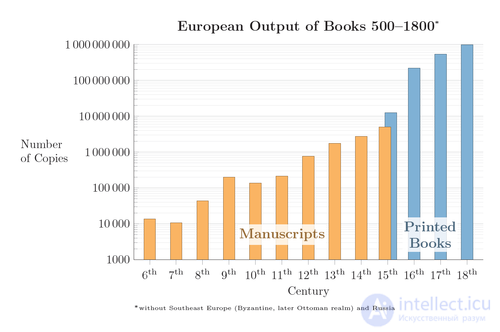
The volume of book production in Europe before the introduction of copyright, from the 500s to the 1700s. Printed books are shown in blue. A logarithmic graph; a straight line therefore indicates exponential growth.
A possible historical precedent on the question of the right to copy goes back to ancient Ireland. The Cathach is the oldest surviving Irish manuscript of the Psalter and the earliest example of Irish writing. It contains a version of Psalms XXX (30) to CV (105) in the Vulgate, with an explanatory rubric or heading before each psalm. It is traditionally held to be a copy made at night in haste by a miraculous light, of a psalter lent to Columba by Saint Finnian. In the sixth century a dispute arose over ownership of the copy, and King Diarmait Mac Cerbaill ruled: "To every cow belongs her calf, therefore to every book belongs its copy." The Battle of Cúl Dreimhne is said to have been fought over this issue. However, the account of the dispute over the copy of the Cathach comes from a considerably later source, and its reliability has been questioned.
Modern copyright is influenced by a range of older rights recognised throughout history, including the moral rights of the author who created the work, the economic rights of the benefactor who paid for the copy to be made, the property rights of the individual owner of the copy, and the sovereign's right to censor and regulate the printing industry. The origins of some of these rights can be traced to ancient Greek culture, ancient Jewish law and ancient Roman law. In Greek society in the sixth century BC there emerged the notion of the individual "self", encompassing personal ideals, ambitions and creativity. The individual "self" is important in copyright because it distinguishes creative work produced by a particular person from the rest of society. In ancient Jewish Talmudic law one can find recognition of the author's moral rights and of the author's economic or property rights.
Before the invention of movable type in the West in the middle of the fifteenth century, texts were copied by hand, and the small quantity of texts rarely gave occasion to test these rights. In the time of the Roman Empire, a period of flourishing book trade, there was no copyright or similar regulation, and copying by anyone other than professional booksellers was rare. This is because books were as a rule copied by literate slaves, who were expensive to maintain. Thus any copyist had to pay roughly as much as a professional publisher. Roman booksellers sometimes paid a respected author for priority of access to a text for copying, but they had no exclusive rights in the work, and authors were usually paid nothing for their labour. In his Epigrams, Martial complains of a lack of profit despite the popularity of his poetry throughout the Roman Empire.
The printing press came into use in Europe in the 14th and 15th centuries and made the production of books far cheaper. Since initially there was no copyright law, anyone could buy or rent a printing press and print any text. Popular new works were immediately reprinted by competitors, so printing houses needed a constant flow of new material. The fees paid to authors for new works were high and substantially supplemented the incomes of many scholars.
Printing brought profound social change. Rising literacy across Europe led to a sharp increase in demand for printed matter. Prices for reprints were low, so publications could be bought by poorer sections of the population, creating a mass readership market. In German-speaking regions most publications were scholarly papers, as well as scientific and technical editions, often self-instruction manuals and practical guides on subjects such as dam building. After copyright law was enacted (in 1710 in England and in the 1840s in the German-speaking regions), the cheap mass market disappeared, and fewer but more expensive editions came to be published. Heinrich Heine, in a letter to his publisher of 1854, complains: "Because of the incredibly high prices you have set, I am hardly likely to see a second edition of the book any time soon. But you must set lower prices, dear Campe, otherwise I really do not see why I have been so accommodating about my material interests."
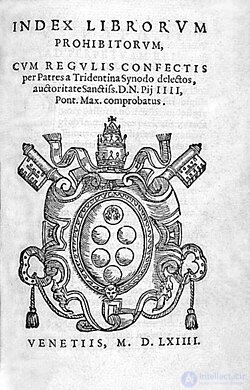
Title page of the Index of Prohibited Books (Index Librorum Prohibitorum, or List of Prohibited Books) (Venice, 1564).
The origins of copyright in most European countries lie in attempts by the church and governments to regulate and control the output of the printing trade. Before the invention of the printing press, a text, once created, could be physically multiplied only by the laborious and error-prone process of hand copying by scribes. No elaborate system of censorship and control over scribes existed, because scribes were scattered and worked on individual manuscripts. Printing made it possible to produce many exact copies of a work, which led to a faster and wider dissemination of ideas and information (see print culture). In 1559 the Index Expurgatorius, or List of Prohibited Books, was published for the first time.
In Europe printing was invented and became widespread in the 15th and 16th centuries. Although governments and the church did much to encourage printing, which allowed Bibles and government information to be disseminated, works expressing dissent and criticism could also spread rapidly. As a result governments established control over printing houses throughout Europe, requiring them to hold official licences to trade in and produce books. Licences generally granted printers the exclusive right to print particular works for a fixed period of time and allowed them to prevent others from printing the same work during that period. Licences could grant printing rights only within the territory of the state that issued them, but they usually prohibited the import of foreign printed matter.
The Republic of Venice granted its first privilege for a particular book in 1486. This was a special case, since it concerned the history of the city itself, the Rerum venetarum ab urbe condita opus of Marcus Antonius Coccius Sabellicus. The second author in the world to obtain copyright and royal printing privileges was the humanist and grammarian Antonio de Nebrija, for his Lexicon hoc est Dictionarium ex sermone latino in hispaniensem (Salamanca, 1492).
From 1492 onwards Venice began granting privileges for books on a regular basis. The Republic of Venice, the dukes of Florence, and Leo X and other popes at various times granted certain printers the exclusive right to print editions of classical authors for fixed terms (rarely exceeding 14 years).
The first printing privilege in England dates from 1518 and was issued to Richard Pynson, the king's printer, successor to William Caxton. The privilege granted a monopoly for a term of two years. This date is 15 years later than the date of the first privilege issued in France. Early printing privileges were called "monopolies", especially during the reign of Queen Elizabeth, who often granted monopolies over everyday commodities such as salt, leather, coal, soap, cards, beer and wine. This practice continued until the Statute of Monopolies was passed in 1623, putting an end to most monopolies with certain exceptions such as patents; after 1623 it became customary to grant patents to publishers.
The earliest German privilege of which reliable records survive was issued in 1501 by the Aulic Council to an association called the Sodalitas Rhenana Celtica for the publication of an edition of the dramas of Hrotsvitha of Gandersheim, prepared for the press by Conrad Celtes. According to the historian Eckhard Höffner, no effective copyright legislation existed in Germany at the beginning of the 19th century. Prussia introduced a copyright law in 1837, but even then authors and publishers had only to turn to another German state to circumvent its provisions.
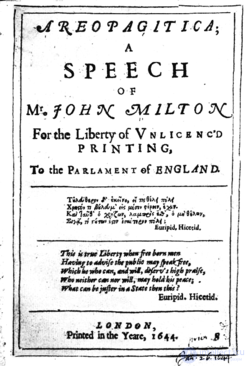
On the first page of the 1644 edition of John Milton's Areopagitica, he argued forcefully against the Licensing Order of 1643.
As the "threat" of printing spread, governments created centralised mechanisms of control, and in 1557 the English Crown resolved to stem the flow of subversive and heretical books by establishing the Stationers' Company. The right to print was restricted to members of that guild, and thirty years later the Star Chamber was set up to curb the "great abuses" committed by "divers contentious and disorderly persons professing the art or mystery of printing or selling of books". The right to print was restricted to the two universities and the 21 existing printers in the City of London, who had 53 presses. The French Crown likewise suppressed printing, and the printer Étienne Dolet was burned at the stake in 1546. When the English took control of the printing trade in 1637, printers fled to the Netherlands. Confrontation with authority made printers radical and rebellious, and 800 authors, printers and booksellers were imprisoned in the Bastille before it was stormed in 1789.
The idea that the expression of dissenting or subversive views should be tolerated rather than censored or punished by law developed in parallel with the rise of printing and the press. Areopagitica, published in 1644 under the full title Areopagitica: A Speech of Mr. John Milton for the Liberty of Unlicensed Printing to the Parliament of England, was John Milton's response to the English Parliament's decision to reintroduce state licensing of printers and hence of publishers. In it Milton set out the main lines of future debates on freedom of expression. In defining the scope of freedom of expression and of "harmful" speech, Milton argued against the principle of prior censorship and for tolerance of a wide range of views.
The Statute of Anne came into force in 1710.
In England the printers, known as stationers, formed a collective organisation known as the Stationers' Company. In the 16th century the Stationers' Company obtained the right to require that all lawfully printed books be entered in its register. Only members of the Stationers' Company could enter books in the register. This meant that the Stationers' Company came to occupy a dominant position in publishing in 17th-century England (no comparable system existed in Scotland and Ireland).
The monopoly came to an end in 1695, when the English Parliament did not renew the powers of the Stationers' Company.
In 1707 the parliaments of England and Scotland were united by the Anglo-Scottish Union. The new parliament was able to change the laws in both countries, and an important early piece of legislation was the Copyright Act 1710, also known as the Statute of Anne, after Queen Anne. The act came into force in 1710 and became the first copyright law. Its full title read: "An Act for the Encouragement of Learning, by Vesting the Copies of Printed Books in the Authors or Purchasers of such Copies, during the Times therein mentioned."
The entry into force of the Statute of Anne in April 1710 marked a historic moment in the development of copyright. As the world's first copyright law, it granted book publishers legal protection for 14 years from the act's entry into force. It also granted 21 years of protection to any book already in print. The Statute of Anne had a far broader social purpose and scope than the monopoly granted to the Stationers' Company. The statute was concerned with the reading public, the continuous production of useful literature, and the advancement and dissemination of learning. Central to the statute is a social quid pro quo; in order to encourage "learned men to compose and write useful books", the statute guaranteed a limited right to print and reprint those works. It established a pragmatic bargain between authors, booksellers and the public. The Statute of Anne put an end to the old system under which only literature meeting the censorship standards set by the booksellers could be published. In addition, the statute created a public domain for literature, since previously all literature had belonged to the booksellers in perpetuity.
According to Patterson and Lindberg, the Statute of Anne:
...transformed the stationers' copyright, which had been used as a device of monopoly and censorship, into a concept of trade regulation intended to promote learning and to curb the publishers' monopoly... The features of the Statute of Anne that justify the epithet of trade regulation include the limited term of copyright, the availability of copyright to any person, and price-control provisions. Copyright, instead of being perpetual, was now limited to a term of fourteen years, with a similar renewal term available only to the author (and only if the author was alive at the expiry of the first term).
When the copyright terms provided by the Statute of Anne began to expire in 1731, the London booksellers set out to defend their dominant position by petitioning the Court of Chancery for injunctions in respect of works by authors that fell outside the statute's protection. At the same time the London booksellers lobbied Parliament to extend the copyright term provided by the Statute of Anne. Ultimately, in a case known as Midwinter v Hamilton (1743–1748), the London booksellers turned to the common law and began a 30-year period known as the "battle of the booksellers", in which the London booksellers confronted the newly emerged Scottish book trade over the right to reprint works falling outside the protection of the Statute of Anne. The Scottish booksellers argued that no common law copyright existed. The London booksellers, for their part, argued that the Statute of Anne merely supplemented and supported a pre-existing common law copyright. This dispute was resolved in a series of well-known cases, including Millar v Kincaid (1749–1751) and Tonson v Collins (1761–1762).
A debate flared up over whether printed ideas could be owned, and the London booksellers and other supporters of perpetual copyright argued that without it learning would cease to exist, and that authors would have no incentive to go on creating works of enduring value if they could not pass property rights to their descendants. Opponents of perpetual copyright argued that it amounted to a monopoly, which inflated the price of books, making them less accessible and thereby impeding the spread of the Enlightenment. The London booksellers were criticised for using authors' rights to mask their own greed and self-interest in controlling the book trade. When Donaldson v Becket reached the House of Lords in 1774, Lord Camden was the most trenchant in his rejection of common law copyright, warning the Lords that if they voted for common law copyright, in effect perpetual copyright, "all our learning will be locked up in the hands of the Tonsons and Lintots of the age". Moreover, he warned that booksellers would set whatever price on books they pleased, "until the public became as much their slaves as their own compilers are". He declared that "knowledge and science are not things to be bound in such cobweb chains".
In its ruling the House of Lords held that copyright rights and duties are determined by statute. There is, however, still disagreement over whether the House of Lords confirmed the existence of a common law copyright before it was abolished by the Statute of Anne. The Lords were traditionally hostile to the booksellers' monopoly and were aware of how the doctrine of common law copyright, promoted by the booksellers, had been used to justify their case for perpetual copyright. The Lords spoke out clearly against perpetual copyright and, in confirming that the copyright term (the length of time for which a work is protected by copyright) expires in accordance with the statute, the Lords also confirmed the public domain. The decision in Donaldson v Becket confirmed that a large number of works and books first published in Great Britain were in the public domain, either because the term of copyright granted by statute had expired or because they had first been published before the Statute of Anne was enacted in 1710. This opened up a market for cheap reprints of the works of Shakespeare, Milton and Chaucer, works now regarded as classics. The expansion of the public domain in books undermined the dominance of the London booksellers and allowed greater competition, as a result of which the number of London booksellers and publishers grew almost threefold, from 111 to 308, between 1772 and 1802.
In the end a settlement was reached under which authors had a pre-existing common law copyright in their works, but with the passage of the Statute of Anne Parliament limited those rights in order to strike a more adequate balance between the author's interests and the public good. In the view of Patterson and Livingston, the confusion over the nature of copyright has persisted ever since. Copyright came to be regarded both as an author's right grounded in natural law and as a statutory grant of a limited monopoly. One theory holds that copyright is created simply by the creation of the work, another that it derives from copyright law.
In August 1906 the Musical Copyright Act 1906, also known as the T. P. O'Connor Bill, was added to copyright law after many then-popular composers of music died in poverty as a result of large-scale piracy by gangs during the sheet music piracy crisis of the early 20th century. The gangs would buy a copy of the music at full price, copy it and resell it, often for half the price of the original.
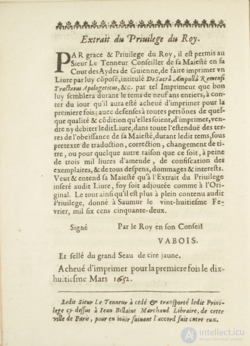
an example from 1652
In pre-revolutionary France all books had to be approved by official censors, and authors and publishers had to obtain a royal privilege before a book could be published. Royal privileges were exclusive and were usually granted for six years, with the possibility of renewal. Over time it was established that the holder of a royal privilege had the exclusive right to renew it in perpetuity. In 1761 the Royal Council granted a royal privilege to an author's heirs rather than to the author's publisher, which sparked a nationwide debate on the nature of literary property similar to the one unfolding in Britain during the battle of the booksellers.
In 1777 a series of royal decrees reformed royal privileges. The term of privileges was set at a minimum of 10 years or the life of the author, whichever was longer. If an author obtained a privilege and did not transfer or sell it, he could himself publish and sell copies of the book and pass the privilege to his heirs, who enjoyed an exclusive right in perpetuity. If the privilege was sold to a publisher, the exclusive right lasted only for the stated term. The royal decrees prohibited the renewal of privileges, and after a privilege expired anyone could obtain a "simple permission" to print or sell copies of the work. In this way the public domain in books whose privileges had expired was expressly recognised.
After the French Revolution a dispute broke out over the fact that the Comédie-Française theatre had been granted the exclusive right to the public performance of all dramatic works, and in 1791 the National Assembly abolished this privilege. Anyone was permitted to establish public theatres, and the National Assembly declared that the works of any author who had died more than five years earlier were public property. To the same extent, the National Assembly granted authors the exclusive right to authorise the public performance of their works during their lifetime and extended that right to authors' heirs and assigns for five years after the author's death. The National Assembly took the view that a published work is by its nature public property, and that authors' rights are recognised as an exception to that principle, providing compensation to the author for his work.
In 1793 a new law was passed granting authors, composers and artists the exclusive right to sell and distribute their works, together with a right extending to their heirs and assigns for 10 years after the author's death. The National Assembly firmly grounded this law in natural law, calling it the "Declaration of the Rights of Genius" and thereby alluding to the famous Declaration of the Rights of Man and of the Citizen. Copyright, however, was conditional on the deposit of copies of the work in the National Library, and 19th-century commentators characterised the law of 1793 as utilitarian and a "charitable gift from society".
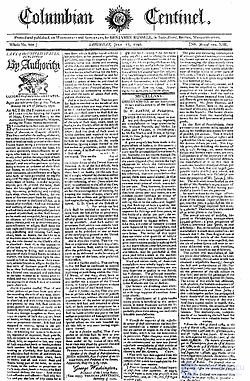
The Copyright Act of 1790 in the newspaper the Columbian Centinel.

The expansion of the term of United States copyright law (assuming that authors create their works at the age of 35 and live to seventy).
The Statute of Anne did not extend to the American colonies. The economy of early America was largely agrarian, and before 1783 only three private copyright acts were passed in America. Two of these acts limited the term to seven years, the third to five years. In 1783 several petitions from writers persuaded the Continental Congress that "nothing is more properly a man's own than the fruit of his study, and that the protection and security of literary property would greatly tend to encourage genius and to promote useful discoveries". But under the Articles of Confederation the Continental Congress had no power to enact copyright legislation. The Continental Congress adopted a resolution calling on the states to "secure to the authors or publishers of any new book not hitherto printed... the copyright of such books for a certain term, not less than fourteen years from the first publication; and to secure to the said authors, if they survive the first-mentioned term,... the copyright of such books for another term, not less than fourteen years". Three states had already passed copyright laws in 1783 before the Continental Congress resolution, and over the following three years every remaining state except Delaware passed a copyright law. Seven states followed the Statute of Anne and the Continental Congress resolution by providing for two fourteen-year terms. The five remaining states granted copyright for a single term of fourteen, twenty or twenty-one years with no right of renewal.
At the Philadelphia Convention of 1787, James Madison of Virginia and Charles Cotesworth Pinckney of South Carolina submitted proposals that would allow Congress to grant copyright for a limited term. These proposals are the origin of the Copyright Clause of the Constitution of the United States, which allows copyrights and patents to be granted for a limited term in order to serve a utilitarian function, namely "to promote the progress of science and useful arts". The first federal copyright law was the Copyright Act of 1790. It granted copyright for a term of 14 years "from the recording of the title", with the right to renew for a further 14 years if the author lived to the end of the first term. The act covered not only books but also maps and charts. Only works printed in the United States and created by citizens were eligible for copyright. Apart from the provision on maps and charts, the Copyright Act of 1790 was copied almost verbatim from the Statute of Anne.
At that time works received protection under federal copyright law only if the statutory formalities were observed, such as proper copyright notice. If they were not, the work passed immediately into the public domain. In 1834 the Supreme Court in Wheaton v Peters (a case analogous to the British case of Donaldson v Becket of 1774) held that, although the author of an unpublished work had a common law right to control the first publication of that work, he had no common law right to control reproduction after the work's first publication.

Countries that are signatories to the Berne Convention (shown in blue).
The Berne Convention was first adopted in 1886 and subsequently revised in 1896 (Paris), 1908 (Berlin), 1928 (Rome), 1948 (Brussels), 1967 (Stockholm) and 1971 (Paris). The convention concerns literary and artistic works, including films, and requires member states to provide protection for every work in the literary, scientific and artistic domains. The Berne Convention has a number of core provisions, including the principle of national treatment, under which each member state of the convention grants nationals of other member states the same copyright rights that it grants its own nationals (Articles 3-5).
Another key feature is the establishment of minimum standards for national copyright legislation, since each member state agrees to certain basic rules that must be contained in its national law. Member states may, however, if they wish, increase the level of protection granted to rightholders. One important minimum rule was that the term of copyright must be at least the life of the author plus 50 years. Another important minimum rule established by the Berne Convention is that copyright arises with the creation of the work and does not depend on any formalities, such as a system of public registration (Article 5(2)). At that time some countries required registration of copyright, and when Great Britain implemented the Berne Convention in the Copyright Act 1911 (1 & 2 Geo. 5. c. 46), it had to abolish its registration system at Stationers' Hall.
The Berne Convention focuses on authors as the key figure in copyright, and the stated aim of the convention is "the protection of the rights of authors in their literary and artistic works" (Article 1), rather than the protection of publishers and others involved in bringing works to the public. The 1928 revision introduced the concept of moral rights (Article 6bis), giving authors the right to be identified as such and to object to derogatory treatment of their works. These rights, unlike economic rights such as the prohibition of reproduction, could not be transferred to others.
The Berne Convention also enshrined limitations and exceptions to copyright, allowing literary and artistic works to be reproduced without the prior authorisation of rightholders. The details of these exceptions were left to national copyright legislation, but the guiding principle is set out in Article 9 of the convention. The so-called three-step test provides that an exception is permissible only "in certain special cases, provided that such reproduction does not conflict with a normal exploitation of the work and does not unreasonably prejudice the legitimate interests of the author". The free use of copyright-protected works is expressly permitted in the case of quotations from lawfully published works, illustrations for teaching purposes and news reporting (Article 10).

Comments