
Lecture
Copyright in the objective sense is the body of civil law rules governing relations concerning the recognition of authorship and the protection of works of science, literature and art, the establishment of the regime for their use, the vesting of moral and economic rights in their authors, and the protection of the rights of authors and other rightholders.
The subject matter of copyright law is the relations arising in connection with the creation and use of works of science, literature and art (copyright), of phonograms, performances, stagings, and broadcasts of on-air or cable broadcasting organisations (related rights).
Copyright law combines dispositive and mandatory methods of regulating legal relations.
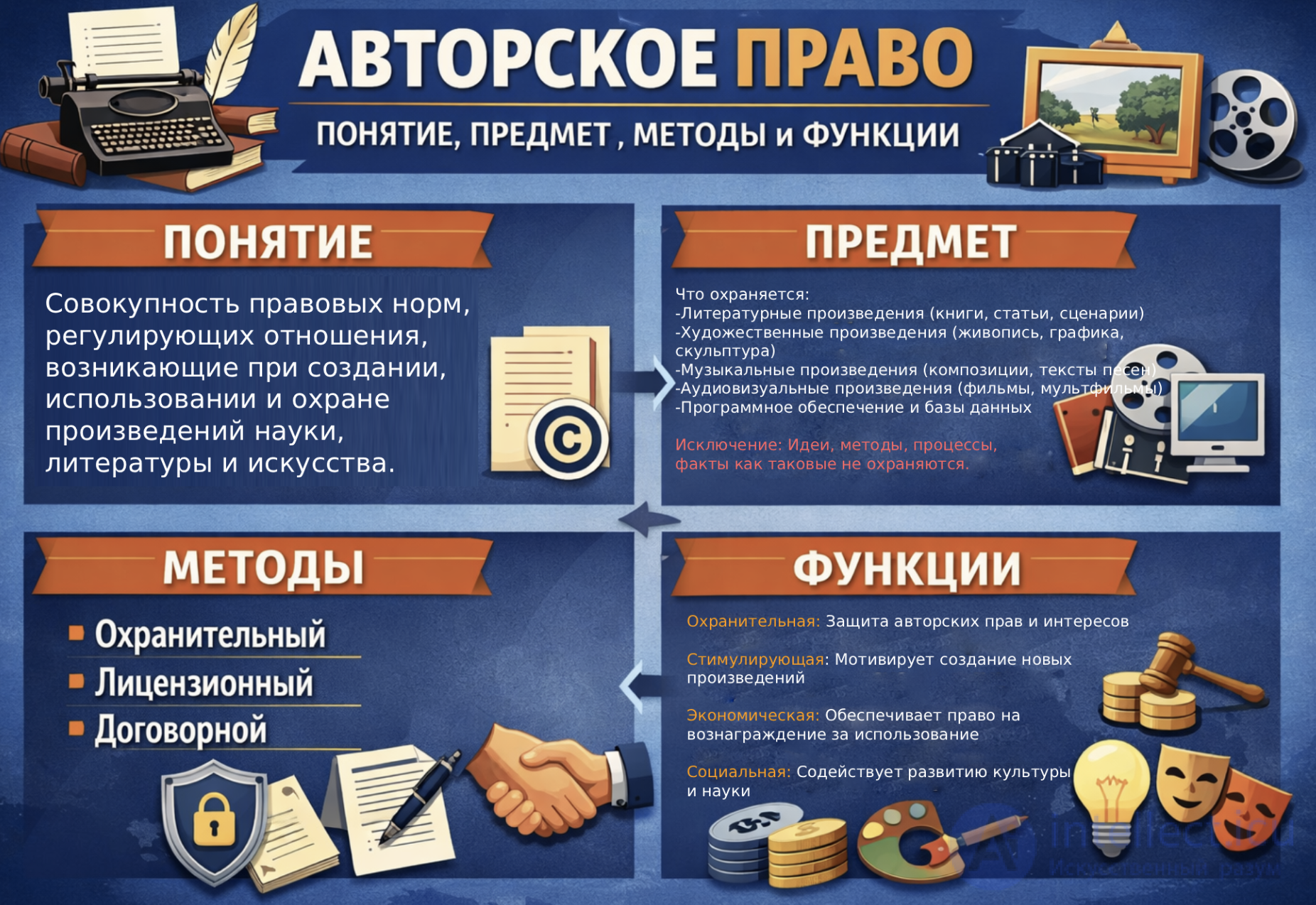
Copyright is an institution of civil law that governs legal relations connected with the creation and use (publication, performance, display, etc.) of works of science, literature or art, that is, the objective results of people's creative activity in these fields. Software and databases also fall under copyright protection, being treated as equivalent to literary works and compilations respectively.
Copyright includes both the moral (non-economic) rights of the author, which are inalienable and unlimited in time, and the economic rights to use the work, which the author may transfer to other persons.
The English term copyright © (from copy and right) denotes in English the economic side of authors' rights, that is, the right to copy and reproduce.
In most countries the term of protection of economic rights depends on the length of the author's life and runs for 70 years after the author's death, after which the work passes into the public domain.
The first of them is the recognition of authorship and the protection of works of science, literature and art. Copyright establishes protection for these works from the moment of their creation. Copyright legislation does not give a general definition of the concept of a work. A work should be understood as any ideal system of scientific and technical categories (works of science) or of literary and artistic images (works of literature and art) that meets the requirements of the law. The law defines only individual types of works, in particular audiovisual works, databases, computer programs and works of applied art. The second function is manifested in establishing the regime for the use of works. The rules of copyright provide who and on what conditions is entitled to use a protected work. By virtue of Article 138 of the Civil Code, the holder of copyright has the exclusive right of use. Third parties may use the work only with the consent of the holder of the exclusive copyright. Copyright does not regulate the procedure for the practical application of works. It only determines what constitutes, for example, reproduction of a work, its performance, display, disclosure to the public, and so on. The regulation of the processes of the practical use of copyright-protected works falls outside the scope of copyright and of civil law as a whole1. The third function of copyright is expressed in vesting the authors of works of science, literature and art and other rightholders with a set of personal and economic rights. The protection of these rights forms the content of the fourth function of copyright.
The initial subject of copyright is always the "natural person by whose creative labour" a work of science, literature or art, as well as other intellectual property, was created — the author. The author holds the whole set of copyrights: moral rights and the exclusive right (economic right) to use the work in any form and by any means not contrary to law. The person indicated as the author on the original or on a copy of the work is deemed to be its author unless proved otherwise (the presumption of authorship).
Subjects of copyright are also persons holding the exclusive right in a work which has passed to them from the author on various grounds (by operation of law or by contract). Such subjects are called rightholders. Such rightholders may be:
Yet another specific subject of copyright is organisations administering authors' economic rights on a collective basis. In foreign countries such organisations have become widespread.
In order to give notice of the exclusive right in a work belonging to him, the rightholder (the author or his successor in title) is entitled to use the copyright protection notice, which is placed on every copy of the work and consists of the following elements:
For example:
© Ivanov I. I., 2006
This format of notice was established by the Universal (Geneva) Copyright Convention of 1952. Today it is purely informational in nature. In some countries, for example in the United States, the inclusion of false information in a copyright notice is punishable by law.
Use of the protection symbol is a right of the author, not an obligation. This means that no one is entitled to use an author's works without his permission, even if they bear no protection marking.
Subjective copyrights may be conditionally divided into two groups: moral rights and economic rights. The conditional nature of this division is due to the difference in the sources and concepts of copyright in common law countries and in countries of the continental legal system.
In common law countries the so-called moral rights (the English term moral rights is a calque of the French legal concept droits moraux) are not at all the same thing as the moral (personal non-economic) rights of continental law. The common law developed on the basis of the freedom of the right of property (although Property is only an indication of an indeterminate range of obliged persons opposed to the entitled person, as well as of the possibility of alienating the right, or at least of contractually waiving its exercise). Therefore property extends not only to things. Moral rights are also, rather, property. In this connection an author may undertake an obligation not to exercise his moral rights in the future.
Moral rights (also designated in the Berne Convention as "moral rights") include:
Moral copyrights are unlimited in time. In Russia they may belong only to a natural person and are inalienable, that is, they cannot be transferred to another person.
The author of a work or another rightholder holds the exclusive right to use the work in any form and by any means not contrary to law (the exclusive right in the work). Use of a work, irrespective of whether the relevant acts are performed for the purpose of making a profit or without such a purpose, includes in particular:
The term of the exclusive right in a work should be determined under the legislation of the state in which "protection is claimed".
International treaties in the field of copyright establish minimum terms of protection for exclusive (economic) rights. Thus, under Article 7(1) of the Berne Convention for the Protection of Literary and Artistic Works, the term of protection is the life of the author and fifty years after his death.
There is a marked tendency towards lengthening the term of protection of exclusive rights in various countries of the world, including Russia.
In accordance with Article 1281 of Part 4 of the Civil Code of the Russian Federation (which entered into force on 1 January 2008), the exclusive right in a work runs for the whole of the author's life and for seventy years, counting from 1 January of the year following the year of the author's death (save in certain specially stipulated cases). Once this term has expired, the work becomes public domain.
Under Article 1259 of the Civil Code of the Russian Federation these are works of science, literature and art, irrespective of the merits and purpose of the work and of the manner of its expression.
A part of a work (including the title of the work or a character in it), if by its nature it may be recognised as an independent result of the author's creative labour and is expressed in an objective form (see the types of objects of copyright), is also an object of copyright.
Copyright extends both to disclosed and to undisclosed works existing in some objective form:
and others.
The objects of copyright themselves may be:
and other works.
The objects of copyright also include:
Derivative works and composite works are protected by copyright irrespective of whether the works on which they are based or which they include are themselves objects of copyright.
The following are not objects of copyright:
Copyright also does not extend to ideas, concepts, principles, methods, processes, systems, ways of solving technical, organisational and other problems, discoveries, facts, or programming languages.
An important issue is the question of copyright in a character. As regards Russia, under paragraph 7 of Article 1259 of the Civil Code of the Russian Federation a part of a work and a character may be an object of copyright. Paragraph 4 of Article 1259 of the Civil Code of the Russian Federation also gives a list of objects of copyright which includes characters, but only where the character may be recognised as an "independent result of the author's creative labour" that is expressed in an objective form and retains its recognisability when used separately from the work. Characters from books, films and video games, if they are well known and recognisable, attract heightened attention to the goods and services in whose advertising they are used. As a result, demand for their commercial use is growing, and this has to be taken into account. For example, after the filming of Walt Disney Pictures' "Enchanted" (2007), which combines the performance of live actors with animated characters, it was originally planned to add Giselle (a princess of a fairy-tale kingdom), played by Amy Adams, to the line-up of Disney princesses. However, in that case the studio would have had to pay Amy Adams for the right to use her likeness in the image of Giselle, and so it was decided not to do so.
Copyright in a work is not connected with the right of ownership of the material medium (the thing) in which the work is expressed.
The transfer of ownership of a copy of a work does not in itself entail the transfer of any rights in the work itself, save in cases of alienation of the original of the work (a manuscript, the original of a painting, a sculpture, etc.) by its owner who holds the exclusive right in the work but is not the author (unless the contract provides otherwise), or in the case where the work was initially created to order and the parties agreed on the alienation of the exclusive right at the moment of transfer of the original of the work.
1. The following are permitted without the author's consent and without payment of authors' remuneration, but with the obligatory indication of the name of the author whose work is used and of the source of the borrowing:
(as amended by Federal Law No. 230-FZ of 18 December 2006)
2. The provision by libraries, for temporary free-of-charge use, of copies of works lawfully put into civil circulation is permitted without the author's consent and without payment of authors' remuneration. Copies of works expressed in digital form, including copies of works provided under arrangements for the mutual use of library resources, may however be provided for temporary free-of-charge use only on library premises, on condition that the possibility of making copies of these works in digital form is excluded.
3. The creation of a work in the genre of literary, musical or other parody, or in the genre of caricature, on the basis of another (original) lawfully disclosed work, and the use of such parody or caricature, are permitted without the consent of the author or other holder of the exclusive right in the original work and without payment of remuneration to him.
Reprographic reproduction in a single copy without profit is permitted without the author's consent and without payment of authors' remuneration, but with the obligatory indication of the name of the author whose work is used and of the source of the borrowing, in the case of:
The reproduction, broadcasting or communication to the public by cable of works of architecture, photography and fine art that are permanently located in a place open to free attendance is permitted without the author's consent and without payment of authors' remuneration, except in cases where the image of the work is the principal object of such reproduction, broadcasting or communication to the public by cable, or where the image of the work is used for commercial purposes.
Infringement of moral copyrights is sometimes called plagiarism. In Russia plagiarism, that is, the appropriation of authorship of a work, may constitute a criminal offence (Article 146 of the Criminal Code of the Russian Federation).
Infringement of economic copyrights is called counterfeiting or, colloquially, "piracy".
Non-payment of authors' remuneration, an incorrectly calculated amount of authors' remuneration, or remuneration paid late to the author, the authors or the heirs of the author or authors, is likewise an infringement of copyright.
In accordance with Article 1259 of the Civil Code of the Russian Federation, neither registration of the work nor compliance with any other formalities is required for copyright to arise, to be exercised or to be protected. In respect of computer programs and databases, registration is possible and is carried out at the rightholder's discretion.
In practice, however, an author may face the need to secure evidence of his rights in the object of intellectual property in advance, in order to insure himself against loss or non-recognition of the author's rights.
The main method of preliminary protection of copyright is to secure evidence of the existence of the objects of copyright as at a particular date (protection of priority). The most popular methods of generating such evidence are: publication of the work in open sources (the media), deposit with an authors' society or a law firm, notarial certification of the date and time of signing of a copy of the work, and the use of special Internet services. It must be understood, however, that none of the mechanisms listed provides evidence of authorship. They only make it possible to confirm the existence of a copy of the work as at an established date and the information about the author indicated on that copy of the work.
Not to be confused with registration of copyright
For his rights to arise and be exercised, an author need not comply with any formalities. The principle of automatic protection of objects of copyright and related rights is laid down both by Russian law (Article 1257 and paragraph 4 of Article 1259 of Part 4 of the Civil Code of the Russian Federation) and by international law (the Berne Convention for the Protection of Literary and Artistic Works). The exceptions are computer programs and databases, which are subject to state registration at the rightholder's discretion.
With regard to other objects of copyright and related rights, it is incorrect to speak of "registration" of copyright. To some extent it is replaced by the concept of "deposit". The procedure consists in uploading a digital copy of any object of intellectual property to a database in encrypted form and recording information about the object in the IPChain distributed ledger (a platform for administering rights in the results of intellectual activity and means of individualisation, developed with the participation of the Skolkovo Foundation, WIPO, RAO, RSP and other organisations). Deposit is most often used to fix the authorship of undisclosed works, since, like any other means of confirming copyright, it is not evidence of authorship as such, but merely confirms that a particular person possessed a particular object of intellectual property on a particular date and at a particular time. A certificate is issued for the deposited object; it contains a number of identifiers and may subsequently be used in court and in pre-trial disputes to support the presumption of authorship.
The first copyright law was enacted in colonial India in 1914 (a calque of the British Act of 1911) and remained in force until 1957. As at 2010 the term of copyright protection is limited to 60 years after the author's death.
India is a member of the Berne Convention, the Universal Copyright Convention, the Rome Convention and the Agreement on Trade-Related Aspects of Intellectual Property Rights (TRIPS).
A copyright law was enacted as early as 1910 in the Qing Empire[unreliable source]. Under the Republic it was almost immediately (in 1915) replaced by a new copyright law, confirmed in 1928. In 1949 the authorities of the PRC abolished all copyright legislation, and for a long time no such concept existed in the country. Only in 1984, in connection with the PRC's opening to the world community, did the Ministry of Culture adopt provisional regulations on the protection of copyright in books and periodicals. In 1990 the country adopted the Copyright Law. In 1992–1993 the PRC acceded to the Universal Copyright Convention and to the Convention for the Protection of Producers of Phonograms Against Unauthorized Duplication of Their Phonograms. As at the early 2010s, the term of copyright in the PRC is 50 years after the death of the last co-author of the work.
Disproportionate duration of copyright protection

Comments