
Lecture
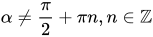
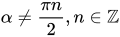
Trigonometric identities — mathematical expressions for trigonometric functions that hold for all values of the argument (from the general domain).
| № | Formula | Permissible values of the argument |
|---|---|---|
| 1.1 |  |
 |
| 1.2 |  |
 |
| 1.3 |  |
 |
| 1.4 |  |
 |
 and
and  respectively.
There are other trigonometric functions as well.
| № | Angle addition and subtraction formulas |
|---|---|
| 2.1 |  |
| 2.2 |  |
| 2.3 | 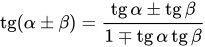 |
| 2.4 | 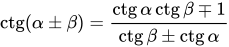 |
Formula (2.3) is obtained by dividing (2.1) by (2.2). And formula (2.4) — by dividing (2.2) by (2.1).
The double-angle formulas are derived from formulas (2.1)—(2.4) , if we take the angle β to equal the angle α:
| № | Double-angle formulas |
|---|---|
| 3.1 |  |
| 3.2 |   |
| 3.3 | 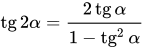 |
| 3.4 | 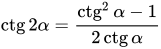 |
Notes[show]
From the double-angle formula for cosine (3.2) the half-angle formulas are derived:
| № | Half-angle formulas |
|---|---|
| 3.5 | 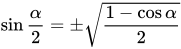 |
| 3.6 | 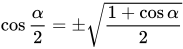 |
| 3.7 |  |
The triple-angle formulas are derived from formulas (2.1)—(2.4) , if we take the angle β to equal the angle 2α:
| № | Triple-angle formulas |
|---|---|
| 4.1 |  |
| 4.2 |  |
| 4.3 | 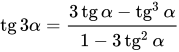 |
| 4.4 | 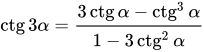 |
The power-reduction formulas are derived from formulas (3.2):
| № | Sine | № | Cosine | |
|---|---|---|---|---|
| 5.1 | 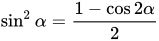 |
5.5 | 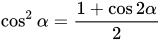 |
|
| 5.2 | 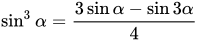 |
5.6 | 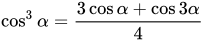 |
|
| 5.3 |  |
5.7 |  |
|
| 5.4 |  |
5.8 |  |
| № | Product |
|---|---|
| 5.9 |  |
| 5.10 |  |
| 5.11 |  |
| 5.12 |  |
| № | Formulas for converting products of functions |
|---|---|
| 6.1 |  |
| 6.2 |  |
| 6.3 |  |
| № | Formulas for converting a sum of functions |
|---|---|
| 7.1 |  |
| 7.2 |  |
| 7.3 |  |
| 7.4 | 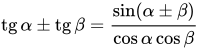 |
| 7.5 | 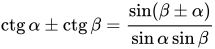 |
Derivation of formulas for converting a sum of functions[show]
Conversion of a sum of sines of 3 different angles into a product when : :
:
 (7.6)
(7.6)

If  — there are no real solutions.
If  — the solution is a number of the form

If — there are no real solutions.
If — the solution is a number of the form 

The solution is a number of the form 

The solution is a number of the form 
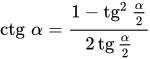
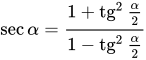
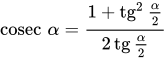
The identities make sense only when both sides exist (that is, when 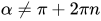 ).
).
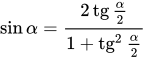 |
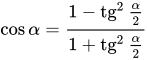 |
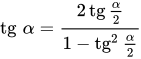 |
 |
 |
 |
The sum of two harmonic oscillations of the same frequency will again be a harmonic oscillation. In particular,

where  ,
,  and
and  are not simultaneously equal to zero,
  — is an angle called the auxiliary argument, which can be found from the system of equations:
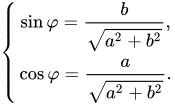
Note. From the system above it follows that  , however it cannot always be assumed that
 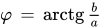 . The signs of and must be taken into account to determine which quadrant the angle belongs to.
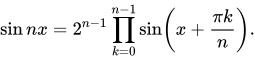
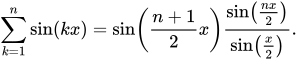
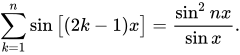
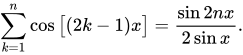
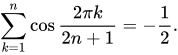
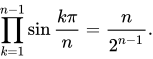
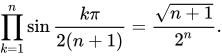
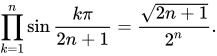
In the formulas below, the numbers  and
and  are integers.



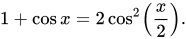
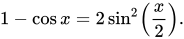
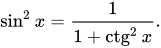
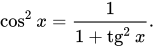












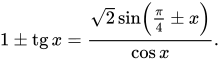
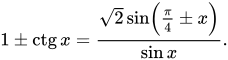

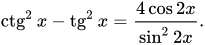








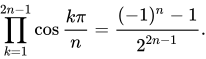
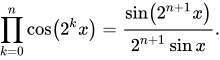
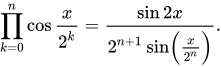
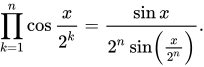
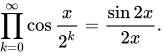
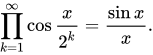






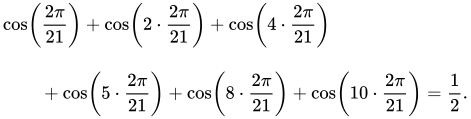
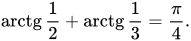
The following formula is given in two variants for the angle  given in degrees and radians:

Euler's formula states that for any real number  the following equality holds:

where  — is the base of the natural logarithm,
 — is the imaginary unit.
Using Euler's formula, the functions  and
and  can be defined as follows:

It follows that



Comments