
Lecture
Logarithmic equations are equations in which logarithmic functions (for example, the natural logarithm or a logarithm to a different base) play an important role.
For example: log2(3x − 2) = 7.
Solving logarithmic equations is based on the definition of the logarithm, the properties of the logarithmic function, and the properties of the logarithm.
They can look as follows:
Simple logarithmic equation:
This equation has the form log(base_a)(x) = b, where "log" is the logarithm, "a" is the base of the logarithm, "x" is the variable, and "b" is a constant.
Example: log(x) = 3. In this case, we are looking for the value of "x" that satisfies the logarithmic equation with base 10.
Logarithmic equation with variables inside the logarithm:
This equation has the form log(base_a)(f(x)) = b, where "log" is the logarithm, "a" is the base of the logarithm, "f(x)" is a function of the variable "x", and "b" is a constant.
Example: log(2x + 1) = 4. Here we are looking for the value of "x" that satisfies the logarithmic equation, where the variable "x" is inside the logarithm with base 10.
Various methods are used to solve logarithmic equations, including:
Isolating the logarithm: Moving the logarithm to one side of the equation and applying the inverse function (exponentiation) to express the variable.
Using the properties of logarithms: Using the properties of logarithms, such as the multiplication property and the division property, to simplify the equation.
Substitution: Sometimes substituting a variable can make the equation simpler to solve.
Graphical method: Plotting the graphs of functions and logarithms can help determine their intersection points.
Logarithmic and exponential identities: Using logarithmic and exponential identities, such as the identity a^log(base_a)(x) = x, to simplify the equation.
Solving logarithmic equations may require certain mathematical skills and a creative approach depending on their complexity and form.
Logarithmic equations find application in various fields of science, engineering, economics, and other disciplines. Here are some examples where logarithmic equations can be useful:
Economics and finance: Logarithmic equations can be used to model economic processes, such as investment growth or calculating the future value of investments based on an interest rate.
Biology: In biology, logarithmic equations can be applied to model the growth of organism populations, the distribution of species in ecosystems, and other biological phenomena.
Engineering: Logarithmic equations are used in various engineering calculations, such as determining sound insulation, analyzing electrical circuits on a logarithmic frequency scale, and calculating leaks in pipelines.
Medicine: In medicine, logarithmic equations can be used to analyze bacterial population growth, calculate the half-life of drugs in the body, and other medical applications.
Geology: In geology, logarithmic equations can be applied to estimate the time elapsed since the formation of rocks, or to analyze the distribution of elements in geological samples.
Computer science: Logarithmic equations can arise in the analysis of algorithms and computational complexity, especially in the context of sorting and searching algorithms.
Physics: In physics, logarithmic equations are used to describe the processes of radioactive decay, changes in atmospheric pressure with altitude, and other phenomena.
Ecology: Logarithmic equations can be useful in analyzing the dynamics of animal and plant populations, assessing ecological balances, and in other ecological studies.
These examples show that logarithmic equations have a wide range of applications and can be a powerful tool for analyzing and modeling various processes and phenomena in different fields of knowledge.
1. Solve the equation: 
The bases of the logarithms are equal, the logarithms themselves are also equal – which means the numbers from which they are taken are equal as well.
We «remove the logarithms» not just arbitrarily, but using the property of monotonicity of the logarithmic function.
We get: 

When solving logarithmic equations, one should take into account the domain of the logarithm. Remember that the expression  is defined for
  .
.
Having found the root of the equation, substitute it into the equation. If after such a substitution the left or right side of the equation makes no sense – then the found number is not a root of the equation and cannot be the answer to the problem.
2. Solve the equation: 
On the left side of the equation is a logarithm, on the right – the number 7. Using the fundamental logarithmic identity, let us represent the number 7 as  .
.
Answer: -124
3. Solve the equation: 
Pay attention to the 2 in front of the logarithm on the right side of the equation. Right now it prevents you from «removing the logarithms». What can be done with it so that the left and right sides contain simple logarithms with base 5? The formula for the logarithm of a power will help here.
 ;
;
 ;
;
 ;
;

4. Solve the equation: 
Domain of admissible values:  This means,
Let us represent 2 on the right side of the equation as  .
.

The function  is monotonically increasing and takes each of its values exactly once.
The logarithms are equal, their bases are equal. Let us «remove» the logarithms.
We obtain  .
.

 .
.
Answer: 21.
5. Solve the equation: 
Using equivalent transformations. We write down the domain and «hide» the logarithms:

Answer: –4.
Solutions of logarithmic equations are best written as a chain of equivalent transformations
6. Solve the equation:  .
.
Let us move from a logarithm with base 4 (in the exponent) to a logarithm with base 2.
Using the formula for change of base:

Let us write the solution as a chain of equivalent transitions.

Answer: 19.
7. Solve the equation:  .
.
It should be remembered that the base of a logarithm must be positive and not equal to 1.
Domain of admissible values:
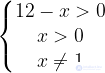
Now the logarithms can be eliminated.


 — the root does not belong to the domain, violating
  .
.
Answer: 
8. Solve the equation  .
.
Domain of the equation:
Using the substitution  .
.
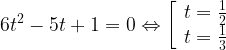
Let us return to the variable x:

9. Solve the equation:

The expression under the logarithm is always positive – since we are adding 25 to a non-negative quantity  .
.
The expression under the root on the right side is also positive.
Therefore, x domain - any real number.
Using the formula for the sum of logarithms on the left side as the logarithm of a product.
On the right side – let us move to a logarithm with base 3.
Applying the formula for the logarithm of a power.


let us «hide» the logarithms.



this is a biquadratic equation. Let us make the substitution 


Let us return to the variable x. We obtain:
 .
.
Answer:  .
.

Comments