
Lecture
Elementary algebra covers some of the basic concepts of algebra , one of the main branches of mathematics . It is usually taught to secondary school students, and it builds on their understanding of arithmetic . While arithmetic deals with specified numbers, algebra introduces quantities without fixed values, known as variables. This use of variables entails the use of algebraic notation and an understanding of the general rules of the operators introduced in arithmetic. Unlike abstract algebra , elementary algebra does not deal with algebraic structures outside the domain of real and complex numbers .
Using variables to denote quantities allows general relationships between quantities to be formally and concisely expressed, and thus allows solving a wider range of problems. Many quantitative relationships in science and mathematics are expressed as algebraic equations .
Algebraic notation describes the rules and conventions for writing mathematical expressions , as well as the terminology used to describe parts of expressions. For example, the expression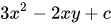 has the following components:
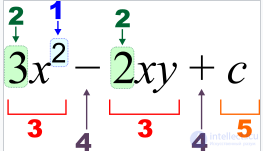
Coefficient is a numerical value, or a letter , representing a numerical constant, that multiplies a variable (the operator is omitted). Term is an addend or summand , a group of coefficients, variables, constants and exponents , which can be separated from other terms by plus and minus operators. Letters denote variables and constants. By convention, letters at the beginning of the alphabet (for example, ) are usually used to represent constants , while letters closer to the end of the alphabet (for example,
 and z ) are used to represent variables . They are usually written in italics.
Algebraic operations work in the same way as arithmetic operations , such as addition , subtraction , multiplication , division and exponentiation . and are applied to algebraic variables and terms. Multiplication symbols are usually omitted and implied when there is no space between two variables or terms, or when a coefficient is used . For example, is written as
  , and likewise
  may be written
  .
.
Usually terms with the highest power ( exponent ) are written on the left, for example, is written to the left of x . When the coefficient equals one, it is usually omitted (for example,
 is written ). Similarly, when the exponent (power) equals one (for example,
 is written
  ). [10] When the exponent equals zero, the result is always 1 (for example,
 is always rewritten as 1 ). [11] However
 , being undefined, should not appear in an expression, and care should be taken when simplifying expressions in which variables may appear in exponents.
Other types of notation are used in algebraic expressions when the required formatting is unavailable or cannot be implied, for example, when only letters and symbols are available. As an illustration of this, although exponents are usually formatted using superscripts, for example,, in plain text and in the TeX markup language the caret symbol «^» represents exponentiation, sois written as «x ^ 2». [12] [13] , as well as some programming languages, such as Lua. In programming languages such as Ada , [14] Fortran , [15] Perl , [16] Python [17] and Ruby , [18] a double asterisk is used, sorecords as «x ** 2». Many programming languages and calculators use a single asterisk to denote the multiplication symbol [19], and it must be used explicitly, for example, is written «3 * x».
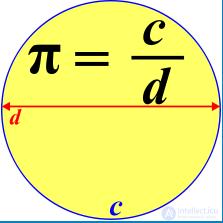
An example of variables showing the relationship between the diameter of a circle and its length. For any circle , its circumference c , divided by its diameter d , equals the constant pi , (approximately 3.14).
Elementary algebra builds on arithmetic [20] and extends it by introducing letters, called variables, to represent general (unspecified) numbers. This is useful for several reasons.
 . [21]
 seconds. In a more general (algebraic) description, it can be stated that the number of seconds,
 , where m is the number of minutes.
 .
. . [24]
Algebraic expressions can be evaluated and simplified based on the basic properties of arithmetic operations ( addition , subtraction , multiplication , division and exponentiation ). For example,
 can be simplified as (where 3 is the numerical coefficient).
 is represented as
 is written as
  , because the terms containing are added together, and the terms containing
  are added together.
 can be written as
  which can be written as
 , by dividing both terms by can be written as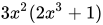
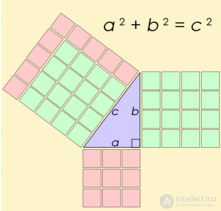
An animation illustrating the Pythagorean rule for a right triangle, which shows the algebraic relationship between the triangle's hypotenuse and its two other sides.
An equation states that two expressions are equal, using the equality symbol = ( equals sign ). [26] One of the most famous equations describes the Pythagorean law, which determines the length of the sides of a right triangle: [27]

This equation states that  , representing the square of the length of the hypotenuse side, the side opposite the right angle, equals the sum (addition) of the squares of the two other sides, whose lengths are represented by the letters a and b .
An equation is a statement that two expressions have the same value and are equal. Some equations are true for all values of the variables involved (for example, ); such equations are called identities . Conditional equations are true only for some values of the variables involved, for example
 true only for
  and also
  . The values of the variables that make the equation true are the solutions of the equation and can be found by solving the equation.
Another type of equation is the inequality. Inequalities are used to show that one side of an equation is greater than or less than the other. For this, the following symbols are used: where
where  represents "greater than", and
  where
where  represents «less than». As with standard equations of equality, numbers can be added, subtracted, multiplied, or divided. The only exception is that when multiplying or dividing by a negative number, the inequality symbol must be reversed.
Properties of equality
By definition, equality is an equivalence relation, which means that it possesses the properties of (a) reflexivity (i.e. ), (b) symmetry (i.e. if
 then
then  ) (c) transitivity (i.e. if and also
  then
then  ). [28] It also satisfies an important property: if two symbols are used for the same thing, then one symbol can be replaced by the other in any true statement about the first, and the statement will remain true. This implies the following properties:
and also  then
then  and also
  ; then
  and also
  ; then
  .
.Properties of inequality
The relations less than and greater than possess the property of transitivity: [29]
and also  then
then  ; and also
  then
then  ; [30] and also
  then
then  ; and also
  then
then  .
.By changing the inequality, and also can be swapped, [31] for example:
is equivalent to 
Substitution replaces terms in an expression to create a new expression. Replacing 3 for a in the expression a * 5 gives the new expression 3 * 5 with the value 15 . Substituting the terms of a statement produces a new statement. When the original statement is true regardless of the values of the terms, the statement produced by the substitutions is also true. Hence, definitions can be given in symbolic terms and interpreted through substitution: if is meant as the definition of
  as the product of a with itself, replacing 3 for a tells the reader about this statement that
 means 3 × 3 = 9 . It is often unknown whether a statement is true regardless of the values of the terms. And substitution makes it possible to derive constraints on the possible values or to show under what conditions the statement holds. For example, taking the statement x + 1 = 0 , if x is replaced by 1 , this implies 1 + 1 = 2 = 0 , which is false, which means that if x + 1 = 0, then x cannot be 1 .
If x and y are integers, rational, or real numbers, then xy = 0 implies x = 0 or y = 0 . Consider abc = 0 . Then, substituting a for x and bc for y , we find that a = 0 or bc = 0 . Then we can substitute again, letting x = b and y = c , to show that if bc= 0, then b = 0 or c = 0 . Therefore, if abc = 0 , then a = 0 or ( b = 0 or c = 0 ), so abc = 0 implies a = 0, or b = 0, or c = 0 .
If the original fact had been stated as « ab = 0 implies a = 0 or b = 0 », then, saying «consider abc = 0 », we would run into a conflict of terms in the substitution. Nevertheless, the logic above is still valid to show that if abc = 0, then a = 0 or b = 0 or c = 0, if instead of letting a = a and b = bc , we replace a with a and b with bc(and with bc = 0 , substituting b for x and c for y ). This shows that substituting terms in a statement is not always the same as equating the terms of the statement to the terms being substituted. In this situation it is clear that if we substitute the expression a into the term a of the original equation, the substituted a will not refer to the a in the statement « ab = 0 implies a = 0 or b = 0 ».
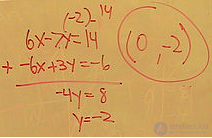
A typical algebra problem.
The following sections give examples of some types of algebraic equations that may be encountered.
Linear equations are called so because, when graphed, they describe a straight line. The simplest equations to solve are linear equations, in which there is only one variable. They contain only constant numbers and one variable without an exponent. As an example, consider:
Word problem: if you double a child's age and add 4, you get 12. How old is the child?
Equivalent equation:  where x denotes the child's age
To solve this type of equation, the method used is to add, subtract, multiply, or divide both sides of the equation by the same number, so as to isolate the variable on one side of the equation. Once the variable is isolated, the other side of the equation is the value of the variable. [32] This problem and its solution are as follows:
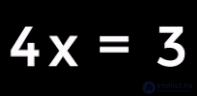
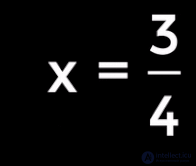
Solving for x
| 1. Equation to solve: | |
| 2. Subtract 4 from both sides: |  |
| 3. This simplifies to: |  |
| 4. Divide both sides by 2: |  |
| 5. This simplifies to the solution: |  |
In words: the child is 4 years old.
The general form of a linear equation with one variable can be written as: 
Following the same procedure (i.e. subtract b from both sides, and then divide by a ), the general solution is given by the formula
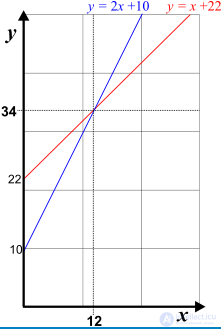
The solution of two linear equations with a single solution at their point of intersection.
A linear equation with two variables has many (i.e. infinitely many) solutions. [33] For example:
Word problem: a father is 22 years older than his son. How old are they?
Equivalent equation:  where y is the father's age, x is the son's age.
This cannot be solved on its own. If the son's age were known, there would no longer be two unknowns (variables). Then the problem turns into a linear equation with one variable, which can be solved as described above.
To solve a linear equation with two variables (unknowns), two related equations are required. For example, if it was also found that:
Word problem
In 10 years, the father will be twice as old as the son.
Equivalent equation
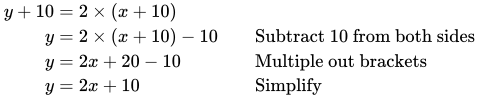
Now there are two related linear equations, each with two unknowns, which makes it possible to obtain a linear equation with only one variable by subtracting one from the other (the so-called elimination method): [34]

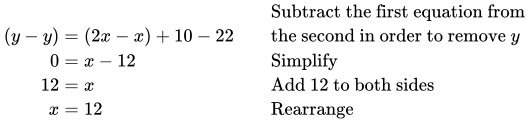
In other words, the son is 12 years old, and since the father is 22 years older, he must be 34. In 10 years the son will be 22, and the father will be twice his age, 44 years old. This problem is illustrated in the figure of the related graph of the equations.
For other ways of solving such equations, see below, System of linear equations .
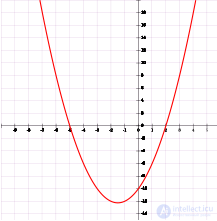
Graph of a quadratic equation  showing its roots at
  and also
  , and that the quadratic function can be rewritten as
A quadratic equation is an equation that includes a term with an exponent of 2, for example, , [35] and no term of higher degree. The name comes from the Latin quadrus , meaning square. [36] In general, a quadratic equation can be expressed in the form , [37] where a is not equal to zero (if it were equal to zero, the equation would not be quadratic, but linear). For this reason, a quadratic equation must contain a term
 , which is known as the quadratic term. Hence
 , and so we can divide by a and convert the equation to the standard form

where  and also
  . Solving this problem by a process known as completing the square leads to the quadratic formula
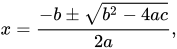
where the symbol "±" means that both

are solutions of the quadratic equation.
Quadratic equations can also be solved using factorization (the reverse process is expansion, but for two linear terms it is sometimes referred to as foiling). As an example of factoring:

which is the same as

From the zero-product property it follows that either or are solutions, since exactly one of the factors must equal zero . All quadratic equations will have two solutions in the complex number system, but not necessarily in the real number system. For example,

has no solution as a real number, since no square of a real number equals −1. Sometimes a quadratic equation has a root of multiplicity 2, for example:
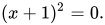
For this equation, −1 is a root of multiplicity 2. This means that −1 appears twice, since the equation can be rewritten in factored form as

Complex numbers
All quadratic equations have exactly two solutions in the complex numbers (but they may be equal to each other), a category that includes real numbers, imaginary numbers, and sums of real and imaginary numbers. Complex numbers first arise when learning about quadratic equations and the quadratic formula. For example, the quadratic equation

has the solutions

since  is not a real number, both solutions for x are complex numbers.
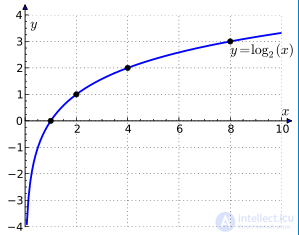
The graph of the base-2 logarithm crosses the x axis (horizontal axis) at 1 and passes through the points with coordinates (2, 1) , (4, 2) , and (8, 3) . For example, log 2 (8) = 3 , because 2 3 = 8. The graph approaches the y axis arbitrarily closely, but never crosses it .
An exponential equation is an equation of the form  for
for  , [38] having the solution
when  . Elementary algebraic methods are used to rewrite the given equation in the manner shown above before arriving at the solution. For example, if

then, subtracting 1 from both sides of the equation, and then dividing both sides by 3, we get

whence

or

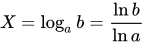
A logarithmic equation is an equation of the form  for , which has the solution

For example, if

then, adding 2 to both sides of the equation, and then dividing both sides by 4, we get

whence

from which we obtain


A radical equation showing two ways of representing the same expression. The triple bar means that the equation is true for all values of x.
A radical equation is an equation that includes a radical sign, which includes square roots , cube roots ,
 , and n- th roots ,
 . Recall that an n- th root can be rewritten in exponential form, so that is equivalent to
  . Combined with regular exponents (powers), then
  (the square root of the cube of x ), can be rewritten as
 . [39] So, the common form of a radical equation
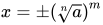
 (equivalent to
  ) where m and n are integers . It has real solution(s):
| n odd | n even and  |
m and n are even and  |
m even, n odd , and |
|---|---|---|---|

equivalent to
|

equivalent to
|
|
no real solution |
For example, if:
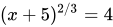
then
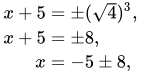
and so

There are different methods for solving a system of linear equations with two variables.
Elimination method
The solution set for the equations  and also
  is the single point (2, 3).
An example of solving a system of linear equations is the use of the elimination method:
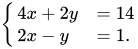
Multiplying the terms in the second equation by 2:

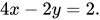
Adding the two equations together, we get:

which simplifies to

Since the fact that is known, it can then be concluded that  by either of the two original equations (using 2 instead of x ). The complete solution to this problem is then

This is not the only way to solve this particular system; y could have been solved for before x .
Substitution method
Another way of solving the same system of linear equations is substitution.
An equivalent for y can be derived using one of the two equations. Using the second equation:

Subtracting  from each side of the equation:
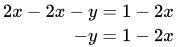
and multiplying by -1:

Using this value of y in the first equation of the original system:
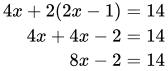
Adding 2 to each side of the equation:
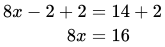
which simplifies to
Using this value in one of the equations gives the same solution as in the previous method.
This is not the only way to solve this particular system; and in this case y could have been solved for before x .
Inconsistent systems
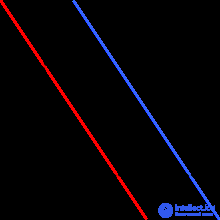
The equations  and also
  are parallel, cannot intersect, and are unsolvable.
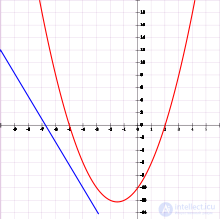
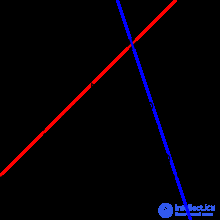
Graph of a quadratic equation (red) and a linear equation (blue) which do not intersect and, therefore, for which there is no common solution.
In the example above, a solution exists. However, there are also systems of equations that have no solution. Such a system is called inconsistent . An obvious example:
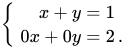
Since 0 ≠ 2, the second equation of the system has no solution. Therefore, the system has no solution. However, not all inconsistent systems are recognized at first glance. As an example, consider the system
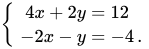
Multiplying both sides of the second equation by 2 and adding them to the first gives

which obviously has no solution.
Indeterminate systems
There also exist systems that have infinitely many solutions, unlike a system with a unique solution (that is, a unique pair of values for x and y ). For example:
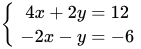
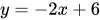
Isolating y in the second equation:
And using this value in the first equation of the system:
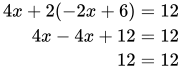
The equality is true, but it does not give a value for x . Indeed, one can easily verify (simply by substituting some values of x ) that for any x there is a solution, as long as. For this system there are infinitely many solutions.
Over- and underdetermined systems
Systems with more variables than the number of linear equations are called underdetermined . Such a system, if it has any solutions, is not unique, but infinite. An example of such a system:
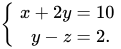
Trying to solve this problem, one is forced to express some variables as functions of others, if any solutions exist, but cannot express all the solutions in numerical form, because there are infinitely many of them, if there are any.
A system with more equations than the number of variables is called overdetermined. If an overdetermined system has any solutions, some of the equations are necessarily linear combinations of the others.


Comments