
Lecture
Hexation (or repeated pentation) — is a hyperoperation of the sixth level, which is a continuation of the series of hyperoperations, starting with the basic operations of addition, multiplication, and exponentiation. Each successive hyperoperation is a repetition of the previous one. For brevity, they are denoted as HnH_nHn, where nnn — is the level of the hyperoperation.
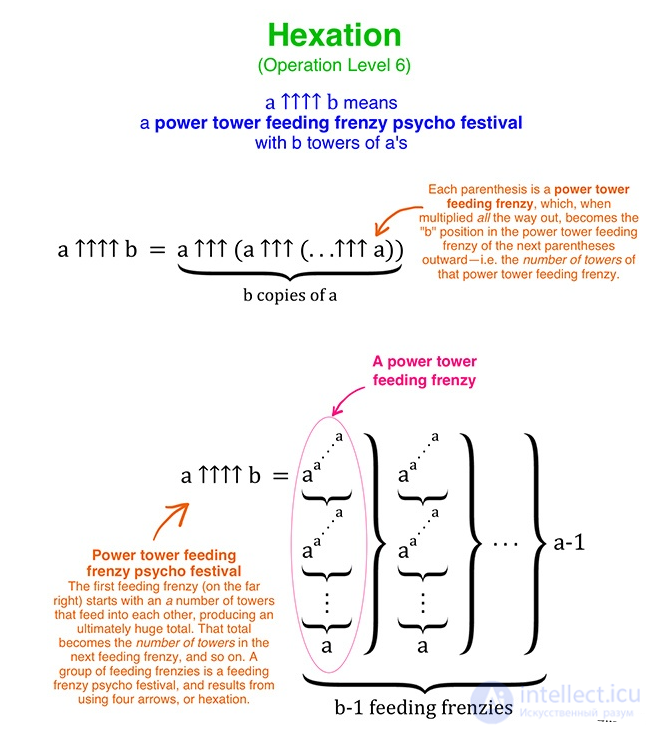
Hexation (operation of level 6). The expression a↑↑↑↑b means «super-absorption» of power towers with b power towers and base a.
Each expression in brackets — is a pentation, an «absorption» of several towers, the result of solving which takes position b in the previous brackets — becomes the value of the number of towers for the previous series of «absorptions».
«Super-absorption». The first pentation-«absorption» (the rightmost one) starts with a number of towers, the result of the solution becomes the number of towers in the next series of «absorptions», and so on. The final result of the last series of «absorptions» becomes the result of hexation.
That is essentially how the series of hyperoperations works. You can continue increasing the number of arrows, each time multiplying the possibilities for computing super-huge numbers. We have become acquainted with seven levels of hyperoperations, including the first 4 with arrows:
↑ = exponentiation
↑↑ = power tower
↑↑↑ = tetration-«absorption»
↑↑↑↑ = hexation-«super-absorption»
Here is a brief description of the levels of hyperoperations:
Put simply, hexation — is an operation in which we repeat pentation (i.e., the fifth-level hyperoperation) several times.
Formally:

Thus, hexation increases values extremely rapidly, even for small numbers.
For example, H6(2,3) will already be an unbelievably large number.
Hyperoperations play an important role in the study of the theory of large numbers and combinatorics.

Comments