
Lecture
Algebra (from Arabic اَلْجَبْرُ al-jabr «restoration» ) — a branch of mathematics that can be loosely characterized as a generalization and extension of arithmetic; in this branch, numbers and other mathematical objects are denoted by letters and other symbols, which makes it possible to write down and study their properties in the most general form. The word «algebra» is also used in general algebra in the names of various algebraic systems. In a broader sense, algebra is understood as the branch of mathematics devoted to the study of operations on elements of sets of arbitrary nature, generalizing the usual operations of addition and multiplication of numbers.
Algebra as a branch of mathematics traditionally includes the following categories.

The quadratic formula expresses the solution of a second-degree equation  in terms of its coefficients
  , where
  is not equal to zero.
Elementary algebra — a branch of algebra that studies the most basic concepts. It is usually studied after learning the basic concepts of arithmetic. In arithmetic, numbers and the simplest (+, −, ×, ÷) operations with them are studied. In algebra, numbers are replaced by variables ( and so on). This approach is useful because:
 for any and
  ), which is the first step toward a systematic study of the properties of real numbers.
 » or, more generally, «Find a number x, such that
  ». This leads to the conclusion that finding the value of the variable lies not in the nature of the numbers of the equation, but in the operations between them.)
 tickets, then your profit will be
  rubles, or
  , where
  — is the function, and — is the number on which the function depends»)
Linear algebra — a part of algebra that studies vectors, vector, or linear spaces, linear maps and systems of linear equations. Linear algebra also includes the theory of determinants, the theory of matrices, the theory of forms (for example, quadratic ones), the theory of invariants (partially), tensor calculus (partially). Modern linear algebra emphasizes the study of vector spaces.
A linear, or vector space  over a field
  — is an ordered quadruple
  , where
 — a non-empty set of elements of arbitrary nature, which are called vectors;
— (algebraic) field, whose elements are called scalars;
 — the operation of vector addition, which assigns to each pair of elements
  of the set a single element of the set , denoted
  ;
;
 — the operation of multiplying vectors by scalars, which assigns to each element
  of the field
  and each element
  of the set a single element of the set , denoted
  ;
;
and the given operations satisfy the following axioms — the axioms of a linear (vector) space:
 , for any
  (commutativity of addition);
 , for any
  (associativity of addition);
 , that
  for any
  (existence of a neutral element with respect to addition), in particular is not empty; there exists such an element
  , that
 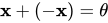 (existence of an opposite element with respect to addition).
 (associativity of multiplication by a scalar);
 (unitarity: multiplying by the neutral (with respect to multiplication) element of the field F preserves the vector).
 (distributivity of multiplication by a vector with respect to addition of scalars);
 (distributivity of multiplication by a scalar with respect to addition of vectors).
Euclidean spaces, affine spaces, as well as many other spaces studied in geometry, are defined on the basis of a vector space. The automorphisms of a vector space over a field form a group under multiplication, isomorphic to the group of nonsingular square matrices, which connects linear algebra with group theory, in particular with the theory of linear representations of groups.
The transition from the n-dimensional vector spaces used in linear algebra to infinite-dimensional linear spaces has found its reflection in some branches of functional analysis . Another natural generalization is the use of an arbitrary ring instead of a field. For a module over an arbitrary ring, the fundamental theorems of linear algebra do not hold. The general properties of vector spaces over a field and modules over a ring are studied in algebraic K-theory .
General algebra deals with the study of various algebraic systems. It considers the properties of operations on objects independently of the actual nature of the objects. It primarily includes the theory of groups and rings. General properties characteristic of both kinds of algebraic systems led to the consideration of new algebraic systems: lattices, categories, universal algebras, models, semigroups and quasigroups. Ordered and topological algebras, partially ordered and topological groups and rings also belong to general algebra.
The exact boundary of general algebra is not defined. It can also be considered to include the theory of fields, finite groups, and finite-dimensional Lie algebras.
A non-empty set  with a binary operation
  defined on it is called a group
  if the following axioms are satisfied:
 ;
; ;
;
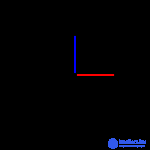
Graph of a free group of order 2
The concept of a group arose from the formal description of symmetry and equivalence of geometric objects. In Galois theory, which gave rise to the concept of a group, groups are used to describe the symmetry of equations whose roots are the roots of some polynomial equation. Groups are used ubiquitously in mathematics and the natural sciences, often to detect the internal symmetry of objects (automorphism groups). Almost all structures of general algebra — are special cases of groups.
A ring — is a set R, on which two binary operations are defined: + and × (called addition and multiplication), with the following properties:
 — commutativity of addition;
 — associativity of addition;
 — existence of a neutral element with respect to addition;
 — existence of an opposite element with respect to addition;
 — associativity of multiplication (some authors do not require this axiom to hold )
 — distributivity.
Universal algebra is a special branch of general algebra that deals with the study of properties characteristic of all algebraic systems. An algebraic system is an arbitrary non-empty set with a given (possibly infinite) collection of finitary operations on it and finitary relations: 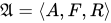 ,
,  ,
,  . The set
  in this case is called the carrier (or underlying set) of the system, and the collection of functional and predicate symbols with their arities
  — its signature. A system with an empty set of relations is called a universal algebra (in the context of the subject — more often simply an algebra), and one with an empty set of operations — a model or a system of relations, a relational system.
In terms of universal algebra, for example, a ring — is a universal algebra  , such that the algebra
  — is an abelian group, and the operation
  is distributive on the left and on the right with respect to
  . A ring is called associative if the multiplicative groupoid is a semigroup.
This branch considers both universal algebras themselves and related structures: the monoid of all endomorphisms  , the group of all automorphisms
  , the lattices of all subalgebras
  and of all congruences
Universal algebra lies at the intersection of logic and algebra.
The origins of algebra go back to the times of deep antiquity. Arithmetic operations on natural numbers and fractions — the simplest algebraic operations — are found in early mathematical texts. As early as 1650 BC, Egyptian scribes could solve abstract first-degree equations and the simplest second-degree equations; these include problems 26 and 33 from the Rhind papyrus and problem 6 from the Moscow papyrus (the so-called «aha» problems). It is assumed that the solution of the problems was based on the rule of false position . The Babylonians also used this same rule, although extremely rarely.
Babylonian mathematicians knew how to solve quadratic equations. They dealt only with positive coefficients and roots of the equation, since they did not know negative numbers. According to various reconstructions, the Babylonians knew either the rule for the square of a sum, or the rule for the product of a sum and a difference, while the method of computing the root fully corresponds to the modern formula. Third-degree equations are also encountered. In addition, a special terminology was introduced in Babylon; Sumerian cuneiform signs were used to denote the first unknown («length»), the second unknown («width»), the third unknown («depth»), as well as various derived quantities («area» as the product of «length» and «width», «volume» as the product of «length», «width» and «depth»), which can be regarded as mathematical symbols, since the Akkadian language was already used in ordinary speech. Despite the clear geometric origin of the problems and terms, they were used abstractly; in particular, «area» and «length» were treated as homogeneous. To solve quadratic equations, it was necessary to be able to carry out various identical algebraic transformations, to operate with unknown quantities. In this way, a whole class of problems was singled out, for the solution of which algebraic methods are necessary.
After the incommensurability of the side and diagonal of a square was discovered, Greek mathematics went through a crisis, and its resolution was aided by the choice of geometry as the foundation of mathematics and the definition of algebraic operations for geometric quantities. Geometric algebra is the subject of the second book of Euclid's «Elements», and of the works of Archimedes and Apollonius. Using segments, rectangles and parallelepipeds, addition and subtraction were defined, as was the product (a rectangle built on two segments). This representation made it possible to prove the distributive law of multiplication with respect to addition, and the identity for the square of a sum. Algebra was originally based on planimetry and was adapted primarily for solving quadratic equations[12]. At the same time, the problems formulated by the Pythagoreans on doubling the cube and trisecting an angle, and constructing regular polygons, reduce to algebraic equations[13]. The solution of cubic equations was further developed in the works of Archimedes (the treatises «On the Sphere and Cylinder» and «On Conoids and Spheroids»), who investigated in general form the equation  . Individual problems were solved with the help of conic sections.
An unexpected transition to algebra based on arithmetic occurred in the works of Diophantus, who introduced letter notation: he called the unknown number «number», the second power of the unknown — «square», the third — «cube», the fourth — «square-square», the fifth — «square-cube», the sixth — «cube-cube». He also introduced notation for negative powers, the free term, a negative number (or subtraction), and the equality sign. Diophantus knew and used the rule of transferring a subtrahend from one part of an equation to another and the rule of cancelling equal terms. In studying equations of the third and fourth degree, Diophantus, in order to find a rational point on a curve, used such methods of geometric algebra as drawing a tangent at a rational point of the curve or drawing a line through two rational points. In the 10th century Diophantus's «Arithmetica», in which he set out his methods, was translated into Arabic, and in the 16th century it reached Western Europe, influencing the works of Fermat and Viète. Diophantus's ideas can also be seen in the works of Euler, Jacobi, Poincaré and other mathematicians right up to the beginning of the 20th century. Nowadays Diophantus's problems are usually classified under algebraic geometry[.
2000 years before our era Chinese scholars solved first-degree equations and their systems, as well as quadratic equations (see Mathematics in Nine Chapters). They already knew negative and irrational numbers. Since in the Chinese language each symbol denotes a concept, there were no abbreviations. In the 13th century the Chinese discovered the law for forming binomial coefficients, now known as «Pascal's triangle». In Europe it was discovered only 250 years later
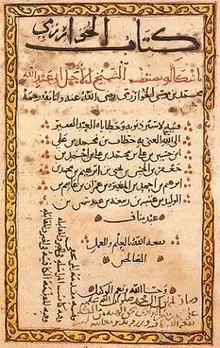
Page from Al-Khwarizmi's Kitab al-jabr wa'l-muqabala
The term «algebra» is taken from the work of the Central Asian scholar Al-Khwarizmi «The Compendious Book on Calculation by Completion and Balancing» (year 825). The word «al-jabr» meant the operation of transferring subtrahends from one part of an equation to another, and its literal meaning is «restoration».
In the 12th century algebra reached Europe. From this time its rapid development begins. Methods were discovered for solving equations of the 3rd and 4th degree. Negative and complex numbers became widespread. It was proved that any equation above the 4th degree cannot be solved algebraically.
Right up until the second half of the 20th century, the practical application of algebra was limited, mainly, to solving algebraic equations and systems of equations with several variables. In the second half of the 20th century the rapid development of a number of new branches of technology began. Electronic computers appeared, along with devices for storing, processing and transmitting information, and radar-type surveillance systems. The design of new types of technology and their use is unthinkable without the application of modern algebra. Thus, electronic computers are built on the principle of finite automata. Methods of Boolean algebra are used to design electronic computers and electronic circuits. Modern programming languages for computers are based on the principles of the theory of algorithms. Set theory is used in computer search and information storage systems. Category theory is used in problems of pattern recognition, defining the semantics of programming languages, and other practical problems. Encoding and decoding of information is carried out using methods of group theory. The theory of recurrent sequences is used in the operation of radars. Economic calculations are impossible without the use of graph theory. Mathematical modeling widely uses all branches of algebra.
In Russia, one of the popularizers of algebra was the first Russian writer of the European type, Prince A. D. Kantemir. He used this term in his first satire (1729) and gave it the following definition: «Algebra is a branch of mathematics that is very difficult, but also highly useful, since it serves in solving the most difficult problems of all mathematics. It can be called general arithmetic, since their parts are for the most part similar to each other, except that arithmetic uses special signs for every number, while algebra uses general ones, which serve every number. This science, they say, came to Europe from the Arabs, who are thought to be its inventors; the very name of algebra is Arabic, which they call Aljabr Walmukabala, that is to make up or to equalize».

Comments