
Lecture
Umbral calculus (from the Latin umbra — «shadow») — is a mathematical method for obtaining certain algebraic identities. Until the 1970s, the term referred to the similarity of certain superficially unrelated algebraic identities, as well as to the techniques used to prove these identities. These techniques were proposed by John Blissard and are sometimes called Blissard's symbolic method. They are often attributed to Édouard Lucas (or James Joseph Sylvester), who used them extensively.
In the 1930s and 1940s, Eric Temple Bell attempted to place umbral calculus on a rigorous foundation.
In the 1970s, Steven Roman, Gian-Carlo Rota, and others developed umbral calculus in the sense of linear functionals on the space of polynomials. Today, umbral calculus refers to the study of Sheffer sequences, including sequences of polynomials of binomial type and Appell sequences, but may also include techniques of the calculus of finite differences.
The method is a notational procedure used for identities obtained by involving indexed sequences of numbers, assuming that the indices are powers. The literal use is absurd, but it works successfully — identities obtained through umbral calculus can be properly obtained through more complex methods that can be used literally without logical difficulties.
An example uses the Bernoulli polynomials. Consider, for example, the ordinary binomial expansion (which contains binomial coefficients):
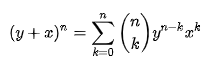
and a remarkably similar-looking relation for the Bernoulli polynomials:
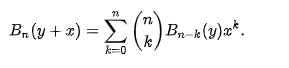
Let us also compare the first derivative
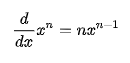
with a very similar relation for the Bernoulli polynomials:
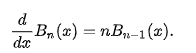
These similarities allow us to construct umbral proofs which, at first glance, cannot be correct, but which nevertheless work. Thus, for example, if we consider the index n−k to be a power:

after differentiation we obtain the desired result:

In the formulas above, b is the «umbra» (the Latin word for «shadow»).
See Faulhaber's formula.
Similar connections have also been observed in the theory of finite differences. The umbral version of the Taylor series is given by similar expressions using the k-th forward differences  of the polynomial f,
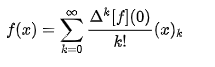
where

— is the Pochhammer symbol, used here to denote the falling factorial. A similar relation holds for backward differences and rising factorials.
These series are also known as Newton series or Newton's forward difference expansion. The analog of the Taylor expansion is used in the calculus of finite differences.
In the 1930s and 1940s, Eric Temple Bell unsuccessfully attempted to make this kind of reasoning logically rigorous. John Riordan, who worked in the field of combinatorics, in his book Combinatorial Identities, published in the 1960s, made extensive use of this technique.
In the 1930s and 1940s, Eric Temple Bell attempted to lay a rigorous foundation for the theory of umbral calculus, but his attempt to make such an argument logically rigorous was unsuccessful.
The combinatorics specialist John Riordan, in his book «Combinatorial Identities», published in the 1960s, made wide use of methods of this kind.
In the 1970s, Gian-Carlo Rota, together with Steven Roman and others, developed umbral calculus by means of linear functionals on spaces of polynomials. Today, umbral calculus refers to the study of Sheffer sequences, including sequences of polynomials of binomial type and Appell sequences, but may also include systematic correspondence methods in the calculus of finite differences.
Another scholar in the field of combinatorics, Gian-Carlo Rota, pointed out that the mystery disappears if we consider the linear functional L over polynomials in z , defined as

Then, using the definition of the Bernoulli polynomials and the definition of the linearity of L , we can write

This allows us to replace the occurrence of Bn(x) with  , that is, to move n from the subscript to the superscript (the key operation of umbral calculus). For example, we can now prove that
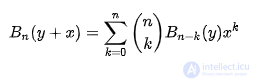
by expanding the right-hand side

Rota later argued that much of the confusion arose from a failure to distinguish between three equivalence relations that arise in this area.
In a 1964 paper, Rota used umbral methods to establish the recursion formula satisfied by the Bell numbers, which count the number of partitions of finite sets.
In the paper by Roman and Rota, umbral calculus is described as the study of the umbral algebra, defined as the algebra of linear functionals over the vector space of polynomials in x with the product L1L2 of linear functionals defined as

If a sequence of polynomials replaces a sequence of numbers as the images  under the linear mapping L , the umbral method appears as an essential ingredient of Rota's general theory of special polynomials, and this theory is umbral calculus under some more modern definitions of the term . A small example of this theory can be found in the article on the sequence of polynomials of binomial type .
Later, Rota applied umbral calculus extensively in a joint paper with Shen to study various combinatorial properties of semi-invariants .
To understand the concepts of umbral calculus, it is necessary to grasp its fundamental principles and axioms.
The umbral method of calculation is based on the following fundamental principles:
The main axioms of umbral calculus include:
Umbral calculus includes various operators that facilitate the manipulation of sequences and series. Key operators include:
These operators satisfy certain properties, including:
| Operator | Property |
|---|---|
| Umbral operator | Linearity, shift invariance |
| Shift operator | Commutativity with the umbral operator |
| Derivative operator | Linearity, Leibniz rule |
To illustrate the capabilities of umbral calculus, let us consider a simple example. Suppose we want to find the sum of the firstnnpositive integers. Using umbral calculus, we can represent the sequence of positive integers as a polynomial, and then apply the umbral operator to obtain the desired sum.
Let an— be a sequence of positive integers, and let A(x) be the corresponding umbral polynomial:
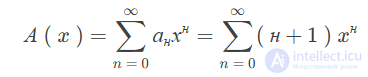
Using the umbral operator, we can derive the sum of the firstnnpositive integers, for example:
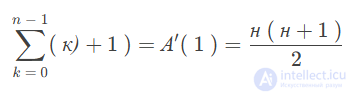
Umbral calculus finds numerous applications in generating functions, which are a fundamental tool in combinatorics and other areas of mathematics.
Generating functions are used to count and order objects in various combinatorial problems. Umbral calculus provides a powerful framework for manipulating generating functions and deriving new identities and relations.
For example, consider the problem of counting the number of ways to arrangenndistinct objects intokkdifferent groups. The generating function for this problem is given as follows:
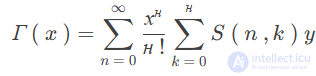
where S ( n ,k )— is the Stirling number of the second kind. Using umbral calculus, we can derive a closed-form expression forG(x) and extract the necessary coefficients.
Umbral calculus finds application in various areas of algebra and analysis, including:
Umbral calculus has found application in solving various real-world problems, including:
For example, consider the problem of counting the number of ways to traverse a lattice. The generating function for this problem can be represented as an umbral-type polynomial, and umbral calculus can be used to derive an analytical expression for the desired number of ways.

Comments