
Lecture
Sociological research is a system of logical and consistent methodological, procedural, and organizational-technical procedures in sociology for obtaining scientific knowledge about social phenomena, as well as about their procedures and processes.
Sociological research constitutes a system of theoretical and empirical procedures.
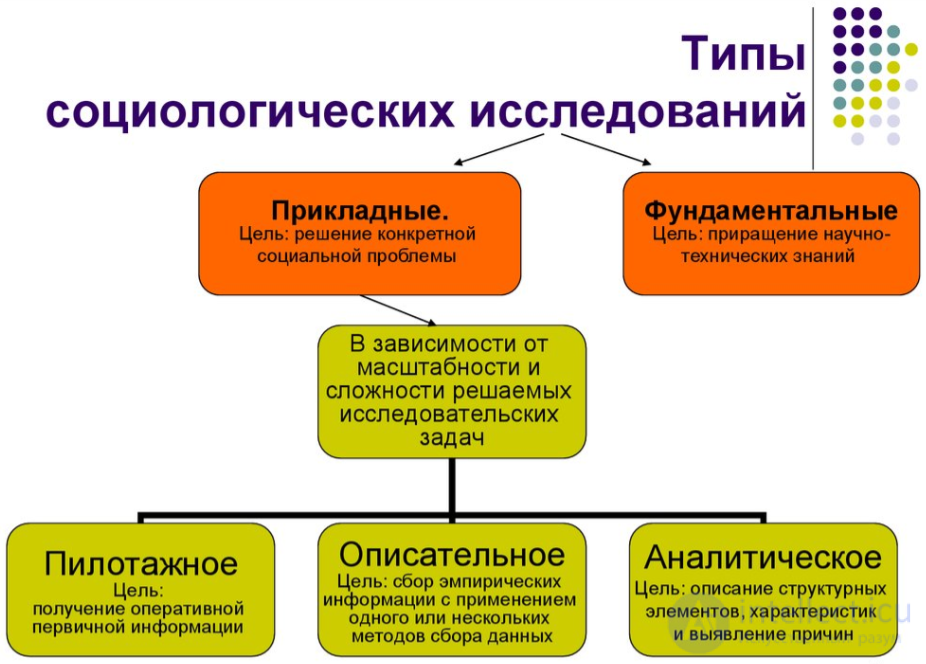
By purpose, sociological research is divided into fundamental and applied research. Fundamental research is aimed at establishing and analyzing social trends and patterns of development and is associated with solving complex problems of society. Applied research is aimed at studying specific objects and solving particular social problems.
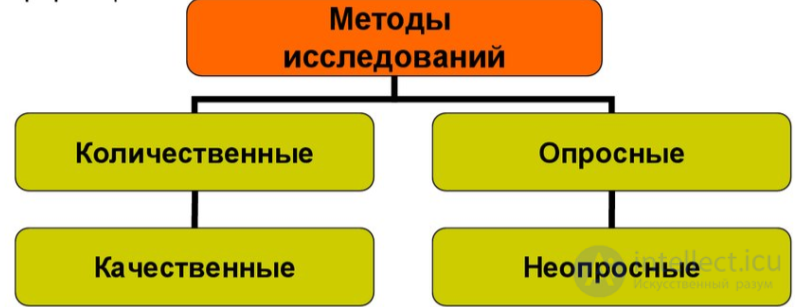
Methodology and methods of sociological research is a field of sociological science that studies ways of methodologically substantiating sociological research, the principles of forming a research program, the content and characteristics of methods for collecting primary sociological information, as well as the specifics of applying methods and computer technologies for the collection and analysis of sociological data.
According to the methods used in sociological research, a distinction is made between the survey method, the information analysis method, the experimental method, sociological observation, and the expert assessment method.
The methodology of sociological research consists of the methods used in conducting sociological research and surveys.
Applied statistics of scientific research on people, that is, research methodology, studies samples of individual units of a population and the related methods of data collection, for example, the construction of questionnaires and increasing the number and accuracy of responses to a survey. The methodology of sociological research includes tools or procedures that pose one or more questions that can be answered or left unanswered.
Statistical studies are conducted to test a certain assumption about a population and depend heavily on the questions posed in the questionnaire. Public opinion polls, health status surveys, marketing research, government activity studies, and censuses are examples of quantitative research that use modern research methods to find answers to questions about a population. Although censuses do not involve sampling, they include other aspects of research methodology: questionnaires, interviews, and subsequent verification. Surveys provide important information to all kinds of public information media and research fields, such as market research, psychology, healthcare professionals, and sociology.

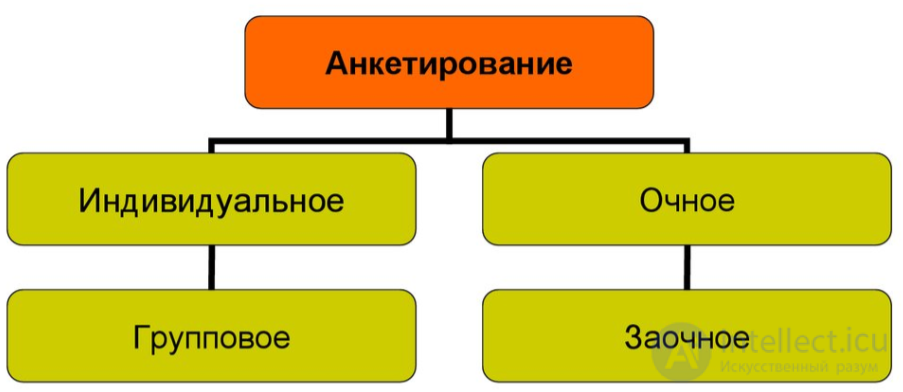
An individual survey consists at minimum of a sample (or the entire population in the case of a census), a data collection method (for example, a questionnaire), and individual questions or items that become data for statistical analysis. An individual survey can focus on different topics depending on its purpose — on voter preferences (for example, regarding presidential candidates), on beliefs (for example, should abortion be legal?), on behavior (smoking and alcohol consumption), or on factual information (family income). Since survey-based research is almost always based on a sample of the population, its success depends on the representativeness of the sample relative to the target population of interest to the researcher. This target population can range from the total population of a given country to specific groups of people within that country, from members of a certain professional organization or students of a particular educational institution (see also sampling (statistics) and survey sampling). People who answer a survey are called respondents, and depending on the questions posed, their answers may represent the respondents themselves, their families, their employers, or other organizations to which they belong.
The methodology of sociological research, as a scientific discipline, aims to determine the principles for developing samples, tools for collecting data, statistical adjustment of data and its processing, as well as the final analysis of data, which can create systematic and random survey errors. Survey errors are sometimes analyzed together with the value of the survey. Cost limitations are sometimes presented as a quality improvement or as an alternative that allows costs to be reduced at a fixed level of quality. Research methodology functions simultaneously as a scientific field and as a profession, which means that some specialists in this field focus on eliminating survey errors empirically, while others design surveys in order to reduce their number. Survey designers face the task of making a large set of decisions about a thousand individual features of surveys with the aim of improving them.
The most important methodological problems faced by the methodologist include making decisions about:
A sample has a certain structure and is drawn from a list of members of the entire population group that is of particular interest to the researcher. The purpose of a survey is to describe not this particular sample, but the larger population. This ability to generalize depends on the representativeness of the sample, as noted above. Each member of the population is called an element. There are many difficulties encountered in creating a representative sample. One common error is selection bias. Selection bias is observed when, as a result, the number of members of a certain group proportionally exceeds its actual share of the population. For example, if a certain group of interest to the researcher consists of 75% women and 25% men, while the sample consists of 40% women and 60% men. In this case, women are underrepresented, while the proportion of men is too high. To minimize selection bias, stratified sampling is usually used. This is when the population is divided into subgroups, so-called strata, and random samples are taken from each stratum, or sample elements are taken on a proportional basis.
There are several ways to conduct a survey. The choice of survey method depends on several factors, including:
Different methods make different impressions on respondents, changing the manner of their responses, and have different advantages. The most common ways of conducting surveys are:
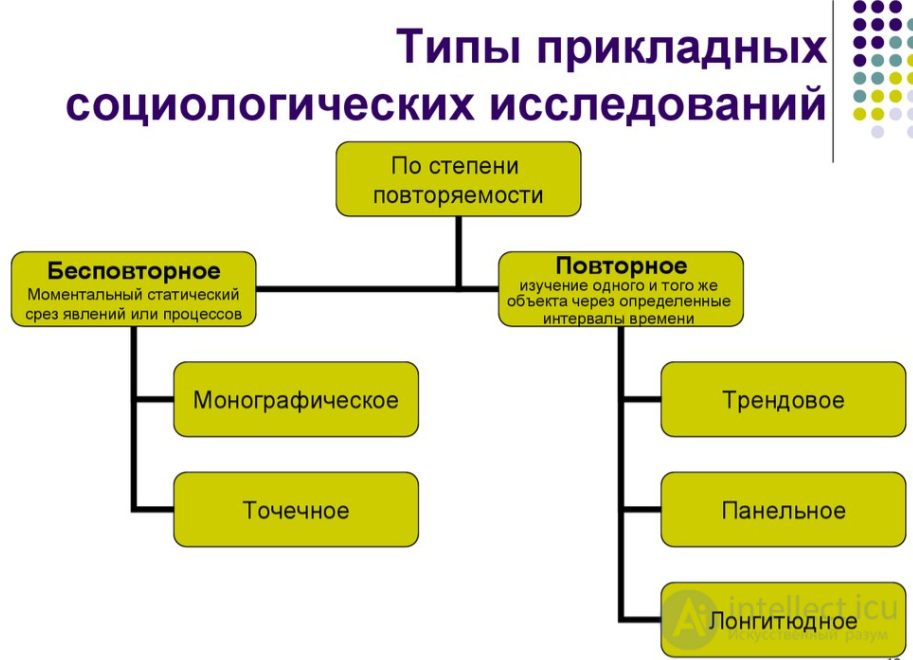
There are several types of design, or general structures, that can be used in a survey. The three main types are: cross-sectional surveys, repeated independent samples, and longitudinal studies.
In cross-sectional studies, samples are drawn from the relevant population group and studied once. Such studies characterize this group of people at a particular time but cannot explain its cause, since they belong to the correlational type, which can only suggest hypotheses about the future.
The repeated independent-sample type of study works with several random samples at a given time or on several occasions. Studies of this type examine changes within a group, but are unable to record changes in individuals, since the same person is not surveyed more than once. Thus, such studies cannot necessarily determine the causes of changes over time. To be effective, such studies must have samples from the same group and reflect a particular phenomenon to an equal degree. If the samples are not comparable, differences between the samples may be explained more by demographic characteristics than by temporal ones. In addition, the questions must be posed in the same way so that the answers can be compared directly.
Longitudinal studies examine the same random sample at different points in time. Unlike repeated independent-sample studies, this type of research focuses on differences in the responses of individual participants over a long period of time. This means that the researcher can potentially analyze the causes of changes in responses by evaluating differences in respondents' experience. Longitudinal studies are the simplest way to assess habitual events, such as divorce, which cannot be tested experimentally. However, longitudinal studies are expensive and difficult to carry out. It is harder to find an individual who would agree to participate in research over several months or years than to find a respondent for a 15-minute interview. In addition, participants often leave the study before the final assessment. This attrition of participants is not random, so the samples may become less representative with each subsequent survey. To account for this factor, the researcher can compare respondents who left the study with those who completed it, in order to determine whether they are statistically different groups. Respondents may also try not to contradict themselves despite changes in their survey responses.
Questionnaires are the most common tool used in surveys. However, the results of a particular survey will be worthless if the questionnaire is designed incorrectly. Questionnaires must provide valid and reliable demographic data, as well as valid and reliable information about the individual's self-identified characteristics.
A changeable category often examined in surveys is demographic variables, which are used to describe people's characteristics. Demographic variables include such aspects as ethnicity, socioeconomic status, race, and age. Surveys often examine the preferences, beliefs, and positions of individuals, and many of them contain a scale by which the respondent independently determines the degree of their interest/awareness/active stance on the question posed. Self-report scales are also used to study differences between people's opinions. This self-report scale, often included in questionnaires, is one of the most widespread instruments in psychology, and it is therefore important that it be carefully constructed, reliable, and valid.
Reliable self-report instruments are defined by their consistency and coherence. Thus, a reliable self-report instrument produces meaningful results each time it is applied. Test reliability can be determined in several ways. First, test-retest reliability can be calculated. Test-retest reliability involves surveying people from a broad sample again at two different points in time. For a survey to be considered reliable, people in the sample do not necessarily need to give the same rating on a given matter each time. It is enough that the relationship in the distribution of their scores is similar in the initial and the repeat testing. Self-report and self-assessment will generally be more reliable if they include more items for evaluating a particular concept. In addition, the rating will be more reliable if people's opinions regarding a particular concept diverge more widely. Finally, greater reliability would be ensured by clear instructions for filling out the questionnaire and a minimum of distracting factors. On the other hand, a questionnaire is valid if what it actually measures matches what it was designed to measure.
To design a questionnaire that will provide reliable and valid results, we use the following six steps. First, we determine exactly what information needs to be found. Second, we decide how the survey will be conducted. Third, we build the first draft version of the questionnaire. Fourth, the questionnaire must be revised, and then tested. Finally, the questionnaire is edited, and instructions for filling it out are drawn up.
The way a question is worded can have a major effect on a respondent's answer. Therefore, survey designers must pay special attention to the wording of survey questions. Designers should keep in mind that different people, cultures, and subcultures may interpret certain words and phrases differently. There are two types of questions used in questionnaires: open-ended questions and closed-ended questions. Open-ended questions do not provide answer options, unlike closed-ended ones, which typically offer multiple choices. Open-ended questions are useful because they give the respondent great flexibility, providing space for full expression of their thoughts. However, they are harder for researchers to interpret, systematize, and evaluate. Closed-ended questions, on the other hand, can be scored and coded much more easily, although they reduce the respondent's expressiveness and spontaneity. In general, the vocabulary of a question should be as simple and direct as possible, consisting of no more than twenty words. Each question should be edited for "readability." Nothing should lead the respondent toward a particular idea different from their initial one. Nothing should be provocative, meaning it should not contain a predetermined answer. Finally, if several statements are used to assess a particular concept, their wording should be reversed to avoid selective bias.
A respondent's answer to an open-ended question can be rated on a scale or analyzed later using more qualitative methods.
Survey designers must carefully observe the order of questions in a questionnaire. For self-administered questionnaires, the most interesting questions should be placed at the beginning of the questionnaire to capture the respondent's attention, while demographic questions should be placed closer to the end. On the other hand, if the survey is conducted by phone or in person, demographic questions should be placed at the beginning of the interview to increase the respondent's trust. Another reason to pay attention to question order is the effect that the answer to one question can have on all subsequent ones.
The following methods effectively reduce respondents' avoidance of answers during in-person or telephone surveys
Brevity is also encouraged. A 1996 literature review confirms this fact for both written and oral surveys, although other factors may also be decisive. A 2010 study, having analyzed 100,000 online surveys, concluded that the response rate drops by about 3% at the tenth question and about 6% at the twentieth, with the decline in response rate subsequently stabilizing (for example, only a 10% decrease was observed at the fortieth question). Other studies have shown that the quality of answers declines as long surveys approach their end.
Survey methodologists have made much effort to determine the extent to which a respondent's answers depend on the interviewer's physical characteristics. It turned out that the main interviewer traits affecting respondents' answers are race, sex, and relative body weight (BMI). These traits are especially influential when the questions are directly related to them. Thus, the interviewer's race affects answers regarding people of another race, their sex affects answers related to gender issues, and their weight affects answers about nutrition and diets. Although the influence of interviewer characteristics has mainly been studied in face-to-face surveys, it turned out that they also have an effect in conditions lacking visual contact, such as during telephone surveys or video calls. This is generally explained by social desirability: the respondent would like to appear better in the eyes of society, so they adjust their answers somewhat depending on the situation. The influence of interviewer characteristics is one example of the effects that influence responses to a survey.

Research directions:

Comments