
Lecture
Frame (from the English "frame") is a concept used in the social sciences and humanities (such as sociology, psychology, communication studies, cybernetics, linguistics, and others), denoting in general terms a semantic frame used by a person to understand something and to act within the scope of that understanding — a wholeness within which people make sense of themselves in the world. In other words, a frame is a stable structure, a cognitive formation (knowledge and expectations), as well as a representational scheme. A frame is a metacommunicative definition of a situation based on principles of organization and involvement in events that govern those events.
According to the cybernetic-linguistic definition, which traces back to cognitively oriented semantics, as well as to cognitive psychology and M. Minsky's research on artificial intelligence, a frame is a cognitive structure regarded as a constructed system of knowledge about the referent, which is "the most generalized schematized representation of the basis of meaning, … the image schema underlying it."
The cognitive understanding of the frame within the framework of his own frame-based cognitive semantics, built on M. Minsky's theory of frames, is developed by C. Fillmore, for whom a frame is "a cognitive structure for schematizing experience."
According to the psychological (G. Bateson) and, later, sociological (E. Goffman) understanding, a frame can be understood as a "structural context of everyday interaction."
According to E. Goffman, a frame is a wholeness constituted by agents — primarily of practices, but also of meanings that people, in typical, recurring social situations, in a social context, attach to their own actions and the actions of others (both verbal and nonverbal). Goffman's frame is "the ability of practical consciousness to 'gather' the world into an organized whole without the involvement of discursive control"; it is a kind of procedural knowledge — "know-how," or a sequence of actions describing some creative aspect of an object or its functional aspect. Goffman's analyst Manning emphasizes that a frame is "the taking apart of existing wholes (social, cultural) and then the assembling of structures as a set of interacting elements." In addition, according to Goffman, a frame is "a particular perspective of perception that creates a formal definition of the situation."
While human actions are traditionally viewed as depending on the situation in which they take place and on the personal characteristics and qualities (dispositions) of the person performing them, the concept of frame introduces another — semantic — perspective for considering them, acting as a semantic frame (or frame of social representations) within whose boundaries a person defines for themselves the situation in which they act.
In the humanities, this semantic dimension is also captured in other concepts — for example, in the psychological study of the family and in psychological research on twins (see, in particular, the work of R. Plomin, D. Daniels, K. Asbury, and others), the concept of the individual (perceived) environment is introduced (as opposed to the shared environment in which siblings are socialized), capturing the fact that differences in siblings' socialization are related to how they themselves perceive the environment in which they develop.
When we want to explain an event, our understanding is often based on our interpretation (frame). If someone quickly closes and opens an eye, we react differently depending on whether we interpret it as a "physical frame" (they blinked) or as a "social frame" (they winked). Blinking may be caused by a speck of dust (leading to an involuntary and not particularly meaningful reaction). Winking may imply a deliberate and meaningful action (for example, to share a joke with an accomplice).
Observers will read events regarded as purely physical or within the frame of "nature" differently than those regarded as occurring within social frames. But we do not look at an event and then "apply" a frame to it. Rather, people constantly project interpretive frames onto the world around them, which allow them to make sense of it; we only switch frames (or realize that we are habitually applying a frame) when an inconsistency requires a change of frame. In other words, we only become aware of the frames we are already always using when something forces us to replace one frame with another.
Although some believe that framing is synonymous with agenda-setting, other scholars argue that there is a distinction between them. According to an article written by Donald H. Weaver, framing selects certain aspects of an issue and makes them more salient in order to evoke particular interpretations and evaluations of the issue, whereas agenda-setting introduces the topic of an issue in order to increase its salience and accessibility.
In communication, framing determines how news media coverage shapes public opinion. Richard E. Vatz's reasoning about the creation of rhetorical meaning is directly related to framing, although he rarely refers to it. Specifically, framing effects refer to behavioral or attitudinal strategies and/or outcomes that are conditioned by how a given piece of information is framed in public discourse. Today, many volumes of major communication journals contain articles on media frames and framing effects. The approaches used in such works can generally be divided into two groups: studies of framing as a dependent variable, and studies of framing as an independent variable. The former usually deal with frame-building (that is, how frames shape public discourse about an issue and how various frames are adopted by journalists), while the latter concern frame-setting (that is, how media framing influences the audience).
Research in the area of frame-building typically identifies at least three main groups of factors that can influence how journalists present a particular issue:
Erving Goffman emphasized the role of cultural context as a shaper of frames, arguing that the meaning of a frame has implicit cultural roots. This dependence of media frames on context has been described as "cultural resonance" or "narrative fidelity." For example, most people may not notice the frame in stories about the separation of church and state, because the media generally do not frame their stories from a religious point of view. [Frame-creation is a process that influences the creation or modification of frames applied by journalists. The term "frame-creation," borrowed from agenda-setting research, seems to best describe these processes.
When people encounter a new news frame, they will adopt constructs applicable to the issue, but they are much more likely to do so when they already have existing thinking for these settings. This is called the applicability effect. That is, when new frames prompt people to apply their existing schema to an issue, the consequences of this application depend, in particular, on what is contained within that schema. Therefore, as a rule, the more an audience knows about the issues, the more effective the frames are. For example, the more an audience knows about the tobacco industry's deceptive practices, the more effective a frame blaming the tobacco industry — rather than smokers — for the health consequences of smoking will be.
There are a number of levels and types of framing effects that have been studied. For example, scholars have focused on changes in attitudes and behavior, degrees of perceived issue importance, voting decisions, and opinion formation. Others are interested in psychological processes other than applicability. For example, Iyengar [15] suggested that news about social problems can influence the attribution of causal and treatment responsibility, an effect observed both in cognitive reactions and in evaluations of political leaders, while other scholars have studied the effects of framing on recipients' evaluative processing style and the complexity of audience members' thoughts about issues. Frame-setting research also examines how frames can influence how someone thinks about an issue (cognitively) or feels about an issue (affectively).
News media frame all news reports by emphasizing certain values, facts, and other considerations, and endowing them with greater apparent applicability for making relevant judgments. News media promote particular definitions, interpretations, evaluations, and recommendations.
Anthropologist Gregory Bateson was the first to define the concept of framing as "the spatial and temporal bounding of a set of interactive messages" ("A Theory of Play and Fantasy," 1954, reproduced in his 1972 book «Steps to an Ecology of Mind»).
Media framing research has both sociological and psychological roots. Sociological framing focuses on «the words, images, phrases, and presentation styles» that communicators use when conveying information to recipients. Frame studies in sociologically motivated media research typically examine the influence of «social norms and values, organizational pressures and constraints, pressures from interest groups, journalistic routines, and the ideological or political orientations of journalists» on the existence of frames in media content.
Todd Gitlin, in his analysis of how the news media trivialized the student "New Left" movement in the 1960s, was one of the first to examine media frames from a sociological perspective. Frames, Gitlin wrote, are «persistent patterns of cognition, interpretation, and presentation, of selection, emphasis, and exclusion... [which] are largely unspoken and unacknowledged... [and] organize the world both for journalists who report it and, in some important degree, for us who rely on their reports».
Frame studies in psychologically driven media research typically examine the influence of media frames on those who receive them. For example, Iyengar investigated the influence of episodic and thematic news frames on viewers' attribution of responsibility for political issues, including crime, terrorism, poverty, unemployment, and racial inequality. According to Iyengar, the episodic news frame «takes the form of a case study or event-oriented report and depicts public issues in terms of concrete instances», in other words, focusing on a particular place at a particular time. The thematic news frame «places public issues in some more general, abstract context... aimed at general outcomes or conditions», for example, examining a commonality that occurs in multiple places and at different times. Iyengar found that most television news coverage, of poverty, for example, was episodic. In fact, in a six-year content analysis of television news, Iyengar found that a typical news viewer was twice as likely to encounter episodic rather than thematic television news about poverty.
Moreover, experimental results show that participants who watched episodic news reports about poverty were more than twice as likely as those who watched thematic news reports about poverty to attribute responsibility for poverty to the poor themselves rather than to society. Given the prevalence of episodic framing of poverty, Iyengar argues that television news shifts responsibility for poverty from government and society onto the poor themselves. For example, news media may use a «laziness and dysfunction» frame, which implies that the poor would rather stay home than go to work. After examining content analysis and experimental data on poverty and other political issues, Iyengar concludes that episodic news frames divert citizens from attributing political responsibility to society and political elites, making them less likely to support government efforts to address these problems and obscuring the connections between these problems and the actions or inactions of their elected officials.
Visual framing refers to the process of using images to depict certain parts of reality. Visual elements can be used to convey meaning alongside textual framing. Text and visual elements work best together. The development of print and screen technologies has led to the merging of the two modes of information dissemination. Since each mode has its own limitations, they are best used together and are interconnected in shaping meaning.
Images are more preferable than text because they are less intrusive than words and require less cognitive load. From a psychological standpoint, images activate nerve cells in the eyes to send information to the brain. Images can also evoke a stronger emotional appeal and have high attractiveness. In the context of framing, images can conceal issues and facts in an attempt to frame information. Visuals consist of rhetorical tools such as metaphors, images, and symbols to graphically depict the context of an event or scene in an attempt to help us better understand the world around us. Images can have a one-to-one correspondence between what is captured on camera and its representation in the real world.
Along with enhancing understanding, visuals can also improve retention rates, making it easier to remember and reproduce information. Because of the comparative nature of images, the rules of grammar do not apply. According to researchers, framing is reflected in a four-level model that defines and analyzes visual frames as follows: visuals as denotative systems, visuals as stylistic-semiotic systems, visuals as connotative systems, and visuals as ideological representations. Researchers caution against relying solely on images to understand information. Because they carry more power than text and correlate more closely with reality, we may overlook potential manipulation and staging and mistake it for evidence.
Images can be representative of ideologies, establishing basic principles that make up our core attributes, by combining symbols and stylistic features of an image into a coherent process of interpretation. One study shows that visual framing plays an important role in news coverage, especially with regard to politics. Emotionally charged images are seen as an important tool for framing political messages. Visual framing can be effective when it emphasizes a particular aspect of an issue, a tactic commonly used in depicting news about war and conflict, known as empathy framing. Visual framing that carries emotional appeal can be considered more salient. This type of framing can be applied in other contexts, including athletics with regard to disability in sports. Visual framing in this context can reshape perspectives on athletic and physical incompetence, a previously entrenched media stereotype.
Perhaps due to their use across the social sciences, frames have been defined and used in many disparate ways. Entman called framing a «scattered conceptualization» and a «fractured paradigm», which «is often defined casually, leaving much to the reader's assumed tacit understanding». In an attempt to provide greater conceptual clarity, Entman suggested that frames «select some aspects of a perceived reality and make them more salient in a communicating text in such a way as to promote a particular problem definition, causal interpretation, moral evaluation, and/or treatment recommendation for the item described».] Entman's conceptualization of framing, which suggests that frames work by elevating certain pieces of information in salience, is consistent with much early research into the psychological foundations of framing effects (see also Iyengar, who argues that accessibility is the primary psychological explanation for the existence of framing effects). Wyer and Srull explain the accessibility construct as follows:
The argument in support of accessibility as the psychological process underlying framing can thus be summarized as follows: because people rely heavily on news media for information about public affairs, the most accessible information about public affairs often comes from the public affairs news they consume. This argument has also been cited in support of debates over whether framing should be included in agenda-setting theory as part of second-level agenda setting. McCombs and other agenda-setting researchers generally agree that framing should be included alongside priming under the umbrella of agenda setting as a complex model of media effects that links media production, content, and audience effects. Indeed, McCombs, Llamas, Lopez-Escobar, and Rey justified their attempt to merge framing and agenda-setting research on the assumption of parsimony
However, Scheufele argues that, unlike agenda setting and priming, framing does not rely primarily on accessibility, which makes it impractical to merge framing with agenda setting and priming for the sake of parsimony. Empirical evidence appears to support Scheufele's claim. For example, Nelson, Clawson, and Oxley empirically demonstrated that applicability, rather than salience, is the key factor. Measuring accessibility in terms of respondents' response latency, where more accessible information leads to faster response times, Nelson, Clawson, and Oxley demonstrated that accessibility explains only a negligible portion of the variance in framing effects, while applicability explains the bulk of the variance. [Thus, according to Nelson and colleagues, «frames affect opinions by emphasizing certain values, facts, and other considerations, endowing them with greater apparent relevance to the issue than they might appear to have under an alternative frame».
In other words, while early research suggested that by emphasizing certain aspects of issues, frames make certain considerations more accessible and therefore more likely to be used in the decision-making process, more recent research suggests that frames work by making certain considerations more applicable and therefore more relevant to the decision-making process.
Chong and Druckman suggest that frame research has largely focused on two types of frames: equivalence frames and emphasis frames. Equivalence frames offer «different but logically equivalent phrasings» that lead people to change their preferences. Equivalence frames are often formulated in terms of «gains» and «losses». For example, Kahneman and Tversky asked participants to choose between two «gain-framed» policy responses to a hypothetical disease outbreak expected to kill 600 people. Response A would save 200 people, while Response B has a one-third probability of saving everyone, but a two-thirds probability of saving no one. Participants overwhelmingly chose Response A, which they considered the less risky option. Kahneman and Tversky asked other participants to choose between two equivalent «loss-framed» policy responses to the same outbreak. In this condition, Response A would kill 400 people, while Response B had a one-third probability of killing no one, but a two-thirds probability of killing everyone. Although these options are mathematically identical to those given in the «gain-framed» condition, participants overwhelmingly chose Response B, the risky option. Kahneman and Tversky thus demonstrated that when framed in terms of potential gain, people tend to choose what they consider the less risky option (i.e., a guaranteed gain). Conversely, when faced with a potential loss, people tend to choose the riskier option.
Unlike equivalence frames, emphasis frames offer «qualitatively different but potentially relevant considerations» that people use to make judgments. Emphasis framing differs from agenda setting. Emphasis framing represents changes in the structure of communication to evoke a particular cognitive schema. Agenda setting relies on the frequency or salience of a message's issues to tell people what to think about. Emphasis framing relates to the influence of message structure, while agenda setting relates to the influence of content salience. For example, Nelson, Clawson, and Oxley showed participants a news story in which the Ku Klux Klan planned to hold a rally. Participants in one condition read a news story in which the issue was framed in terms of public safety concerns, while participants in another condition read a news story in which the issue was framed in terms of free speech considerations. Participants exposed to the public safety condition considered public safety applicable to deciding whether the Klan should be allowed to hold a rally and, as expected, expressed less tolerance for the Klan's right to hold a rally. Participants exposed to the free speech condition considered free speech applicable to deciding whether the Klan should be allowed to hold a rally and, as expected, expressed greater tolerance for the Klan's right to hold a rally.
Preference reversal and other related phenomena have broader significance in behavioral economics because they contradict the predictions of rational choice, the foundation of traditional economics. Framing biases affecting decisions about investing, lending, and borrowing constitute one of the topics of behavioral finance.
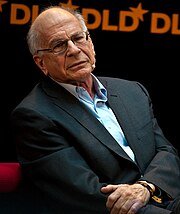
Daniel Kahneman
Amos Tversky and Daniel Kahneman showed that framing can influence the outcome of choice problems (i.e., the choice a person makes), to the extent that some classical axioms of rational choice do not hold. This led to the development of prospect theory. The context or framing of problems adopted by decision-makers is partly the result of external manipulation of the options offered, as well as of forces intrinsic to the decision-makers, such as their norms, habits, and unique temperament.
Tversky and Kahneman (1981) demonstrated systematicity when the same problem is presented in different ways, for example, in the Asian disease problem. Participants were asked to «imagine that the U.S. is preparing for the outbreak of an unusual Asian disease, which is expected to kill 600 people. Two alternative programs to combat the disease have been proposed. Assume that the exact scientific estimate of the consequences of the programs is as follows».
The first group of participants was given a choice between programs: out of a group of 600 people,
72 percent of participants preferred program A (the remaining 28% chose program B).
A second group of participants was given a choice between the following options: in a group of 600 people
In this decision-making context, 78% preferred program D, while the remaining 22% chose program C.
Programs A and C are identical, as are programs B and D. The change in the decision-making framework between the two groups of participants led to a shift in preferences: when the programs were presented in terms of lives saved, participants preferred the safe program A (= C). When the programs were presented in terms of expected deaths, participants chose the gamble D (= B).
Framing effects arise because a decision can often be formulated using several scenarios in which the benefits can be expressed either as relative risk reduction (RRR) or as absolute risk reduction (ARR). External control over the cognitive differences (between risk tolerance and reward expectation) adopted by decision-makers can occur through changes in the presentation of relative risks and absolute benefits.
People generally prefer the absolute certainty inherent in the positive framing effect, which offers a guarantee of benefit. When decision options appear framed as a probable gain, risk-averse choices predominate. A shift toward risky behavior occurs when the decision-maker formulates decisions in negative terms or adopts the negative framing effect. In medical decision-making, framing bias is best avoided by using absolute measures of effectiveness.
Researchers found that framing decision problems in a positive light generally leads to less risky choices, while negative framing tends to produce riskier choices. In a study conducted by researchers at Dartmouth Medical School, 57% of subjects chose the medication when its benefits were presented in relative terms, whereas only 14.7% chose the medication whose benefits were expressed in absolute terms. Further surveys of patients showed that, because subjects ignored the underlying risk of the disease, they perceived the benefits as greater when they were expressed in relative terms.
Researchers have proposed various models to explain the framing effect:
Cognitive neuroscientists have linked the framing effect to neural activity in the amygdala and have identified another brain region, the orbital and medial prefrontal cortex (OMPFC), which appears to moderate the role of emotions in decision-making. Using functional magnetic resonance imaging (fMRI) to monitor brain activity during financial decision-making, they observed greater activity in the OMPFC among those subjects who were less susceptible to the framing effect.
Framing theory and frame analysis provide a broad theoretical approach that analysts have used in studies of communication, news (Johnson-Cartee, 1995), politics, and social movements (among other applications). According to Bert Klandermans, «the social construction of collective action frames» involves «public discourse, that is, the interface of media discourse and interpersonal interaction; persuasive communication during mobilization campaigns by movement organizations, their opponents, and countermovement organizations; and consciousness raising during episodes of collective action».
Word choice was a component of rhetoric. Most commentators attribute the concept of framing to Erving Goffman's work on frame analysis and point to his 1974 book «Frame Analysis: An Essay on the Organization of Experience». Goffman used the idea of frames to refer to «schemata of interpretation» that allow individuals or groups «to locate, perceive, identify, and label» events and occurrences, thereby conveying meaning, organizing experience, and guiding action. Goffman's concept of framing developed from his 1959 work «The Presentation of Self in Everyday Life», a commentary on impression management. These works may, in turn, draw on Kenneth Boulding's concept of the image.
Sociologists have used framing to explain the process of social movements. Movements act as carriers of beliefs and ideologies (compare memes). In addition, they act as part of the meaning-construction process for participants and opponents (Snow and Benford, 1988). Sociologists consider the mobilization of mass movements «successful» when the projected frames align with the frames of the participants, so as to produce resonance between the two sides. Framing researchers refer to this process as frame alignment.
Snow and Benford (1988) view frame alignment as an important element of social mobilization or movement. They argue that when individual frames are linked in agreement and complementarity, «frame alignment» occurs, producing «frame resonance», a catalyst in the process of transitioning from one frame to another (although not all framing efforts prove successful). Conditions that affect or constrain framing efforts include the following:
Snow and Benford (1988) suggest that once the correct frames have been constructed as described above, large-scale changes in society, such as those needed for a social movement, can be achieved through frame alignment.
Frame alignment takes place in four forms: frame bridging, frame amplification, frame extension, and frame transformation.
When this happens, securing participants and support requires new values, new meanings, and new understandings. Goffman (1974, p. 43–44) calls this «keying», whereby «activities, events, and biographies that already have meaning in terms of one primary framework are transposed in terms of another framework» (Snow et al., 1986, p. 474), such that they are perceived differently. There are two types of frame transformation:
Although the idea of linguistic framing had previously been explored by Kenneth Burke (terministic screens), political communication scholar Jim A. Kuypers first published work advancing framing analysis as a rhetorical perspective in 1997. His approach begins inductively by searching for themes that persist over time in a text (for Kuypers, primarily in news narratives about an issue or event), and then determining how these themes are framed. Kuypers's work begins with the assumption that frames are powerful rhetorical entities that «prompt us to filter our perception of the world in a particular way, essentially making some aspects of our multidimensional reality more salient than other aspects. They function by making certain information more salient than other information».
In his 2009 essay «Framing Analysis» in the book «Rhetorical Criticism: Perspectives in Action» and in his 2010 essay «Framing Analysis as a Rhetorical Process», Kuypers offers a detailed conception of conducting framing analysis from a rhetorical standpoint. According to Kuypers, «framing is the process whereby communicators, consciously or unconsciously, act to construct a point of view that encourages others to interpret the facts of a given situation in a particular way. Frames operate in four essential ways: they define problems, diagnose causes, make moral judgments, and suggest remedies. Frames are often found within a narrative account of an issue or event and are generally the central organizing idea». Kuypers's work rests on the premise that framing is a rhetorical process and, as such, is best viewed from a rhetorical perspective. Resolving this issue is not a matter of rhetoric and is best left to the observer.
Climate activism is continuously shaped and reshaped through dialogue at the local, national, and international levels concerning climate change, as well as through the evolution of societal norms and values. Beginning with the transcendentalist movement of the 19th century, in which Henry David Thoreau wrote his novel «Walden», detailing his experience communing with the natural environment, and complemented by the works of other transcendentalists such as Ralph Waldo Emerson, climate activism has taken many forms. John Muir, also from the late 19th century, advocated for the preservation of the Earth for its own sake, founding the Sierra Club. Aldo Leopold's 1949 essay collection «A Sand County Almanac» established a «land ethic» and laid the foundation for modern environmental ethics, calling for the conservation and protection of nature and wildlife. Rachel Carson's book «Silent Spring», published in 1962, exposed the harm pesticides cause to the environment and human health, and successfully advocated for the discontinuation of DDT use.
The concept of global climate change, and correspondingly the space of climate-related activism, emerged in the 1970s. The first Earth Day took place on April 22, 1970. In the following decades, Greenpeace, Earth First!, the United Nations Environment Programme (UNEP), and the United Nations Framework Convention on Climate Change (UNFCCC) were established. Landmark climate documents of the past 30 years include the Rio de Janeiro Declaration, the Kyoto Protocol, the Paris Climate Agreement, the Global Youth Climate Action Declaration, and others.
More recently, the People's Climate March and the Global Climate Strike have grown into events attended annually by millions of activists and citizens around the world. Climate activism has been energized by an uprising of young people at the forefront of the dialogue and advocacy. Greta Thunberg, a young Swedish woman, founded the Fridays for Future initiative, which now has active branches in dozens of countries around the world. Other active youth climate groups include Extinction Rebellion, the Sunrise Movement, SustainUS, the Global Youth Climate Action Declaration (GYCAD), ZeroHour, and others, working at both the transnational and local levels.
Individual motivation to address the problem of climate change is the foundation on which collective action is built. Decision-making processes are shaped by a range of factors, including values, beliefs, and normative behavior. In the United States, people are most effectively motivated to support climate change policy when a public health frame is used. This frame reduces the sense of ambiguity and disconnection often triggered by talk of melting ice sheets and carbon emissions, by placing climate issues in a local context for the individual, whether in their country, state, or city.
Climate change, as an issue that has not yet become established as a normative belief, often becomes a subject of dissent in the face of activism and advocacy. Activists engaged in interpersonal, grassroots advocacy aimed at fostering more pro-environmental behavior within their social groups — even those engaged in polite confrontation — face backlash and social consequences in the face of opposition. Moreover, climate change can be defined as a moral issue because of its anthropogenic impact on the planet and on other human life; however, there are psychological barriers to accepting climate change and to the subsequent motivation to act in response to the need for intervention. An article in the journal Nature Climate Change by Ezra Markowitz and Azim Shariff highlights six psychological challenges, listed below, that climate change poses to the human moral judgment system:
Climate activism manifests through a range of expressions. One aspect of climate change framing that is commonly observed is the doom messaging frame, which is criticized as alarmist and pessimistic, leading to the disregard of evidence-based messages.
Just-world theory supports the idea that some people must rely on their assumptions of a just world to justify their beliefs. «Research on just-world theory has demonstrated that when people's need to believe in a just world is threatened, they typically resort to defensive reactions, such as ignoring or rationalizing information that threatens their just-world beliefs». In the case of climate change, the notion of doom messaging is crucial to understanding what motivates activism. For example, fear of climate change, «attributed to an inability to prevent it oneself, can lead to disengagement, while attributing responsibility to someone else can lead to anger».
A 2017 study found that surveyed activists from the Global North accept fear as a motivator but «emphasize hope, reject blame, and treat anger with caution». Respondents from the Global South indicated that they «instead are more acutely afraid, less hopeful, and angrier, attributing blame – responsibility – to Northern countries. These differences may point to a relatively depoliticized approach to climate change among activists in the North, in contrast to a more politicized approach in the South».
Another 2017 study shows that fear motivates action by raising awareness of the threat of climate catastrophe. The paralyzing potential of fear is mediated by hope: hope prompts action, while collective action generates hope while also managing fear. Fear's ability to warn of danger is accepted «internally», but rejected as an effective emotion for motivating people to mobilize. Studies have shown that conveying doom messages reduces the effectiveness of advocacy initiatives by demotivating people, lowering concern levels, and reducing engagement.
Research argues that prognostic framing, which offers tangible solutions, strategies, goals, and tactics, combined with motivational framing, is most effective for prompting people to act. Especially with regard to climate change, the power of positive psychology becomes evident when applied by activists and other change agents.
The four core principles of motivation, as explained by positive psychology, are agency, compassion, resilience, and purpose. Applied to climate action, the 4th edition textbook «Psychology for Sustainability» further expands on these principles as they relate to resilience and serve as catalysts for action:
Hope strengthens the sense of purpose and activity while also increasing resilience. For climate activists, it is impossible to separate hope from fear. However, when deconstructing hope that others will take the necessary action, hope is generated through belief in one's own capabilities, indicating that «trust in «one's own» collective action appears to be the essence of the hope that activists speak of». In addition, creating a link between climate action and positive emotions such as gratitude and pride, improved subjective well-being, and the potential for impact allows people to perceive their own climate-improving actions as a sustainable, rewarding path rather than a demotivating one. [ 51 ]
Another approach that has proven effective is projecting a future utopian society in which all pressing problems have been solved, offering creative narratives that lead people from current problems to future solutions and allow them to choose whether to serve as a bridge between them. This intergenerational, positive approach generates a sense of excitement in people about climate action and offers creative solutions in which they can participate. For example, a public service announcement about climate change might be framed as follows:
It's the year 2050, your electric car is parked and ready to go outside your zero-emission home, but you choose the extremely efficient, green, clean, high-speed transit system that is available from most locations across the United States and subsidized for low-income citizens. Perhaps you live in the beautiful Appalachian Mountains of West Virginia, where the coal industry has been replaced by major hubs for green energy and innovation jobs. You can easily commute to Washington, D.C. or New York. Your food is grown locally and distributed through the Urban Agricultural Cooperative, which teaches children how to grow food, the importance of localization, and how to be more sustainable.
Political communication scholars have employed framing tactics since political rhetoric first emerged. Advances in technology have changed the communication channels through which they were conveyed. From oral communication to written materials, radio, television, and most recently social media, each has played an important role in how policy is shaped. Social media, in particular, allow politicians to convey their ideologies through brief and precise messages. The use of emotionally charged words, focusing on evoking fear or anger to change how the public feels about a policy, is facilitated by the short attention span created by social media.
In recent decades, climate change has become deeply politicized, and initiatives to address or conceptualize climate change are often acceptable to one side while highly contentious to the other. Thus, it is important to frame climate activism in a way that is relatable to the audience, finding means of communication and minimizing provocation. In the context of the United States, left-leaning « liberals » share core values of care, openness, egalitarianism, and the collective good, and possess tolerance for uncertainty or ambiguity and acceptance of change; while right-leaning « conservatives » share core values of security, purity, stability, tradition, social hierarchy, order, and individualism. Research shows that presenting environmental protection as aligning with values of «purity» and sanctity can increase conservative support for environmental protection.
A study examining various predictors of public approval of renewable energy use in the western United States used seven different frames to assess the effectiveness of renewable energy framing. Neoliberal frames, often favored by conservatives, such as support for a free market economy, are pitted against climate change measures that inherently impose restrictions on the free economy through support for renewable energy via subsidies or an additional tax on non-renewable energy sources. Thus, when climate activists engage in conversation with conservative-leaning people, it would be beneficial to focus on framing that does not evoke fear of restrictions on the free market economy or that hints at large-scale lifestyle changes. Findings from the same study support the idea that «renewable energy frames not based on climate are likely to gain broader public support» regarding the political context and will demonstrate a polarized response to climate-based framing, indicating deep political polarization around climate change.
The idea of political framing stems from loss aversion. Politicians want to make their idea seem less risky for potential voters, since «People pay more attention to losses than to gains, just as they tend to behave in a certain way in the face of losses. Specifically, people take risks when they believe it will help them avoid losses, but when facing a gain, they choose risk-avoidant strategies that preserve the status quo». They will report on this in a way that convinces themselves they are not losing by agreeing with their ideology.
Political framing has also influenced other policies besides climate change. For example, welfare has been subject to political framing to shift public opinion regarding policy implementation. The steady flow of different frames contributes to changing public opinion over the years. This affects how people view «deservingness» when it comes to welfare. One end can be viewed as a political credit, arguing that citizens in need have the right to claim welfare as a necessity. This is framed as the government's duty to its citizens. In this frame, no one loses, because the government is fulfilling its duty to maximize quality of life for the whole of society. The other side considers cutting welfare necessary, using framing tactics to shift blame and responsibility from the government to citizens. The idea is to convince the public that welfare should be scaled back for their own good. Modern rhetoric, championed by former U.S. President Ronald Reagan, made the idea of «hard work» its frame, arguing that welfare would not be necessary if people «worked harder». With this contrasting frame, wealthier people now lose, because they lose money helping fund social benefits for those who «work less» than they do. This alternative frame makes welfare resemble a zero-sum game.
climate change framing varies depending on the target audience and their anticipated reactions to different approaches to activism. In Sweden, a study assessing sustainability in the male-dominated transportation sector suggests that norms associated with femininity are more likely to promote sustainability efforts and thereby reduce overall CO2 emissions in the sector. This is evident throughout the study, which continues to point out that «women's mobility patterns, behavior, and attitudes suggest norms that are more conducive to decarbonization policy and more sustainable transportation policy». This suggests that masculinity is often portrayed as the norm in many sectors and confirms the link between women and a sustainability ethic that is critically absent in many male-dominated sectors and industries.
Research shows that consumers who display a predisposition toward environmentally conscious, «green» behavior are perceived across the gender spectrum as more feminine, imposing a stereotype of «green femininity». Climate activism is viewed as an effeminate act that undermines distinctive traits of masculinity and highlights the gender gap in climate concern. Furthermore, as a result of theories concerning the maintenance of gender identity, «men's environmental choices may depend on gender cues; findings showed that after a threat to gender identity (compared to age), men were less likely to choose green products». Attributes associated with femininity and that reinforce the cognitive link between women and green behavior include empathy and the capacity for self-transcendence
Edward Zelinsky showed that framing effects can explain some observed patterns of legislator behavior.
In media, to frame means «to select some aspects of a perceived reality and make them more salient in a communicating context in such a way as to promote a particular problem definition, causal interpretation, moral evaluation, and/or treatment recommendation for the item described». The role of framing in media presentation effects has been widely discussed, with the central idea being that the associated perception of factual information can change depending on how the information is presented. Often journalists do not necessarily design and use these frames consciously, but they are used as a way of organizing ideas and suggesting what the issue is in the media.
In the book «Bush's War: Media Bias and Justifications for War in a Terrorist Age», Jim A. Kuypers examined the differences in the framing of the war on terror between the Bush administration and mainstream U.S. news media between 2001 and 2005. Kuypers looked for common themes between presidential speeches and press coverage of those speeches, and then determined how the president and the press framed these themes. Using a rhetorical version of framing analysis, Kuypers determined that U.S. news media promoted frames that contradicted those used by the Bush administration:
The press actively challenged the framing of the war on terror as early as eight weeks after September 11. This finding stands apart from the body of communication literature suggesting that the press supported the president or was insufficiently critical of the president's efforts after September 11. On the contrary, taking into account how the themes were framed, [Kuypers] found that the news media framed their response in such a way that it could be seen as supporting the idea of some action against terrorism while simultaneously opposing the president's initiatives. The news media may report accurately what the president says, but it does not necessarily follow that it is framed the same way; thus, this is an echo of the theme, but not of the frame. The present study demonstrates, as shown in Table 1 [below], that soon after September 11, the news media began actively opposing the Bush administration and began omitting information important to understanding the Bush administration's concept of the war on terror. Overall, eight weeks after September 11, the news media went beyond the frames of covering political opposition to the president — a critically necessary and invaluable function of the press — and instead actively selected themes and framed them in such a way that the president's focus was contradicted, distorted, or ignored.
Table 1: Comparison of themes and frames of the president and the news media 8 weeks after September 11
| Themes | President's frame | Press frame |
|---|---|---|
| Good versus evil | The struggle of good and evil | Not mentioned |
| Civilization versus barbarism | The struggle of civilization against barbarism | Not mentioned |
| Nature of the enemy | Evil, ruthless, killers | Deadly, indiscriminate
Bush administration |
| Nature of the war | Domestic/global/sustained
War |
Domestic/global/long-standing
War or police action |
| Similarity to previous wars | A different kind of war | World War II or Vietnam? |
| Patience | Not mentioned | Some, but limited |
| International efforts | Stated | Minimally reported |
In 1991, Robert M. Entman published findings concerning the differences in media coverage of Korean Air Lines Flight 007 and Iran Air Flight 655. After assessing various levels of media coverage, based on both the amount of airtime and the number of pages devoted to similar events, Entman concluded that the frames in which the events were presented in the media differed dramatically:
By reducing the emphasis on agency and victims, and through the choice of imagery and adjectives, news stories about the Iranian plane shot down by the U.S. called it a technical problem, while the Korean plane shot down by the Soviets was portrayed as a moral outrage... [T]he contrasting news frames used by several major American media outlets in covering these two tragic cases of military force misapplication. In the first case, the frame emphasized the moral bankruptcy and guilt of the offending nation; in the second case, the frame downplayed blame and focused on the complex issues of operating advanced military technology.
Differences in coverage of the events across various media outlets:
| Volume of media coverage of each event | Korean Air Lines | Iran Air |
|---|---|---|
| Time and Newsweek | 51 pages | 20 |
продолжение следует...
Часть 1 The Concept of Frame in the Social Sciences
Часть 2 Frames in politics - The Concept of Frame in the

Comments