
Lecture
Social (societal) metabolism, or socioeconomic metabolism, is the set of material and energy flows that occur between nature and society, between different societies, and within societies. These human-controlled flows of materials and energy are a basic feature of all societies, but their magnitude and diversity depend heavily on particular cultures or socio-metabolic regimes. Social or socioeconomic metabolism is also described as "the self-reproduction and evolution of the biophysical structures of human society. It includes those biophysical processes of transformation, distribution processes, and flows that are controlled by people for their own purposes. The biophysical structures of society ('stocks in use') and socioeconomic metabolism together form the biophysical basis of society."
Social metabolic processes begin with the human appropriation of materials and energy from nature. They can be transformed and distributed for consumption and ultimately discharged back into nature itself. Each of these processes has a different environmental impact depending on how it is carried out, the amount of material and energy involved in the process, the area where it takes place, the available time, or nature's capacity for regeneration.
Social metabolism represents an extension of the concept of metabolism from biological organisms, such as human bodies, to the biophysical basis of society. In capitalist societies, people build and operate mines and farms, oil refineries and power plants, factories and infrastructure to supply the energy and material flows needed for the physical reproduction of a given culture. Stocks in use, which include buildings, vehicles, appliances, infrastructure, and so on, are created and maintained by various industrial processes that are part of social metabolism. These stocks then provide people with services in the form of housing, transportation, or communication. Karl Marx believed that these aspects of the specifically capitalist mode of production are alienated, since they reflect a socially and economically mediated form of social metabolism, reducing the amount of energy regenerated both for the people involved and for their natural environment, only to divert it in the interest of capital. Thus, John Bellamy Foster developed the concept of the metabolic rift to further develop Marx's understanding of the harmful impact of capitalism on ecosystems.
Society and its metabolism together form an autopoietic system, a complex system that reproduces itself. Neither culture nor social metabolism can reproduce itself in isolation. People need food and shelter, which are provided by social metabolism, and the latter needs people to operate it.
Social or socioeconomic metabolism suggests that human society and its interaction with nature form a complex, self-reproducing system, and can therefore be viewed as a paradigm for studying the biophysical basis of human societies in terms of self-reproduction. "A common paradigm can facilitate the combination and integration of models, which can lead to more robust and comprehensive interdisciplinary assessments of sustainable development strategies. ... Using social or socioeconomic metabolism as a paradigm can help substantiate alternative economic concepts."
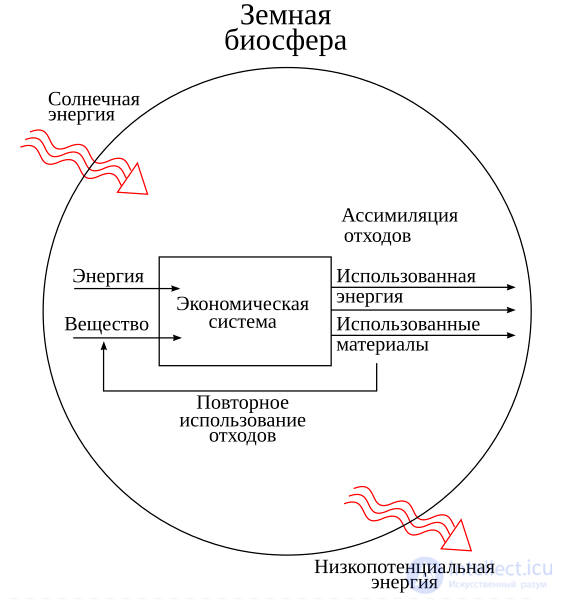
A diagram describing the flow of natural resources in the economy. Valuable resources are extracted from nature at the entry point of the economy; the resources pass through the economy, being transformed along the way into goods. Low-value waste and pollution eventually accumulate at the output. Recycling of material resources is possible, but only through the use of some energy resources, as well as additional amounts of other material resources. Energy resources, in turn, cannot be recycled at all, but are dissipated as waste heat.
The concept of social metabolism emerged in the nineteenth century, a time of scientific integration and reciprocity among naturalists and social scientists. The evolutionary perspective, in particular analogical reasoning, provided cross-links between the natural and social sciences.
It was only in the late 1970s that the paradigm of human exceptionalism was seriously challenged, leading to the birth of environmental sociology.
Studies of social metabolism can be conducted at different levels of system aggregation. For example, material flow accounting analyzes the inputs and outputs of materials and energy for a given country or region, as well as imports and exports. Such studies are facilitated by the ease of access to information on commercial transactions.
The concept of social metabolism has been used in historical research as a basis for describing the development of human societies over time. Particularly important in this area is the work of the German historian Rolf Sieferle on socio-ecological models of societies. Focusing on the energy dimension of social metabolism (i.e., energy metabolism), Sieferle proposed that different "socio-ecological regimes" or modes of human societies over time can be classified according to the primary energy source and the dominant energy-conversion technology they use. Sieferle identified three main regimes that have characterized human history: the hunter-gatherer, agrarian, and industrial regimes. The hunting and gathering regime relied on "passive use of solar energy," since in this configuration people relied mainly on the products of recent photosynthesis, namely plants and animals for food and wood for heat. This led to highly nomadic societies and low population density. Eventually, the Neolithic revolution allowed societies to transition to the agrarian regime, based on "active use of solar energy." People began to modify their environment more systematically through deforestation in order to make maximum use of land and sun for agriculture, to produce food for people and livestock. This led to a settled way of life, an increased burden on human labor, and higher population growth, which in turn accelerated the development of more structured social hierarchies and dynamics. Finally, the invention of the steam engine in the 16th century triggered the emergence of the industrial regime, which relies on fossil fuels as its main energy source. This led to the industrial socio-ecological model that governs human society as we know it today.
Following in Sieferle's footsteps, other sociologists eventually attempted to reconstruct human history through social metabolism, as well as through quantitative analysis and indicators. Among these it is worth mentioning Total Primary Energy Supply (TPES), Domestic Energy Consumption (DEC), Human Appropriation of Net Primary Production (HANPP), and others.
Using energy metabolism as an indicator of human development has important implications not only for historical analysis but also for the development of future scenarios. According to many studies, peak fossil fuel (i.e., the maximum rate of fossil fuel extraction on a global scale) has already been reached or is likely to be reached in the near future. Understanding what will become the next primary energy source and conversion technology for human societies in the future has important political and social implications.
Studies of social metabolism can be conducted at different levels of system aggregation, see material flow analysis . For example, material flow accounting analyzes the inputs and outputs of materials and energy of a particular state or region, as well as imports and exports. Such studies are facilitated by the ease of access to information on commercial transactions .
There are various schools of thought regarding social metabolism, each with its own accounting method. Two that can be highlighted have their roots in two different schools of research, Material and Energy Flow Analysis (MEFA), which is associated with the "Vienna School" (not to be confused with the Austrian School), and Multi-Scale Integrated Analysis of Societal and Ecosystem Metabolism (MuSIASEM), which has its roots in the "Barcelona School," associated with the Autonomous University of Barcelona . The scholar who laid the foundations of MEFA is Marina Fischer-Kowalski , while MuSIASEM developed around Mario Giampietro and Kozo Mayumi .
While MEFA primarily focuses its research on national economies across time and space, MuSIASEM primarily focuses its research on modern economies, here focusing on specific subsectors of the economy This also entails some methodological differences: in the MEFA school of thought, researchers were more oriented toward standardizing data collection as much as possible, which would lead to easier comparison across a wide range of cases and data. On the other hand, in the MuSIASEM school, scholars were more reluctant to do this; they prefer to have an individual form of accounting for each case, working within a predefined "grammar"

Comments