
Lecture
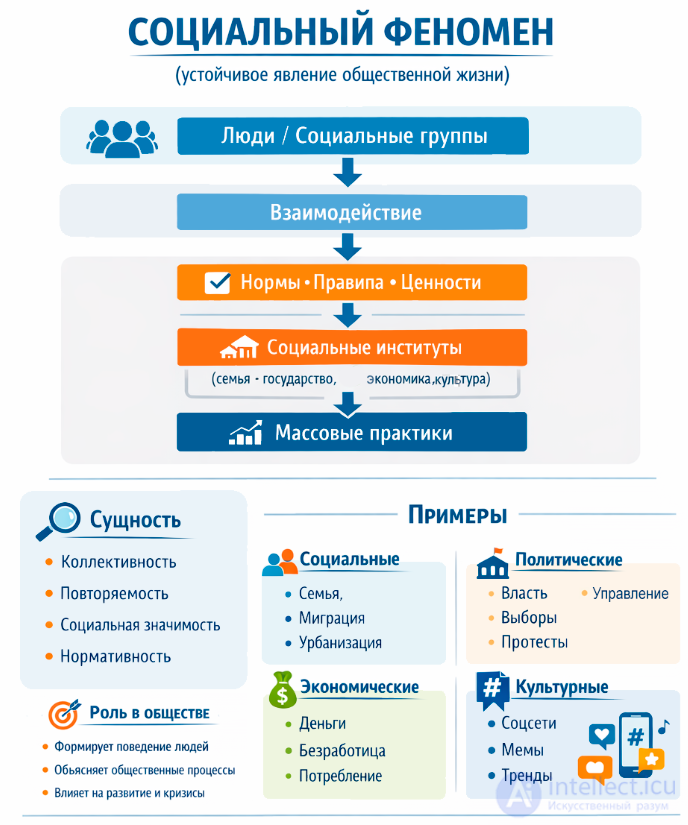
Social phenomenon or social occurrence — one of the fundamental concepts of sociology and social philosophy, meaning "an element of social reality possessing the full range of social properties and characteristics"; it is any manifestation of relations or interaction between people, or even a single event or occurrence; anything that manifests itself, exists, and is present in social reality. Social phenomena are phenomena of human interaction carried out in social space: directly within a contact group or indirectly through individuals' involvement in communities, through social organizations and institutions.
People, with their actions, feelings, relationships, and thoughts, as well as objects, act as social phenomena. Social phenomena are "material and spiritual products of human activity, social institutions, establishments, organizations, needs, interests, individual aspects of processes, and the like." Many social phenomena are latent and, alongside expressing the obvious characteristics of social reality, express its deeper processes, although in this case their direct connection with the given social phenomenon is not observed. Sociological research, using "certain techniques, procedures and methods for obtaining information about a social phenomenon," serves as a means of identifying it (social practice).
Two main varieties of social phenomena are distinguished:
Of the entire set of social phenomena, the latter are more often singled out, because they possess stable, recurring (mass) and typical connections and relations of social reality. Each social phenomenon differs from another by certain "empirical characteristics," which are noted in social indicators. Mass (recurring) social phenomena are studied using statistical methods. Quantitative study of the totality of social phenomena and the intensity of the manifestation of their characteristics contributes to an awareness of the probabilistic nature of social connections and relations, and makes it possible to record patterns and trends in their development.
Any social phenomenon can be regarded as a social fact if its properties and characteristics have been established — "repeatability, mass character, typicality, social significance." Thus social phenomena are the starting point of sociological research. In such a complex process as the study of the social life of society, a social phenomenon represents a certain stage in the understanding of its significant traits, and also acts as the most direct and simple of the observable elements of this process, being the point of departure for the ascent of social cognition from the simple to the complex, "from the diversity of properties in the manifestation of social life to its basic characteristics."
Human personality is a complex social phenomenon and has its own structure. It includes biological, psychological and social components. V. K. Tsechoyev, Social Studies, 2017
Thus, while slaves were already known in late primitive society, slavery as a distinct social phenomenon took shape only in the era of the formation of class society. A. A. Nemirovsky, History of the Ancient World: The East, Greece, Rome, 2010
Analysis of the nature of a social phenomenon is aimed at revealing the mechanisms of its emergence, development and functioning.
Lyudmila Georgievna Pochebut, Social Psychology: A Textbook for Universities, 2017
The Russian revolution is not a political and social phenomenon, political and social, it is above all a phenomenon of a spiritual and religious order.
Berdyaev N. A., The Fate of Russia, 1917
"RUMORS" AS A SOCIAL PHENOMENON -Rumors are a form of the spread of socially significant information within society, a collective, or a group. Unlike official information, rumors, as a rule, do not have a sufficient and reliable informational basis — the presence of established facts, events, and so on — and arise in the process of interpersonal communication, in the course of the exchange of information between people.
Power as a social phenomenon - By its nature, power is a social (public) phenomenon, since it arises within society. Power as a phenomenon manifests itself in various spheres of human activity. In personal life, it is power over oneself and circumstances; in society, it is power over people; in the biosphere, it is power over nature. Social power is a set of volitional relations between people concerning the organization of their joint activity, the formulation and implementation of a will (interest) common to a given social collective. State power is a particular variety of social power.
KNOWLEDGE AS A SOCIAL PHENOMENON
Fashion as a social phenomenon, and so on.

Comments