
Lecture
Conducting sociological surveys during military hostilities is a complex and delicate task that requires attention to a number of factors in order to obtain reliable data while ensuring the safety of both respondents and researchers. Under conditions of military hostilities, sociological surveys may indeed reflect primarily the effectiveness of propaganda and manipulative information campaigns rather than the objective mood of society.
A sociological survey (poll) is a method of sociological research consisting of the collection and acquisition of primary empirical data on specific opinions, knowledge, and social facts that constitute the subject of research, through oral or written interaction between a researcher (interviewer) and a given set of respondents (interviewees).
Here are some key aspects related to conducting sociological surveys under such conditions:
When conducting surveys under wartime conditions, many researchers turn to qualitative methods, such as in-depth interviews or focus groups, which, despite their more limited reach, allow for a deeper understanding of people's moods and reactions to events. Such data can be reinforced with remote surveys, which, however, requires a strong emphasis on anonymity and confidentiality.
Under such conditions, survey results will depend on the following factors:
Some researchers develop special techniques to circumvent the effects of propaganda, for example:
A sociological survey conducted under conditions of propaganda may show a high level of support for the actions of the state or the army, but this is not always an indicator of sincere approval. Sometimes it is merely evidence of the strength of propagandistic influence, especially when the data are inconsistent with other indicators of mood, such as indirect markers of discontent, the level of protest activity, and so on.
Sociological research conducted during military conflicts has a rich and varied history. Below are examples and features of such research that illustrate how sociology has been used to understand public sentiment and the effectiveness of propaganda during various wars.
In Soviet Russia in the 1920s and 1930s, public opinion polls were conducted mainly among readers of newspapers and magazines. The mass media collected and analyzed audience opinions in order to assess the workings of the mechanisms of Soviet propaganda and their effectiveness. Such approaches, of course, differed significantly from the methods of studying public opinion that emerged later. Starting in the 1930s, all sociological research and its results in the USSR became strictly subordinated to the ideological framework of Marxism-Leninism and dialectical and historical materialism, which limited the study of social life and influenced the interpretation of survey results; and if surveys of attitudes toward the political system and organs of power were conducted at all, their results were not published in open sources.
In domestic military sociology of the early twentieth century, there was a period of development and growth, during which the methodological and procedural foundations for military-sociological research were formed. In the 1920s, although the scholarly community had virtually no theoretical and methodological works, empirical research in the Red Army (RKKA) developed actively. Despite its predominantly statistical character and the insufficient professional training of researchers, specialists in army units used a variety of sociological methods, such as observation, interviews, and document analysis, to study the social problems, needs, and interests of servicemen. [Obraztsov, 2018: 45–54] and [Obraztsov, 1998: 91–107] [Khlebtsevich, 2019: 142–156]
Broad questionnaire surveys were conducted among servicemen, such as, for example, studies of the reading interests of Red Army soldiers, initiated by E.I. Khlebtsevich, a well-known popularizer of librarianship. However, by the end of the 1930s, all research in the army and navy had been discontinued. Nevertheless, some military leaders of the RKKA understood the value of survey techniques for solving specific military-political and propaganda tasks. As a result, some sociological methods continued to be used to obtain information when other methods were difficult to apply. During the Great Patriotic War, this experience was also applied in work with prisoners of war.
The methodology for interviewing German prisoners of war was described in detail by A.R. Korsunsky in the journal "Sociological Studies," where he discussed the experience of the Soviet Army's special propaganda service in using survey techniques in 1944–1945. The main purpose of such surveys was to study the political convictions and morale of Wehrmacht soldiers. Declassified documents from military archives showed that, starting in the autumn of 1941, the Red Army command applied public-opinion survey methods in its work with German prisoners of war for the purposes of ideological struggle.
On October 3, 1941, the head of the Main Political Directorate of the RKKA, L. Mekhlis, approved the "Instruction on the procedure for the political interrogation of enemy army prisoners of war." According to this instruction, prisoners of war were to be immediately subjected to "ideological influence" by the political bodies. This work included identifying and isolating supporters of Nazi ideology, as well as fostering anti-fascist attitudes among the prisoners.
To determine the strategy for working with prisoners of war, political officers at the level of divisions, armies, and fronts were instructed to organize and conduct a political interrogation, and then analyze its results. The interrogations were conducted by specially appointed political workers who spoke German, who could be assisted by qualified interpreters. Information collected during the interrogations remained strictly confidential.
The main task of the political interrogations of prisoners of war was to determine the political and moral state of their units, the personal convictions of the prisoners, as well as the methods and content of ideological work among the enemy army's servicemen. In addition, the surveys were used to study the influence of Soviet propaganda on the German troops and their rear, to carry out anti-fascist work, to identify prisoners of war sympathetic to the USSR, and to gather data that could improve the effectiveness of Soviet propaganda among enemy troops and the population.
The strategy for conducting political interrogations included a set of methods and procedures. The instruction required that prisoners of war be interviewed individually in the form of an oral interview, following an established list of questions. A protocol was drawn up for each person interviewed, to which a photograph was attached indicating the surname, military unit, date of the interview, and protocol number. The political departments of the divisions sent reports up the chain: first to the political departments of the armies, then to the departments of the fronts, and finally to the Main Political Directorate of the RKKA.
In the course of the interrogations, it became necessary to verify the sincerity of the prisoners' answers. To this end, the political department of the 34th Army developed a questionnaire of twenty-three questions, grouped into four themes: attitude toward the war, attitude toward Nazi propaganda and Soviet counter-propaganda, attitude toward the USSR, and general political questions.
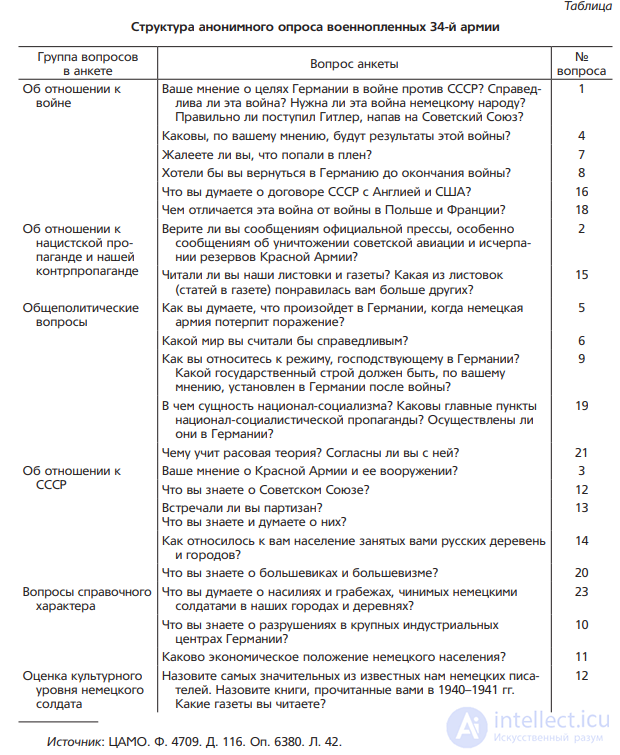
To assess the cultural level of the prisoners of war, the questionnaire included a question about the most significant German writers and about books and newspapers read during 1940–1941. The questionnaire's questions were shuffled rather than organized into thematic blocks, which was probably done to increase the objectivity of the answers, using approaches from psychotechnical research of the 1920s. These methods, developed to solve social problems, drew on the ideas of the Soviet psychotechnical school. According to I.N. Shpilrein, one of the founders of this school, in selecting, training, and managing military personnel, it is important to take into account how social conditions influence a person. This approach also reflects the use of American experience, where intelligence tests masked the collection of social data on the opinions of military personnel.
The sample for the survey covered prisoners of war who had fought since the first days of the war, as well as those who arrived at the front later and represented various branches of the Wehrmacht on the Northwestern Front. However, the archival documents contain no information on the principles used to form the sample, which makes it difficult to assess its representativeness. It is likely that the surveys were conducted on a continuous-survey basis.
The collection of empirical information was carried out systematically: from the autumn of 1941 to the winter of 1942, seven surveys were conducted — on September 15, October 2 and 19, December 27, and then in 1942 — on January 20, in mid-February, and on March 20. In total, 326 people were surveyed: 5 officers, 10 sergeant-majors, 33 non-commissioned officers, 6 senior corporals, 120 corporals, and 152 soldiers.
The research strategy was that the period from September 1941 to March 1942 was conditionally divided into three stages of military operations on the Northwestern Front: the orderly withdrawal of Red Army units (September-October 1941), active defense, and offensive operations. In September-October 1941, during the Red Army's retreat, 47 people were surveyed, including 2 lieutenants, 17 corporals and non-commissioned officers, and 28 soldiers aged 21 to 30, most of whom had been conscripted in 1939–1940 and had combat experience in Poland and France.
Prisoners of war captured during the active defense (81 people) were surveyed in November-December 1941. Among them were 3 officers, 4 sergeant-majors, 6 non-commissioned officers, 6 senior corporals, 22 corporals, and 40 soldiers aged 19 to 35. During the Red Army's offensive operations in January-March 1942, 198 people were surveyed, including 6 sergeant-majors, 21 non-commissioned officers, 87 corporals and senior corporals, and 84 soldiers aged 19 to 42.
Analysis of the archival documents shows that in the political department of the 34th Army, the logical-substantive analysis of the primary data from the questionnaire surveys was carried out in stages, as information accumulated. Reports on the survey results were prepared as reviews for the head of the army's political department and contained information on the number of respondents, their socio-demographic structure, their attitude toward the war between the USSR and Germany, the political and moral state of the unit in which the prisoner of war served, his personal political and moral character, his cultural level, and the state of propaganda work.
Comparative analysis of the results of the anonymous questionnaire surveys shows a trend toward their improvement. Review No. 72, covering the period from September 15 to December 27, 1941, analyzed the results of four surveys. The organizers of the study realized that, in order to obtain more sincere information, the surveys had to be conducted anonymously using paper questionnaires. To assure respondents of confidentiality, they were handed identical sheets of paper and pencils, and the serviceman conducting the survey left the room after explaining the purpose of the questionnaire.
Nevertheless, anonymity was not strictly enforced. Most likely, the questionnaires were checked against the handwriting of documents or letters belonging to the prisoners of war. Reports noted that in some cases it was possible to establish the authorship of a questionnaire by handwriting, which revealed contradictions between statements given during interrogations and the answers given in the questionnaires. In particular, mention is made of senior corporal "Panzer," who during interrogation called himself a "communist," and soldier Hans Wutz, who tried to pass himself off as an anti-fascist, but in their answers to the anonymous questionnaires both used "thoroughly Nazi formulations."
The results of the surveys of German prisoners of war were analyzed in order to identify changes in their opinions on key issues. For example, the question of trust in Hitler showed considerable dynamics. In the first survey, conducted on September 15, 1941, all respondents retained their faith in Hitler and his propaganda. However, in the second survey on October 2, of the 16 respondents only 6 retained their faith, 5 did not answer, and 3 gave a direct denial. On October 19, of the 11 respondents asked about their trust, 6 gave positive answers.
In addition, on the question of who would win the war, in the first period of the war 13 prisoners of war answered that Germany would win, while the remaining 7 gave evasive answers. In subsequent surveys, opinions emerged that contradicted earlier convictions; for example, some stated that the outcome of the war would be unfavorable for Germany, having seen the real situation at the front.
The surveys also made it possible to draw conclusions about perceptions of the war. Some respondents held the typical Nazi viewpoint, believing that the Red Army threatened Germany and that the war was just. The studies were of a monitoring nature, and Review No. 101 presented a summary of the questionnaire survey results from September 15, 1941, to March 20, 1942, including data in absolute values and frequency distribution.
The final report is divided into thematic blocks: the prisoners of war's attitude toward the war, their political and moral state, and their cultural level. The results showed that most respondents had only a primary education, many knew nothing about the Soviet Union, and were limited in their cultural needs, preferring light literature and cinema.
The analysis showed that in the first period of the war the morale of the German army remained high despite losses, and many respondents expressed trust in Hitler and a willingness to fight for the ideas of National Socialism. In the second period a shift in mood was observed: 47% of respondents still believed in Hitler, but the proportion of anti-fascist-minded soldiers rose to 20%.
In the third period, when the Red Army began offensive operations and losses increased, the number of anti-fascist-minded soldiers rose to 59%. The number of those who believed in Germany's victory fell sharply from 44.6% in the first period to 2% in the third, while the number of those who doubted or abstained from answering rose significantly.
Methodological techniques used in the study also included content analysis of soldiers' letters. These letters, translated into Russian, were used to understand the feelings and thoughts of servicemen. They often expressed suffering from cold, hunger, and fear of the Red Army's strength, which underscored a declining belief in an imminent victory and changes in how German soldiers perceived the war.
Thus, sociology under conditions of military action reflects the influence of propaganda on public consciousness and the degree of its penetration more than it reflects objective and stable attitudes. Such public opinion surveys require a special approach and careful preparation in order to minimize risks and improve the accuracy of the data obtained.
Historical experience shows that sociological research conducted under wartime conditions is often used to measure the effectiveness of propaganda and to study public attitudes, but the data obtained do not always objectively reflect the real situation. Under conditions where people are subject to the pressure of propaganda and fear, they may not give honest answers, and the results of the research can become a means of managing public opinion rather than a reflection of it.
The application of sociological methods and empirical research by political officers of the USSR during the Second World War underscores the importance and relevance of this field within military-scientific knowledge. Analysis of the opinions of prisoners of war and of their social and psychological characteristics provided the command with valuable information about the enemy's mood and its political and ideological attitudes.
This data helped not only in assessing the morale of the German troops, but also in understanding broader social processes taking place within the enemy's ranks. Modern researchers, with access to declassified archival materials, will be able to gain a deeper understanding of how conclusions based on the results of questionnaire surveys and statistical methods influenced specific decisions made by military commanders.
It is important to note that sociological studies of prisoners of war served not only to analyze the enemy, but also for internal monitoring of the mood and condition of one's own troops. This aspect also requires further research in order to understand how political work and information-gathering methods influenced strategic and tactical decisions during the war.
Nowadays, military command authorities actively make use of the theoretical and applied achievements of sociology. Modern social technologies, research methods, and practices help study the state and dynamics of processes within military units, predict social processes within the troops, and provide sociological data for making management decisions at various levels of military leadership. This data also makes it possible to monitor the implementation of decisions and, if necessary, adjust them.

Comments