The Streisand effect (Eng. Streisand effect) — a social phenomenon in which an attempt to remove certain information from public access (censorship) only leads to its wider dissemination (usually via the internet). For example, an attempt to restrict access to a photograph, file, text, or number (for instance, by legal means) leads to that information being duplicated on other servers, appearing on file-sharing networks, or being otherwise replicated.
Origin of the name
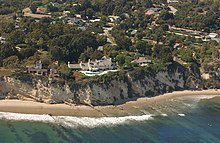
Coastline photograph number 3850 from the California Coastal Records Project, depicting Streisand's estate (2002)
The term "Streisand effect" gained currency after an incident in 2003, when Barbra Streisand filed a lawsuit seeking 50 million US dollars from photographer Kenneth Adelman and the site Pictopia.com, because a photograph of her house was available among more than 12,200 other photographs of the California coastline[4][5][6]. Adelman claimed that he had photographed the house along with other houses along the coast as part of the California Coastal Records Project, which studies coastal erosion under government-sanctioned and government-commissioned authorization.
Before Streisand's lawyers filed the lawsuit, photograph number 3850 (which showed Streisand's house) had been downloaded from the project's website only 6 times — two of those downloads were made by the lawyers themselves. On May 10, 2004, the court dismissed Streisand's claims and ordered Streisand to reimburse Adelman's legal costs in the amount of 154 thousand dollars.
Later, journalist Paul Rogers (San Jose Mercury News) noted that as a result of the spread of information about the lawsuit, the photograph of Streisand's house became very popular on the internet. In particular, a month after the lawsuit was filed, the image had been viewed by more than 420 thousand visitors.
Adelman stated that information about the lawsuit drew more than a million visitors to his website, and the photograph was used in its photo archive by the news agency Associated Press, which in turn led to it being reprinted by numerous newspapers around the world.
The term itself was first used in early 2005 by a blogger named Mike Masnick, who founded and runs the well-known blog Techdirt.com.
Examples
- After the death of British schoolgirl Leah Betts in 1995, which was linked to MDMA use, a wide-ranging campaign was launched publicizing the dangers of ecstasy. Studies conducted in the northeast of England suggest that the campaign contributed to the spread of information about ecstasy and, as a result, encouraged young people to try it.
- In April 2007, an attempt was made to block the distribution of one of the encryption keys of the AACS system through the site Digg. Warning letters (cease-and-desist letters) demanding an end to the illegal distribution of the information were sent to several popular sites, but this only led to the mass distribution of the key in various formats on other sites and in chats. Some people called the number containing the key "one of the most famous numbers on the Internet" Within a month the key had been published on more than 280,000 pages, printed on t-shirts and used as tattoos, and mentioned in a song whose video was viewed on YouTube more than 45 thousand times. A Flag of Free Speech was also created, in whose colors the key is encoded.
- In January 2008, the Church of Scientology unsuccessfully tried to force several websites to remove a video interview with Tom Cruise in which the religious organization was discussed. These attempts led to the birth of the "Project Chanology."
- On December 5, 2008, the British non-governmental organization Internet Watch Foundation (IWF) added the Wikipedia article Virgin Killer, about a 1976 album by the German band Scorpions, to its blacklist of sites containing child pornography, claiming that the album cover featured a potentially illegal image of a child. The article quickly became one of the most popular on the site, and due to the public discussion of censorship, the image spread across numerous sites on the web. IWF later told the news organization BBC News that its task is to reduce the availability of inappropriate images of children on the internet, but that in this case its efforts led only to the opposite effect. This effect was mentioned by IWF in a statement explaining the removal of the Wikipedia page from the blacklist.
- In December 2010, the website WikiLeaks was subjected to DDoS attacks and blocking by internet providers after the publication of leaked US diplomatic cables. Many people sympathetic to the WikiLeaks project created mirrors of the website to make it more difficult to immediately censor the information.
- In early April 2013, the Directorate-General for Internal Security, an agency of the French intelligence community, forced an administrator of the French Wikipedia to delete an article about the Pierre-sur-Haute military radio station, threatening him with criminal prosecution. The DGSI first tried to have the article removed through official representatives of the Wikimedia Foundation, but was refused, since the article contained only a compilation of publicly available information assembled in accordance with verifiability requirements. The article was restored some time later and became one of the most popular articles on the site (as of April 8, 2013): it had been translated into dozens of other language versions of Wikipedia. The Wikimedia Foundation issued a public statement.
- In June 2015, the prosecutor of the Chernoyarsky District of Astrakhan Oblast found that an article in the Russian Wikipedia titled "Charas" contained detailed information about the preparation of the drug, including its ingredients and dosage, and demanded that access to this illegal information be restricted. The Chernoyarsky District Court of Astrakhan Oblast ruled that the information contained in the article was prohibited under parts 1 and 2 of Article 46 of Federal Law of the Russian Federation No. 3-FZ of 08.01.1998 "On Narcotic Drugs and Psychotropic Substances," as propaganda of narcotic drugs aimed at disseminating information about methods of manufacturing narcotic substances. The information posted in the article was ruled by the court to be "information whose dissemination on the territory of the Russian Federation is prohibited." Roskomnadzor sent Wikipedia a notice demanding that the article be blocked, but the article was not deleted, and Wikipedia was subjected to a brief block in some regions of the country. Due to widespread media coverage of the dispute and Roskomnadzor's threats to block all of Wikipedia, traffic to the "Charas" article increased significantly, and for some time it held 2nd place in the list of the most visited pages of the Russian Wikipedia. Some media outlets called this rise in traffic a manifestation of the Streisand effect.
- On June 23, 2017, the head of Roskomnadzor warned of the possible blocking of the Telegram messenger if it refused to cooperate with Russian authorities under the "Yarovaya law." Following this, the FSB reported that Telegram had been used by terrorists in preparing the terrorist attack on the St. Petersburg metro on April 3, 2017. After these statements, Telegram's popularity soared, and it rose to first place in the App Store rankings.
See also
- Cobra effect
- Forbidden fruit
- Prohibited number


Comments