
Lecture
Erlang system
As performance measures of a QS with losses (loss system) we will consider:
A — the absolute throughput of the QS, i.e., the mean number of customers served per unit time;
Q — the relative throughput, i.e., the mean fraction of arriving customers served by the system;
Ploss — the loss probability, i.e., the probability that a customer will leave the QS unserved;
 — the mean number of busy channels (for a multichannel system).
Single-channel system with losses . Let us consider the problem.
There is one channel receiving a flow of customers with rate λ. The service flow has rate μ1. Find the limiting probabilities of the system's states and its performance measures.
System S (the QS) has two states: S0 — the channel is free, S1 — the channel is busy. The labeled state transition diagram is shown in Fig. 6.
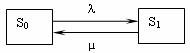
Fig. 6
In the limiting, steady-state regime, the system of algebraic equations for the state probabilities has the form.

 (18)
(18)
i.e., the system degenerates into a single equation. Taking into account the normalization condition p0+p1=1, we find from (18) the limiting probabilities of the states
 (19)
(19)
which express the mean relative time the system spends in state S0 (when the channel is free) and S1 (when the channel is busy), i.e., they determine, respectively, the relative throughput Q of the system and the loss probability Ploss:
 (20)
(20)
 (21)
(21)
We find the absolute throughput by multiplying the relative throughput Q by the loss flow rate
 (22)
(22)
Problem 5. It is known that requests for telephone calls at a television studio arrive with rate λ equal to 90 requests per hour, and the mean duration of a telephone call is tserv.=2 min. Determine the performance measures of the QS (telephone communication) with one telephone line available.
Solution. We have λ=90 (1/h), tserv.=2 min. The service flow rate is μ=1/tserv=1/2=0.5 (1/min)=30 (1/h). By (20), the relative throughput of the QS is Q=30/(90+30)=0.25, i.e., on average only 25% of arriving requests will complete a phone call. Accordingly, the probability of a service refusal will be Ploss.=0.75 (see (21)). The absolute throughput of the QS by (29), A=90∙0.25=22.5, i.e., on average 22.5 call requests will be served per hour. Obviously, with only one telephone line available, the QS will handle the flow of requests poorly.
Suppose that a Poisson flow with rate λ arrives at a system with one channel (n = 1) (in the general case, λ is a function of time, i.e., λ = λ (t)). A customer that finds the channel busy is refused and leaves the system (Fig. 22). Service in the system takes place during a time Tserv – this is a random variable distributed according to an exponential law:
F(t)=μ·e-μ·t (20)
It is required to find:

Fig. 22
Let us consider the single service channel as a physical system S, which can be in two states:
S0 – the channel is free;
S1 – the channel is busy.
Since the events S0 and S1 form a complete group of mutually exclusive events, the following equation holds
P0(t) + P1(t) = 1. (21)
The Kolmogorov equations for this queueing system have the form
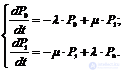 (22)
(22)
From equation (21) let us express the probability of the event that the channel is busy, and as a result we obtain
P1 = 1 – P0. (23)
Substituting the obtained expression for P1 into the first equation of system (22), we then obtain an expression of the form
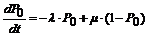 .
.
Let us combine like terms for the probability P0:
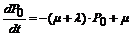 .
.
Then the system of equations (22) can be written in the following form:
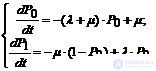 (24)
(24)
The initial conditions will be:
Let us integrate the first equation of system (24):
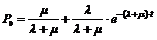 .
.
Using expression (23), one can obtain an expression for calculating the probability P1, i.e., the probability that the system is busy. A graph of the system's behavior over time is shown in Fig. 23.
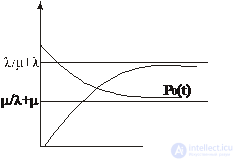
Fig. 23
After the end of the transient process, as t→∞, the probability P0 will be calculated as follows: P0=M(λ+M) as t→∞.
Obviously, for a single-channel system with losses the probability P0 is precisely the relative throughput, which is calculated as follows:
Q = P0(t)=μ/(λ+μ), (25)
Knowing Q, one can find the absolute throughput A as the product of the relative throughput Q and the arrival rate λ, i.e.
A = λQ.
Substituting expression (25) in place of Q, we obtain,
A = λ·μ/(λ+μ).
The loss probability is nothing other than the mean fraction of unserved requests.
Ploss = 1 – Q,
as t→∞, Ploss = 1 –  .
.
EXAMPLE. Suppose there is a telephone line in which the arrival rate of requests λ equals 0.8 calls/min, and the service time of one call (request) tserv equals 1.5 min. It is required to determine the performance measures of this QS.
Solution. Since there is only one telephone line, the queueing system belongs to single-channel QS. If the next request arriving in the system finds the system busy, it is refused and leaves the system; hence, this system is a single-channel QS with losses. For this type of QS, the following characteristics can be calculated:
 .
.
Knowing the arrival rate of requests in the QS λ and the service rate of requests in this QS μ, let us find the relative throughput Q:
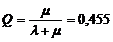 .
.
This means that in the steady state the system will serve 45.5% of passing requests.
Now let us calculate the absolute throughput of the QS:
A=Q·λ = 0.364
I.e., the line is capable of servicing on average 0.364 calls per minute.
Let us find the loss probability: one minus the relative throughput of the system:
Ploss = 1 – Q = 0.545.
The probability that a request arriving in the system will find it busy is 54.5%.
In addition to the characteristics listed above, the nominal throughput can also be calculated:
 .
.
It equals 0.667 calls per minute, which is twice the actual throughput obtained for the random process.

Comments