
Lecture
Consider an n-channel queueing system with an infinite queue, into which the simplest flow of customers arrives with rate λ;
the service rate is μ (i.e., on average a continuously busy channel will produce ρ = λ/ μ serviced customers per unit (of time).
The service duration is a random variable following an exponential distribution law.
The service flow is the simplest Poisson flow of events.
A customer arriving at a moment when all n channels are busy joins the queue and waits for service.
As performance measures of a single-channel queueing system with a limited queue length, we will consider:
A - absolute throughput of the QS;
Q - relative throughput;
Ploss - loss probability;
Pqueue - probability of queue formation;
 - mean number of busy channels;
Ls - mean number of customers in the system;
Ts — mean sojourn time of a customer in the system;
Lq - mean queue length;
Tq- mean waiting time in the queue.
A labeled state transition diagram is shown in Figure 12.
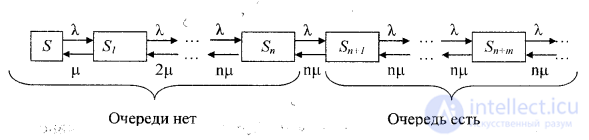
Fig . 12. Multichanne l QS with a limited length queue
S0 - all channels free, k = 0;
S1 - one channel busy, the rest free, k = 1 ;
***
S„ - all n channels busy, no queue, k = n;
S„+i - all n channels busy, one customer in the queue k = n + 1 ;
***
Sn+m-all n channels busy, r customers in the queue, k=n + m;
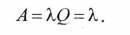
Since there is no restriction on the queue length, every customer can be served, hence Pserv= 1,
consequently, the relative throughput  and the absolute through'put capacity
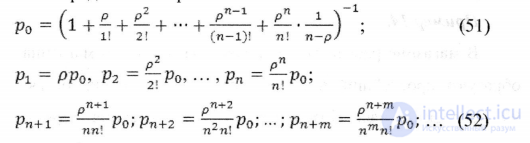
Limiting probabilities:
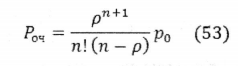
Probability of queue formation;
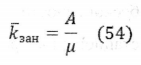
Mean number of busy channels:
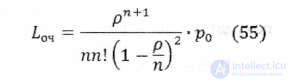
Mean queue length:
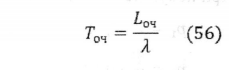
Mean waiting time in the queue:
Mean number of customers in the system:

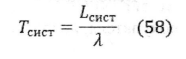
Mean sojourn time of a customer in the QS:
If p < n, then the service process is stable.
If p > n => the QS operates unstably.
A store has 3 salespeople working. The store's customers form the simplest flow of requests with a rate of 90 people per hour. The service rate for one customer is 60 people per hour.
Find the service performance measures.
Solution
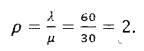
By the condition p < n, hence the queue will not grow indefinitely and the system reaches a limiting steady-state regime.
Let us find the probability that there are no customers at the checkouts:

The probability that one, two, or three customers are being served at the checkouts is found using the formulas:
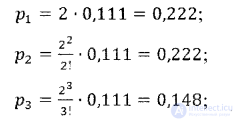
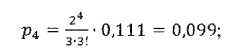
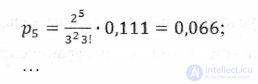
The probability that one or two customers are standing in the queue at the checkouts is found using the formulas:
The probability that a customer will end up in the queue is determined by the formula

Mean number of busy checkouts: 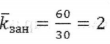 cashiers.
Mean number of customers in the queue:
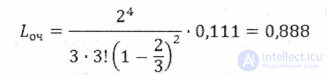
Mean number of customers being served by cashiers and standing in the queue:
Ls = 0.883 + 2 = 2,888
Mean sojourn time of a customer in the queue:

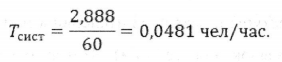
Mean sojourn time of a customer in the system:
1. What is the number of states of an n-channel QS with unlimited waiting?
2. Draw the labeled state transition diagram for an n-channel QS with unlimited waiting.
3. Formulate the condition for the existence of limiting probabilities for an n-channel QS with unlimited waiting.
4. What are the absolute and relative throughput - capacities of an n-channel QS with unlimited waiting?
5. With which performance measures of an n-channel QS with waiting does the mean number of busy channels of this system coincide?
6. How are the time characteristics «mean service time of one customer, relative to all customers» and «mean service time of one customer, relative only to served customers» related for an n-channel QS with unlimited waiting?
1. A multichannel QS with two service channels receives customers with an arrival rate of 0.8 customers per hour. (The flow of customers is the simplest.) The service flow has a rate of 0.5 customers per hour. The queue of customers waiting for service can grow practically without limit.
Determine all the mean characteristics of the system.
Answer:

2. A seaport has three berths, the arrival flow rate is 2.5 ships per day. The rate of loading/unloading operations is 2 ships per day. The flow
of customers and the service flow are Poisson. The queue of ships can grow practically without limit. Assuming a steady-state regime of operation, determine all the mean characteristics of the system.
Answer:

1. A gas station has 4 pumps. The mean refueling time is 2 min. The input flow of cars is the simplest with a rate of 1.5 cars/min. If all pumps are busy, the request is lost. Determine the loss probability and the mean number of busy pumps.
2. The store's customers form the simplest flow of requests with a rate of 150 people/h. Determine the smallest number of salespeople for which the mean number of customers waiting for service does not exceed 3.
3. An oil terminal has 4 berths for loading tankers, which arrive on average every 18 h, and the loading time averages two days. No more than 2 tankers can stand in the queue. Determine the throughput and the idle time of the port.
4. Determine the distribution law of the time interval between the arrival of two requests in the simplest flow of requests with rate L
5. The flow of people wishing to request a doctor's home visit is the simplest. On average, callers call every 10 s. The call handling time follows an exponential distribution with a mean value of 12 s. Determine the smallest number of phones at the reception desk for which a call is accepted from at least 90% of callers. It is assumed that in case of failure, the caller does not make further attempts to get through.
6. Prove that the flow leaving an exponential channel (at the input of which customers are always present) is the simplest.
7. An automatic car wash can service 4 cars at the same time. On average, cars arrive every 2 min, and the mean washing duration is 10 min. No more than 6 cars can be in the queue. Determine the probability that there is at least one car in the system, and the utilization of one car-wash unit.
8. A store has 3 inquiry phones. On average, 40 people/h call for information. The mean duration of an inquiry call is 3 min. The costs associated with operating one phone are a rub./min. Determine the minimum cost of one minute of a phone call at which the system is not unprofitable.
9. A paid parking lot for cars has 7 spaces. Find the probability that an arriving car will find a free space, if cars on average
arrive every 10 min. and occupy a parking space on average for 1 h.
10. The flow of parts coming off the conveyor is the simplest with a rate of 2 parts/min. The time for a part to be inspected by the inspector follows an exponential distribution with a mean of 2 min/part. Determine the fraction of uninspected parts.
11. A city is served by 4 ambulances. Calls arrive on average every 4 h. The probability that at least one vehicle is busy is 0.25. Determine the mean number of busy vehicles and the mean idle-time fraction of the vehicles.
12. Two hairdressers work in a barbershop. The service time follows an exponential distribution with a mean of 12 min. No more than three people can wait for service. The flow of clients is the simplest with a rate of 10 clients/h. Find the most important operational characteristics of this system.
k.
13. An automatic aircraft landing system can simultaneously store data on only six aircraft in the air. Aircraft approaching the airfield form the simplest flow with a rate of 6 aircraft/h. If the system is full at the moment of the landing request, the aircraft flies to an alternate airfield. The airfield has 3 runways, and an aircraft occupies a runway for an average of 20 min. Find the throughput of the QS, the utilization of one runway, the mean number of busy runways, and the mean waiting time before the start of landing after the request.
14. Consider the operation of a gas station (filling station) that has 2 fuel pumps. Assume that it is described by a birth-and-death process in a steady-state regime. Refueling each car takes an average of 3 minutes. On average, a car needing refueling arrives at the station every two minutes. The number of places in the queue is unlimited. All cars that join the line patiently wait their turn. Determine: 1. The probability that there are 5 cars at the station. 2. The probability that a newly arrived car will have to wait for service.
15. A snack bar at a gas station has one counter. Cars arrive according to a Poisson distribution, on average 2 cars per 5 minutes. On average, 1.5 minutes is enough to fulfill an order, although the service duration follows an exponential distribution. Find: a) the probability that the counter is idle; b) the mean characteristics; c) the probability that the number of arrived cars will be at least 10.
16. An X-ray machine can examine an average of 7 people per hour. The rate of visitors is 5 people per hour. Assuming a steady-state regime of operation, determine the mean characteristics.
17. A river port has one berth, the input flow rate is 5 ships per day. The rate of loading/unloading operations is 6 ships per day. Assuming a
steady-state regime of operation, determine all the mean characteristics of the system.
18. What is the optimal number of service channels a QS should have if the arrival flow rate is 3, the mean number of customers served per unit time is 2, the penalty for each loss is 5, and the cost of idling one line is 2?
19. What is the optimal number of service channels a QS should have if the arrival flow rate is 3, the mean number of customers served per unit
time is 1, the penalty for each loss is 7, and the cost of idling one line is 3?
20. What is the optimal number of service channels a QS should have if the arrival flow rate is 4, the mean number of customers served per unit time is 2, the penalty for each loss is 5, and the cost of idling one line is 1 ?
21. Determine the number of runways for aircraft taking into account the requirement that the waiting probability must be less than 0.05. Here the input flow rate is 27 aircraft per day, and their service rate is 30 aircraft per day.
22. How many equivalent independent conveyor lines should a shop have to ensure a work rhythm at which the probability of waiting for parts processing must be less than 0.03 (each part is produced by one line). It is known that the order arrival rate is 30 parts per hour, and the processing rate of a part by one line is 36 parts per hour.
23. The mean number of calls arriving at a telephone exchange per minute is 3. Assuming the flow is Poisson, find the probability that in 2 minutes there will arrive: a) two calls; b) fewer than two calls; c) at least two calls.
24. How many channels should a loss system (QS with losses) have if the arrival flow rate is 2 requests/h, the mean number of customers served per unit time is 1 request/h, the penalty for each loss is 8 thousand rub., and the cost of idling one line is 2 thousand rub. per hour?
25. A queueing system is represented by an automatic telephone exchange that can support no more than five calls simultaneously. A call request arriving at a moment when all channels are busy is refused and leaves the system. On average, the exchange
receives 0.8 calls per minute, and the mean duration of one call is 1.5 minutes. For the steady-state regime of the system's operation, it is necessary to determine: a) the probabilities of the system's states; b) the loss probability; c) the absolute and relative throughputs; d) the mean number of busy channels.
26. A gas station has one fuel pump with an area allowing no more than three cars to be in the refueling queue at the same time.
If there are already three cars in the refueling queue, then the next car arriving at the station drives past. On average, one car arrives for refueling per minute, and the refueling process itself takes an average of 1.25 minutes. For the steady-state regime of the gas station's operation, it is necessary to determine: a) the loss probability; b) the relative and absolute throughputs; c) the mean number of cars in the refueling queue; d) the mean waiting time in the queue.

Comments