
Lecture
Let us consider a single-channel queueing system with unlimited queue length, into which the simplest flow of customers arrives with arrival rate  ; service rate
  . (i.e., on average a continuously busy channel will produce
  serviced customers per unit (of time).
Service duration is a random variable subject to the exponential distribution law. The service flow is the simplest
Poisson flow of events.
A customer arriving at a moment when the channel is busy joins the queue and waits for service.
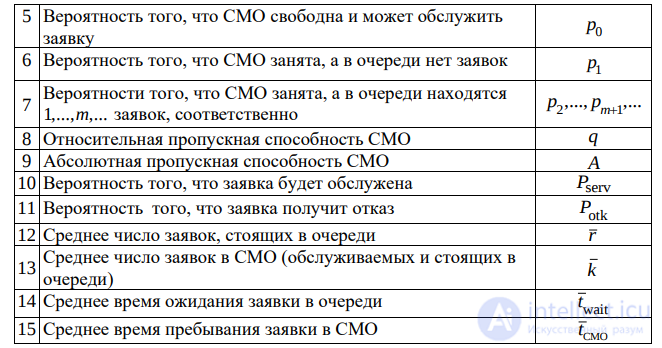
As performance measures of a single-channel QS with a limited queue length we shall consider:
A - the absolute throughput of the QS;
Q - the relative throughput;
Ploss - the loss probability;
Ls - the mean number of customers in the system;
Ws - the mean time a customer spends in the system;
Lq - the mean queue length;
Wq - the mean waiting time in the queue.

The labeled state transition diagram is shown in Figure 11.

Fig. 11. Single-channel QS with limited queue length
S0 - the service channel is free;
S1 - the service channel is busy, but there is no queue;
S2 - the service channel is busy, there is 1 customer in the queue;
***
Sm - the service channel is busy, all m customers are in the queue;
***
Problem statement

Since there is no limit on the queue length, any customer can be serviced, therefore Pserv = 1, hence the relative throughput  , and the absolute throughput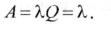
Limiting probabilities:
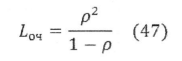
The mean number of customers in the queue:
The mean number of customers in the system:

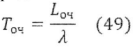
The mean waiting time for service in the queue:
The mean time a customer spends in the system:
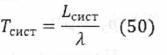
If  ., then the queue will grow indefinitely. Of greatest interest is the QS at
One barber works at the barbershop.
The arrival rate of clients is 4 clients per hour.
The service rate is 5 clients per hour.
It is assumed that the queue may be of unlimited length.
Determine the performance measures of the barbershop's operation and the probability that no more than two clients are waiting in the queue.
Solution.
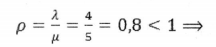 the limiting probabilities exist.
The limiting probability that the barber is idle is determined by the relation
 , and the probability that he is busy is
The probability that there are no more than three clients in the queue:
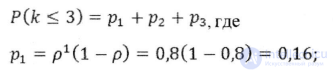

We obtain, 
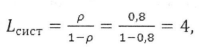
The mean number of customers and the mean time spent in the system are determined by the formulas:
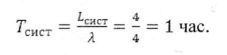
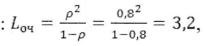
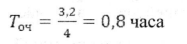
The mean number of clients waiting in the queue, and the mean time spent in the queue:
1. Customers arrive at a single-channel QS with an arrival rate of 0.85 customers per hour. The service time is distributed according to the exponential law and on
average equals 1.05 hours. The queue can grow practically without limit. The flow of customers is the simplest. Find
the performance measures of the QS's operation.
Answer: 
2. A port has one berth for unloading ships. The arrival rate of ships is 0.4 (ships per day).
The mean unloading time of one ship is 2 days. It is assumed that the queue may be of unlimited length. Find the performance measures of the berth's operation, as well as the probability that no more than 2 ships are waiting to be unloaded.
Answer: 

Comments