
Lecture
In various fields of human activity (in industry, science, trade, everyday life), mass demand for various services often arises. The term «mass» implies the multiple repeatability and statistical stability of the process as a whole.
Service — this is direct interaction with a customer, aimed at satisfying their demand.
A queueing system (QS) is a system in which:
The main feature of queueing processes is their randomness. Two interacting parties are distinguished, one of which serves, while the other acts as the one being served. The presence of randomness in the behavior of one of the parties leads to a random course of the entire service process. The causes of randomness lie in the mass character of the needs, as well as in the randomness of the operation of the serving system.
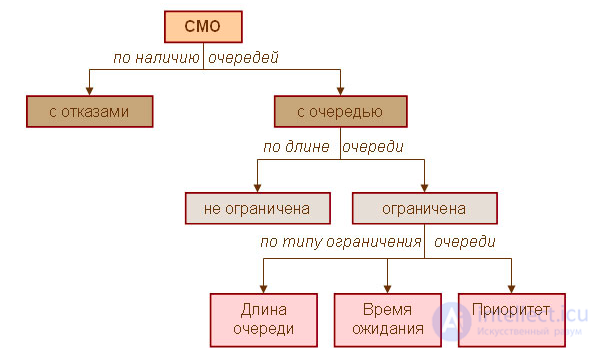
Classification of QS
By the number of service channels:
By the time customers spend in the queue before service begins
In turn, QS with waiting (a queue) are subdivided into:
III. By service priority
1. QS with statistical priority - a QS in which service is performed in order of customer arrival.
2. QS with relative priority - a QS in which a high-priority customer waits for the service of a lower-priority customer to finish (a QS where a more important customer only gets a «better» place in the queue).
3. QS with absolute priority — a QS in which a high-priority customer, upon arrival, preempts a lower-priority customer.
4. QS with mixed priority — a QS in which absolute priority is used if the lower-priority customer has been served for a time less than the critical value, and relative priority is used otherwise.
IV. By service principle
1. QS with service based on the principle "first come - last served" (for example, a QS with service based on the principle "first come - last served")
2. QS with service based on the principle "first come - last served"
V. Depending on the way customers are generated
1. Open QS - a QS in which a finite, usually constant, number of customers circulates, which return to the source after service is completed.
2. Closed QS - a QS in which the source generates an infinite number of customers.
The classification of QS given above is conditional.
In practice, QS most often act as mixed systems. For example, customers wait for service to begin up to a certain moment, after which the system starts working as a loss system. A classification of queueing systems
is given in Diagram 1
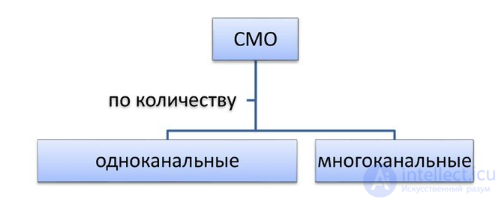
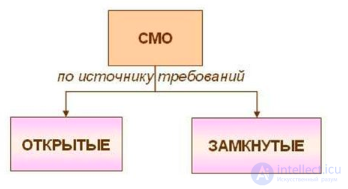
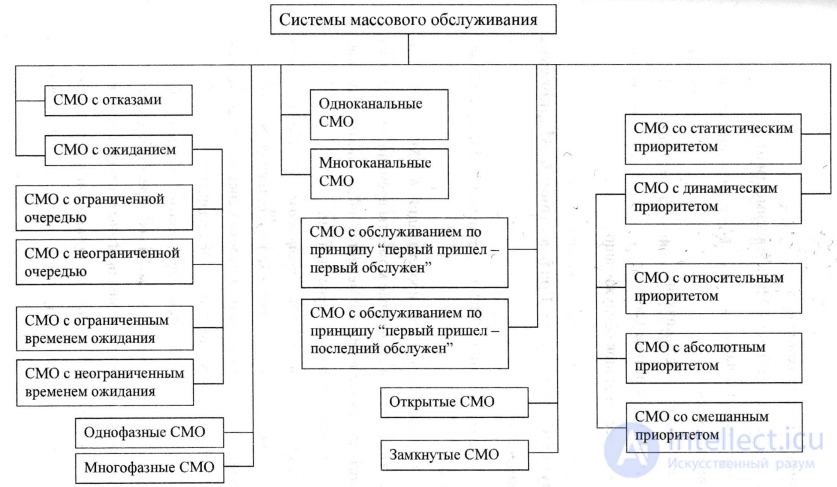
Fig. 1. Classification of QS
Modeling
System
Inventory management system.
Petri nets

Comments