
Lecture
Let us consider a single-channel queueing system with waiting, into which
the simplest flow of customers arrives with arrival rate λ; the service rate μ, (i.e., on average a continuously
busy channel will produce  serviced customers per unit (of time).
The service duration is a random variable subject to the exponential distribution law.
The service flow is the simplest Poisson flow of events.
A customer arriving at a moment when the channel is busy joins the queue and waits for service.
Suppose that the number of places in the queue is limited to a number m, i.e., if a customer arrives at a moment when in the queue
there are already m customers, it leaves the system unserved.
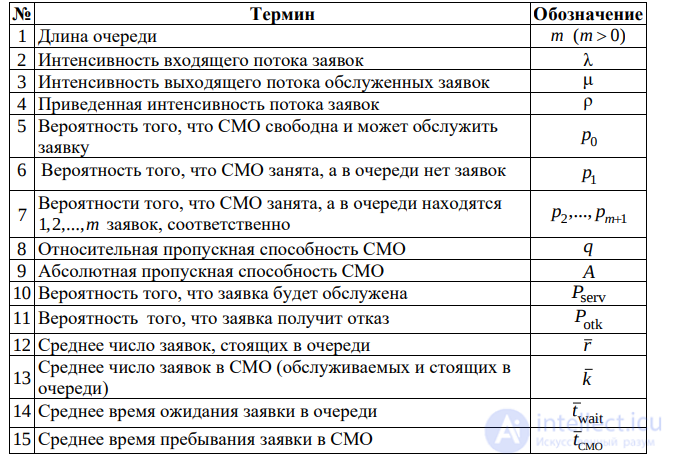
List of terms and notations used
The service flow is the simplest Poisson flow of events.
A customer arriving at a moment when the channel is busy joins the queue and waits for service.
Suppose that the number of places in the queue is limited to a number m, i.e., if a customer arrives at a moment when there are already m customers in the queue, it leaves the system unserved.
As performance measures of a single-channel
QS with a limited queue length we shall consider:
A - the absolute throughput of the QS;
Q - the relative throughput;
Ploss - the loss probability;
Ls - the mean number of customers in the system;
Ws - the mean time a customer spends in the system;
Lq - the mean queue length;
Wq - the mean waiting time in the queue.
The labeled state transition diagram is shown in Figure 9.
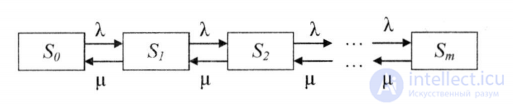
Fig. 9. Single-channel QS with limited queue length
S0 - the service channel is free;
S1 - the service channel is busy, but there is no queue;
S2 - the service channel is busy, there is 1 customer in the queue;
***
Sm - the service channel is busy, all m places in the queue are occupied, any next customer is rejected.
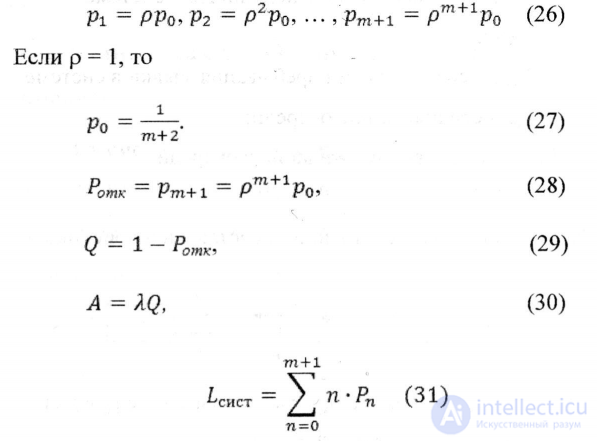
The state probabilities are determined by the equations:

Hence we obtain that if ρ  1, then

Then the remaining limiting probabilities are found by the formulas:
Problem statement
The parameters m , λ and μ are known.
It is required to find 
Formulas for calculations
The traffic intensity of the flow of customers is calculated, as in the previous sections, by the formula

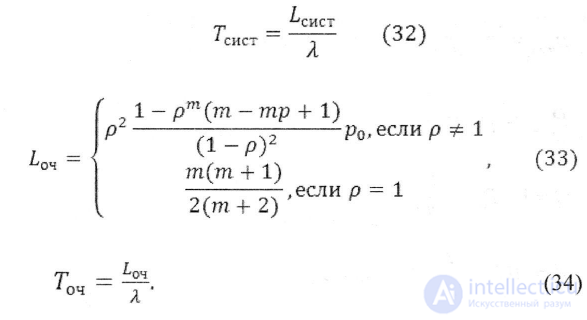
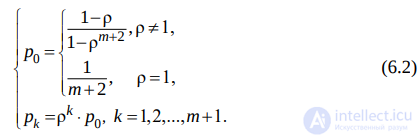
The probabilities 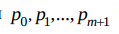 are calculated by the following formulas:
Since a customer is rejected if the QS is busy and there are m customers in the queue, then

Next we obtain

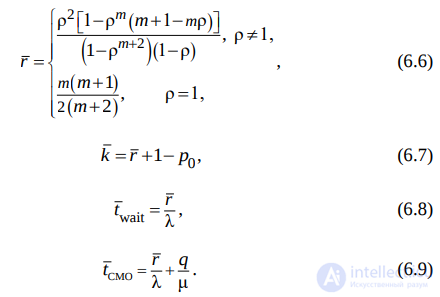
In addition, the following formulas hold
Example 10.
A gas station represents a QS with one service channel (one pump).
The area at the station allows no more than five cars to be in the queue for refueling at the same time (m = 5). If
there are already five cars in the queue, the next car arriving at the station does not join the queue. The flow
of cars arriving for refueling has an arrival rate of λ = 2 (cars per minute). The service
rate is μ = 2.
Determine the characteristics of the QS and draw a conclusion about the efficiency of its operation.
Solution.

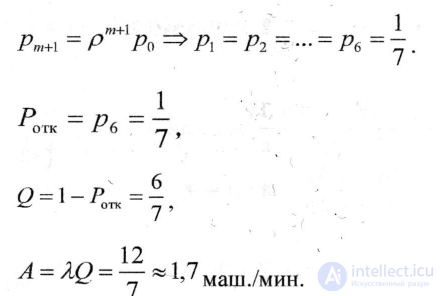
The mean number of customers in the system:

The mean time a car spends in the system: 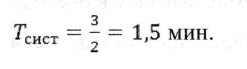
The mean queue length: 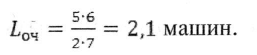
The mean waiting time in the queue: 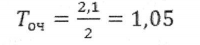
Every seventh customer is denied service => the efficiency of the QS is low.
Example 11.
In a small self-service store it was found that the flow of customers is the simplest with arrival rate λ = 1 customer per minute. This store has one cash register installed, which allows achieving a level of productivity at which the mean service time for one customer is approximately 1.25 min. per customer per minute.
Determine the characteristics of the QS given that the queue is limited by a controller at the entrance to the self-service hall: m = 3 customers.
Solution: Let us find the service rate:
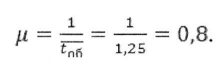
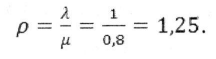
Let us find the traffic intensity of the flow of customers:
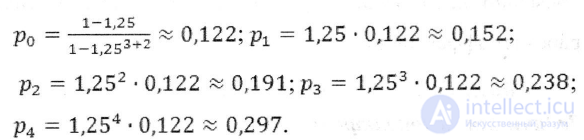
Let us find the limiting probabilities:
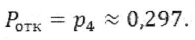
The loss probability:
The relative throughput of the QS:

The absolute throughput of the QS:
 customers per min.
The mean number of customers at the register:

The mean time a customer spends at the register:

The mean number of customers in the queue:

i.e. the mean number of customers waiting in the queue at the register is equal to 1.56.
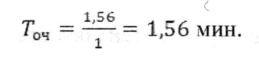
The mean waiting time of a customer in the queue:
The probability of the cashier being idle is small, the mean waiting time of a customer is not large, the loss probability is approximately 0.297. Thus, it can be said that the system operates efficiently.
1. At a car wash there is one servicing unit and a place for a queue. Cars arrive according to a Poisson distribution with an arrival rate of 5 cars/hour. The mean service time of one car is 10 minutes. Find all the mean characteristics of the QS.
Answer 
2. An auto service (diagnostic station) represents a single-channel QS. The number of parking spaces for cars waiting for service is limited and equal to 3. If all the parking spaces are occupied, i.e. there are already three cars in the queue, then the next car arriving at the auto service for diagnostics does not join the queue. The flow of cars arriving for diagnostics is distributed according to the exponential Poisson law and has an arrival rate of 0.85 (cars per hour). The diagnostic time is distributed according to the exponential law and on average equals 1.05 hours. Determine the probabilistic characteristics of the QS's operation and draw a conclusion about the efficiency of its operation.
Answer: 

Comments