
Lecture
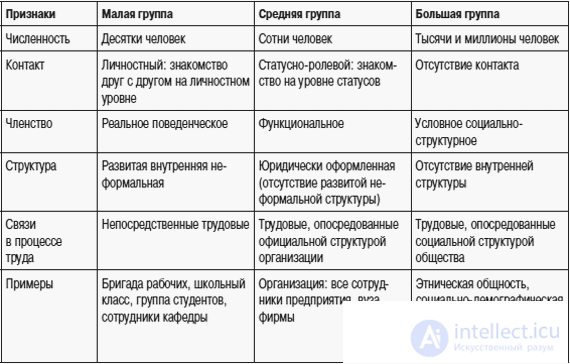
A small group — a social group small in composition, whose members are united by common social activity and are in direct personal contact, which is the basis for the emergence of emotional relationships, group norms, and group processes. A distinctive feature in defining the concept of a small group is its inclusion in the social world, which is why the American psychologist Roger Brown considers awareness of the group's existence by persons outside the group to be one of the important characteristics of a small group.
Small groups include an individual's immediate environment: family, study group, work team, and so on.
The family, as a small group, is the environment that surrounds a child from birth, within which the child is socialized, develops, and interacts with other members of the group. Thus, this area falls within the interest of social psychology, whose subject is the study of the behavior and interaction of individuals belonging to a particular social group. Researchers' attention to the small group is also explained by the fact that it is a unit of analysis in which psychological experimentation is most appropriate.
In the classification of social groups by quantitative characteristic, besides small groups, large and medium groups are also distinguished.
A large group — a group unlimited in number, having its own values, traditions, and norms of behavior. Interaction in such a group is carried out through the mass media.
Medium groups are similar in their characteristics to large groups; however, a distinctive feature is that individuals interact with one another in a formal manner (for example, in the workforce of a large factory).
Members of small groups interact directly with each other and are united by a common goal and activity. The connection between members of a small group is so strong that a change in one part of the interaction entails a change in the group as a whole.
Research on small groups has passed through three stages:
It is traditionally customary to speak of the «lower» and «upper» limits of a small group.
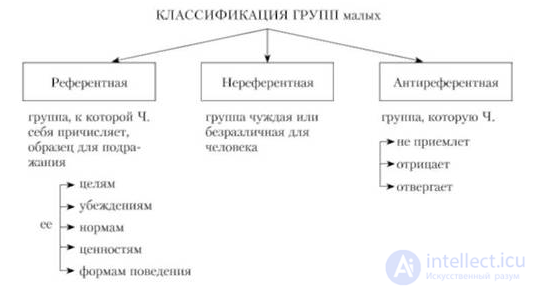
Fig. 6.16. Classification of small groups

Fig. 6.17. The position of the individual in the group
Three main directions in the study of small groups are distinguished :
1. The most generalized concept comes down to the following: A small group — a group small in composition, whose members are united by common social activity and are in direct personal contact, which is the basis for the emergence of emotional relationships, group norms, and group processes.
If we single out what is most essential and significant, the concept of small groups will be as follows:
A small group – is a group in which social relationships take the form of direct personal contacts.
This definition contains, in condensed form, the main features of a small group identified in other systems of social-psychological knowledge, and at the same time clearly conveys the central idea of understanding the group from the standpoint of the principle of activity.
The definition also fixes the specific feature of a small group that distinguishes it from large groups: social relationships here take the form of direct personal contacts.
The following features of small groups are distinguished:
The following patterns are characteristic of a group:
In principle, the most varied bases for classifying small groups are admissible: groups differ by the length of their existence (long-term and short-term), by the degree of closeness of contact between members, by the manner of an individual's entry, and so on. The three most common classifications are: 1) the division of small groups into «primary» and «secondary», 2) their division into «formal» and «informal», 3) division into «membership groups» and «reference groups».
The division of small groups into primary and secondary was first introduced by the American sociologist C. Cooley. He introduced into the classification of small groups such a feature as the directness of contacts.
Primary groups — the members of the group are connected by a strong emotional bond and share common goals, values, and standards. Such a group consists of a small number of people among whom direct relationships are established, in which their individual characteristics play a significant role. Examples of such groups are student study groups and academic department staffs.
Secondary groups – connections within the group are less emotional but more rational, consisting of people who have little in common, sharing only certain values and interests. An example of such a group is the entire staff of an educational institution.
The division of small groups into formal and informal was first proposed by the American researcher E. Mayo.
A formal group is distinguished by the fact that the positions of all its members are clearly defined and prescribed by group norms. The roles of all group members are strictly distributed, as is the system of subordination to leadership. An example of a formal group is any group created for a specific activity: a work brigade, a school class, a sports team, and so on.
Within formal groups, E. Mayo also identified «informal» groups, which form and arise spontaneously, where neither statuses nor roles are prescribed, and where there is no given vertical system of relationships. An informal group can form within a formal one — for example, when cliques of close friends united by some common interest arise within a school class, so that two structures of relationships become intertwined within the formal group. But an informal group can also arise on its own, not within a formal group but outside of it: people who happen to come together to play volleyball somewhere on the beach, or a closer circle of friends.
H. Hyman distinguishes the following groups:
Reference groups – any real group to which a person voluntarily assigns himself or of which he would like to become a member.
Non-reference groups – groups that are alien to the individual or indifferent to him.
2. Structural Components of Small Groups
The composition of a group, or its makeup, is considered first of all in describing it. It can be described depending on whether, in each particular case, characteristics such as the age, professional, or social characteristics of each group member are significant.
There are several models of the structure of a small group: the structure of interpersonal relations among group members, the power structure, the communication structure, and others.
The structure of interpersonal relations primarily requires clarifying the position of the individual in the group as one of its members. The first of the concepts used here is the concept of «status» or «position», denoting the individual's place within the system of group life. The second characteristic of the individual in the group is «role». A role is usually defined as the dynamic aspect of status, which is revealed through the list of actual functions assigned to a person by the group, by the content of the group's activity. If we take a group such as the family, we can use it to illustrate the relationship between status, or position, and role. In a family, different status characteristics exist for each of its members: there is the position (status) of mother, father, elder daughter, younger son, and so on. If we now describe the set of functions that the group «prescribes» for each position, we obtain the characteristics of the role of mother, father, elder daughter, younger son, and so on. A role should not be regarded as something fixed: its dynamism lies in the fact that, while the status is preserved, the set of functions corresponding to it can vary greatly across different groups of the same type, and, most importantly, in the course of the development of both the group itself and the broader social structure in which it is included.
An important component of the individual's position in a group is the system of «group expectations». This term denotes the simple fact that every member of a group not merely performs his functions within it, but is also necessarily perceived and evaluated by others. In particular, this refers to the fact that for each position, as well as for each role, the performance of certain functions is expected, and not merely a simple list of them but also the quality of their performance. Through a system of expected patterns of behavior corresponding to each role, the group exerts a certain degree of control over the activity of its members. In order for this system of expectations to be somehow defined, two extremely important formations also exist within the group: group norms and group sanctions.
All group norms are social norms, that is, they represent «prescriptions, models, standards of what ought to be, from the point of view of society as a whole and of social groups and their members, regarding behavior». In a narrower sense, group norms are certain rules that have been developed by the group, accepted by it, and to which the behavior of its members must conform in order for their joint activity to be possible (Bobneva, 1978). Norms thus perform a regulatory function with respect to this activity. Group norms are connected with values, since any rules can only be formulated on the basis of the acceptance or rejection of certain socially significant phenomena (Obozov, 1979).
When examining group norms, an analysis of sanctions is necessary – the mechanisms by which a group «returns» its member to the path of compliance with norms. Sanctions may be of two types: encouraging and prohibitive, positive and negative. The system of sanctions is designed not to compensate for non-compliance with norms, but to ensure compliance with them.
The power structure of a small group refers not to forms of political power, but to a purely psychological distribution of relations of leadership and subordination. Forms of power: rewarding power (existing, for example, in the family to maintain harmony); coercive power (necessary, for example, in an institution to maintain discipline); informational power (relying on persuasion).
The communication structure. The success of group activity depends on how clearly and effectively the necessary information is disseminated, and on how the exchange of it among group members is ensured.
Several models of communication networks are distinguished. The «wheel» model is considered the most centralized: in this case, information is transmitted only through the leader. For some forms of communication this is necessary, while for others less centralized models are acceptable: the «Y», the «chain», the «circle». The advantages and disadvantages of these models can only be fully understood in connection with the study of the effectiveness of group activity.
The main task of social-psychological analysis is the study of the processes that take place in the life of a group.
The term «group dynamics» has several meanings: 1. A field of research in social psychology in which the processes of the emergence, functioning, and development of social groups are studied. 2. The social-psychological processes occurring in small groups as they form and develop.
The dynamic process includes the formation of small groups and their development, processes of group cohesion, processes of leadership and management, processes of group decision-making, and processes of group pressure and mutual influence.
The overall system of human relations that has taken shape within a social group is called the socio-psychological climate. The psychological climate includes people's attitudes toward the work and toward one another, their compliance or non-compliance with moral norms, their satisfaction or dissatisfaction with what is happening within the group and beyond it, and so on.
Having arisen due to external circumstances, a small group «undergoes» a lengthy process of becoming a psychological community. The most important content of this process is the development of group cohesion.
Group cohesion — a socio-psychological characteristic of the unity of a small group, manifested in the commonality of views, goals, values, social attitudes and social norms of the group's members, as well as in the consistency of their actions in various social situations.
In the course of this development, the group does not simply produce certain norms and values while its members merely assimilate them. A far deeper integration of the group takes place, in which the values relating to the group's substantive activity are increasingly shared by individual members not because they «like» them more or less, but because the individuals are included in this joint activity itself. This activity becomes so significant in the life of each group member that he accepts its values not under the influence of the development of communication or persuasion, but through the very fact of his ever more complete and active involvement in the group's activity. The main determinant of a group's formation, in the psychological sense of the word, is joint activity. It is thus not only an externally given condition for the existence of a given group, but also its internal foundation.
Related but more specific concepts in relation to group cohesion are «compatibility» and «coordination». Compatibility is understood as the psychological result of such a combination of the individual-personal characteristics of group members that leads to their high subjective satisfaction and interpersonal sympathy. Coordination — is the psychological result of the interaction of group members in the course of joint activity, which leads to a high level of its productivity.
In the process of a small group's development, a considerably important role is played by the so-called phenomenon of group pressure. In social psychology, this phenomenon has been given the name of the conformity phenomenon. The word «conformism» itself has a quite definite meaning in ordinary language and denotes «opportunism». The matter is further complicated by the fact that the concept of «conformism» has acquired a specifically negative connotation in politics, as a symbol of appeasement and reconciliation. In order to somehow separate these different meanings, the social-psychological literature more often speaks not of conformism but of conformity, or conformist behavior, referring to a purely psychological characteristic of the individual's position relative to the position of the group, that is, the degree of his submission to group pressure. In works of recent years, the term «social influence» is often used.
Conformity is established there and then, where and when a conflict is recorded between the opinion of the individual and the opinion of the group, and this conflict is resolved in favor of the group. The degree of conformity is the degree of submission to the group in a case where the opposition of opinions was subjectively perceived by the individual as a conflict.
The conformity model was first demonstrated in the well-known experiments of S. Asch, carried out in 1951. These experiments are considered classic, despite having been subjected to quite serious criticism. (Example: a group of students was asked to determine the length of a presented line. For this, each was given two cards — one for the left hand and one for the right hand. The card in the left hand showed a single line segment, while the card in the right hand showed three segments, only one of which was equal in length to the segment on the left-hand card. Subjects were asked to determine which of the segments on the right-hand card was equal in length to the segment shown on the left-hand card. When the task was performed individually, everyone solved it correctly. The point of the experiment was to reveal the pressure of the group on individuals' opinions by means of the «confederate group» method. The experimenter arranged in advance with all participants in the experiment except one (the «naive subject»). The essence of the arrangement was that, when the segment on the left-hand card was successively shown to all members of the «confederate» group, they gave a knowingly incorrect answer, calling this segment equal to a shorter or longer segment on the right-hand card. The «naive subject» answered last, and it was important to determine whether he would stand by his own opinion (which had been correct in the first series, when deciding individually) or yield to the pressure of the group. In Asch's experiment, more than a third (37%) of the «naive subjects» gave erroneous answers, that is, they demonstrated conformist behavior. In subsequent interviews they were asked how they had subjectively experienced the situation set up in the experiment. All the subjects stated that the majority opinion exerted very strong pressure, and even the «independent» ones admitted that it was very difficult to resist the group's opinion, since each time it seemed that it was they themselves who were mistaken).
Further research into the phenomenon of conformity led to the conclusion that pressure on an individual can be exerted not only by the majority of a group but also by a minority. Accordingly, M. Deutsch and H. Gerard identified two types of group influence: normative (when pressure is exerted by the majority, and its opinion is perceived by the group member as a norm) and informational (when pressure is exerted by the minority, and the group member regards its opinion merely as information on the basis of which he must make his own choice). Thus, the problem of majority and minority influence, analyzed by S. Moscovici, is also of great significance in the context of the small group.
In characterizing the dynamic processes in small groups, a question naturally arises as to how the group organizes itself, who takes on the functions of organizing it, and what the psychological pattern of the activity of managing the group looks like.
The problem of leadership and management is one of the cardinal problems of social psychology, since both of these processes not only relate to the problem of the integration of group activity but also psychologically describe the subject of this integration. It is extremely important, first of all, to make terminological clarifications and to distinguish between the concepts of «leader» and «manager».
A leader is a member of the group whose authority, power, and standing are voluntarily recognized by the other members of the group, who are ready to obey him and follow him. He possesses informal, or unofficial, authority in the group, distinct from the authority held by an officially appointed or elected manager. As a rule, the person who becomes leader is one whom the group's members themselves choose and recognize and who, for his part, expresses a desire to become one.
Leadership and management were most clearly and consistently distinguished in the works of B. D. Parygin.
1) a leader is primarily called upon to regulate interpersonal relations within the group, whereas a manager regulates the official relations of the group as a certain kind of social organization;
2) leadership can be observed under conditions of the microenvironment (which is what a small group is), whereas management is an element of the macroenvironment, that is, it is connected with the entire system of social relations;
3) leadership arises spontaneously, whereas management arises in an organized manner;
4) the phenomenon of leadership is less stable, and the emergence of a leader depends to a large degree on the mood of the group, whereas management is a more stable phenomenon;
5) management of subordinates, unlike leadership, has a far more clearly defined system of various sanctions, which a leader does not have at his disposal;
6) the process of decision-making by a manager (and in the system of management in general) is considerably more complex and is mediated by a multitude of various circumstances and considerations not necessarily rooted in the given group, whereas a leader makes more direct decisions concerning group activity;
7) the sphere of a leader's activity is essentially the small group in which he is the leader, while the sphere of a manager's activity is broader, since he represents the small group within a wider social system.
There are four main theoretical approaches to understanding the origin of leadership. The «trait theory» (sometimes called the «charismatic theory of leadership»). According to this theory, only a person who possesses a certain set of personal qualities or a combination of certain psychological traits can be a leader. And these properties are inherent in the person from birth or are given to him as a kind of «grace from God» («charisma» means simultaneously both «God's gift» and «God's grace»).
The trait theory was replaced by a new explanation formulated in the «situational theory of leadership». This theory asserts that a person does not need to possess any particularly special personal qualities in order to become a leader. It is enough to have certain positive traits valued by people, together with a favorable situation for their manifestation.
The theory of value exchange (authored by R. L. Krichevsky) asserts that a person's rise to group leader depends not only on his individual characteristics or on the situation prevailing in the group, but rather on the interaction of that person with the group. If, in the course of such interaction, the individual and the group discover common interests or values, this circumstance will facilitate that person's emergence as the group's leader.
The systemic theory of leadership asserts that, first, leadership is not unambiguously determined by a single factor; and second, in order for someone to become a leader in a group, a combination of an entire range of conditions is necessary, and these conditions must arise simultaneously.

Comments