
Lecture
A crowd (ochlos, throng, gathering, multitude, crush) — a large accumulation, a multitude of people converged together, as well as the most random association of people united in a given space by a purely temporary, transient interest.
A crowd is chaotic, though not entirely devoid of organization. The organizing factor may be a common object of attention, a tradition, or an event. Members of a crowd are often in a similar emotional state. A crowd is described by a whole range of parameters and characteristics, such as the number of people gathered, the direction and speed of movement, psychological state, and others. The crowd is a subject of study in social psychology, which in particular introduces classifications of crowds according to a number of criteria. Gustave Le Bon was the first, along with other representatives of the criminological school, such as Cesare Lombroso, Scipio Sighele, and Raffaele Garofalo, to regard the crowd as an exclusively irrational, spontaneous, and destructive force in society. In some cases a crowd can pose a danger to those around it (for example, looters, rioters) and to itself (in the case of panic). Crowds have played a significant role in history. V. G. Belinsky wrote: «A crowd is a gathering of people living by tradition and reasoning by authority».
Social psychology has developed several classifications of crowds.
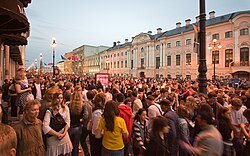
A conventional crowd of schoolchildren on Nevsky Prospekt («Scarlet Sails» 2008)
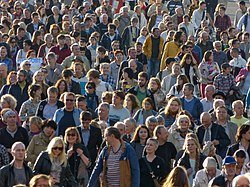
A large gathering of people in Moscow during the «March of Peace» on September 21, 2014
By degree of organization:
By the nature of people's behavior:
By activity and direction of action (classification by S. K. Roshchin):
Phenomena such as riots, uprisings, coups (revolutions), migrations of peoples, wars, and other phenomena involving the participation of large numbers of people are studied.
The main task is predicting crowd behavior. In doing so, differences between individual members of the crowd are not taken into account, and phenomena are treated as statistical averages.
The goal is to explain the mechanisms that bring a person into a state in which they become susceptible to the influence of the crowd.
Crowd psychology — a branch of social psychology that studies the behavior of groups of people and the differences between group behavior and the behavior of individuals.
In psychology, a crowd is understood as an unstructured, temporary gathering of people without a clear goal, whose members share a similar emotional state and objects of attention. One of the striking features of a crowd from a psychological standpoint is that any individuality can dissolve within it, no matter how educated and cultured the individual may be outside the crowd.
History knows many examples of large groups of people producing dramatic and unexpected social changes by acting outside the usual mechanisms and patterns. Such events often lead to conflicts. Scholars have developed several different theories explaining crowd psychology.
The mental state of an individual in a crowd is characterized by a sharp intensification of the influence of the following factors:
The psychology of the crowd has long occupied the minds of thinkers. Gustave Le Bon, in «The Psychology of Peoples and Masses», characterized the soul of the crowd as follows:
The most striking fact observed in an animated crowd is this: whatever the individuals composing it may be, whatever their way of life, occupation, character, or intelligence, their mere transformation into a crowd is enough to form in them a kind of collective soul that makes them feel, think, and act in a completely different way from how each of them would think, act, and feel individually. There are ideas and feelings that arise and turn into actions only in individuals who form part of a crowd. The animated crowd is a temporary organism formed from heterogeneous elements united for a single moment, much as cells that make up a living body join together to form, through this union, a new being possessing properties different from those possessed by each cell individually.
Mass hysteria — a phenomenon in crowd psychology in which, according to the Russian psychologist and academician V. M. Bekhterev, a crowd behaves more foolishly than an individual and ceases to be a collection of rational beings.
If a crowd or parts of it move in some way, the following division can be made:
An example of periodically forming crowds is the passenger flow of the Moscow Metro during rush hours, 7-8 and 18-19. The most overloaded metro station in Moscow is considered [by whom?] to be «Vykhino». Large crowds form at all transfer stations near the escalators.
Studies have shown that human crowds move in ways resembling a fluid, and can be modeled using such methods as particle simulation and statistical physics. Similar observations have been made regarding automobile traffic and the movement of ant colonies.
Crowd manipulation — the deliberate or unintentional use of techniques based on the principles of crowd psychology to engage, control, or influence the desires of a crowd in order to direct its behavior toward a particular action. [This practice is common in religion, politics, and business, and can foster approval, disapproval, or indifference toward a person, policy, or product. The ethics of crowd manipulation are commonly called into question.
Crowd manipulation differs from propaganda, although the two can reinforce one another to produce a desired outcome. If propaganda is «a consistent, long-lasting effort to create or shape events in order to influence the public's attitudes toward an enterprise, idea, or group», then crowd manipulation is a relatively brief call to action after the seeds of propaganda (i.e., more specifically, «pre-propaganda») have been sown and the public has been organized into a crowd. A propagandist appeals to the masses, even when they are dispersed, whereas a crowd manipulator appeals to a segment of the masses gathered into a crowd (for example, a political demonstration, a congregation, or a camp meeting) in real time. However, in situations such as a national emergency, a crowd manipulator can use the mass media to address the masses in real time, as if speaking to a crowd.
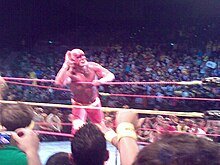
WWF wrestler Hulk Hogan works the crowd during a televised wrestling match.
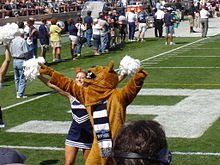
The Penn State Nittany Lions football team fires up a crowd of more than 100,000 college football fans
Since the advent of mass production, companies and corporations have used crowd manipulation to sell their products. Advertising serves as propaganda that prepares a future crowd to receive and accept a particular message. Edward Bernays believed that certain advertisements are more effective if they create an environment that encourages the purchase of specific products. Instead of advertising the features of a piano, sell prospective customers on the idea of a music room.
The entertainment industry makes extensive use of crowd manipulation to excite fans and increase ticket sales. It not only fosters unity through the mass media, but also employs rhetorical devices to engage the crowd, thereby enhancing its experience.

Comments