
Lecture
Panic, panic fear — a sudden feeling of fear so strong that it overwhelms logical thinking. Panic can arise in individual people or manifest in large groups as mass panic. Panic — is a sudden feeling of fear that is so strong it overwhelms or impedes common sense and logical thinking, replacing it with an overwhelming feeling of anxiety and frantic agitation consistent with the animal «fight or flight» response. Panic can arise in individuals or suddenly manifest in large groups in the form of mass panic (closely related to herd behavior).
The word «panic» comes from Ancient Greek and is a tribute to the god Pan, who, according to mythology, was the god of shepherds, forests, and pastures.
The Greeks believed that he often wandered peacefully through the forest playing his pipe, but when he happened to wake up from his midday nap, he would let out a loud cry that sent the herds scattering. That is why Greek authors coined the word panikos, meaning «sudden fear», which became the basis for the Russian word «panika» . The Greek term points to a feeling of utter fear, which was also often attributed to the sudden presence of a god .
A growing sense of anxiety, a feeling of helplessness, and the inability to somehow influence a situation faced by a person in a crowd can trigger the activation of panic behavior. As a rule, the damage from the consequences of mass panic significantly exceeds the damage from the events that provoked it. That is why we propose to examine what panic is, why it arises, and how to eliminate it.
Panic is a socio-psychological phenomenon representing the manifestation of a group affect of fear.
As a consequence, fear blocks the ability to rationally assess the situation that has arisen.
Characteristics of panic:
1) it arises in numerically large groups;
2) it is caused by a feeling of uncontrollable fear based on a real or imagined threat;
3) it arises spontaneously and in a disorganized way;
4) people display behavioral uncertainty (a state of confusion, ambiguity, chaotic actions, and inadequate behavior overall).
Types of panic:
1) by scope:
a) mass panic – encompasses large masses of people (during fires, floods, etc.);
b) individual panic – the panic of a single person (a student's nervousness before an exam);
2) by nature:
a) affective panic – a group reaction regulated by an instantaneous overwhelming of people with strong feelings of horror and fear. It begins with the individual panic of certain hysterical, highly suggestible individuals (panic-mongers), who infect other people with panic moods;
b) behavioral panic (panic moods) – these are emotionally driven, deliberate decisions and actions that do not always correspond to the scale of the threat or the reasons prompting them. It develops and subsides gradually. It arises not in a crowd, but among the population or in individual groups.
Forms of manifestation of panic:
1) mass flight – the unconscious flight of people from an imagined or real danger;
2) panic moods – the psychological states of individuals or entire classes and strata of society, in which the ratio between the orientational and regulatory components, the emotional and the rational, is altered. Behavior is determined by random stimuli and is poorly predictable;
3) economic panic most often occurs on banking exchanges, resulting in either an incredible influx of depositors or a financial crisis, amid inflation, rising prices, and changes in the economic way of life in the country.
Factors contributing to the development of panic:
1) an atmosphere of anxiety and uncertainty in a large group of people;
2) a danger which, if realized, threatens a person with death, injury, or loss of property;
3) the brevity of the situation for making a decision on which a great deal depends;
4) the need to act without a conscious plan;
5) the presence of rumors that excite and stimulate panic;
6) a large number of people prone to panic;
7) certain unpredictable physical, mental, and social factors (a coincidence of circumstances).
The causes that give rise to panic are usually divided into three groups: physiological, psychological, and socio-psychological.
Physiological causes include severe physical fatigue, prolonged insomnia, severe mental shock, depression, hunger, intoxication, and so on.
Among the psychological causes are self-doubt and the awareness of helplessness in the face of imminent danger, a feeling of isolation, and sudden fear.
Socio-psychological causes. An excess of alarming information or a deficit of information.
Stages in the development of panic:
1) the appearance of a stimulus for panic;
2) a strong emotional reaction of individual people who begin to sow panic;
3) the emotional contagion of those around them, who also fall into panicked motion;
4) general panic;
5) the restoration of calm as a result of the decrease in the number of people in the crowd and the loss of strength, apathy.
Ways to prevent panic:
1) at the first stage – loud and authoritative persuasion;
2) at the second – individuals not prone to a panicked state plan and regulate through orders;
3) at the third – the use of a strong stimulus (an announcement over a loudspeaker that the panic is over, followed by instructions). The use of force and the removal of the most malicious panic-mongers.
Rules for interacting with a crowd in a state of panic: -
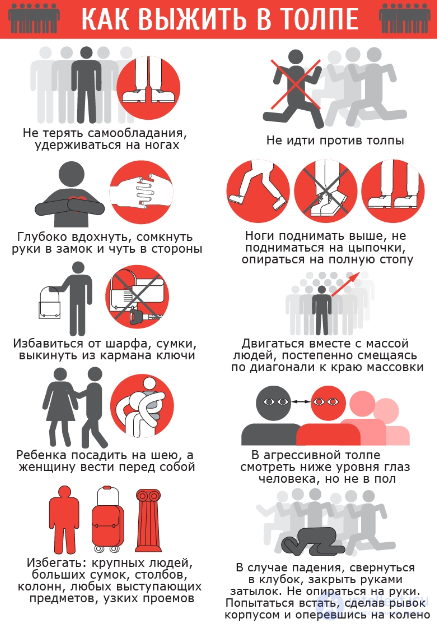
1. Analyze the situation. Do not let your opinions drift on their own; focus on analyzing what is happening;
2. Control the situation. In extreme circumstances it is important to control the process; your actions must be deliberate;
3. If, in the given circumstances, you do not know what needs to be done, the simplest thing you can bring under control is your own breathing;
4. Try to think of something pleasant, smile, or joke about the situation: this will help ease the nerves and shift your thoughts away from a sense of hopelessness.
5. Look at the situation from above. Try to detach yourself, direct your thoughts upward, and imagine that you are observing the situation from a bird's-eye view. This will help you get out of the state of panic more quickly.
Consequently, in a crowd the human psyche and the specific way in which mental processes unfold change fundamentally. Instincts become the main regulators of people's behavior in a crowd. Cognitive processes aimed at understanding and categorizing the surrounding world weaken significantly. Interaction between people becomes one-sided, and rules and norms lose their regulatory function. The psychological world of a person undergoes especially strong changes in a crowd that is in an agitated state.
As preventive measures among participants in the educational process, activities can be introduced that involve: analyzing the characteristics of the emergence and course of various forms of individual and collective fear reactions (panic); familiarization with methods of preventing panic; and reviewing rules of behavior and methods of self-control in a crowd gripped by panic, which will undoubtedly contribute to awareness and have a positive effect.
In psychology, panic is defined as a disorder and is closely linked to biological and psychological factors and their interactions. One point of view holds that panic is a specific psychological vulnerability of people to interpret normal physical sensations in a catastrophic way. Leonard J. Schmidt and Brooke Warner describe panic as «that terrible, deep emotion that pulls us beyond our capacity to imagine a more terrible experience», adding that «doctors like to compare painful clinical conditions on some imaginary „Richter scale“ of vicious, moderate pain … for the psychiatrist, there is no more vicious, moderate pain than an exploding and personally devastating panic attack».
During panic, a person experiences intense fear and negative thoughts, depending on the cause of the panic.
Panic in social psychology is considered contagious, since it can spread to many people, and those affected are expected to act irrationally as a result. Psychologists distinguish various types of panic states with slightly differing descriptions, which include mass hysteria, mass psychosis, mass panic, and social contagion .
An influential theoretical treatment of panic is found in Neil Smelser's theory of collective behavior. The science of panic management has found important practical application in the armed forces and emergency services around the world.
Ancient people used mass panic as a technique when hunting animals, especially ruminants. Herds reacting to unusually loud sounds or unfamiliar visual effects were driven toward cliffs, where they ultimately leapt to their deaths when cornered.
People are also vulnerable to panic, and it is often considered contagious. One person in a panic can easily spread it to other people nearby, and soon the entire group begins to act irrationally. At the same time, people have the ability to prevent and/or control their own panic and that of others. Substance abuse in the form of illegal drug use, tobacco smoking, and marijuana use has also been shown to be linked to panic attacks.
Architects and urban planners try to accommodate such a symptom of panic as herd behavior when designing and planning, often using simulations to determine the best way to lead people to a safe exit and prevent stampedes. The most effective methods are often not intuitive. A tall column, or columns positioned in front of a doorway exit at a precisely calculated distance, can speed up the evacuation of a large space.
Many widely covered cases of deadly panic have occurred during mass public events. The layout of Mecca has been extensively redesigned by Saudi authorities in an attempt to eliminate the frequent crushes that kill an average of 250 pilgrims each year. Deadly crushes caused by crowds of fans surging and panicking have also occasionally occurred at football stadiums. For example, at Heysel Stadium in Belgium in 1985, with more than 600 casualties, including 39 deaths, or at Hillsborough Stadium in Sheffield, England, in 1989, when 96 people were killed in a crush.
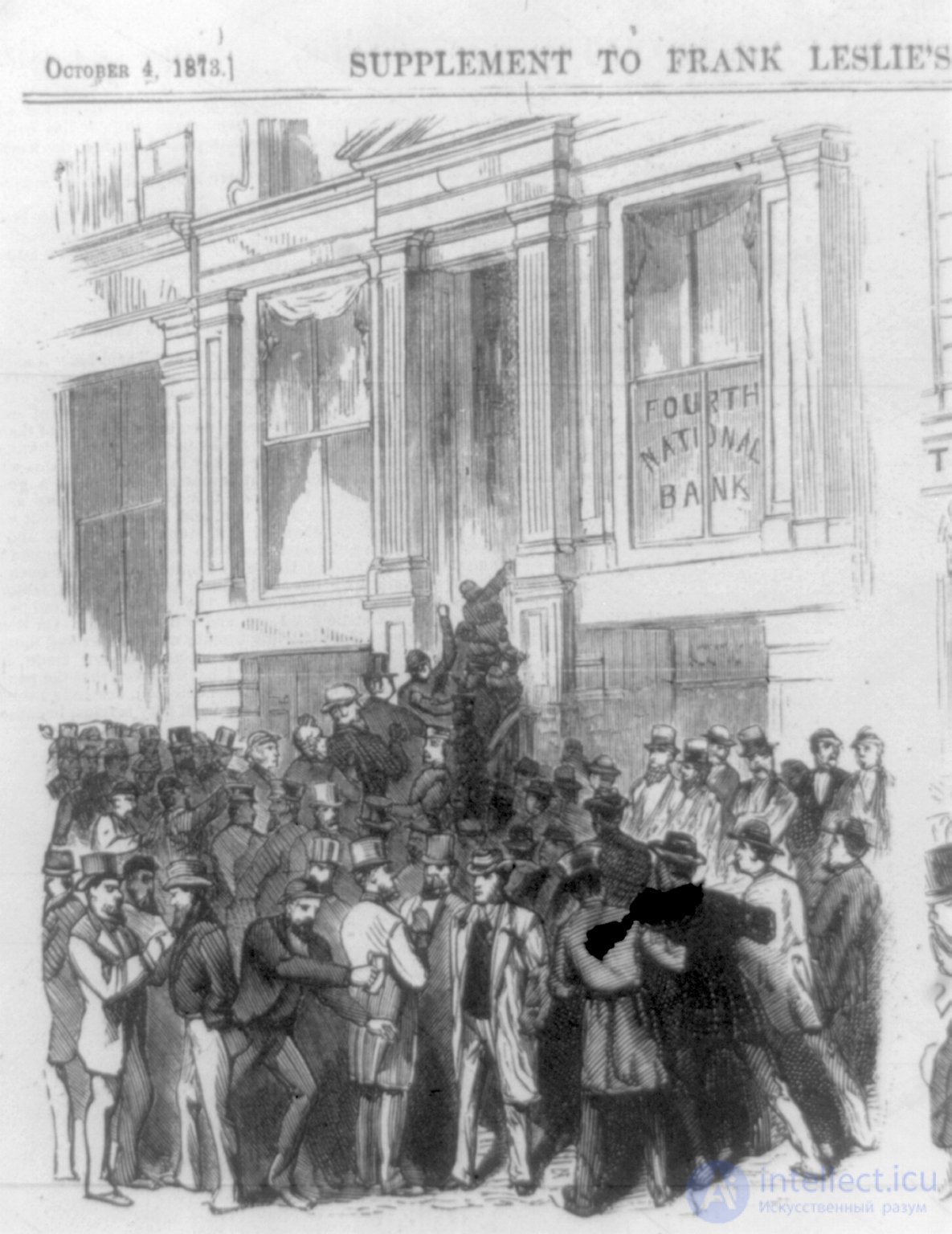
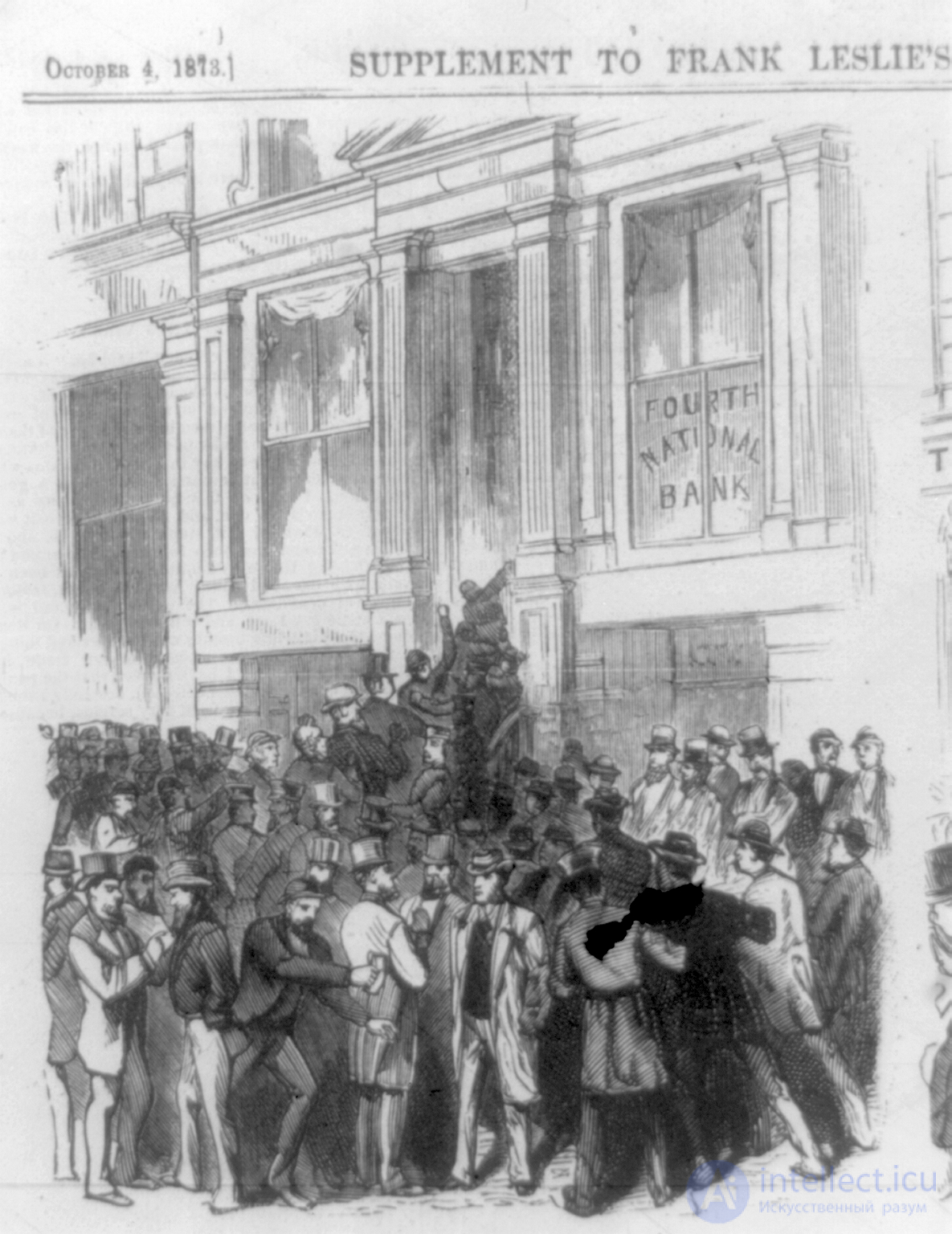
Panic at a bank, Fourth National Bank, New York, 1873.

Comments