
Lecture
Это окончание невероятной информации про мотив.
...
results of studies carried out under both variants of the second-type design for measuring motivation are described in more detail in Chapter 6. It goes without saying that this design focuses all its attention on personality factors.
There is yet another experimental design for studying individual differences in the hypothetical variable "motive." In this third type of experiment, the specific conditions for the actualization of the motive are neither controlled nor arranged by the researcher. The main task here is to identify, as the individual develops, the specific motive-actualizing situations that have entered into his past experience, since the current individual manifestations of the motive should depend on them. In other words, this concerns the second of the fundamental problems — the genesis of motives — which means that, in clarifying situational aspects, it is necessary to record selectively, but with the fullest possible detail, indicators of the character and frequency of motive-actualizing situations experienced in the past.
For this purpose, special questionnaires and experimental observations are used, in which everyday situations connected with motive actualization are classified in accordance with the history of the individual's prior development (see Chapter 13). Thus, for example, for the genesis of the achievement motive it matters to what extent, and how early, the child began systematically encountering situations in which the mother granted and supported his independence. Explanations of individual differences in behavior in theories of socialization are built on the model of the third-type experimental design. The age-related, ecological accumulation of stimulus situations leads to individual differences in motives.
The analysis of the hypothetical construct "motivation" (HC2) is associated with two experimental designs (IV and V) that have acquired the status of standard, widely used designs in the psychology of motivation. In these designs the motive (i.e., the behavior representing it) is already treated as an independent variable, while all manner of behavioral aspects serve as dependent variables, insofar as they are considered to be determined — even if only indirectly — by the specifics of the corresponding motive. To distinguish them from the direct behavior representing the motive, the dependent variables representing motivation are treated as criterion variables and designated with the numeral 2. Table 1.3 gives examples of such criterion variables for three different motives.
Table 1.3
Examples of criterion dependent variables covarying with individual differences via the corresponding motive
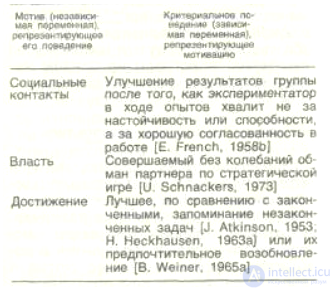
In the experimental designs under consideration, data on criterion dependent variables make it possible to judge how consistently and broadly the range of behaviors regarded as relevant to the motive covaries with its hypostatized manifestation, i.e., is apparently determined by it. These data also make it possible to refine the motive itself, as identified on the basis of representative behavior. If the expected relationships are confirmed, the resulting tightening of the network of nomological relations [L. Cronbach, P. Meehl, 1955} will contribute to testing the construct validity of the corresponding motive. But the criterion variables obtained can also be used, so to speak, in reverse order, to revise, improve, and refine the methods for determining the independent variable—namely, the behavior representing the motive. This method of construct validation of motive-measurement techniques [H. Heckhausen, 1963a] is often used alongside the approach already discussed, built in accordance with the first type of experimental design. In the latter, the behavior representing the motive—i.e., motivation—is a variable dependent on systematically varied situational stimulation.
We have not yet discussed how the situation is used in the latter experimental designs. It is always organized so as to activate the motive: in Type IV it is kept constant, while in Type V it is systematically varied together with the simultaneous systematic variation of other independent variables, namely the strength of the motive. Figure 1.6 illustrates both schemes.
Scheme IV, since the situation is kept «constant», contains only one type of independent variable—the strength of the motive. In research practice, this design easily degenerates into questionable correlational studies that neither control for nor even take into account the constancy of the situation. In this case, two dependent variables are correlated (DV—DV), namely motive indicators (identified according to Scheme II) and criterion variables that depend on situational stimulation that is not carefully controlled. Correlations between achievement motive and school performance, or various criteria of professional success, can serve as an example of this. Since the content of the stimulation in school and, correspondingly, professional situations can vary greatly from case to case, entirely different characteristics that activate one and the same motive get mixed together. It is therefore not surprising that the calculated correlation coefficients can take on quite different values: this depends on the type and diversity of the stimulus situations selected. The degeneration of the fourth experimental design into studies of correlations between dependent variables is characteristic of explanations of motivation problems from the standpoint of trait theory, i.e., explanations that reduce almost everything to personal factors while ignoring situational ones [see: M. Wasna, 1972—correlation between achievement motive and school grades].
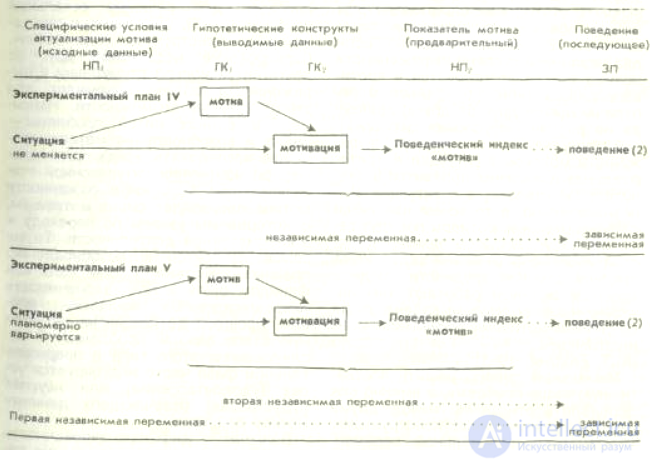
Fig. 1.6. Experimental designs of the fourth and fifth types: explanation of the hypothetical construct «motivation» (the dependent variables are various forms of behavior which are assumed to be determined in part by a constant (Type IV) or systematically varied (Type V) situation, as well as by the dispositional variable «motive»)
Experimental design type V is multifactorial. Two or more variables are varied simultaneously and systematically combined with one another. This yields a greater resolving power for the experimental analysis. It now becomes possible to distinguish and separately assess the contribution of the situation (IV1) and of the motive (IV2) to the resulting motivation (HC2), as manifested in the criterial forms of behavior (DV). In this way, statistical relationships between the two independent variables can be revealed. Such a relationship exists if two differing degrees of motive strength are consistently reflected in opposite (or at least differing) reactions to different conditions of situational stimulation - that is, people with a pronounced motive show the criterial behavior to a marked degree in situation A but only slightly in situation B, whereas people with an unpronounced motive behave the other way around. Take, for example, persistence in solving tasks of below-average difficulty: people with a strong motive work harder the more difficult the task is; people with a weak achievement motive work harder the easier the task is [N. T. Feather, 1961].
We can now address the problem posed above, namely how to determine the relationship between two purely hypothetical constructs: the dispositional variable "motive" and the functional variable "motivation"? To the extent that we have succeeded in empirically establishing the relationship between the two independent variables - the situation (its stimulating content) and the motive - we can disentangle the latter from its connection with the other hypothetical construct, motivation. In other words, if criterial behavior is understood as a product of the interaction between the situation and the motive, and the influence of the dispositional variable "motive" is isolated, then it becomes possible to state under what circumstances a given degree of expression of this variable will lead to an increase or decrease in the values of the functional variable "motivation."
Both experimental designs are suitable for investigating four (5-8) of the fundamental problems of motivation, and above all the eighth - the manifestation of motivation in various behavioral acts and the detailed analysis of the situational and personal factors that condition these manifestations. Furthermore, the fifth type of experimental design is quite suitable for resolving the remaining problems (5-7) connected with the hypothetical construct "motivation." Varying situational stimulation and the strength of the motive independently of one another opens up great possibilities here. For example, within the fifth problem - the shift and resumption of motivation - one can investigate when, given a systematic change in situational stimulation at a fixed level of motive strength, a shift in motivation will occur, which is recognized by the transition to an alternative activity. The same applies to the resumption of earlier actions. After Freud demonstrated the significance of "unfulfilled wishes," the influence of past motivation on current motivation became an important problem. In studies of this type, success (satisfaction) or failure (frustration) of the action corresponding to the given motive is often induced in a preliminary phase.
Greater differentiation of the experimental designs used is required in studies that attempt to isolate the mediating motivational processes of self-regulation (the seventh problem). For this purpose, multifactorial experimental designs are best suited, in which situational stimulation and motive strength are varied simultaneously, while the dependent variables are indicators of hypostasized cognitive processes. Examples include expectancy and the value of the achieved goal state (their influence on animal behavior has long been established [M. Elliott, 1928; L. Crespi, 1942]), the subjective estimate of the probability of success in forthcoming attempts [K. Schneider, 1973], or the a posteriori assessment of the causes of one's own success or failure, so-called causal attribution [W.-U. Meyer, 1973a], as well as self-assessment [H. Heckhausen, 1978]. All these kinds of mediating cognitive processes have proven to be important components of motivation (see Chapters 10 and 11).
Experimental designs IV and V make it possible to bring together various approaches to behavior. Whereas design IV, holding situational influences constant, shifts the explanation of behavior toward personal, i.e., dispositional, factors, design V allows for a more balanced accounting of personal and situational factors and permits actually motivated behavior to be analyzed as the (statistical) product of the interaction of both sources.
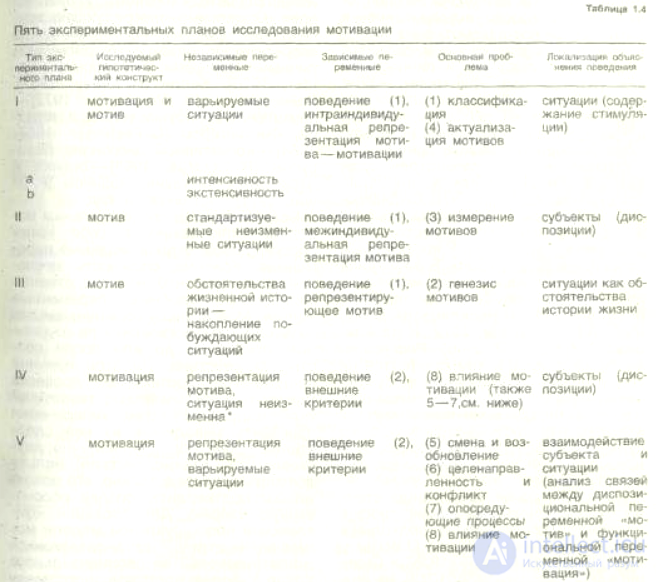
Everything said above about the specific experimental designs is summarized in Table 1.4. It brings together all the points considered: the hypothetical construct under study, the independent and dependent variables, the relevant core problems, and finally, the locus of the explanation of behavior.
____________
* If the constancy of the situation is not controlled for, the possible correlations between the two dependent variables (the motive and the external criteria) may be called into question.
We have set out a number of viewpoints that have previously dominated the psychology of motivation and that have shaped it in one way or another. Not merely a historical but a systematic examination makes it possible to determine whether the explanation of behavior is reduced to personal or situational factors, which of the core problems of the psychology of motivation are at the forefront, and which experimental methods are used to investigate them.
However, one important aspect has not yet been considered, and taking it into account also makes it possible to classify earlier research approaches. This aspect is the place accorded to cognitive structures and processes within motivation. In recent times cognitive theories of motivation have been gaining ever greater importance [F. Srwin, 1971; H. Heckhausen, B. Weiner, 1972; B. Weiner, 1972; H. Heckhausen, 1973a; 1977 a; b]. The decisive question is whether the connection between situational instigation and subsequent behavior is regarded as direct, or whether some series of mediating processes occurring in the subject's psyche is postulated between them, and whether these processes are held to be cognitive in nature.
At one end of such a series stand purely stimulus-response theories, for example the associative approaches in the learning theories of Watson [J. Watson, 1924], Guthrie [E. Guthrie, 1935], and Skinner [B. F. Skinner, 1938; 1953]; at the other end are theoretical approaches that separate stimulus and response by a more or less lengthy series of various cognitive processes: appraisal of the current situation, anticipation of events and appraisal of their consequences; projection, which prepares the choice of a course of action, or retrospection, which forms a self-assessment of the results achieved [F. Halisch, 1976; H. Heckhausen, 1978]. Here the content of the cognitive processes is regarded not as a mere epiphenomenon of some underlying events, but as a factor that decisively influences motivational phenomena and thereby subsequent behavior. And although such approaches complicate the theoretical, and above all methodological, side of the problems of motivation, in many respects they surpass noncognitive theories. Individual mediating cognitive processes have been investigated and theoretically developed by various authors: Heider [F. Neider, 1958], Kelley [H. Kelley, 1967], Weiner [B. Weiner, 1972] — causal attribution of success and failure, Festinger [L. Festinger, 1957; 1964] — cognitive dissonance, Lazarus [R. Lazarus, 1968] — appraisal and reappraisal of the situation, Irwin [F. Irwin, 1971] — intention, and so on.
A number of process models have been developed that include such mediating functional variables. Of course, the difficulty lies in the fact that such variables cannot be observed directly. One can only indirectly infer their existence from particular indicators before or after the action itself. For this reason, the course of the process can only be represented through a theoretical model, whose derived consequences can then be tested empirically. Thus, the existence of two-way interaction cannot be proven directly — it can only be confirmed by constructing a well-grounded theory. To test a comprehensive process model of motivation, computer-simulation programs built on the rules of the corresponding logical calculus are more adequate than a variance-analytic experimental design V. The simulation results are compared with empirical data [see: J. Kuhl, 1977].
Between these extreme types of theories there are important transitional forms that likewise postulate intervening variables — in the nature of hypothetical constructs — between situation and behavior. The neobehaviorist theories of Hull, Spence, and Miller [C. Hull, 1952; K. Spence, 1956; N. Miller, 1959] no longer assert a strict stimulus-response link, but instead propose as mediating explanatory constructs such quantities as need strength and the incentive characteristics of the target object. The next step leads to yet another group of theories in which the intervening variables (hypothetical constructs) are given such content that they can already be called theories of «expected value». The significance (value) of alternative outcomes of an action is weighted by the subjective probability of attaining or failing to attain them (expectancy). A popular variant is the risk-taking decision model proposed by Atkinson [J. W. Atkinson, 1957; 1964].
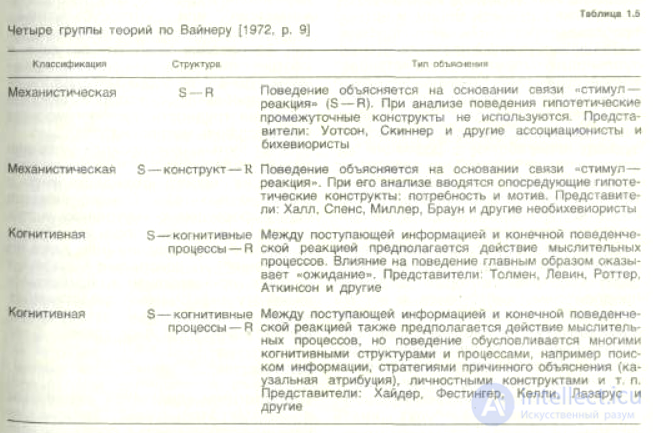
Theories can also be more or less «economical», that is, they may use a greater or lesser number of variables and attribute to them the character of cognitive processes, processes of information processing. Such theories trace back above all to Tolman's «psychological behaviorism» [E. Tolman, 1932; 1955] and Lewin's field theory [K. Lewin, 1938]; various explanatory models of behavior, of greater or lesser significance, may likewise underlie them. This becomes apparent upon a detailed examination of how the basic concepts used to analyze behavior are interpreted. So far we have spoken of situation and action (leaving aside the mediating intervening processes) only in the most general terms, and both concepts have generated nothing but a string of problems. The extent to which these can be resolved or circumvented will make it possible to justify metatheoretical approaches to the construction and methodological equipping of theories.
Let us begin with the situation. In the most general sense, situation refers to the actual environment of a living being that determines its behavior at a given moment. The situation thus implies a flow of information about the actual environment. In behaviorist theories, the term «stimulus» is used instead of situation. Regardless of which of these terms is used, at least four problems can be identified.
First, what part of its current environment does a living being register? Certainly not everything, but only a part — above all what is new, unexpected, salient. All these qualities, however, are themselves a result of information processing during the perception of the situation. They depend on the characteristics of the perceiving subject's activity (for example, on the ways information is coded, selected, and given meaning).
Second, how elementary or complex is the perceived information? The hypotheses that are favored range across a very wide spectrum: from the perception of simple signals («stimuli») to the perception of holistic meaningful configurations. Most likely, what occurs is something like a grasping of the «situation as a whole», and it is this grasping that determines what significance the details will have.
Third, how is information singled out within the motivational features of a situation? There are three fundamentally different systems of description: physicalist statement of fact, intersubjective report (i.e., the agreed opinion of several observers, or what the experimenter takes to be such), and subjective (phenomenal) features as they are perceived by the given individual in the corresponding situation. The choice of one of these three systems is extremely important for constructing a psychological theory. Not only physicalistically identical situations, but also situations perceived intersubjectively as identical (in their general, obvious sense), will as a rule be experienced differently by different individuals (that is, will have a different personal meaning). A precise determination of the psychologically significant features of a situation is ultimately possible only at the level of personal meanings, that is, at the level of those meanings that actually exist for the subject [H. Heckhausen, 1973a]. For the psychology of motivation, what matters is what is given to the subject as an experience essential to him, not what is given physicalistically or intersubjectively, i.e., not what others consider important. The requirement to evaluate situations according to their personal meaning entails a methodological problem that underlies the main difficulty of psychological research on motivation.
Fourth, where does the boundary lie between the individual and his environment? It is often simply identified with the surface of the body. However, there is also information about internal states (such as hunger or pain) which, in experience (or even in relation to the central nervous system that receives and processes this information), represent something external and therefore should be assigned to the situation.
The concept of «action», introduced at the beginning of this chapter, is bound up with no fewer problems than the concept of «situation».
First, does the subject attend to his own actions to the same degree as to the situation he is in? For all the reflexivity of action, attention is, as a rule, directed at those fragments of the situation that appear significant and toward which the action is oriented. The subject can observe himself only as an exception. The conditions and consequences of such self-attention have been studied, in particular, by Duval and Wicklund, as well as by Heckhausen [S. Duval, R. Wicklund, 1972;
H. Heckhausen, 1980]. Self-directed cognitive processes can take as their object the action as a whole, its current state and development, only insofar as the perception yields a «situation as a whole» with many distinguished details, and self-observation readily disrupts the course of the action. What is noticed are individual components against the background of which the action unfolds, namely emotional state, changes in expectation, the degree of success of the given stage of the activity, current self-evaluation [H. Heckhausen, 1980]. Attention becoming directed at oneself is fostered by attentiveness to one's own personality (or to its representation), as well as by coming into another person's field of view. For example, a person sees himself in a mirror, hears his own name, feels that he is being watched, and so on [R. Wicklund, 1975].
However, as Jones and Nisbett showed, the subject's attention is usually directed toward the situation. This does not mean that the subject completely forgets about himself. An action is, as a rule, accompanied by a kind of framing self-awareness — more precisely, a reflection that through his actions the subject is changing the situation in a certain direction, that he is striving toward one or another target state and intends to attain it, and so on. The answer to the question of how much and exactly what the subject notices about his own behavior is decisive for determining the value and depth of data obtained through intro- and retrospective self-assessment. The notion that a subject continuously, fully, and reliably registers his own actions (including all internal processes) and could give a complete and undistorted account of them is mistaken. Nisbett and Wilson attempted to test this experimentally [R. Nisbett, T. Wilson, 1977] and to differentiate the conditions under which self-reports cannot be relied upon — for example, cases in which the appropriate use of ad hoc theories fills the gaps in experience so thoroughly that it seems as though the subject actually saw what he is describing [see the critique of this study: E. Smith, F. Miller, 1978]. There is no doubt that omitted or missing details are easily reconstructed and appear in recollection owing to bias or suggestion [H.-J. Kornadt, 1958].
Second, in which system should action be described and defined: by means of physicalist measurement, intersubjective external observation, or subjective inner perception? A preference for one of these systems noticeably affects what is considered to belong to action. In physicalist (or physiological) measurement, one can include involuntary bodily activity not noticed by the subject — such as the activity of the endocrine glands or changes in the skin's electrical resistance — while, conversely, excluding such things as representations and thought processes. External observation, in essence, is limited to recording motor activity (including verbal and nonverbal communication). Introspection can, in principle, disclose (subject to the limitations mentioned above) particular aspects and contents of one's own actions that are, or can in principle be, controlled by consciousness. These include both «internal actions», such as representations and thought processes, and «external actions» in the form of motor reactions and communicative behavior.
Third, depending on which of the three systems is chosen, an answer is given to the question of how elementary or complex, structured, and temporally extended the units of activity are. Thus, at the physicalist-physiological level of description, an action can be broken down into elementary muscle contractions, whereas at the level of external observation and self-perception, quite complex, varied, and temporally extended sequences of movement can be represented as units of action. At the level of concrete data description, a distinction is therefore drawn between «molecular» and «molar» units of description. The same applies to the theories built upon them.
It is only quite recently that the segmentation of a continuous stream of activity into units has become the subject of closer study*. Newtson [D. Newtson, 1976] and his colleagues showed subjects videotapes of sequences of action. By pressing a button, subjects were to mark a «transition», that is, the point at which, in their judgment, one unit of behavior ended and another began. The task presented no difficulty for them, regardless of whether they were asked to identify smaller or larger units, or units they considered «natural». Smaller units turned out to be parts of larger ones. High agreement was observed among subjects, as well as stability of the transition points under repeated testing. When the stream of activity of the observed person became less predictable, subjects shifted to segmenting the action into smaller units. The transition points proved decisive for understanding the observed stream of activity. They did not merely form temporal boundaries between segments of action but also carried all the information about changes in the flow of activity needed to understand and recognize the sequence of actions.
_________________
* In the works of Soviet psychologists and psychophysiologists, numerous objective indicators have been identified that make it possible to distinguish successive phases of activity presumably corresponding to individual actions. Such indicators can, for example, include phases of involuntary eye movements [Gippenreiter Yu. B. Movements of the human eye. Moscow, 1978] or the moments at which the ratio of cognitive and executive components of a motor act changes [Gordeeva N. D., Zinchenko V. P. The functional structure of action. Moscow, 1982]. Theoretical works emphasize the non-additive character of activity, which cannot be exhaustively represented as a sequence of actions directed at conscious goals [see: Leontiev A. N. Activity. Consciousness. Personality. Moscow, 1975]. This is explained above all by the coexistence, at any given moment, of several goals of differing degrees of generality. The performance of local actions therefore turns out to be embedded within the context of achieving goals of a higher level. The reconstruction of activity presupposes the description of processes of activation unfolding simultaneously at different levels. (Editor's note.)
Fourthly, a problem arises that is specific precisely to the psychology of motivation. Might it not be possible to single out, within the flow of activity, a central, governing component of activity, setting it apart from instrumental, executive skills? If this could be done, the latter would become action in the proper sense of the word, i.e., that which is explained by the psychology of motivation by means of motivating and governing central processes. Mediating processes excluded from the concept of action are either given phenomenologically in self-perception, or are deductively derived from hypothetical constructs similar to those considered above. But even so, they are not excluded from motivational-psychological explanation. Usually only one component of a behavioral act is analyzed, namely the regulation of external action by internal cognitive processes. What remains unclarified, however, is the reverse influence of external action on the situation and its perception, on self-perception, including the corresponding change in the mediating motivational processes, and so on. Identifying the initial conditions of internal activity in the form of mediating motivational processes, and the individual differences manifested in this process, is no less significant a problem for the psychology of motivation than the analysis of the conditions of external activity.
In such a tangled (and even more tangled than shown above) maze of relationships between "situation" and "action," it no longer seems surprising that theories of motivation are built from entirely different positions, which immediately leads to a biased choice of explanatory model. Thus, doubts about the results supposedly revealed by the introspective method regarding the elementary components of consciousness contributed to the emergence, in the 1920s, of behaviorism and the condemnation of self-observation. Only such data as could be described in physical quantities or established intersubjectively by means of external observation began to be recognized as scientific. In the process, cognitive formations of every kind were declared mentalistic and banished from psychological theories of motivation. Abilities that distinguish humans from any animal, such as the anticipation of events, thinking, and speech, were left outside the researchers' attention. Experiments with animals under severely restricted conditions of stimulation and possibilities for responding became the model for the analysis of behavior, predominantly of that form of it known as learning, i.e., the adaptation of the organism to changed situational circumstances. All this had an effect on the corresponding theoretical approaches in the psychology of motivation.
The behaviorist explanatory model is a case in point. According to this model, a situation is a set of discrete stimuli. A living creature is an «organism». Its response consists of movements or internal secretory activity. A stimulus evokes a response in the organism that has become firmly associated with the stimulus through prior learning processes. The explanation is reduced to the idea of a passively reacting apparatus that, under changed situational conditions, is able to alter its «stimulus—response» program in accordance with the criterion of maximal need reduction. The situation and the action are treated in an elementary, easily objectifiable form as stimuli and responses, while mediating intermediate processes, not to mention cognitive structures, are omitted. Such is a somewhat exaggerated and simplified picture of one of the explanatory models, which nonetheless proved useful for identifying many relationships.
But difficulties in explaining behavior that is clearly regulated by the anticipation of future goal states increasingly prompted a decoupling of the link between stimulus and response, the inclusion of intervening variables and explanatory constructs, the infusion of these with cognitive content, the replacement of a mechanistic-causal interpretation with a pseudo-finalist one, the understanding of stimulus and response at a psychologically higher conceptual level, and recognition of the fact that living creatures are active rather than condemned to permanent passivity until external or internal stimuli awaken them—that they receive information about their surroundings, transform it, and act in the world according to the knowledge they possess.
Over the course of decades, researchers whose views largely coincided not only spoke of the motivating influence of cognitive formations but also tried to uncover their role in the process of motivation, making them accessible to scientific analysis through the application of intersubjective methods. The following chapters describe the stages that had to be passed through along this path. But first of all, it is necessary to give a general picture of the history of the psychology of motivation and the development of its subject matter.
Attempts to explain the behavior of living creatures have been made for a long time. Under one name or another, and from different starting positions, what is today associated with the problem of motivation—the questions of activation, control, and implementation of goal-directed behavior—has been discussed. We will not examine the entire tangled history of this problem in detail [see: R. C. Bolles, 1975] and will instead use the words of Hermann Ebbinghaus (1850—1909), spoken, admittedly, about psychology as a whole: «It has a long past, but a short history».
With the emergence of scientific, i.e. experimental*, psychology, discussions of motivation began to use a great variety of terms: will, instinct, drive, need, driving force, motive, cause, and so on, and motivation itself gradually came to occupy an ever larger place in the explanation not only of behavior and learning, but also of such seemingly «automatic» processes as perception, imagination, and thinking. Over time, the study of motivation grew into an independent field with its own conceptual apparatus, methods, and theories. The first studies were devoted to the analysis of the volitional act.
_________________
* Equating scientific psychology with experimental psychology is justified only insofar as one is referring to the institutional separation of psychology from philosophy that took place at the end of the last century. The actual emergence of psychology as a scientific discipline relied to a great extent on non-experimental or quasi-experimental research methods, above all on various methods of observation. Suffice it to say that most of the results cited in this book were obtained through correlational studies, which cannot be considered experimental in the strict sense of the word. (Editor's note.)
Thus, Pfänder, in his descriptive work "Motive and Motivation" [A. Pfänder, 1911], treated the motive as the basis of a volitional decision, while the first English-language book, published in 1936, was titled "Motivation and Behavior" [P. T. Young, 1936]. Twenty years later, papers, monographs, reviews, and handbooks followed one after another. Among them one should mention the series of yearbooks on problems of motivation from the University of Nebraska (since 1953), the handbooks [S. Koch, 1959—1963; H. Thomae, 1965], and the more or less comprehensive textbooks [C. N. Cofer, M. N. Appley, 1964; J. W. Atkinson, 1964; J. W. Atkinson, D. A. Birch, 1948; R. C. Bolles, 1967; 1975; K. B. Madsen, 1959; 1974; B. Weiner, 1972].
Today, motivation research is still far from a final resolution of all its questions and from the development of unified methods and theories, and it therefore makes sense to trace the development of motivation problems in historical perspective. To do this we will have to go back almost a century. Let us first turn to the earliest researchers of motivation, who at the beginning of our century took up problems that have not lost their significance to this day, and trace the emergence of individual lines of work on these problems.
In philosophy and theology, man has long been regarded as a being endowed with reason and free will. These qualities not only distinguish man from animals, defining his essence, but also place on him responsibility for his actions and decisions. The problem of explaining human action is, in this case, extremely simple. Man acts rationally for readily discernible reasons and legitimate grounds, since he possesses reason, and since he is endowed with free will, it is unnecessary and futile to explain his actions by external forces — whether the influence of the environment or the states of his own body. Of course, outbursts of emotion and passion can hinder rational action and the exercise of free will. A similar (if less simplified) explanation of behavior recurs repeatedly in the history of science. Whether one recognizes in this the dependence of man and of human actions on the material and physiological data of the organism, or holds that human behavior is governed by the hedonistic principle of seeking pleasure and avoiding displeasure, makes no difference. For any such explanation fails to bridge the gulf between man and the animals, whose behavior is governed not by reason and will but by blind natural forces, by instincts.
This Cartesian-type dualism was finally overturned by Charles Darwin's book "The Origin of Species," published in 1859. Darwin (1809—1862) explained differences in the bodily structure and behavior of living beings by the action of two principles: the occurrence of random variation in traits and the natural selection of these traits in the struggle for survival. Both principles proved highly promising for a deterministic explanation of man and human action. On the basis of this deterministic worldview — whose extension to the phenomena of human motivation was long hindered by notions of a fundamental ontological difference between man and animals — three of the most authoritative viewpoints on the problems of motivation took shape.
The first point of view, proceeding from the existence of a series of transitional forms between humans and animals and holding that the explanation of animal behavior could share common features with the explanation of human behavior, identified the instincts and drives that set human behavior in motion. McDougall, treating instincts as the main explanatory concept in a work published in 1908, thereby laid the foundations for the study of motivation in the spirit of instinct theory. This line of thought is still represented in the work of modern ethologists (Lorenz, Tinbergen). Almost simultaneously with McDougall, Freud attempted to explain such seemingly irrational phenomena as the content of dreams (1900) and the behavior of neurotics (1915) through the dynamics of hidden needs, thereby laying the foundations for the study of motivation within personality theory. The second point of view, proceeding from the development of a species as the result of the reproduction and continued existence of only those living beings capable of adapting to their environment, held that human intelligence is not an exceptional phenomenon but a product of the millions-of-years-long history of its formation. Intelligence, the ability to draw conclusions from acquired experience, allowed the species to survive by ensuring rapid adaptation to changing environmental conditions. However, if this is so, then modern animal species should possess the rudiments of intelligence. Attempts made in the 1880s to establish the forms of intelligence characteristic of various species and to compare them with one another gave rise to comparative psychology. Out of factual descriptions and purely speculative comparisons, types of systematic experimental research into learning gradually took shape. The first work in this direction was carried out by Thorndike [E. L. Thorndike, 1898; 1911] in the basement of the house of his teacher William James. James himself (1842—1910) occupied, as a psychologist, a remarkable intermediate position between the old and the new psychology. Possessing an unsurpassed gift for introspection, he traced the phenomenon of consciousness in volitional acts, proceeding, on the one hand, from the existence of free will, and on the other, from instincts inherent to human beings. According to James, human consciousness is the result of the development of "a nervous system that has become so complex that it can no longer manage itself" [see: E. G. Boring, 1929, p. 501]. James did not conduct experiments, but the concept of "habit" that he developed later became central to the associative theory of learning: a habit is an automatically occurring action which, according to James, was at first controlled consciously.
Darwin, too, regarded instinct as a mechanism of adaptation in which natural selection manifests itself in a particular way, but he explained the emergence of instincts as the result of random changes. Darwin represented instincts as an accumulation of individual reflex acts, and, according to evolutionary theory, changes and progress in such accumulations could only occur gradually. Thus, instincts in the behavior of humans and animals no longer had to be regarded as something whole and indivisible; they could be broken down into observable reactions to stimuli. The reflex arc came to be regarded as the basic element of behavior. The Russian physiologist Pavlov (an English translation of his work appeared in 1927) and the American Thorndike, at the beginning of our century, became the initiators of experimental research into learning that has not yet lost its significance as a method for studying motivation.
Pavlov and Thorndike laid the foundations of what may be called the associative direction in the study of motivation. Both scientists were interested in the change of associations between stimulus and response. For Thorndike this meant the replacement of responses with more successful ones (so-called instrumental, or operant, behavior); for Pavlov, the replacement of the stimulus that triggers a reflex with an originally neutral stimulus (classical behavior). Within the associative direction of research on the problem of motivation, Thorndike's name is linked to the line of the psychology of learning, and Pavlov's name to the line of the psychology of activation.
Finally, a third viewpoint. According to Darwin, features of body structure and behavior that confer an advantage in natural selection appear not only as species-specific traits. Within a species there are always individuals whose structural and behavioral features allow them to adapt better to increasingly complex conditions in the struggle for existence. This conclusion drew scientists' interest toward identifying and taking into account individual differences. Francis Galton (1822—1911), Darwin's cousin, carried out extensive observations testing the assumption of the heritability of psychological traits and abilities (compare eugenics). Together with the French researcher Alfred Binet (1857—1911), who developed the first intelligence tests at the beginning of the century, he laid the foundations of psychological testing. For a time, especially in the USA, this line of research developed independently of the concerns of other areas of psychology, and only in the 1930s did Allport G. W. Allport, 1937], Murray
H. A. Murray, 1938] and Cattell R B. Cattell, 1950] find application for it in the study of motivation, conducted within the framework of personality theory.
Among the constellation of pioneers, one can finally single out scientists on whose views Darwin's theory had no strong influence. Their ideas were shaped by the work of the founders of classical experimental psychology — Fechner (1801 —1887) and especially Wilhelm Wundt (1832—1920). The central theme of Wundt's research was the psychological nature of motivation, namely of volitional acts. In these acts Wundt [W. Wundt, 1874; 1896] saw the essential feature of the acting and sensing individual, and therefore argued that, as a psychological cause, these acts must be sharply distinguished from physical causality as studied by the methods of natural science.
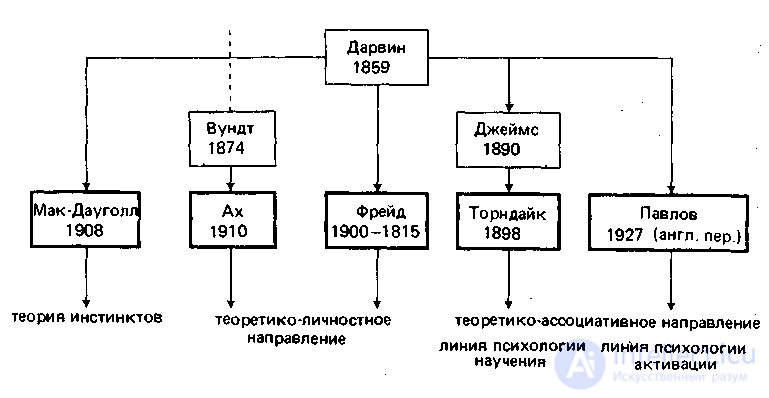
Fig. 2.1. Directions of motivation research
Information-processing processes, as we would say today, are accompanied, according to Wundt, by volitional acts. Wundt himself tried to illustrate his claim using the phenomena of attention and apperception, as well as perception, thinking, and memory [W. Wundt, 1874; 1896, contemporary data: T. Mischel, 1970]. All emotional processes, such as feelings and ideas, are permeated by a volitional element, which is the result of a synthesis of feelings, sensations, and ideas. The feelings and ideas that lead to a volitional act Wundt called motives, in which ideas, as a component of volitional actions, play the role of the instigating cause, while feelings play the role of the driving force.
The spirit of Wundt's research, especially his methods for studying the psychology of consciousness, was taken up by Külpe, around whom the adherents of the Würzburg school gathered. The representatives of this school set out to investigate, by laboratory means using the introspective method, so elusive a process as thinking. Wundt himself did not consider this path fruitful. He linked the prospects for the study of thinking to the resolution of problems in the psychology of peoples and proposed studying the products of activity as the primary method. In analyzing mental activity, Külpe and his students were forced to conclude that the decisive processes are not accessible to conscious reflection. From this they concluded that there exist unconscious sets and tendencies that govern the observable process of problem solving. Ach [N. Ach, 1910] designated these sets with the concept of a «determining tendency». In an ingenious experiment he devised, an associative reproductive tendency, induced by instruction to the subject, was brought into conflict with the determining tendency, which made it possible to measure individual willpower. As we shall see later, this experiment prompted Kurt Lewin to conduct a refuting study that had a decisive influence on the study of motivation within the framework of personality theory.
The dispute between Ach and Lewin is only indirectly connected to the line of problem development leading from Wundt to personality theories. Out of Wundt's research tradition, thanks to the work of such students of Kulpe as Ach, Watt, Messer, and Lindworsky, as well as the phenomenologist Pfander, there grew a general psychological theory in which considerable importance is given to the problem of will — in particular, its role in decision-making amid conflicting ideas and in the stability of volitional actions. In Germany this theory was developed by Ducker [H. Ducker, 1931; 1975], Mierke [K. Mierke, 1955], Rohracher [H. Rohracher, 1932], and Thomae [H. Thomae, 1944; 1960], but since it did not gain wide currency and is represented by only a small number of studies, we will not dwell on it specifically. With this we conclude our schematic review of the earliest motivation research [in selecting the more significant representatives of the main directions of this research, the author was guided by the work of K. B. Madsen, 1974]. Figure 2.1 conventionally indicates the position of five researchers from the pioneering generation working at the turn of the nineteenth and twentieth centuries.
Часть 1 Motive and Motivation, Situation and Action, Lines of Motivation Research
Часть 2 - Motive and Motivation, Situation and Action, Lines of Motivation

Comments