
Lecture
Paralinguistics - is the branch of linguistics that studies the nonverbal aspects of communication associated with speech. Unlike linguistics, which studies language as a system of signs, paralinguistics focuses on various speech parameters that are not semantic (meaning-bearing) or grammatical, but that influence the communicative process.
Specialists classify paralinguistic and extralinguistic sign systems among the nonverbal ways of human communication and behavior .
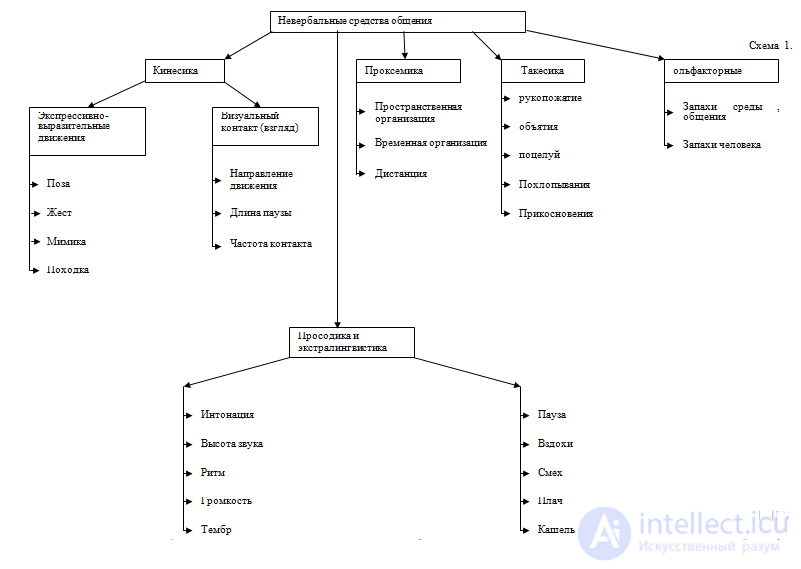
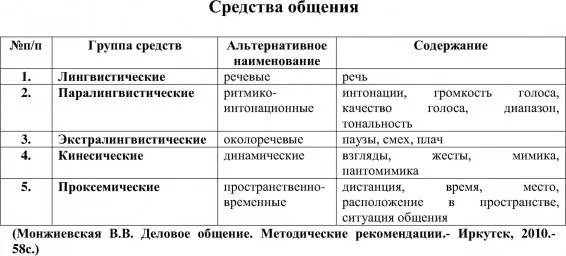
Paralinguistics (from Greek παρα, "near", and lingva, "language") is a system of vocalization that manifests itself in the tone of voice, its timbre, pitch and intonation, in speech errors, and in the particular way contact is organized. A substructure of paralinguistics is prosody, the general name for such rhythmic and intonational aspects of speech as pitch, loudness of the vocal tone, voice timbre and stress. This field of science arose in the late 1940s and early 1950s in the USA at the intersection of such areas of scientific knowledge as linguistics, psychology, medicine and cultural anthropology. The first scholars to attempt to systematize scientific knowledge in this field were G. Trager, H. Smith, A. Hill and T. Sebeok.
Specialists distinguish three main types of paralinguistic means . They are: phonation means (timbre, tempo, loudness of speech, filling of pauses), kinetic means (gestures, posture, facial expressions) and graphic means (features of handwriting, the graphic form of letters, the presence of substitute signs (&, $), etc.). In this case, an individual places emphasis on one paralinguistic means or another unconsciously, unlike with linguistic means. The reason for this is the functional nature of prosody. Functionally, it supplements verbal communication, replaces verbal elements or colors them. All this is hard for an individual to reflect upon, since what they first of all consider are their own linguistic constructions.
Paralinguistics is connected with the particular features of a person's verbal manifestations. These are, above all, the vocal qualities of the voice, its range and timbre. However, it is also connected with a person's kinesthetic manifestations, above all through paracinesics, that is, gestural communication, which by its nature is unconscious. Imitative constructions are also possible here, as in the acting of theater and film actors. In general, it should be kept in mind that a person's paralinguistic manifestations must be regarded as one of the elements of the verbal and nonverbal system of communication. An important aspect of paralinguistics is the sociocultural context of its realization, or ethnolinguistic manifestations. Thus, neglecting the paralinguistic features of communication in a given ethnic group can lead to misunderstanding, incorrect reflection of the behavior of those around us and even conflicts. The interpretation of paralinguistic manifestations in particular spheres of human activity is significant. For example, in medicine it is used to determine the symptoms of a disease (trembling of the voice, slowed or accelerated tempo of speech, etc.), and in criminology and legal psychology to compile a psychological portrait of a criminal (specific features of the voice, intonation, accompanying gestures, etc.). Thus, the ability to perceive and interpret paralinguistic signs and signals is one of the marks of a specialist's professional level in a particular sphere of activity where this ability is highly valued.
Paralinguistic elements include such aspects as intonation, tempo, loudness, pauses, rhythm, emotional expressions and accent. They help convey additional information and feelings that can change or supplement the meaning of what is said.
For example, intonation can indicate a question, surprise, sarcasm or the emotional state of the speaker. The loudness and tempo of speech can reflect confidence, excitement or hesitation. Pauses and rhythm also affect the perception and meaning of communication.
Emotional expressions, such as laughter, crying, shouting and interjections, are another aspect of paralinguistics. They convey the speaker's emotional state and can influence the listener's emotional reaction.
Accent is another important aspect of paralinguistics, which relates to the pronunciation of sounds, rhythm and intonation characteristic of a particular dialect, region or language group. An accent can indicate the speaker's linguistic affiliation and carry social and cultural connotations.
Paralinguistics is important for a full understanding of communication, since nonverbal elements can significantly affect the transmission of meaning and the emotional coloring of an utterance. Research in the field of paralinguistics helps us better understand how nonverbal elements interact with verbal speech and how they vary across languages and cultures.
Three types of paralinguistic means are distinguished :
The speaker's choice of one realization or another of a paralinguistic means is distinguished by unpredictability, unlike with linguistic means; thus, the intonational shaping of a question in a given language is fixed, so it must be considered a linguistic means, while its timbral coloring is not known in advance and is a paralinguistic means. (According to another point of view, the criterion for identifying paralinguistic means is not their arbitrariness, but the fact that they are not part of the system of phonological oppositions of the given language, although they are obligatory for realization in speech .)
Paralinguistic means can perform the following functions in relation to the verbal component of an utterance :
Paralinguistic means can serve as a source of information about the speaker (or writer), since they often reflect their social and age characteristics and personality traits, and also include an ethnolinguistic component.
Extralinguistics (Eng. linguistics – speech, exterior – external) – is the use of extra-linguistic devices in speech. In its general form it consists of the tempo of speech, pauses, throat clearing, laughter, crying, sighs, sobs, wailing, etc. Such manifestations serve as ways of fascination of verbal constructs, that is, they increase the semantic value of the transmitted information.
Extralinguistics – is one of the acoustic nonverbal means of communication; it covers pauses in speech and various psychophysiological states of a person manifested in crying, coughing, laughter, breathing, pauses, etc.
Pauses can differ in character:
Pauses are necessary , but they should not be overused, because this will reduce interest in the speech and tire the audience. Spoken words are never neutral. Sometimes the way we pronounce some piece of information is more important than the content of the message. In general, intonation can highlight the main point of a sentence and give information a particular shade, so that a seemingly neutral message can sound like a question, a suggestion, sarcasm, humor, and so on.
Specialists attach different meanings to these concepts. Thus, G. Trager believes that the modality of the informational extralinguistic channel is, above all, the transmission of information exclusively by the voice. Another foreign researcher, T. Sebeok, insists that extralinguistics is not only a person's voice but also their kinesthetics . V. Labunskaya believes that the extralinguistic system includes the speech of pauses, as well as various kinds of psychophysiological manifestations of a person (crying, coughing, laughter, sighing, whispering, etc.) . Moreover, she considers that extralinguistics, like prosody, is a substructure of paralinguistics, which examines the properties of the voice that are not part of the system of properly differential, phonological oppositions and that replace the sphere of nonverbal communication.
It should be noted that the kinesthetic aspects of nonverbal behavior that have extralinguistic features were analyzed by A. Leontiev , who identified four types of nonverbal components of communication: the significance of what is being said; the significance of the information for the recipient; the significance of correcting the communication; and constructs that have no significance for the communication process. G. Kolshansky believes that extralinguistics performs the function of economizing the speech utterance, that is, economizing the use of linguistic means in communication . Tempo of speech, pauses, stresses, throat clearing, etc. are precisely aimed at functionally providing such economy. But economy in verbalized communication can also be achieved through gestures, facial expressions, pantomime and other tactile-kinesthetic manifestations. All this indicates that an individual's nonverbal manifestations are polyfunctional and must be considered in the context of the entire communication process.

Comments