
Lecture
In human life there are a great many factors that, one way or another,
determine the qualitative and quantitative aspects of how it unfolds. We know that color
determines the level at which we perceive the outside world in all its hues. Sound determines the level of external noise
stimuli. All of them act as conditioned signals and give us the opportunity
to orient ourselves correctly in the surrounding world. But in complete darkness we have no choice but
to "sniff around." Neither color nor sound will give us any information. Only
smell! But what is smell, and what does our sense of smell mean as one of the simplest kinds
of sensation?
The question is far from idle, considering that smells are conditioned signals
of a person's external and internal world that help them find their bearings, and the connection
between smell and the sense of smell reveals itself in a dichotomous dependence, signal –
sensor. Smell exerts an influence; through the sense of smell we perceive it.
People have been seeking an explanation of smell and the sense of smell for several thousand years, yet
they have still not arrived at a single opinion. The difficulty is that some
scholars consider neither smell nor the sense of smell to be basic constants of human
life.
Thus, for example, S. Freud and his followers believe that sensitivity to
smells is a kind of atavism, a symptom of retarded mental
development, and a fascination with smells is a sign of individual degradation [34].
Nevertheless, at present this problem is becoming ever more relevant, as
evidenced by the large number of studies and publications carried out.
Probably everyone is familiar with the phrase "Saw, saw…". These words, addressed
by Panikovsky to Shura Balaganov, could be rephrased as "Sniff,
sniff…", if, first, gold had a specific smell and, second,
Balaganov had a perfect sense of smell and could tell plain metal from
gold by scent. How much effort and energy that would have saved the hapless "Antelopeans"!
But, alas, humans are not given such a gift, and not everything in the world around them has one
smell or another.
Indeed, the sense of smell, or the ability to distinguish odors, is a unique
property of living organisms. But it is far from being developed to the highest degree in all of them.
There are several points of view regarding humans, but however that may be, history
holds a multitude of testimonies indicating the special significance of this kind of
sensation in human life.

Figure 1. Concentration of oil essence and type of aromatic marketing substance

Figure 2. Marketing scents
Finally, the most extensive and ambiguous of the classifications, about which there is still no consensus even among specialists, is the division of perfumes into groups according to their leading components and, consequently, the olfactory impression they produce.
The first problem in classifying families is how to identify, isolate and group into classes the leading note (or even combination of notes) of a fragrance.
The second is the subjectivity of scent perception.
Four types that all existing systems distinguish to one degree or another:
Sensual, warm, usually long-trailing scents obtained from the essential oils contained in wood and bark.
The most widespread family of scents, thanks to the variety of essential oils obtained from flowers of different species and even subspecies.
The fragrances most often have sweet notes and are fairly heavy, although fresher and lighter shades also occur.
The fragrances of this family are bright, cheerful, intense, invigorating and light.
They refresh and help one endure the summer heat.
Most colognes belong here.
This category includes rich fragrances that combine the notes listed above.
Languorous, warm, heavy, saturated, intense and dry, they give a feeling of luxury.
In high concentrations they can cause dizziness and headache.
The following fragrance families are singled out only by some sources:
The family joined the classification in 1917, with the first fragrance that brought all these notes together into a single whole. For a long time it existed as a separate, distinct class, but its presence today is being questioned.
The key ingredient, oakmoss, because of its high allergenicity, ended up on the list of components that are practically banned from use, and so modern chypres bear little resemblance to their predecessors.
They are often classed with the chypres because of the similarity of their composition, but fougère fragrances are more astringent, spicy-bitter.
Leather scents – smoky, smoked, slightly bitter – are sometimes singled out as a separate family.
High, light fragrances, moist and cool, with hints of salt and bitterness.
They often carry a combination of citrus-aldehydic notes and amber.
Distinctive moist and cool scents, soft, juicy and fresh.
Close to fougère and chypre, but lacking their bitterness.
Fragrances with warm and sweet notes, close to floral ones, but much juicier and fresher.
They stimulate appetite and desire.
They have gained popularity over the last decade.
They imitate the aroma of some dish, thereby evoking unconditional liking for their wearer among all fans of that treat.
"Status" perfumes that have the aroma of expensive drinks and allow one to make the impression of a refined and well-off person.
Perfumes whose leading notes were created artificially.
They can imitate notes of various families, but often have a "soapy" shade or a cleaner, "linear" sound.
They are considered fashionable among devotees of urbanization.
Unique, one-of-a-kind fragrances, original combinations of notes, provocative and flamboyant.
These include perfumes with the smell of gasoline and asphalt, with the aroma of a cemetery, and others.
Remember that a perfume does not necessarily belong to just one family.
There are many intermediate types and combinations.
Let us return to history.
Let us recall at least the famous line: "Josephine, stop washing. I am hurrying and in eight days I will be at your feet!" [24]. So wrote Napoleon Bonaparte to his
wife, thereby confirming that sexual relationships are built at the unconscious level, and that smell is the most powerful stimulator of such relationships. Josephine, for her part, adored musk, and even after she left her husband she tried to leave
a memory of herself by spraying an enormous quantity of it all over the palace. The smell of musk lingered for quite a long time. For those around, this smell was associated with the great tragedy of two great lovers.
It is also known that Napoleon was a great lover of perfumery. The emperor carried everywhere, tucked into the top of his boot, a special flask made in the shape of a roller, which held cologne with his favorite scent of black currant, and he doused himself with it from head to toe every day (Napoleon used up to two flasks of cologne a day) [12].
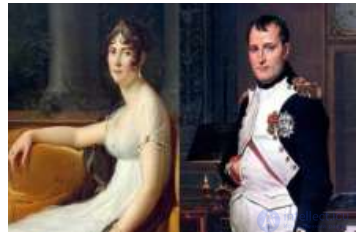
François Gérard, Josephine and Napoleon Bonaparte (1769-1821)
It should be noted that this was a scented water that was brought to France in the second
half of the 18th century under the name "Cologne water," created by the Italian
perfumer Johann Maria Farina, and which received the French name Eau de
Cologne. Napoleon bought up to 60 flasks of this water a month. And in exile on
the island of St. Helena, after his supply of this scented water ran out, Napoleon
devised his own recipe with the addition of bergamot. The exiled emperor called his invention
"toilet water," and this name became official.
A great admirer of scents was the French king Henry IV of Bourbon, who
was also an ardent admirer of women. He addressed one of his mistresses
as follows: "Gabrielle d'Estrées, your body, which I kiss, tastes like
flowers, like the ferns in my native mountains. It is the taste of the sun and the eternal sea – hot and
bitter; I love what is made by the sweat of the brow. Everything is embodied in you, God forgive me –
even He" [26, p. 80].
In deep antiquity, primitive people lived like animals. Perhaps they did not yet
distinguish colors, but, like animals, they perceived the surrounding world through smell. Thus, they
heard the smell of blood, could tell an enemy from a friend by scent, found the way to their
cave, and so on. The sense of smell helped them survive in difficult and dangerous conditions, but over
time it came to play an ever smaller role. Millennia passed, and the sense of smell as a
vital necessity gave way to the sense of smell as social communication.
The desire to have a pleasant smell so that others would perceive you positively
arose, apparently, when humans became more or less
civilized. Thus, in Ancient Egypt men had a custom of shaving their heads and rubbing them
with aromatic compounds. And the beauty of Egyptian women depended in large part on their long-standing skill
in using everything that we today call cosmetics. As specialists note,
one of the ancient Egyptian cosmetic recipes began with these words: "To turn
an old woman into a young one." Indeed, in ancient burials pots are still found containing
powder, ointments, rubbing creams, kohl pencils for the eyes, hand mirrors, incense and
other important mixtures used thousands of years ago by the women of Egypt.
From ancient manuscripts it is known that the Egyptian queen Nefertiti possessed
the highest secrets of the cosmetic art. It was she who managed to find that special kind of
incense to which the powerful pharaoh Akhenaten responded. It was thanks to
incense that this unapproachable ruler, who kept a huge harem, plunged into a
languorous garden of delights, strove toward it and found in Nefertiti's embrace
the sweet bliss of rest and spiritual refuge. It was thanks to this, as chroniclers
note, that the queen managed to hold the ruler's heart for quite a long time
[24].
The priests of Ancient Egypt invariably used in all their prayers and rituals
myrrh and frankincense, amber and sandalwood in order to awaken with beautiful aromas the statues of sleeping
gods. Moreover, all burial rituals of the ancient Egyptian nobility were accompanied by
the use of large quantities of aromatic substances. Thus, in the tombs of the
pharaohs the remains of hardened fragrant extracts were found. And each
deceased person was accompanied by his own special aroma [14]. These substances are still used
by clergy in the religious rites of the Christian church, and compositions of these
substances find application in the production of perfumes.
There is a well-known ancient Greek myth according to which the Greek ferryman Phaon was
in love with the beautiful Sappho, who was known for her erotic poetry. But he was
so ugly in appearance that he could not even think of seducing this
enchanting girl. And then Phaon was helped by the goddess Aphrodite, who gave him a
small flask of fragrant liquid. After smearing his face with this liquid, Phaon was
so transformed that Sappho fell in love with him. The fragrant divine water
transformed the slave of love and made him the happiest of men [28].
The ancient Greeks were passionate admirers of scents. Thus, when visiting the bath, they
made use of the services of slave masseurs, who used aromatic oils. They
were the first to begin adding various spices and
seasonings to the composition of scented liquids. Incidentally, today perfume companies that produce fragrances of the
so-called "oriental group" use them in all their perfumes. In Greece the
first perfumers also appeared, the so-called "ointment distillers." They composed fragrant
blends from the oils of saffron, iris, sage, lily, anise, cinnamon and other substances.
In Ancient Rome, too, people treated with respect everything
connected with scents. Thus, the Romans discovered healing properties in many
aromatic substances (aroma from Lat. aroma –
smell). They spent hours taking baths covered with rose petals. They
surrounded themselves with incense everywhere and were even the first to speak of the
smell of money.
Let us recall at least the saying of the Roman emperor
Vespasian (reigned 69-79 AD). When his son Titus reproached him
for imposing a tax on public latrines, Vespasian held up to
his nose the first money received from this tax and asked whether
it smelled. When his son answered that it did not, the emperor said: "And yet it comes from urine." Juvenal's 14th satire traces back to
Vespasian's words: "Lucri bonus est odor ex qualibet"
"The smell of profit is good, whatever its source."
Roman emperor Titus Flavius Vespasianus (the Elder) (9-79 AD)
The ancient Romans, as is known, were not strangers to sensual pleasures either. Just consider
the era of imperial Rome! Emperors such as Tiberius, Nero, Caligula and
others spent most of their lives not on military campaigns but in women's arms,
since human flesh does indeed inflame the passions.
One of the ancient Roman sages once remarked: "The best perfume of a woman
is her natural scent, when she smells of nothing else." And the Roman poet
Horace wrote: "A youth smells of a kid, and a girl is fragrant like the
flower of a white narcissus…"
The ancient Greek physician Galen, who was personal physician to the Roman emperor
Marcus Aurelius, was one of the first to attempt to classify medicinal
plants into definite categories. He developed the first recipe for a "solid cream,"
which is still used today.
Eastern men and women also surrounded themselves with incense. And the Arabs valued
aromatic substances on a par with precious stones. Moreover, it was the Arabs who were the
first to develop the "perfume trade." For example, in the 2nd century AD, up to three thousand tons of
incense were exported annually from South Arabia to
various countries (Greece, Rome, Egypt, etc.). The merchants of the Baghdad Caliphate were especially successful. They had the greatest
range of fragrant substances, which they traded successfully in "perfume shops"
in Eastern bazaars and European markets alike.
In medieval Japan, cosmetics were in fashion among women and men alike. Among
North American Indians, a scent was the most wonderful gift. An Indian was given
a vial of potion, instructing that it be opened only twice. The first time – when things are very good,
the second time – when things turn truly bad [33].
In medieval Europe, until the second half of the 16th century,
men did not recognize cosmetics. Only at the court of
the French king Louis XIV did men, following women,
begin to rouge their cheeks, paint their lips, and so on [13]. And already in the 17th-18th centuries
one of the greatest royal courts of Europe came to be fragrant with
perfumes. For example, the French researcher Annick Le Guérer,
describing "The Scents of Versailles in the 17th-18th Centuries," points out that
the use of perfumes in the era of Louis XIV, and even in later
times, was by no means identical to today's understanding of their
significance. According to contemporaries, Versailles was filled with
a foul stench (there were no latrines there). The use of scented water
was perhaps only a small obstacle to the spread of unpleasant odors. After all, French nobles considered themselves impeccable compared with the
nobles of other royal courts [11].

The French king Louis XIV de Bourbon (the Sun King), 1638-1715.
However, there is also other evidence of the spread of perfumes at this time. As is
known, in the 16th century a plague pandemic struck Europe. Doctors began to look for a way out and came to the
conclusion that it was water that transmitted disease-causing microbes, and that washing with
hot or cold water weakened the body, opening the pores to the destructive
influence of contaminated air. They began to insist that aristocrats
use scented water, since it supposedly increased the body's natural defensive
forces. Apparently, this is also connected with the ritual of the Sun King before a meal –
washing his hands with wine spirit.
Indeed, things were far from normal with smells in medieval Europe, and even in later times.
Here, for example, is how Patrick
Süskind in his novel "Perfume" describes the smells that were characteristic of 18th-century France: "In the cities of that
time there reigned a stench barely imaginable to us modern people. The streets stank of
manure, the courtyards stank of urine, the stairwells stank of rotting wood and rat droppings,
the kitchens of bad coal and mutton fat, the unaired parlors stank of stale
dust, the bedrooms of dirty sheets, damp featherbeds and the sharp-sweet
fumes of chamber pots. The chimneys reeked of sulfur, the tanneries of caustic lyes, the
slaughterhouses of spilled blood. People stank of sweat and unwashed clothes, from their mouths
came the smell of rotten teeth, from their bellies the smell of onion juice, and their bodies, when they grew old,
began to smell of old cheese and sour milk and diseased tumors. The
rivers stank, the squares stank, the churches stank, it stank under the bridges and in the palaces. The peasants stank
and the priests, the apprentices and the master craftsmen's wives, the whole nobility stank, even
the king himself stank – he stank like a beast of prey, and the queen like an old goat, in winter and in summer. For in the
eighteenth century no barrier had yet been set against the decomposing activity of
bacteria, and therefore every human activity, whether constructive
or destructive, every manifestation of emerging or
perishing life was accompanied by stench" [15, p. 8].
In tsarist Russia in the time of Peter I, attention to smells became especially
acute after progressive noblemen began to dress in
everything foreign. The Emperor even issued a decree stating:
"It has also been noticed that women and girls at assemblies appear dressed like
bogeywomen, having put on filthy satin hoop skirts, they sweat a great deal, from
which they spread a vile smell, throwing foreign guests into confusion. I decree henceforth – before an assembly to wash with soap in the bathhouse and to keep clean not only
the outer garments, but the underclothes as well, so as not to disgrace the wives and girls of Russia with such a vile stench" [11].
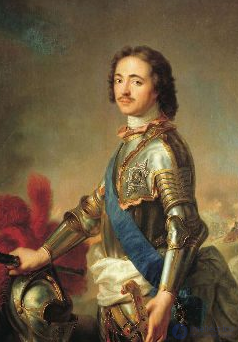
The Russian Emperor Peter I the Great, 1672-1725.
Honoré de Balzac in his work "Père Goriot" describes a French boarding house of the early 19th century as follows: "In this first room there is a particular smell; it has no corresponding name in our language, but it ought to be called the smell of a boarding house. It has a staleness, a mustiness, a rottenness; it makes one shudder, strikes the nose with something dank, soaks into one's clothes, smells of a dining room where dinner has just ended, of a stinking cookshop, a servants' hall, a coachmen's quarters. Perhaps it could be described if a way were found to isolate all its nauseating components – the peculiar, sickly odors emanating from each young or old lodger. And yet, despite all this vulgar horror, if one compares the sitting room with the adjoining dining room, the former will seem elegant and fragrant as a boudoir" [5, p. 36]. The research carried out by the French scholar Dominique Laporte is interesting. He attempted to describe the history of filth in the context of the history of the Modern era (16th-19th centuries) [37].
The original subject and non-standard approaches to analysis are highly valuable, especially where the author speaks about smells. Laporte, for example, notes that the early Modern era is characterized by a pronounced emphasis on sight and almost complete indifference to smell. If the source of a bad smell is hidden from view, it causes no concern. Moreover, he notes that shame about one's own body giving off a bad smell is a fairly late phenomenon.
The development of individualism leads a person to stand guard over his personal space and to begin to fence it off even with his own smell. Thus, the scholar notes that with the formation of the norm according to which natural needs must be performed in privacy, new forms of social distance also arise. The transition from the publicity of bodily functions to bashfulness and modesty would have been impossible without a raising of the threshold of sensitivity to certain smells within the family. It becomes the norm not to notice a bad smell under certain conditions. At the same time, bad smell itself for a long time remains a marker of social difference – the poor are vulgar, spoiled and foul-smelling, while the rich are suspected of being spoiled by luxury, which is accompanied by a refined scent. And yet both sides, with astonishing unanimity, can "sniff out" anyone else. The changes that took place in the social life of Europeans by the end of the Modern era, one way or another, also changed people's attitude to smells. Already from the middle of the 19th century there is less and less "stench." European civilization acquires a polish, which shows itself in the emergence and development of the perfume industry and the creation of conditions for localizing the "decomposing activity of bacteria." History also knows specific persons who possessed an unsurpassed gift for giving off beautiful fragrances. Thus the English clergyman William Stainton Moses (1839-1892), author of the book "Spirit Teachings," a Master of Arts of University College London, whom spiritualists consider one of the greatest mediums of the past, became almost the most famous bearer of mysterious scents in modern history. Moses' scents came from his head, and the more actively people tried to drive them away, the stronger they became.
Most often the clergyman smelled of verbena, musk, freshly mown hay, but besides this he also gave off one more, unknown scent, which was called the "spiritual fragrance" [30]. Unfortunately, the nature of this phenomenon has remained unstudied. There is only Moses' own testimony of July 4, 1874, which researchers found in his diary: "In the garden, even before everyone had sat down in a circle, I felt an onset of fragrance – it came from my hair. I stroked my head, and my hands smelled just as strongly. This happened more than once. The smell of mint was always concentrated near my head." As Moses himself supposed, the fragrances that arose apparently performed some healing function, because they were felt especially strongly during illness. Today smell and the sense of smell are attracting more and more attention from scientists and specialists in various fields of scientific knowledge and activity. Even such a distant sphere as space. For example, cosmonauts claim that there is a smell of space.
Thus, if right after working in open space one sniffs one's outfit, the smell of space leaves its traces. NASA astronauts express the opinion that space smells of fried steak and welding, and the Moon of gunpowder smoke. Russian cosmonauts insist that weightlessness, too, has a specific smell. Thus, the pilot-cosmonaut P. Vinogradov believes that this smell is similar to the smell of ozone – "clean, as if a thunderstorm had just passed," and his colleague S. Volkov notes: "A year after the flight, I never found a smell that came anywhere close to the one you inhale right as you step out into space" [11]. The most pronounced side of this interest is the practical use of knowledge about smells and the sense of smell in human life. This is connected both with the commercial aspects of the problem and with the implementation of projects aimed at ensuring people's safety and preserving their health, and, of course, with the reflection in each person's everyday life of the whole richness of the world of scents.
Whole branches of production and services have appeared that use knowledge about smells and the peculiarities of their effect on the human being and body. Thus, such fields as the following are developing intensively today: aromatherapy – the science of using volatile aromatic substances (VAS) for therapeutic and preventive purposes; aromatology – the science of odorous substances; odorology (clinical, forensic) – the science of the perception of smells; aromacology – the influence of smells on human life in the social world, also called the "social psychology of smells"; aromamarketing – the science that studies the effect of aromas of natural and artificial origin on a person's emotional state with the aim of prompting him to act. Thus, the world of smells and its perception by humans represent both scientific and practical interest, which has been realized in human relationships for many centuries.

Comments