
Lecture
Takesics is the science that studies the various forms of a person's tactile manifestations in communication situations. In a broader sense, it is the science that studies various forms of touch, as well as electromagnetic, emotional and gravitational influence, and various irrational stimuli. There is also the view that dynamic touches are a physiologically determined form of stimulation.
The tactile-kinesthetic system of reflecting nonverbal behavior is the system that forms a person's ideas about the position of the body in space, carries information about the presence of an object (things, people, animals, etc.) and, in general, contributes to the creation of the body schema as a certain structure .
Tactile sensations (from Lat. tactilis – tangible) are a form of skin sensitivity that arises from touch, pressure, vibration, and the action of texture and extent. These sensations are due to the work of two kinds of skin receptors: nerve plexuses surrounding the hair follicles, and capsules consisting of connective tissue cells.
Specialists distinguish more than 1500 different types and forms of social tactile
contacts with various semantic loads of touches [14].
Takesics includes such types of touch as the handshake, patting,
kissing, stroking, grooming, hugging, etc. (see Table 2.1).
As specialists note, every touch carries a certain
meaning. It can express love, trust, fear, weakness, admiration,
disdain, etc. .
In addition, such manifestations of takesics as stroking, kissing, patting,
and blows are for a person important sources of interaction with the
world around him. With their help, ideas about the spatial position of
one's own body and knowledge of the body parts of other people are formed.
Touches appear in forms of positive and negative reflection. Thus,
stroking performs in communication the function of approval and emotional support.
Moreover, for example, stroking the head shows that a person acknowledges
the trustworthiness of the relationship and "exposes" the most sensitive and vulnerable part
of his body. Besides, such a touch also speaks of a certain intimate
character of the relationship between the communication partners.
Table 2.1 Types of touch*
| Types of touch | Parts of the body involved in the touch |
| Light patting, expressing approval |
Head, back |
| Slap | Face, hand, buttocks |
| Punch | Face, chest, arms, lower torso |
| Pinch | Cheek |
| Stroking | Hair, face, upper torso, knees |
| Shaking | Palms, shoulders |
| Kiss | Mouth, cheek, chest, palm, leg, genitals |
| Licking | Face, genitals |
| Holding | Palm, hand, knee, genitals |
| Guiding | Palm, hand |
| Embrace | Shoulders, whole body |
| Clasping | Hands |
| Laying on | Palms |
| Kicks | Legs, buttocks |
| Grooming | Hair, face |
| Tickling | Almost the whole body |
*Source: M. Knapp, J. Hall, 2007.
An interesting detail: the Dutch physician Frans Veldman, after the Second World
War (he had been held in the Buchenwald concentration camp), declared that there is much
evil in the world because of a lack of love, which children do not receive in due measure from their fathers.
Fathers, busy with work and war, rarely spend time with their children until they reach
adolescence [23].
Veldman came to the conclusion that a father should take part in the child's fate even
during the mother's pregnancy. He became the founder of haptonomy (from Greek haptein –
touch and nomos – law, literally the law of touch), in which the father, simply caressing
the mother's belly, can announce his existence to the child and try to establish
first contact with it. It has been observed that quite often the human embryo, among other
touches, recognizes the father's hands and can even move toward them. The most "skillful
dads" manage to get the children to jump in the mother's womb from one hand to the other.
Haptonomy reached its greatest popularity in the 1980s, but even today
it provokes ambiguous judgments. The point is that it is impossible to
trace clearly whether the embryo's reactions are connected precisely with the father's touches or whether there
are other causes. But, in any case, this technique increases the personal
responsibility of fathers, the mother does not feel alone during pregnancy, and in the
prenatal period the triangle "mother, child, father" is clearly built.
Blows express a negative attitude toward the interaction partner. The handshake,
on the contrary ‒ a positive attitude toward the communication partner. Moreover, it has its own
history. As researchers note, the handshake is a survival from the distant
past. In this way primitive people greeted their vis-à-vis (open
palms), to show that they were unarmed.
In Ancient Rome the handshake (the wrists of the
right hands were clasped) was a sign of special regard and greeting, and in
time the handshake became an indispensable attribute of the
greeting of people who are closely acquainted or who
wish to get acquainted with each other.
In its present form the handshake is a little
more than 150 years old. The handshake, its intensity and
duration give information about the intentions of the communication
partners and their attitude toward each other. Here, takesics specialists
divide the handshake into 3 kinds: dominant, submissive and equal.
The dominant handshake is a manipulation in which the hand
is placed on top and the palm is turned downward. It is an aggressive form of
greeting and serves as a nonverbal signal of dominance in the process of communication.
Specialists from the University of Alabama (USA), in the course of
research, established that extraverts shake hands firmly
and commandingly, while neurotic individuals (melancholics)
never do so. At the same time, women who do not accept
male leadership and generate new ideas shake hands
energetically and firmly. Most men always strive
to reproduce a firm handshake.
Researchers believe that these signals are sent and received
unconsciously. A person who is inclined to this kind of handshake often unconsciously
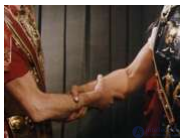
A handshake in Ancient Rome, accepted among patricians

An example of a dominant handshake
seeks to gain control of the situation and win the interlocutor over to his side. This is
seen in the example of handshakes between individuals of equal social status. In turn,
this can become one of the barriers to constructive dialogue.
At the gender level, this kind of greeting is more common among men than
among women. Research results show that power and control matter more
to men, of whom eight out of ten strive for a dominant
handshake, and only one woman in three (a businesswoman or manager) positions
her hand with the palm turned downward during a handshake.
However, men must always remember that they are about twice as strong as
the average woman, and therefore the greeting of a representative of the weaker sex should be
gentle, warm, friendly, and to leave a positive impression.
It should be noted that offering a straight, unbent
arm and a firm handshake that crushes the fingers is also a sign of aggression. In this way, one of the partners in
communication wishes to keep his distance and not to let the other into his intimate zone.
Shaking not the hand but only the fingertips testifies to the same thing, but it also points to
a person's insecurity and high anxiety.
A submissive handshake is one with the hand underneath and the palm
turned upward. This type of handshake signals that
the communication partner does not mind if the initiative in
the interaction belongs to the other. This type of handshake
is quite acceptable when one of the communication partners
deliberately seeks to hand control of the situation
to the interlocutor, or tries in this way to
apologize to him.
At the same time, attention should be paid to the fact that a submissive handshake should not always
be interpreted precisely this way. Once again, the social
context or the physiological features of a person leave their mark. An individual with arthritis will not shake
hands firmly and will turn the hand palm up, since this position is less
painful for him. A weak handshake is characteristic of people in creative professions
(artists, musicians, sculptors). For them, hands are "the means of production" and they
take great care of them. There are also other, characterological reasons for such a gesture.
First of all, these are the type of temperament, the type of character accentuation, the features of constitution
etc.
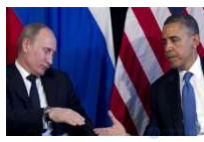
An example of a submissive handshake

An example of an equal handshake
An equal handshake is a product of
the partners' mutual respect, in which the palms are positioned
in a vertical plane, and neither claims dominance or submission in
the process of communication. When two
equal partners shake hands, an element of play seems to arise,
in which their hands remain in a vertical position, which
helps to establish an atmosphere of mutual respect and
equality.
The handshake, as an element of the takesic system of nonverbal behavior,
is interpreted differently in different sociocultures. In Slavic culture,
the handshake is used more often in greeting situations than in Anglo-Saxon culture. In the USA,
as specialists note, high-ranking officials try to be the first to extend
a hand for a handshake and demonstrate a domineering way of shaking hands [30].
Such an element of takesics as patting on the back or shoulder signifies closeness
in the relationship between the communication partners, as well as their social equality. Embraces
symbolize equality, brotherhood, and love among those who communicate. An embrace around the shoulders
is characteristic of both men and women. It is a manifestation of both romantic relations
between a man and a woman and friendly (emphatically amicable) relations
between men. But a man embracing a woman around the waist already speaks of a certain
level of intimate closeness.
Kisses are the most intimate elements of takesics, but they too
manifest themselves differently in different sociocultural spaces. S. Freud was one of the first to
draw researchers' attention to the problem of the pleasure that infants derive from
rhythmic tactile sensations. The scientist wrote: "Sucking for the sake of pleasure
absorbs the infant's whole attention and leads either to falling asleep or even to a motor
reaction resembling an orgasm. … Anyone who has seen a satisfied baby drop away from
the mother's breast and fall asleep with flushed cheeks and a blissful smile
must admit that this picture is very much like the expression of sexual satisfaction
in adult life" [33, p. 135].
The observations of Freud and his followers (Kinsey, Pomeroy, Martin) made it
possible to conclude that rhythmic tactile self-stimulation (especially
self-stimulation of the erogenous zones) is the biological basis of acquired
motives of attachment and affiliation. Moreover, another researcher, H. Harlow, found
that the pleasure experienced in infancy and early childhood from contact with the mother
or with peers is the most important factor in forming a normal
heterosexual orientation and corresponding behavior in adulthood [20].
The British anthropologist Helen Fisher believes
that the kiss as a phenomenon is not a consequence of the habit of
ancient people (mothers) of passing chewed food
into their children's mouths. The researcher holds that the kiss, as one
of the human tactile manifestations, has always been the main
method of choosing a suitable sexual partner [37].
The psychologist Susan Hughes conducted an experiment
in which more than 1,000 students took part
from Rutgers University. The study established that men
kiss mainly to seduce a partner, while women use kisses to
choose a worthy life companion. Hughes states that if a woman does not like a
kiss, she will not have sex with that man [35]. Men have no such
restrictions – he will rather not kiss a woman he does not
like, that is, biologically both women and men are, as it were, "programmed" for
sexual relations with a particular partner, but only one who
has sufficient potential for sensual kisses.
It should be noted that the female and male kiss also have their own
differences. Thus, men prefer a wet kiss. A typical example of such a
kiss is the French kiss, when the tongue is pushed into the partner's mouth. Another
example of such a kiss ‒ is when tactile contact takes place with a wide
open mouth. Specialists link this to the fact that men are less sensitive to
smells [24].
Women are more attentive to the frequency and strength of kisses, and along with smell and
taste sensations, these are the most important criteria for evaluating a partner.
According to the results of one study, 66% of women completely lost attraction to
their partners after the first kiss, even though before the oral contact
they had felt a need for a serious romantic relationship.
Sexologists note that the kiss is an indispensable attribute of establishing
warm, close relationships between people in the overwhelming majority of cultures. And zoologists
and ethologists assert that the kiss is characteristic of the animal world too. Thus N. Tinbergen
noted that elephants, as a "prelude", put their trunks into each other's mouths, and swans and
other birds touch beaks [31].
A kiss between lovers
At the same time, it should be noted that among some African tribes the kiss
is considered an extremely indecent display of feeling. For example, among the members of the
Mbala tribe (Uganda) there is a ban on kissing, because "eating the saliva of another person"
is the greatest licentiousness.
However, among civilized peoples the kiss is a "sacred ritual", and July 6
is celebrated all over the world as World Kissing Day. The holiday, which originated
in Great Britain twenty years ago, was officially established by the UN. Since then, in many countries various contests and competitions are held, both for the duration of a kiss and for the number of people kissing at once.
According to the classification of various touches proposed by N. Heslin,
the meanings they contain reflect the functional, social,
friendly, and intimate contacts of communication partners [22]. (See Table 2.2).
Touches that testify to
sexual arousal are interesting. Thus, the American psychologist D. Morris, studying
heterosexual couples brought up in the traditions of Western culture, identified a series of
stages they pass through on the way to sexual intimacy. These stages, except for the
first three, involve one or another kind of tactile contact:
1) eye to body;
2) eye to eye;
3) voice to voice;
4) hand to hand;
5) hand to shoulder;
6) hand to waist;
7) mouth to mouth;
8) hand to head;
9) hand to body;
10) mouth to breast;
11) hand to genitals;
12) genitals to genitals and/or mouth to genitals.
Morris believes that the stages usually follow in exactly this order, although
variations are possible. One form of skipping over stages or of advancing to a higher
level of intimacy than expected is a kiss-accompanied
good-night wish or a handshake upon introduction.
Table 2.2 Classification of touches according to N. Heslin*
Types of touch - Purpose of touch
Functional (professional)
The meaning of such impersonal, often emotionless touches is the performance of some task or
the provision of some service. The communication partner is regarded as an object, with whom any
hints of human closeness or sexuality that could interfere with the performance of the specific task are excluded.
Examples of such contacts: interaction between a coach and a pupil, a tailor and a client, or a teacher and a student.
Social (signs of politeness)
Such touches serve as proof of recognizing
in another person a representative of one's own biological
species, who is guided by the same rules
of behavior. However, there is nothing personal in the touch that would
testify to any personal
contact between the "participants of the event". Example: the ordinary
handshake of acquaintances.
Friendly (cordial)
Such tactile contact testifies that the other
person is perceived as an individual, is regarded as
a friend, and is welcome. However, a touch of this kind
may involve some constraint, as a consequence of
the fear of being taken for too intimate or
even sexual. If people are left alone, the fear of being
misunderstood grows stronger, so such
touches are more likely in public.
Intimate (loving)
Touches of this kind − are an expression of feelings to
the communication partner. Whom we embrace, we love,
and that person is close to us. The various touches
expressing these feelings can be highly
nonstandard and correspond most closely to the personality
of the communication partner.
*Source: Knapp M., Hall J., 2007.
As E. Aronson, T. Wilson, and R. Akert note, in cultures with a high level of
contact, people stand close to each other and often touch the person they are
talking to. In cultures with a low level of contact, people stand farther
from each other when talking and touch less often. The first group of cultures includes
the countries of the Middle East, South America, and Eastern Europe. The second group includes
North American countries, the countries of northern Europe, Southeast Asia, Pakistan, and
the indigenous peoples of America. Cultural differences also show up in the appropriateness or
inappropriateness of touches between friends of the same sex. Thus, in Korea and Egypt men and
women hold hands, link arms, or walk side by side with a friend
of the same sex, and this nonverbal behavior is given no
sexual meaning. In the USA such manners are less common, especially among male friends .
Researchers at the University of Minnesota, USA, set out to determine what
role touch plays in the return of a lost coin. They placed a coin (10
cents) on a shelf and then hid behind a tree, waiting until someone entered the telephone booth.
After waiting a while, one of the researchers approached and asked: "Did you see my coin here? I need
to make another call." Only 23% of those who had made calls
admitted that they had indeed found a coin in the booth, and returned it to its owner.
However, if the researcher casually touched the caller's elbow (the touch lasted no more than
three seconds), 68% of respondents returned the coin. Moreover, those who had made calls
looked embarrassed and began to justify themselves, explaining that they had been trying to find whoever
had left the coin in the telephone booth.
The results of the experiment show that touching increases threefold
a person's chances of getting what he wants from the target of influence. The reason for this
is that the elbow is a remote space, since it is located
quite far from the intimate parts of the body. In addition, there is an opinion that one should not
touch a stranger, since this gesture makes an impression at once, and ‒ what is
most significant – a three-second touch creates an instant communicative
bond between the interlocutors.
In cross-cultural experiments it was established that the return of a coin in different
cultural environments depends significantly on how widespread
touching is in them. Thus, among Australians 72% returned the coin, English – 70%, Germans –
85%, French – 50%, Italians – 22%. [34] On this basis one can conclude that
touches are most relevant in those social environments where such
gestures are not a cultural norm.
If you are an Italian or a Frenchman, touching will not cause heightened
arousal in you, but if you are an Englishman or a German, who very rarely touch
one another – the effect of a touch will be quite productive.
The data of cross-cultural studies indicate that the people who touch
each other most often are the inhabitants of Costa Rica (180 touches per hour) and the Dominican Republic
(160). In London, researchers over the course of an hour failed to record a single
touch.
On the whole, specialists have established that touching is quite acceptable and even
necessary in countries such as India, Turkey, France, Italy, Greece, South
America, the Middle East, some countries of Asia, and the Slavic states.
It is better to refrain from touching in England, Germany, Japan, the USA and Canada,
Scandinavia, Australia and New Zealand, and the Baltic states [18].
Differences in gender roles are interesting. A woman will touch another woman four times
faster than a man will touch another man. And, what is most
significant, a touch above or below the elbow does not produce the effect that
a touch directly on the elbow does. In women such actions provoke an unambiguously
negative reaction (fear of sexual subjugation), and in men it may
even provoke defensive aggression, since such a gesture is akin to the techniques of
attack or detention

Comments