
Lecture
Spiral of silence (German: Schweigespirale) — a concept in political science and mass communication proposed by the German political scientist Elisabeth Noelle-Neumann. It asserts that a person is less likely to voice their opinion on a given topic if they feel they are in the minority, because they fear retribution or isolation (being ignored: see boycott and ostracism) . Elisabeth Noelle-Neumann considers the “spiral of silence” to be an attribute of the manifestation of public opinion: “All manifestations of public opinion are united by their connection with the threat of isolation for the individual. Wherever an individual cannot freely speak out or act as they see fit, but must take into account the views of those around them so as not to end up isolated, we are always dealing with manifestations of public opinion”.
The phenomenon of the “spiral of silence” as such has been known for quite a long time. Already in 1856, in A. de Tocqueville's published “The Old Regime and the Revolution”, one can find an exact description of the dynamics of the effect of the “spiral of silence”: “those who held to the old faith were afraid of finding themselves in a minority of people devoted to their religion. And since isolation frightened them more than error, they joined the majority without changing their views. The views of only one part of the nation seemed to be the opinion of everyone, and it was precisely this that misled irresistibly those who were themselves the cause of this deception” . Moreover, an indication of the existence of the “spiral of silence” itself can also be traced back to ancient authors, and later — in the works of J.-J. Rousseau and D. Hume, J. Locke, M. Luther, Machiavelli, Jan Hus and others However, this phenomenon received its name only in the 1960s, from the doctor of philosophy and economics, professor at the Institute for Public Opinion Research in Allensbach, Elisabeth Noelle-Neumann, the author of the monograph entitled “The Spiral of Silence: Public Opinion — Our Social Skin”.
Since the main basis for the manifestation of the “spiral of silence” is the phenomenon of public opinion, the preconditions of the theory are explained through the concept of how public opinion is generated. In society there are two sources that generate public opinion. The first is direct observation of one's surroundings, sensing whether this or that action, phenomenon, or statement is approved of. The second source is the mass media. They generate the so-called “spirit of the times” — another concept used to denote the subject matter of public opinion that persists over a long period of time. This “spirit” influences the attitudes and behavior of the individual. The formation of public opinion occurs owing to attitudes, the purpose of which was already emphasized back in 1922 by the American journalist-sociologist Lippmann. Lippmann believed that every person is regulated, determined through attitudes that define what they see, hear, and how they interpret their surroundings, and what is important to the individual . Thus, the mass media should possess publicistic diversity, that is, provide the opportunity to “tell the world” different points of view and opinions. After all, the mass media play a large role in determining which opinion is dominant, since the possibilities of our direct observation are limited to a small percentage of the population. The mass media exert an enormous influence on how public opinion is represented, and can strongly influence the individual's perception of public opinion, regardless of whether the depiction corresponds to reality . It is precisely on how public opinion is perceived by a person that it depends whether the effect of the “spiral of silence” will arise.
The analogy with a spiral in the description of the theory is used to visually represent it. At the end of the spiral are people who do not express their opinion publicly out of fear of isolation. The more a person's opinion diverges from the generally accepted one, the lower in the spiral that person is positioned . The fear of becoming isolated serves as the initial point around which the spiral rotates, which, with each new turn, increases its diameter, thereby acting upon the opinions of the majority. Noelle-Neumann describes the spiral of silence as a dynamic process in which predictions about public opinion become fact, because the coverage of the majority opinion in the mass media becomes the status quo, and the minority becomes less and less likely to be willing to speak out. Noelle-Neumann's research showed that every person forms their own impression of public opinion but self-restricts their statements, fearing to come into conflict with the opinion dominant in society, since this may provoke the disapproval of those around them and, as a consequence, isolation. Thus, a holder of an opinion that he himself considers unpopular in most cases either remains silent, not revealing it, or even joins the opposing side, orienting himself toward the winners, the representatives of the prevailing opinion, thereby minimizing his social risks. At this stage the spiral makes its first turn and continues to unwind in the sense that the “social skin” of other members of society will perceive public opinion also on the basis of the information presented by the first holder who has adopted a conformist position. This effect continues further, winding the spiral in a number of cases until the real majority adopts a position of silence .
The “last-minute shift”, the “last-minute bandwagon effect” — a situation in which the electorate changes its opinion at the last moment in favor of one party or another under the influence of public opinion;
The “bandwagon effect” — a situation in which an individual tries to present himself as a supporter of the winning party, even if he actually voted differently. It is also called the “effect of success”. Poll results, widely covered in the mass media, have a direct influence on the nature and content of the election campaign, forcing candidates to make corresponding adjustments to their positions. The essence of the “effect of success” is that people tend to adopt the positions that, in their opinion, are shared by a greater number of people. Observers trace a tendency for voters to shift to the side of the leading candidate. A contender gaining an advantage over his rivals suddenly begins to enjoy growing popularity among the population. The mass media give him significantly more attention than other candidates, and he gains greater fame. As a result, “success breeds success”.
To carry out social isolation (which is what drives the winding of the spiral of silence) or any other form of disapproval of an individual's actions, it is necessary to precisely identify the actor who expressed the disapproved viewpoint, or to fully de-anonymize his identity. In this connection it is necessary to consider three global levels of disclosure of personal information in communication mediated by the Internet :
Some critics argue that the rise of the Nazis to power cannot be explained from the standpoint of the “spiral of silence”. This is explained by the fact that they were initially in the minority, and their views shocked the majority of the population. Other critics cited different facts: in the German society of the Weimar Republic, the spiritual climate was determined by the right, not the left, who expressed their views loudly enough and had fairly good starting positions.
N. Mansurov, in the annotation to Elisabeth Noelle-Neumann's book, states that the concept of the “spiral of silence” is not universal and is not able to explain all cases of social life . The fear of isolation should nevertheless be regarded as one of the factors in the system of causes underlying the formation of public opinion, since in a number of cases it acts as a consequence rather than a cause.
Critics of the “spiral of silence” theory argue that people are subject to an enormous number of factors that determine whether they will openly express their opinion or not.
As research shows, the fear of becoming isolated within narrower circles of communication is far greater than the fear of becoming isolated within society as a whole[10]. Within an entire country, a person is quite likely to find a group of people sharing his interests, which is why people fear isolation within their close circle much more.
In addition, scholars say that both the personal factors of the individual and the cultural differences between various social groups will influence how likely a person is to express their opinion openly. Thus, if a person has high self-esteem and does not experience a feeling of shame, then he will be able to speak out regardless of how he perceives the climate of public opinion. As for culture, in some cultures the open expression of one's ideas is not approved of. Thus, individualist cultures encourage the expression of individual opinion, even the direct expression of disagreement and confrontation, while collectivist cultures place the opinions and needs of the majority, of the collective, first. A person's gender can also be considered a cultural factor. In some cultures, women are either deprived of a voice or partially restricted in it. Thus, not only an individual's personal perception of public opinion but also cultural factors must be considered when substantiating the “spiral of silence” theory.
While the existence of groups with opinions different from those assumed to be dominant in society gives some people the opportunity to express seemingly unpopular opinions, the assumptions within such groups that criticism of their underrepresented opinion is equivalent to support for society's mainstream views are a source of false dilemmas.
Some studies show that such false dilemmas, especially when contradictions exist both within the mainstream views and within organized opposition views, trigger a spiral of silence that specifically suppresses logically consistent criticism from a third, fourth, or higher point of view.
The spiral of silence has provided insight into various topics, ranging from discussions of popular culture phenomena to smoking. Given that the spiral of silence occurs more often in controversial issues and issues with a moral component, many scholars have applied this theory to controversial topics such as abortion , affirmative action , the death penalty , mandatory COVID-19 vaccines, and mask-wearing.
The theory of the spiral of silence can also be applied to the context of social capital . Recent studies view social capital as “a variable that enables citizens to develop norms of trust and reciprocity , which are necessary for successful participation in collective activity”. One study examines three individual indicators of social capital: civic engagement , trust, and neighborliness, as well as the relationship between these indicators and people's willingness to express their opinion and their perception of support for their opinion. The results show that civic engagement has a direct effect on people's willingness to express their opinion, while neighborliness and trust have a direct positive effect on people's perception of support for their opinion. In addition, the study shows that “only the direct (but not indirect) influence of civic engagement on opinion expression further underscores the potential distinction between bonding and bridging social capital”.
Existing literature predating the spiral of silence theory suggests a link between social conformity and culture , motivating communication scholars to conduct a cross-cultural analysis of the theory. Scholars in the field of psychology , in particular, had previously examined cultural differences related to conformity to majority opinion. More recent studies confirm the link between conformity and culture: a meta-analysis of Asch conformity experiments , for example, suggests that collectivist cultures are more likely to exhibit conformity than individualist cultures.
Huiping Huang's “A Cross-Cultural Test of the Spiral of Silence” analyzes the results of a telephone survey conducted in Taiwan and the United States . The hypotheses tested were the beliefs that the United States is an “individualist” society , while Taiwan is a “ collectivist ” one. This suggested that the spiral of silence would be less likely to be activated in the United States, because people would be more likely to emphasize their personal goals. They place the “I” identity above the “we” identity and strive for personal success. It was therefore hypothesized that they would be more likely to speak out, regardless of whether they were in the minority. On the other hand, it was predicted that people in Taiwan would pay more attention to the collective goal, and therefore would submit to the influence of the majority in the hope of avoiding tension and conflict. The study also examined the influence of motives , including self-efficacy and self-confidence .
Telephone surveys were conducted; citizens of the United States were asked about American intervention in Somalia , while citizens of Taiwan were asked about the possibility of direct presidential elections. Both questions focused on politics and human rights, and were therefore comparable. Respondents were asked to choose “for”, “neutral”, or “against” with respect to the categories of self, family and friends, the media, society, and society in the future on the given issue. Measurements were also taken with respect to the constructs of individualism and collectivism, as well as “motives for opinion non-expression” based on a scale from 1 to 10 and from 1 to 5, respectively, in agreement with these statements.
The results confirmed the initial hypothesis. Overall, Americans were more inclined to speak out than Taiwanese . Nonconformity to the majority reduced Taiwanese respondents' motivation to speak out (and they had a higher collectivism score), but had little effect on Americans. In Taiwan, future support and societal belief played a larger role in the likelihood of expressing one's opinion and confirmed that the activation of the spiral of silence was at work. In the United States it was hypothesized that, being more individualistic, they would be more likely to speak out if they found themselves in the minority or a nonconforming group. However, this was not true, but Huang suggests that perhaps the chosen issue was not directly widespread, and therefore they considered it “necessary to voice their objections to the majority opinion”. A lack of self-efficacy led to a lack of speaking out in both countries.
Basque Nationalism and the Spiral of Silence — an article by Spencer and Croucher, which analyzes public perception of ETA (Euskadi Ta Askatasuna, a militant separatist group) in Spain and France. This study was conducted similarly to the previous one: Basques from Spain and France were asked questions about their support for ETA. They were asked questions such as “How likely are you to engage in a conversation about ETA with a stranger on a train?”. Cultural differences between the two different regions in which ETA existed were taken into account.
The results confirmed the spiral of silence theory. Although opinion of the group was extremely unfavorable, there were no protests to stop it. Individuals claimed that they were more inclined to express their opinion to non-Basques, which suggests that they had a “fear of isolation” toward other Basques . In addition, the Spaniards surveyed were more inclined to remain silent due to their greater proximity to acts of violence.
One study by Henson and Denker “examines the perception of muting behavior, political affiliation, and political differences as correlates of the perception of climate in university classrooms and communicative behavior”. They studied whether students' view of the class changes if they perceive the instructor and other classmates as having a different political affiliation, while the instructor and other classmates communicate using muting behavior. The article stated that little had been researched regarding the interaction of students and instructors in the classroom and how it affects students. The purpose of the article was to “determine how political ideas are expressed in university classrooms and, thereby, to assess the effect of classroom communication on the perception of political tolerance”.
The article argues that university classrooms are an appropriate place to study the spiral of silence theory, since it is a place where interpersonal , cultural , media , and political communication occurs. Henson and Denker say: “Since classroom interaction and public discourse mutually influence one another, instructors and students bring their own biases and cultural perspectives into the classroom”.
The study examined whether there was a correlation between students' perception that they were politically suppressed and their perceived differences in political affiliation between students and instructors. The study also asked whether there was any relationship between perceived climate and the similarity of students and instructors in their political leanings. The researchers used participants from communication courses at a Midwestern university. Students responded to a survey about their perception of political suppression, classroom climate, and the climate created by the instructor. The results of this study showed that there was a positive relationship between perceived similarity in political party and ideology between students and instructors and perceived greater political suppression.
While research on the spiral of silence theory focused on face-to-face interaction before 2000, the theory was later applied to the computer-mediated communication environment . The first study in this context analyzed communication behavior in online chats on the topic of abortion and found that minority speakers were more likely to speak out, while their comments remained neutral. Another study focused on postings on Korean bulletin boards regarding national elections and found a connection between online postings and the representation of candidates in mainstream mass media. A third study focused on an online review system, suggesting that fear of isolation tends to reduce participants' willingness to express neutral and negative reviews. The spiral of silence theory is extended “to the context of non-anonymous multichannel communication platforms”, and it is also argued that “there is a need to consider the role of communicative affordances in expressing opinion online”.
The concept of isolation has many definitions depending on the circumstances in which it is studied. In one case, the problem of isolation was defined as social isolation , defined as a low relative frequency of interaction with peers. Other researchers have defined isolation as low peer acceptance or high peer rejection . Studies that examine isolation in relation to the Internet either focus on how the Internet makes people more isolated from society, cutting off their contact with real people , or how the Internet reduces people's social isolation by allowing them to expand their social networks and giving them more opportunities to stay in touch with friends and family. With the development of the Internet, and the World Wide Web in particular , a large number of diverse groups emerged, including web chat and Internet relay chat (IRC), newsgroups , multi-user dimensions (MUDs), and, more recently, commercial virtual communities . Theories and hypotheses about how internet groups affect people are numerous and widespread. Some researchers view these fast-growing virtual chat groups, online games, or computer marketplaces as a new opportunity, especially for stigmatized people, to take a more active part in public life.
Traditionally, social isolation was conceived as a one-dimensional construct organized around the notion of a person's position outside a peer group , and referred to isolation from a group as a result of exclusion from the group by peers. The literature shows that from children to adults, people understand the concept of isolation and fear the consequences of isolation from the groups to which they belong. Fearing isolation, people did not feel free to speak out if they felt they held differing views, which meant that people limited themselves to talking with like-minded people or did not engage in conversation at all. Witschge further explained: “Whether it is fear of harming others or fear of harming oneself, there are factors that prevent people from speaking freely, and this thus leads to a less than ideal type of discussion, since it hinders the full expression of diversity and equality of participants and points of view”.
The Internet has the power to free people from the fear of social isolation, and thus ends the spiral of silence. One article shows that social networks can weaken the fear of isolation. Research shows that an active minority holding racist views is willing to express unpopular views on Facebook. The Internet allows people to find a place where they can find groups of people with similar thinking and similar points of view. Van Alstyne and Brynjolfsson stated that “Internet users can seek out interactions with like-minded people who share similar values, and thus become less inclined to entrust important decisions to people whose values differ from their own”. The capabilities of the Internet may not only encourage more people to engage in discussion by freeing people from psychological barriers, but also open up new opportunities, since it “makes manageable large-scale, many-to-many discussions and debates”. [ 82 ] Unlike traditional mass media , which limit participation, the Internet provides such characteristics as empowerment, a vast scale of available information, the ability to effectively reach a specific audience, and to bring people together through this medium.
The Internet — is a place where many reference and social groups with similar views are available. It has become a place where people seem to fear isolation less. One research paper examined people's willingness to express their opinions online and offline. Using survey results from 305 participants, a comparison and contrast was made between spiral-of-silence behavior online and offline. Liu and Fahmy stated that “it is easy to leave an online discussion without pressure from the majority”. This does not mean that the spiral of silence does not occur in the online environment. People are still less likely to speak out, even in an online setting, when there is a dominant opinion that differs from their own. But people in the online environment will speak out if someone has a reference group that stands up for them.
Online, the presence of a single person who supports a minority viewpoint can put an end to the spiral of silence. Studies of spiral-of-silence behavior online have not acknowledged that a person may be more likely to speak out against dominant views offline as well. A person may have characteristics that allow them to comfortably speak out against dominant views in real life, which makes them equally comfortable speaking out online.
Although research shows that people disclose their opinions more often in an online setting, suppression of views can still occur. One study shows that people on Facebook are less likely to discuss the Snowden and NSA stories than in real life, for example, at a family dinner or a public gathering. Another research paper examined the influence of different opinions on online forums (agreement of opinions with the majority of forum participants compared to the source on the website) and found that agreement with personal opinions was more influential than the online site on which the forum was located. Nekmat and Gonzenbach said that it might be worth investigating whether factors in these studies, or other factors, are the reason people feel more comfortable when it comes to expressing their opinion online.
The nature of the Internet fosters not only the participation of more people, but also a more heterogeneous group of people. Page stated: “The progressive development of electronic communication technologies appears likely to increase the diversity of available ideas, as well as the speed and ease with which they fly about and compete with one another”. The reason people participate in discussions lies in their differences, and the Internet makes it easy to find differences. The Internet seems like an ideal place to find the different views of a very heterogeneous group of people who are at the same time open to the kinds of differences and disagreements necessary for discussion. Noelle-Neumann's original idea of shrinking and silent citizens is difficult to reconcile with empirical research documenting free-flowing discussions in computer-mediated contexts such as chats and newsgroups.
The Internet provides an anonymous setting, and it can be argued that in an anonymous setting the fear of isolation and humiliation will be reduced. Wallace acknowledged that when people believe their actions cannot be attributed to them personally, they tend to become less constrained by social conventions and restrictions. This can be very positive, especially when people are given the opportunity to discuss difficult personal issues in a setting where they feel safer.
The ability of groups to mock an individual is diminished on the Internet, thereby reducing the tendency toward conformity. Wallace goes on to summarize a number of empirical studies showing that dissenters feel more liberated to express their views online than offline, which may be the result of a minority individual not having to endure mockery or bullying from the people making up the majority, or feeling embarrassed for holding a different opinion. Stromer-Galley believed that “the lack of nonverbal cues, which leads to a reduced sense of social presence and an increased sense of anonymity” frees people from the psychological barriers that prevent them from participating in in-person discussion.
The essence of the spiral of silence is that people consciously or subconsciously believe that expressing unpopular opinions will lead to negative consequences. These beliefs may be absent on the Internet for several reasons. First, embarrassment and humiliation depend on the physical presence of others. In computer-mediated communication, physical isolation often already exists and poses no further threat. Second, a significant portion of normative influence is conveyed through nonverbal cues, such as eye contact and gestures , but computer-mediated communication usually excludes many of these cues. Third, Kiesler, Siegel, and McGuire note that the nonverbal cues of social context convey formality and status inequality in face-to-face communication . When these cues are removed, the importance of social status as a source of influence recedes. Group hierarchies that develop in direct interaction are less distinctly manifested in a mediated environment. The form and consequences of conformity influence must undergo substantial changes, given the intervention of a medium that reduces the social presence of participants. Social presence is defined as the degree of salience of the other person in an interaction , or the degree to which the medium conveys a part of the person's presence.
An important issue in achieving heterogeneity in conversation is equal access for all participants and equal opportunity to influence the discussion. When people believe they are ignorant of a topic, unable to participate in a discussion, or not equal to their peers, they tend not to even engage in the discussion . When people do decide to participate, their contribution can be overridden by dominant others , or their input may be valued less or more, depending on their status. Dahlberg praises the Internet for its ability to free people from the social hierarchies and power relations that exist offline: “the “blindness” of cyberspace to bodily identity... [is supposed to mean] that people can interact as if they were equals. Arguments are said to be judged on the merit of the claims themselves, rather than on the social standing of the author”.
Gastil views this feature as one of the Internet's greatest strengths: “if computer-mediated interaction can consistently reduce the independent influence of status, it will hold a powerful advantage over face-to-face discussion”. Although status cues are difficult to detect, perceptions of status converge, and this reduces stereotyping and prejudice .
Perhaps people really do feel more equal on online forums than in real life. Racism , ageism , and other forms of discrimination against out-groups “appear to diminish, since cues about out-group status are not as obvious”. Along with this, the Internet has rapidly and significantly increased opportunities for developing, distributing, and organizing information , realizing greater equality in access to information .
The relationship between perceptions of public opinion and willingness to speak out is primarily measured through surveys . Survey respondents are often asked whether they would disclose their opinion in a hypothetical situation, immediately after their opinion of public opinion and their own opinion are obtained. Some communication scholars have questioned whether posing hypothetical questions can reflect real-life cases, leading to criticism of this methodology as unable to capture what a respondent would actually do in a real-life situation. One study responded to this criticism by comparatively testing the spiral model in both a hypothetical survey and a focus group . The results are consistent with the criticism of hypothetical survey questions, demonstrating a significant increase in the spiral of silence in focus groups.
Among the various approaches to survey methodology, cross-sectional research design is the leading method used to analyze and test the theory. Cross-sectional design involves analyzing the relationship between public opinion and willingness to speak at a particular point in time.
While many researchers use a cross-sectional design, some scholars have used panel data . Within this methodology, three specific approaches have been used. Noelle-Neumann herself tested the theory at the aggregate level. Using this approach, the process of change “is observed by comparing the absolute proportion of people perceiving the majority climate with people willing to express their views over time”. The second approach, which has been used in spiral-of-silence research, is to run separate regressions for each wave of the panel survey. The drawback of this approach is that individual change in climate and opinion perception is ignored. The last approach, which several scholars have used when conducting spiral-of-silence research, is to use change scores as dependent variables. However, intuitive as this approach may be, it “leads to well-documented difficulties regarding statistical properties, such as regression to the mean or negative correlation of the change score with the time-point status”.
The spiral analogy in this theory is used to visually depict it. People who do not express their opinion publicly for fear of being rejected by the majority are at the very end of such a spiral. And the more these people's opinion diverges from the generally accepted one, the lower in the spiral they are positioned. It is precisely the fear of being rejected by the majority that serves as, so to speak, the starting point of rotation of such a spiral, which, acting upon the opinion of the majority, increases its diameter more and more with each new turn.
Here is a picture illustrating this process:
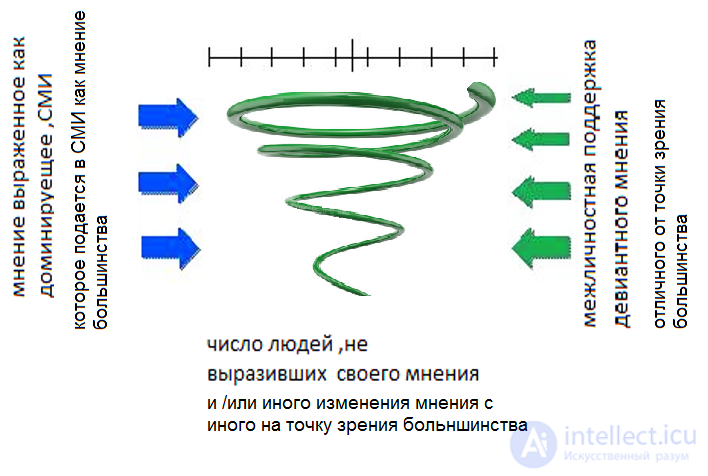
This theory applies to a greater degree to questions of morality and opinion. It does not extend to questions that can be confirmed or refuted by specific facts. And since such a “spiral of silence” unfolds only with regard to questions of morality, which usually provoke a strong emotional reaction even in the most reserved people, it can often be used to contain social tension over topics that spark heated debate. However, although the “spiral of silence” can help preserve civil order, attempts at its conscious use are nothing other than methods of manipulation and pressure.
According to Noelle-Neumann, this is possible “by neutralizing, in the communicative field, the ideas that generate social fears”, or by injecting stronger ideas into that field.
Overcoming the effect of the aforementioned spiral is facilitated by highly educated or more well-off people, as well as certain other unceremonious individuals who are not afraid of condemnation and isolation and are more likely to speak out regardless of public opinion. It is precisely this minority that is the necessary factor of change in society, while the compliant majority – is the necessary factor of stability.
Only the most unceremonious, shameless, and conscienceless people, who never look back at what the majority says, can change this imperfect world. All changes, all development, and all progress rest on such people. That is why I have always believed that one should not care about public opinion at all, and should live by one's own conscience, as one sees fit. For if this opinion were so true and indisputable, this world would be far better than it is.

Comments