
Lecture
Media virus (Eng. media virus) — a term introduced by the American mass communication specialist Douglas Rushkoff to denote media events (where media means the means of communication) that directly or indirectly cause certain changes in the life of society.
In his book "Media Virus! Hidden Agendas in Popular Culture" (1994; published in Russian translation in 2003), Douglas Rushkoff describes through various examples how the mass media manipulate public opinion, promoting the interests of the world of big corporations.
According to Rushkoff's book, since they exist on the money of advertisers and corporations, the mass media, willingly and unwillingly, promote day after day the consumer values (consumerism) that they impose on society, and shape the corresponding public opinion, thereby imposing a particular understanding of the modern world.
In Rushkoff's view, along with the development of the means of mass communication, Generation X appeared in world and above all American mass culture: a generation that grew up in close contact with the mass media, is well acquainted with information and communication technologies, and functions mainly in the global information space (which Rushkoff considers a synonym of "media") — the infosphere, or "mediasphere", a prototype of virtual reality. Members of this generation, with their knowledge of psychology, sociology, marketing, techniques of neuro-linguistic programming and the psychology of influence, create groups whose aim is to carry out "media sabotage" capable of blowing up the map of reality created by the mass media as a simplified model of the modern world. And whereas previously the "mediasphere" was perceived by most people as a means informing people about reality, now more and more people regard the infosphere as an independent phenomenon existing by its own laws.
In the book "Media Virus" Rushkoff describes in detail what counteracts the deliberate simplification of the picture of the world by the means of mass communication — media events that "cause genuine social change", children of the prevailing situation, information about which spreads through the information and communication environment on the principle of viruses, which Rushkoff called media viruses. It is precisely the launching of such media viruses that modern media activists and specialists in the influence of mass communication are engaged in. The fruits of their work can be used by election campaign headquarters, large corporations and other interested parties.
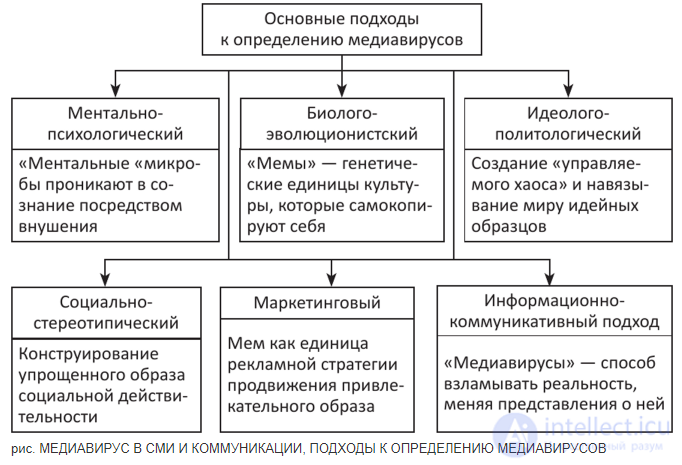
Media viruses are memes and meme complexes spreading through the infosphere that change the perception of local and global events. The scientific discipline that studies viral and less influential memes is called memetics, whose fruits Douglas Rushkoff used to form the concept of the "media virus".
The shell of a media virus, as a factor revealing the complexity and fullness of the connections of the infosphere, can be:
By arousing interest among consumers of mass media and spreading, these events, Rushkoff claims, are able to cause a serious shift in mass consciousness. Rushkoff gives the example of the "butterfly effect": an insignificant event in one part of a complex system can provoke unpredictable catastrophic changes in another.
Today one of the spheres in which media viruses spread is the Internet. Some researchers hold the hypothesis that in the near future the Internet may serve as a springboard for revolutions .
Three types of media viruses can be distinguished:
Viral videos are one of the most common kinds of viral phenomena. A viral video is any clip with animation or film that spreads rapidly through the Internet. Viral videos can get millions of views because they are shared on social networks, reposted on blogs, sent by e-mail, etc. When a video goes viral, it becomes very popular. Its presence on the Internet grows exponentially as more and more people discover it and share it with others. An article or an image can also go viral. [15]
The classification is probably assigned more as a result of intense activity and the speed of growth in the number of users over a relatively short period of time than simply by the number of visits something receives. Most viral videos contain humor and fall into broad categories:
With the creation of YouTube , a video-sharing website, the number of viral videos on the Internet rose sharply. This is primarily due to the ease of access to these videos and the ease of spreading them through social networking websites . The ability to easily share videos from one person to another means that in many cases viral videos appear overnight. "YouTube, which makes it easy to embed its content elsewhere, has the freedom and mobility once attributed to papyrus, allowing them to spread quickly across a range of social networks." : 30 YouTube has overtaken television in audience size. As one example, American Idol was the most-watched television show in the US in 2009, while "a video of the Scottish woman Susan Boyle auditioning with her singing for the British show Britain's Got Talent was viewed on YouTube more than 77 million times". The ability to attract a huge audience on a user-friendly platform is one of the leading factors by which YouTube creates viral videos. YouTube promotes the spread of viral phenomena because the idea of the platform is based on sharing and contribution. "Sites such as YouTube, eBay, Facebook, Flickr, Craigslist and Wikipedia exist and have value only because people use them and contribute to them, and they are clearly better the more people use them and contribute to them. That is the essence of Web 2.0." [20]
One of the most widespread viral YouTube videos in the category of advertising viral videos is Kony 2012. On March 5, 2012, the charity Invisible Children Inc. posted a short film about the atrocities committed in Uganda by Joseph Kony and his rebel army. Artists use YouTube as one of the main platforms for branding and communication, to spread videos and make them go viral. For example, after a break, Adele released her most-viewed song, "Hello". "Hello" passed 100 million views in just five days, making it the fastest video to reach that mark in 2015. [21] Viral YouTube videos make stars. For example, Justin Bieber, who was discovered after his YouTube video of Chris Brown's song "With You" went viral. Since its launch in 2005, YouTube has become a hub for aspiring singers and musicians. Talent managers turn to it to find up-and-coming pop stars. [22]
According to Visible Measures, the original documentary film "Kony 2012", together with hundreds of excerpts and responses uploaded by online audiences, collectively gained 100 million views in a record six days. [23] This example of how quickly a video spreads highlights how YouTube acts as a catalyst for the spread of viral media. YouTube is seen as a "multitude of existing forms of participatory culture", and this trend is useful for business. "The discourse of Web 2.0, its power lies in erasing this vast history of collaborative practices, as companies act as if they were 'empowering' audiences with agency, making their creative product meaningful, valuing it within the logic of commodity culture." : 71
Viral marketing is a phenomenon in which people actively evaluate media or content and decide to pass it on to others, for example by making word-of-mouth recommendations, sharing content through social networks, or posting videos on YouTube. The term was first popularized in 1995, after Hotmail spread its service offer "Get free email at Hotmail". : 19 Viral marketing has gained importance in business for building brand awareness, as companies try to engage their customers and other audiences in spreading and circulating their content on social networks, both voluntarily and involuntarily. Many brands run guerrilla marketing or trend marketing to attract public attention. Some marketing campaigns aim to get the audience to unwittingly pass on the message of the campaign.
The use of viral marketing is shifting from the concept that content attracts its own attention to a deliberate attempt to attract attention. Companies worry about getting their content to "go viral" and about how the communication among their customers can spread it widely. There has been much discussion about the ethics of viral marketing. Ian Short (2010) notes that many applications on Twitter and Facebook generate automatic marketing messages and update them to fit the audience's personal timeframes, without passing them on to users personally. [24]
Stacy Wood of North Carolina State University conducted research and found that the value of recommendations from "ordinary people" can have a potential impact on brands. Every day consumers are bombarded with thousands of messages, which calls into question the authenticity and credibility of a marketing message; the word of mouth of "ordinary people" thus becomes an incredibly important source of trustworthy information. If a company sees that the word of mouth of an "ordinary person" is crucial for a greater ability to influence others, many questions remain. What implicit contracts exist between brands and those who recommend them? What moral norms and rules should brands follow when they encourage, solicit or respond to comments from the audiences they want to reach? What kind of reward, if any, do audience members deserve for their promotional labor when they give a testimonial? : 75
An example of effective viral marketing may be the unprecedented growth in sales of the Popeyes chicken sandwich. After the Chick-fil-A Twitter account tried to take a jab at Popeyes by suggesting that the Popeyes chicken sandwich was not the "original chicken sandwich", Popeyes replied with a tweet that eventually went viral. After the reply gathered 85,000 retweets and 300,000 likes, Popeyes restaurants began selling far more sandwiches, and in many locations they sold out of their entire stock of chicken sandwiches. This prompted other chicken chains to tweet about their own chicken sandwiches, but none of those attempts spread as widely as Popeyes' did. [25]
In macroeconomics, "financial contagion" is a supposed socio-viral phenomenon in which disturbances quickly spread across global financial markets.
According to Rushkoff, viruses counteract oversimplification and distraction. To tell them apart from ordinary PR stunts, one should determine whether an information event simplifies an issue, reduces it to emotions, or makes it complex. A media virus reveals the complexity of the connections within a system and often places the emphases in a new, unexpected way, whereas a PR stunt artificially simplifies the issue (for example, the slogan "Just Say No to Drugs", which demands that people refuse drugs merely because they are drugs). Accordingly, the effects of a media virus on society are more tangible and longer-lasting than those of a standard PR campaign. However, even such simplifying memes can mutate into media viruses over time and make people change their attitude toward certain issues.
Media viruses give rise to new questions rather than ready-made answers. The simplest way to tell a media virus from a PR stunt is to determine whether it simplifies an issue, reduces it to emotions, or, on the contrary, makes it extraordinarily complex. A virus always makes the social system or system of beliefs it attacks look tangled and incomprehensible, which is what it really is. The technique of simplification and distraction becomes hopelessly obsolete after a media virus attack.
Media viruses also neutralize the technique of marginalization. The first reaction of PR to a countercultural idea is to try to marginalize it. For example, if you are against a war, they will try to stick the label of "anti-patriot" on you. But the shell of a well-constructed media virus lets its memes spread before they can be marginalized. It is enough to show the true face of war. Media viruses that go beyond the "official point of view" do not allow the exploitation of the "right to the sole representation of reality". They comment on the media themselves. Viruses express themselves through irony and appeal to the viewers' ability to make objective judgments. Thanks to this, people become aware of the complexity hidden behind the apparent simplicity of the representations of our world.
—
Media activism . is a phenomenon especially characteristic of the last several decades, although its preconditions could probably be observed throughout the entire development of the means of communication between people. Media activists can be called "guerrillas of the information war", because existing organized groups or individuals carry out dedicated work to create media viruses. Among the best-known media activists, or at least people who launched a number of well-known media viruses, one can name the American scholar Timothy Leary, whom Douglas Rushkoff knew personally. Eco-terrorism, practiced by extremist "green" groups, also aims to create media viruses. There are sociological studies of media activism among HIV-infected people .
Today political figures and other public personalities, who in all likelihood are familiar with memetics and the principles by which memes spread, being natural newsmakers for the mass media, often become the authors of various viral memes.
Most of Rushkoff's book consists of examples of various media viruses. Nevertheless, it does not give an unambiguous and absolutely strict definition of a media virus that would make it possible to say clearly what is a media virus and what is not.
Today one can very often observe the global effects of the most diverse events that have reached the media or the Internet. The definition of a media virus is quite applicable to such events, since they cause consequences significant for society, and the medium of spread is the media environment. In practice, the term media virus is quite often applied to, for example, scandalous incidents, gossip about politicians and pop stars, and similar events with a negative or provocative background that cause consequences noticeable to society . At the same time, the concept of a media virus is rather blurred and vague, depending largely on the subjective opinion of the particular researcher.
Here are examples of the media events that provoked the greatest public resonance:
Russians too have had the opportunity to observe a number of media viruses of varying scale of consequences. One of the first was a television segment prepared by the musician Sergey Kuryokhin and the journalist Sergey Sholokhov and first shown in the television program "Pyatoye Koleso" ("The Fifth Wheel") on May 17, 1991, on Leningrad Television, which "proved" that Lenin was a mushroom and a radio wave.
In July 2006, Vladimir Putin's kiss of a boy named Nikita caused wide public resonance, because the event could not be interpreted unambiguously. The event was immediately reflected in Internet forums. The complexity of this event was most likely amplified by the fact that the question of the motives that led Vladimir Putin to publicly kiss a child on the stomach made it onto the list of the most popular questions to the president at the Internet conference of July 6, 2006.
Another media event with grounds to be called potentially viral is the well-known scandal surrounding Filipp Kirkorov, who used obscene language against a journalist . The singer is known to have taken a break from performing for about a year. How effective the media virus proved to be is unknown, but it drew a certain amount of media attention to the Russian pop star.
On the Runet, one of the most notable media viruses was the appearance of the neologism "preved", which quickly spread as a meme through the information space of the Russian-language Internet and to which a number of articles in various media were devoted[10]. This fact served as inspiration for the creation of an Internet resource devoted to media activism, called "Preved" (currently unavailable). Its creators call the site a "media virus laboratory", and on its pages the authors analyze the activity of various media viruses. Viral videos, which spread through social networks from user to user and gain a comparatively large number of views in a short period of time, are also considered a separate category of media viruses. Some viral clips are recorded and distributed spontaneously, while others are created specifically for subsequent viral promotion (for example, many works of the studio "My Duck's Vision"). Sometimes an entire work becomes a media virus; a vivid example is the 1998 film "Zelyony Slonik" ("The Green Elephant") by director Svetlana Baskova, which began spreading across the Runet from imageboards, initially with the aim of shocking as many people as possible. But the film suddenly became beloved by many Runet users and is now literally torn apart into quotations, and thousands of videos are already circulating on the Runet that overlay various audio and video fragments from the film onto some arbitrary (but usually well-known and popular) video in order to create a comic effect. A large number of viral videos are uploaded to the YouTube video hosting service.
The Internet meme "Upyachka" has also spread; it is a counter-cultural movement and a vivid example of opposition to the "virtual reality" of the Internet.
Informational genres
Analytical genres

Comments