
Lecture
Propaganda (from Latin congregatio de propaganda fide — the congregation for propagating the faith) is the dissemination of views, facts, arguments, rumors, and information (including distorted information) or deliberately false claims in order to shape public opinion as desired and to manipulate public consciousness.
Unlike ordinary ways of presenting information, propaganda is deliberate and emphasizes manipulation in order to achieve predetermined goals, although the original aim of propaganda is usually not concealed. Propaganda involves the selective presentation of facts, arguments, and symbols in a way that, in the view of those spreading it, produces the necessary effect; facts may also be distorted or suppressed. In an attempt to achieve the maximum effect, propagandists may resort to lies and diversion of attention. Maximum effectiveness is also ensured by psychological and rhetorical techniques, and by the fact that these techniques, like the very existence of propaganda, go unnoticed by the target audience.
Originally the term "propaganda" was neutral and was used to denote the mass dissemination of information, but it later acquired an increasingly pejorative connotation and came to be associated with manipulation and disinformation . A "propagandist" is a person who creates, carries out, or spreads propaganda. Propaganda is countered by counterpropaganda, which is itself also a form of propaganda.
"The better people understand the nature of the technologies that influence consciousness, the more likely they are to grasp their purpose, and the less likely it is that these technologies will be used," – John D. Marks (author of the book "The CIA and the Cult of Intelligence").
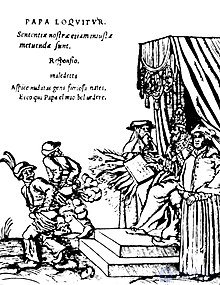
Caricature of the Pope by the artist Lucas Cranach the Elder, 1545. "Do not frighten us, Pope, with your excommunication, and do not be so angry. Otherwise we will turn around and show you our backsides"
Propaganda as a phenomenon existed long before the term itself appeared. One of the earliest examples of propaganda can be seen in the preamble to the Code of Hammurabi, which states that these laws were created to establish justice in the land and to protect the weak against the strong. The content of the laws themselves, however, is mainly aimed precisely at protecting the interests of the rich and prosperous classes at the expense of suppressing and exploiting the poor and rightless inhabitants.
During the Reformation, both Protestants and Catholics felt a need to propagate their ideas. The development of propaganda was aided by the spread of printing in the 16th century. Even more important than the publication of books proper was the printing of engravings and illustrated leaflets for the broad masses of the population.
The term "propaganda" itself derives from the name of the Catholic organization Congregatio de Propaganda Fide (the Congregation for the Propagation of the Faith), established by Pope Gregory XV in 1622.
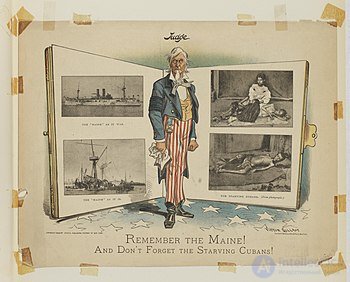
"Remember the Maine! And do not forget the starving Cubans!" An example of American propaganda during the Spanish-American War, Judge magazine, Victor Gillam, 1898
Before the 19th century the word "propaganda" had only a religious meaning, but it then began to be used in a purely political context as well.
The Bulletin of the Grande Armée (French: Bulletin de la Grande Armée) was a periodical published during the years of the First Empire. The bulletins were issued by an official government organ, "Le Moniteur universel," also called simply "Le Moniteur." Copies of the bulletins were sent to local authorities and posted on the walls of public buildings. Julien Sorel, the hero of Stendhal's "The Red and the Black," read the bulletins avidly, just as he read the "Memorial of Saint Helena" .
In all, four series of publications saw the light, each with its own numbering and each devoted to one of Napoleon I's campaigns:
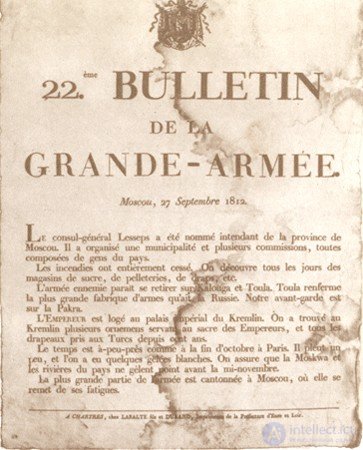
The 22nd bulletin of the Grande Armée (Moscow, 27 September 1812)
To this may be added the official communiqués that formally replaced the bulletins in 1813—1814 .
The bulletins described almost exclusively the military operations and plans of the Grande Armée and its opponents, both current and potential. They also contained laudatory mentions of soldiers, officers, and units for various actions.
The bulletin was addressed not only to the soldiers of the Grande Armée (whom it enabled to better understand the scale of the events in which they were taking part), but also to the public and to foreign courts. Being addressed to such a broad audience, the bulletin was used by Napoleon as an effective instrument of propaganda; because of this, the "grumblers," who were better informed about the real state of affairs, coined the saying "lies like a bulletin" (French: ment comme un Bulletin), which entered not only French but other languages as well .
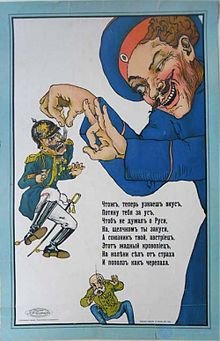
A Russian poster from 1914
The mass use of propaganda dates from the First World War, when many states of the world faced the problem of a contradiction between the need to mobilize the forces of the whole society, on the one hand, and disunity combined with individualism, on the other. To strengthen ties between people and society and to raise the loyalty and morale of citizens, a variety of means available in the historical period in question were actively used — leaflets, poems, photographs, radio broadcasts. It was then that the role of the mass media in spreading propaganda messages became apparent.
After Germany's defeat in the First World War, German military leaders such as General Erich Ludendorff noted the important role of enemy propaganda in that outcome. Adolf Hitler supported this view, believing that it was the main cause of the collapse of morale and of the uprisings in the German rear and in the navy in 1918.
Will Irwin wrote in 1936 :
Before 1914 the word "propaganda" appeared only in dictionaries of literature and had a dignified, elevated meaning… Before the World War, "propaganda" meant only the means by which an adherent of a political or religious faith persuaded the unconverted to accept it. Two years later the word had entered the everyday vocabulary of simple peasants and ditch diggers and had begun to give off poisonous fumes. In the end, this word came to be used to cover up outright lies.
In the second half of the 20th century, many people marveled at how easily millions of people believed the propaganda of totalitarian regimes. This was largely due to the fact that in a huge number of people "internal conformity" was at work, in which a person not only agrees with what propaganda imposes on him, but also convinces himself that it is right to think this way. The American psychologist Solomon Asch demonstrated the power of such "internal conformity" experimentally .
The countries of the West and the USSR made extensive use of propaganda during the Cold War. Films, television, and radio programs were employed to influence their own citizens, each other, and the countries of the Third World. During the Cuban revolution, Fidel Castro stressed the importance of propaganda . Propaganda was also widely used during the Vietnam War as a means of managing people's opinions .
During the Yugoslav wars of the 1990s, propaganda was used to create fear and hatred and, in particular, to turn the Serbian population against members of other nationalities (Bosniaks, Croats, Albanians, and other non-Serbs). The Serbian media made enormous efforts to justify or deny the mass war crimes committed by Serbian forces during these wars .
Broadly speaking, theories of propaganda were among the first theories that focused attention on the mass media, their content, their influence, and so on: researchers sought to explain how the mass media, by means of particular information, can influence people in such a way that they adopt particular points of view. At that time the dominant view was the simplified "stimulus-response" theory of mass communication, according to which the media can deliver to each individual specifically formed stimuli that will be perceived identically by all recipients and will evoke similar or identical reactions in them. Accordingly, the first theories of propaganda were based on the ideas of behaviorism and Freudianism; at their intersection arose rather pessimistic views that assumed a high degree of human vulnerability to external psychological influence and the individual's inability to exercise rational self-control.
The views described above, characteristic of the period after the First World War, were not generalized as such, but were later given the collective name "magic bullet theory." This theory corresponded closely to the psychological and sociological views then current and was supported by information about the power of wartime propaganda. Its main tenets were later rejected as unreliable.
The attention that Western researchers paid to propaganda in this period, up to the end of the 1930s, was due to the fact that it was regarded as a threat to the American-style political system and to the democratic organization of society as such: there was a conviction that the free dissemination of propaganda would be fatal to democracy. On the other hand, however, banning propaganda would entail restricting freedom of communication, one of the key principles of a democratic state. This dilemma was accordingly at the center of attention of propaganda theorists of the time.
It was initially assumed that citizens could be taught to resist propaganda as a phenomenon that violates the basic principles of equal democratic communication, by critically evaluating information and rejecting it if it was false. Later, however, as Americans, for example, began to absorb ever more actively certain rhetoric from the political leaders of a number of European countries, specialists in this field came to the conclusion that the process of educating the people might take too long without guaranteeing complete success, and that propaganda must therefore be actively combated, chiefly by means of "good," "white" counterpropaganda.
The propaganda theories created by H. Lasswell, W. Lippmann, and J. Dewey may be mentioned as key ones.
In Lasswell's theory, which bears the influence of Freudianism and behaviorism, the power of propaganda is associated with the vulnerability of the human mind rather than with the characteristics of particular messages. Any economic crisis or political conflict, in the researcher's view, is potentially dangerous, since it leads to mass psychosis and aggravates individuals' susceptibility to propaganda influence.
H. Lasswell later changed his position on this issue, abandoning the ideas characteristic of "magic bullet" concepts. He concluded that a successful propaganda campaign must have a long-term, carefully worked-out strategy, in the course of which certain symbolic images must be created and people taught to associate the required emotions with them; as a result, in the scholar's terminology, "collective" or "reference" symbols can be developed. H. Lasswell proposed to systematize this process by handing control of media propaganda to a kind of "new elite," a certain "scientific technocracy," which would give and fulfill a solemn promise to use its knowledge not for harm but for the good of society.
Lippmann's ideas were also marked by the skepticism characteristic of Lasswell's original views. He doubted that the average person is capable of finding his bearings in the surrounding world on his own and of making sensible decisions about how to act in a given situation. As key reasons Lippmann cited the complexity of the environment characteristic of that time, the danger posed by certain political forces, and the insufficiency of sources of information. He also shared the concerns about the destructive influence of propaganda and believed that the seriousness of the threat required restructuring the political system, creating a certain body or mechanism that would exercise acceptable but strict control over the content of the mass media. Lippmann proposed, in particular, forming an investigative bureau whose tasks would include analyzing information, forwarding it to elites for decision-making, and determining what information people should and should not know.
J. Dewey actively criticized the ideas put forward by H. Lasswell and W. Lippmann. In his view, the key means of countering propaganda was educating the people so that they could protect themselves from malicious influence. He also rejected the idea of handing control of mass information to some elite technocracy. J. Dewey proposed reforming education and the media so that they would pay more attention to the fundamentals of critical thinking and to the discussion of important public issues
Propaganda is one of the main means of political manipulation. Compared with propaganda, advertising is closer to self-presentation or to an informational genre. At the core of the broad family of informational genres — business, political, religious — lies the announcement. When the original signal function of a message concentrates within itself elements of expression (emotional expressiveness) and suggestion (inducement), advertising becomes most effective. Advertising that calls for specific political action turns into agitation. Even if agitational advertising seeks to evoke collective rather than individual action, it remains agitational advertising. Unlike advertising, propaganda is not bound by strict time limits and is not easy to detect. Advertising acts primarily on people's emotions. Propaganda acts on both the emotions and the reason of people. Accordingly, propaganda, like emotions, can be negative or positive.
Positive (constructive) propaganda seeks to convey certain beliefs to the consumer in an accessible form. The goal of positive propaganda is to promote social harmony and consensus and to educate people in accordance with generally accepted values. Positive propaganda performs educational and informational functions in society. It is carried out in the interests of those to whom it is addressed, and not of a limited circle of interested persons. Positive propaganda, unlike negative propaganda, does not pursue manipulative goals. Nevertheless, because "generally accepted values" are already generally accepted even without propaganda, the true goals of "constructive" propaganda often differ from those declared by the propagandists.
Negative (destructive) propaganda imposes certain beliefs on people on the principle that "the end justifies the means." The goal of negative propaganda is to incite social enmity, escalate social conflicts, aggravate contradictions in society, awaken base instincts in people, and the like. This makes it possible to divide people and make them obedient to the propagandist's will. The technology of creating an "image of the enemy" makes it possible to rally the crowd around the propagandist and to impose on the crowd beliefs and stereotypes that suit him. The main function of negative propaganda is the creation of an illusory, parallel reality with an "inverted" system of values, beliefs, and views. Negative propaganda actively exploits the low critical faculties and suggestibility of the masses in order to manipulate them in the interests of a narrow group of persons.
One of the characteristics of an idealized democracy is freedom of both propaganda and the counterpropaganda opposing it, provided that they pursue peaceful goals . Propaganda has replaced coercive methods and censorship as a method by which change can be achieved . The basic idea is that in a well-educated and literate society, propaganda could be used for the benefit of society itself. However, the degree to which any given state corresponds to this model is unknown .
In democratic societies, propaganda achieves its greatest effect when it is not apparent that the information being presented is propaganda . However, propaganda can also be harmful to society. To protect themselves against it, modern democracies introduce various requirements for the registration and explicit labeling of propaganda or advertising. In many countries, claims about the content or properties of foods and medicines are subject to registration, and the foods and medicines themselves are labeled. Independent studies may lead to the publication of counterpropaganda in response to such claims. Political propaganda is also usually regulated, especially in the run-up to elections, since enormous sums are usually spent on propaganda. In particular, spending on propaganda may be limited, or propaganda may be banned immediately before elections. If propaganda were not restricted in such cases, small parties, for example, might simply not get any airtime .
The effectiveness of propaganda is determined by the ratio of the actual number of supporters attracted to the planned number.
Three main criteria for the content of effective propaganda can be identified:
Thus, some idea will be promoted (1) that is easily accessible to the audience's understanding (2) and resistant to outside criticism (3). Moreover, a balance must be maintained between (2) and (3). If the balance is not maintained, then the ideas will either simply be incomprehensible to a significant part of the target audience, or too vulnerable to counterpropaganda.
As for form, the following criteria can be identified:
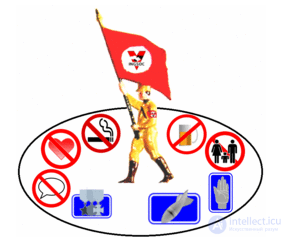
The concept of the ideal citizen, illustrated by the biography of Comrade Ogilvy from the novel "1984"
George Orwell's world-famous works "Animal Farm" and "1984" portray in detail various ways of using propaganda in dystopian societies.
Alongside traditional means of propaganda such as posters, brochures, leaflets, and radio or television announcements[31], and so on, virtually all genres of visual art can be used for propaganda, including specially made films , theater, literature, poetry, and games, as well as other kinds of mass influence on the population's consciousness — the internet, chats, social networks, and the like.
Propaganda techniques are methods used in propaganda to persuade an audience to believe what the propagandist wants them to believe. Many propaganda techniques are based on social-psychological research. Many of these same techniques can be classified as logical fallacies or as tactics of abuse of power and control .
In their book "Propaganda and Persuasion ", the authors Garth S. Jowett and Victoria O'Donnell define propaganda as "the deliberate, systematic attempt to shape perceptions, manipulate cognitions, and direct behavior to achieve a response that furthers the desired intent of the propagandist". The definition of Harold D. Lasswell is even more precisely aimed at the technical aspect:
"Propaganda in the broadest sense is the technique of influencing human action by the manipulation of representations. These representations may take spoken, written, pictorial or musical form."
Manipulation can be organized or unorganized, conscious or unconscious, politically or socially motivated. The concept ranges from systematic state propaganda for manipulating public opinion ( Edward Bernays ) to "sociological propaganda" (propaganda of integration), where an unconscious desire to be manipulated, and self-manipulation, cause a person to adapt to socially expected thoughts and behavior ( Jacques Ellul ).
The transition from non-propaganda to propaganda is fluid. Effective manipulation presupposes non-manipulative embedding in order to unfold its effect, so a reference to these contexts is not yet a refutation of the manipulative character of an act of communication.
Propaganda is understood as a form of manipulation of public opinion. Semiotic manipulation of signs is an essential characteristic ( "Propaganda is the primary form of manipulation of symbols" ). A distinction is made between "white", "gray" and "black" propaganda. "White" propaganda involves providing more or less reliable information from official sources and is usually intended to present the source of the propaganda itself in a better light or to emphasize the superiority of certain ideas or ideologies. A good example of "white" propaganda is statements about national pride. "Gray" propaganda involves a careful selection of arguments to appeal to people's emotions and is distinguished by the fact that its source is difficult to identify or is concealed (the sponsor of the propaganda remains unknown); the very fact that propaganda is present is also hard to determine in this case. In "black" propaganda, the sources are concealed (or false ones are claimed), and false information is disseminated; with "black" propaganda, attempts are usually made to demonize the enemy.
Thus, propaganda is a special form of communication , which is studied in communication studies , and especially in media effects research, focusing on media manipulation . Propaganda is a special type of communication, characterized by a distortion of the representation of reality and by manipulation.
Propaganda can be classified by its goals and by the openness of its source into white, black and gray.
White propaganda: This type clearly identifies its source and is open about its intentions. The information here may be accurate, but it is presented with a certain bias in order to support a particular point of view. White propaganda often comes from governments or organizations that seek to communicate their policies, goals or achievements to the public, creating a positive perception.
Black propaganda: This kind of propaganda is used to deliberately mislead people. It is often built on false information and distortion of facts, and appears to come from another, often hostile, source. The goal of black propaganda is to cause confusion and distrust, to undermine the reputation of a particular group or person, and to sow discord.
Gray propaganda: Occupying an intermediate position between white and black, gray propaganda combines truth and lies. The source of such messages may be uncertain, which makes it harder to verify the reliability of the information. The goal of gray propaganda is to cause doubt and uncertainty, so as to make it difficult to tell truth from fiction.
Propaganda can also be divided by sphere of application: political, military and advertising.
Political propaganda: Aims to shape public opinion and influence the outcomes of elections, referendums and political discussions. Politicians and parties use it to promote their programs, discredit rivals and mobilize the electorate. It can be expressed through speeches, slogans, advertising campaigns and political manifestos.
Military propaganda: Used to gain support for armed conflicts, raise morale and justify military actions in the eyes of society. It often includes demonization of the adversary and heroization of one's own goals. Examples include patriotic posters, films and songs, as well as official reports and press releases.
Advertising propaganda: Created to persuade consumers to buy particular goods and services. Companies use various methods, from emotional appeals and celebrity endorsements to the creation of artificial demand. Advertising propaganda is widely present in the media, on billboards, in product packaging and at events.
Common media for conveying propaganda messages include news reports, government reports, historical revision, pseudoscience , books, leaflets, films , social media , radio, television and posters. Less common nowadays are cow-mail envelopes, examples of which survive from the time of the American Civil War . (Connecticut Historical Society; Civil War Collections; Covers.) In the case of radio and television, propaganda may exist in newscasts, current affairs or talk-show segments, as advertisements or public service announcements "spots", or as long-running infomercials . Propaganda campaigns often follow a strategic transmission pattern to indoctrinate the target group. This may begin with a simple transmission, such as a leaflet dropped from an airplane, or an advertisement. Usually these messages will contain instructions on how to obtain more information, via a website, a hotline, a radio program, and so on. The strategy aims to initiate a person from a receiver of information into a seeker of information through reinforcement, and then from a seeker of information into an opinion leader through indoctrination .
Information dissemination strategies become propaganda strategies only when they are combined with propaganda messages Identifying these messages is a necessary prerequisite for studying the methods by which they are disseminated.
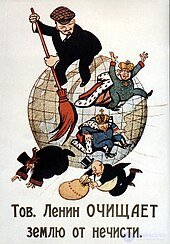
"Comrade Lenin Cleanses the Earth of Filth" by Viktor Deni . November 1920.
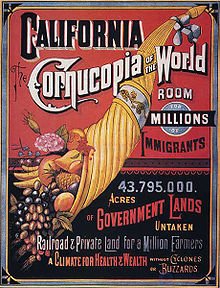
Propaganda urging immigrants to move to California, 1876.
Some techniques are classified, analyzed and interpreted psychologically within political psychology , especially mass psychology , social psychology and cognitive psychology , which includes the study of cognitive biases .
With regard to political and military conflicts, propaganda is regarded as part of psychological and information warfare , which acquire particular significance in the era of hybrid warfare and cyberwarfare
Some techniques are classified as logical fallacies, because propaganda uses arguments that may have a psychological effect but are logically invalid.
In rhetoric and dialectics, they are treated as sophisms , tricks and eristic stratagems .
During his rise to power and throughout his rule, Napoleon actively cultivated his own image through propaganda. He successfully used propaganda to secure public support, to capitalize on his victories and to create an image associated with success and heroism. To disseminate propaganda, Napoleon used not only newspapers but also other available means, including theater and painting (see illustration).
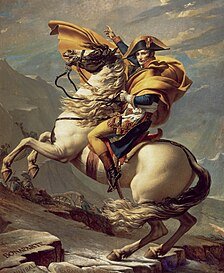
Bonaparte Crossing the Great St Bernard Pass, the romantic version painted by Jacques-Louis David, 1801.
Everything was done in order to "promote precisely the image he wanted". Bulletins from the battlefields were published in newspapers and were available throughout the country . Napoleon used these publications to exaggerate his successes and downplay his setbacks.
Napoleon knew the power of propaganda and actively tried to influence public opinion . Thus, on 18 February 1797 the Army of Italy began publishing a sheet, the "Journal de Bonaparte et des Hommes Vertueux", with the epigraph: "Hannibal slept at Capua, but Bonaparte does not sleep at Mantua." Napoleon personally wrote notes for the newspaper, dictating passages such as: "Bonaparte flies like lightning and strikes like a thunderclap." In the same year he founded two army newspapers: Courrier de l’Armée d’Italie and La France vue de l’Armée d’Italie, whose material was often quoted by the Paris press.
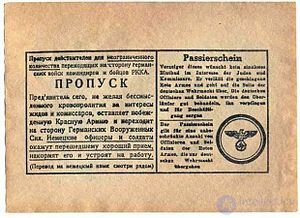
A German leaflet from the Second World War. Counting on antisemitic and anti-communist sentiments in the Red Army, the keywords "Yids" and "commissars" are used.
Inducing the enemy to surrender, propaganda of captivity, is one of the most promising and effective directions of psychological warfare. However, it is very important to choose the right forms and means of influence:
The effectiveness of this direction of psychological operations can be illustrated by the example of the Vietnam War. During the period of hostilities, about 250 thousand soldiers of the communist forces voluntarily went over to the enemy side. The cost to the American army of killing one NLF fighter averaged 400 thousand dollars, whereas persuading one to surrender cost only 125 dollars per person.
"Elementary Principles of War Propaganda" (French: Principes élémentaires de propagande de guerre) is a monograph by the Belgian historian Anne Morelli , published in 2001. The subtitle reads: "applicable in cold, hot or lukewarm war".
In writing the work, Morelli studied the experience of the wars and colonial conflicts of the twentieth century and their reflection in military propaganda. The ten "commandments" of propaganda that Anne Morelli sets out in this work constitute, above all, an analytical framework for pedagogical purposes and media analysis. Morelli does not wish to take anyone's side or defend "dictators", but shows the regularity with which the ten principles are used in the media and in society.
Specific methods and techniques of propaganda
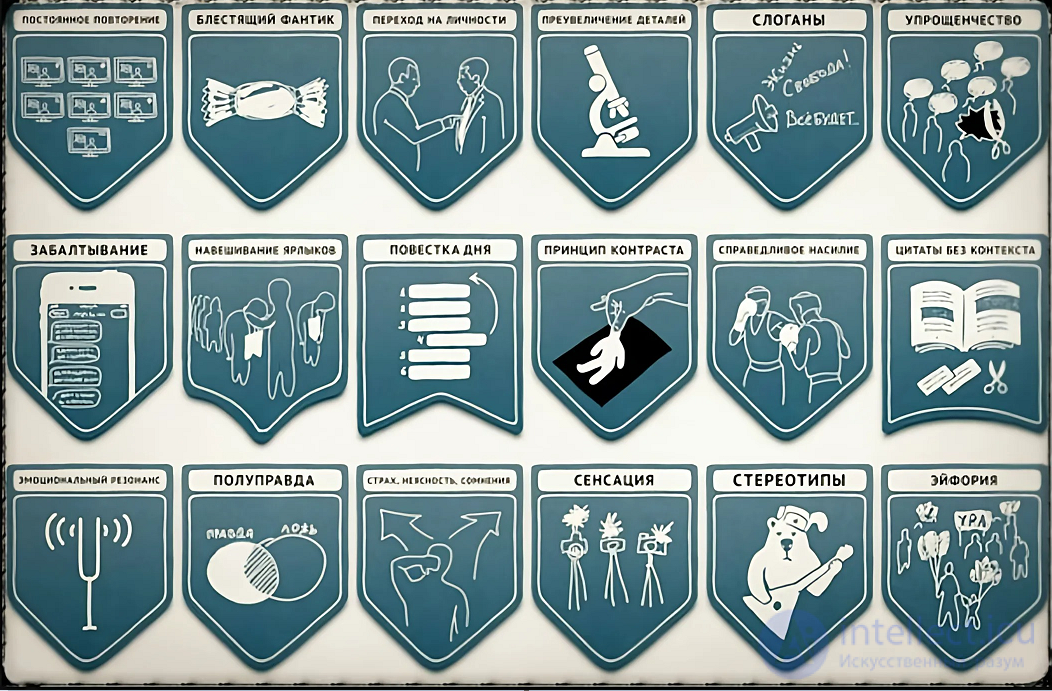
Scholars have identified many standard techniques used in propaganda and persuasion.
Repetition: Constant repetition of the same message in order to fix it in people's minds.
Emotional appeals: Use of emotionally charged words and images to evoke strong feelings such as fear, anger or patriotism.
Display of authority: Bringing in well-known figures or experts to support the message, in order to give it more weight and credibility.
Display of an enemy: Creating the image of an enemy or threat in order to unite people against a common adversary.
Selective presentation of facts: Presenting information selectively to support a particular point of view, while ignoring or concealing contrary facts.
Stereotyping: Use of stereotypes to simplify complex issues and create prejudiced opinions.
Slogans and catchphrases: Short, memorable phrases that are easy to repeat and spread.
Manipulation of numbers and statistics: Presenting data in such a way that it supports the desired message, even if this requires distorting facts.
Appeal to traditions and values: Use of cultural and historical symbols to create a sense of belonging and patriotism.
Display of successes and achievements: Emphasizing positive results and achievements to create a positive image.
The "rotten herring" method (a smear technique) consists of putting forward an absolutely false and scandalous accusation that need not be proven. The goal of this method is to provoke wide public discussion and to discredit the target of the accusation. Examples of such accusations may include petty theft, child molestation or murder out of greed. This method is used to manipulate public opinion and to create a negative image of the target.
The "big lie" method consists of offering the audience, with maximum confidence, a lie so monstrous and enormous that it is practically impossible to believe that anyone could lie about such a thing. This method differs from the "rotten herring", although they are similar. The point is that a properly composed and well-devised "big lie" inflicts a deep emotional trauma on the listener or viewer, which then determines his views for a long time, despite any arguments of logic and reason.
The "40 to 60" method, developed by Goebbels, consists of creating media outlets that provide 60% of their information in the interests of the adversary. This makes it possible to win the audience's trust. The remaining 40% is used for disinformation, which becomes extremely effective thanks to this trust. During the Second World War there was a radio station that anti-fascists considered British. However, after the war it turned out to be Goebbels's radio station, operating on the "40 to 60" principle.
The "Unknown Hero" method consists of falsely heroizing the actions of one's own troops, which makes it one of the oldest and most effective methods of propaganda. This method is used so often that the public practically ceases to notice it.
The essence of the method is that any war is cruel and senseless, provoking resistance in the human psyche. This resistance is intensified by fear for oneself and one's loved ones. The only way to overcome this resistance is to act on the emotional component of the psyche.
Therefore the armies of "invaders" are turned into armies of "liberators", and the armies of "occupiers" into armies of "saviors". Creating the illusion of a struggle for high moral values and justice helps to justify the cruelty of war and to overcome a person's natural resistance.
Ad hominem Demagogy (Ad hominem, argument against the person)
A Latin expression that has come to mean attacking an opponent rather than attacking his arguments. Demagogy is a set of oratorical and polemical devices and means that make it possible to mislead an audience (the people) and win it over to one's side by means of false theoretical reasoning based on logical errors.
Demagogy is most often used to achieve political goals, in advertising and in propaganda[
Ad nauseam
This uses the relentless repetition of an idea. An idea, especially a simple slogan , that is repeated enough times may begin to be perceived as truth. This approach is more effective when combined with propagandistic restriction or control of the media.
Agenda setting
Agenda setting means "the ability [of the news media] to influence the importance placed on the topics of the public agenda". If a news story is covered frequently and prominently, the audience will regard the issue as more important.
Appeal to authority
Appeals to authority involve bringing in prominent figures to support a position, idea, argument or course of action.
Appeal to fear
Appeals to fear seek to build support by instilling anxieties and panic in broad sections of the population. For example, Joseph Goebbels used Theodore Kaufman's work " Germany Must Perish!," to claim that the Allies sought to destroy the German people.
Appeal to prejudice
Using emotionally loaded or emotive terms to attach value or moral worth to a belief in a claim.
Bandwagon
Appeals to "inevitable victory" and to "join the crowd" attempt to persuade the target audience to join in and take the same course of action as "everyone else".
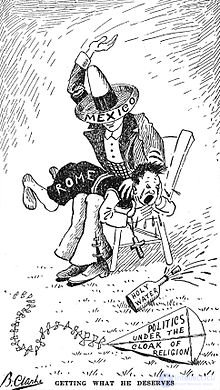
"Getting What's Coming to Him" — an American anti-Catholic cartoon from the 1928 series "Heroes of the Fiery Cross".
Beautiful people
A type of propaganda that deals with famous people or depicts attractive, happy people. It suggests that if people buy a product or follow a certain ideology, they too will be happy or successful. (This is used more in product advertising than for political reasons.) Usually for advertising rather than political purposes, sexual arousal may also be used. For example, a message promoting a brand of motorcycles to a male target audience may also feature sexually attractive women in bikinis in the advertising, to make the product more appealing to the audience by targeting sexual desires . However, some evidence suggests that using sex appeal to sell a product may not succeed, because the target audience may focus too much on the sexually attractive people in the advertisement rather than on the product itself.
Big lie
The repeated restatement of a complex of events that justifies subsequent actions. Descriptions of these events contain elements of truth, and the generalizations of the "big lie" merge and eventually displace the public's accurate perception of the underlying events. After the First World War, the German explanation of the cause of their defeat as a stab in the back became the justification for Nazi remilitarization and revanchism.
Black-and-white fallacy
Presenting only two choices, with the product or idea being promoted as the better choice. (for example, "You are either with us or against us ...")
Cherry picking (also called "card stacking")
Richard Crossman , the British Deputy Director of the Psychological Warfare Division (PWD) of the Supreme Headquarters Allied Expeditionary Force (SHAEF) during the Second World War, said: "In propaganda truth pays... It is a complete delusion to think of the brilliant propagandist as a professional liar. The brilliant propagandist is the man who tells the truth, or that selection of the truth which is necessary for his purpose, and tells it in such a way that the recipient does not think he is receiving any propaganda... [...] The art of propaganda is not to lie, but to choose the right truth and to give it intermingled with the truth the audience wants to hear".
Classical conditioning
All vertebrates, including humans, respond to classical conditioning . That is, if A is always present when B is present, and B causes a physical reaction (for example, disgust or pleasure), then when object A is presented in the absence of B, the same reaction will be experienced.
Cognitive dissonance
People want to be consistent. Suppose a sociologist discovers that a certain group of people hates his candidate for senator but loves actor A. They use actor A's endorsement of their candidate to change people's minds, because people do not tolerate inconsistency. They are forced either to dislike the actor or to like the candidate.
Common man
The "plain folks" or "common man" approach attempts to convince the audience that the propagandist's positions reflect the common sense of the people. It is designed to win the audience's trust by communicating in the ordinary manner and style of the target audience. Propagandists use ordinary language and manners (and frame their message in personal and audiovisual communications), attempting to identify their point of view with that of the common person. A typical example of this type of propaganda is a political figure, usually running for office, in a backyard or a shop, going about everyday business. This image appeals to the ordinary person. With the "plain folks" technique, the propagandist can win the trust of people who resent or distrust foreign-sounding, intellectual speech, words or manners". For example, a politician speaking to a crowd in the southern United States may use words such as " Y'all " and other colloquialisms to create a sense of belonging.
Cult of personality
A cult of personality arises when an individual uses the mass media to create an idealized and heroic public image, often through unquestioning flattery and praise. The heroic personality then champions the positions that the propagandist wishes to promote. For example, modern propagandists hire popular personalities to promote their ideas and/or products.
Demonization of the enemy
Portraying people from an opposing nation, from another ethnic group, or those who support an opposing viewpoint as subhuman (for example, the Vietnam War-era term "gooks" for the National Liberation Front of South Vietnam, a.k.a. the Viet Cong, or "VC", soldiers), worthless or immoral, through suggestion or false accusations . Dehumanization is also a term used as a synonym for demonization, the latter usually appearing as an aspect of the former.
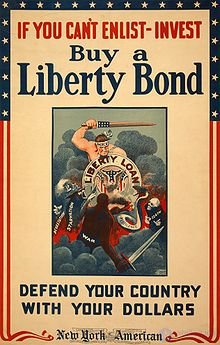
A World War I poster by Winsor McCay urging Americans to buy Liberty Bonds
Demoralization
Propaganda directed at an enemy in order to undermine morale and encourage surrender or desertion.
Diktat
This technique hopes to simplify the decision-making process by using images and words, including interjections, to tell the audience exactly what action to take, eliminating any other possible options. Authority figures may be used to give the order, overlapping with the appeal to authority technique, but not necessarily. The Uncle Sam "I Want You" image is an example of this technique.
Disinformation
The creation or deletion of information in public records in order to produce a false record of an event or of the actions of a person or organization, including outright forgery of photographs, films, broadcasts and sound recordings, as well as printed documents.
Divide and rule
Divide and rule in politics and sociology is the gaining and maintaining of power by breaking up larger concentrations of power into pieces that individually have less power than the one implementing the strategy.
Door-in-the-face technique
Used to increase a person's latitude of acceptance. For example, if a salesperson wants to sell an item for $100, but the public is only willing to pay $50, the salesperson first offers the item at a higher price (for example, $200), and then lowers the price to $100 so that it looks like a good deal.
Dysphemism
A dysphemism is an expression with a negative connotation. It is the opposite of a euphemism.
Euphemism
A euphemism is generally an innocuous word or expression used in place of a word or expression that may be considered offensive or that may suggest something unpleasant.
Euphoria
The use of an event that generates euphoria or happiness, or the use of an appealing event, to raise morale. Euphoria can be created by declaring a holiday, making luxury items available, or organizing a military parade with marching bands and patriotic messages.
Exaggeration
Exaggeration (or hyperbole) occurs when the most basic aspects of a statement are true, but only to a certain degree. It is also seen as "stretching the truth" or making something stronger, more significant or more real than it actually is. Saying that a person ate 20 spring rolls at a party, when in fact he ate 7 or 8, would be considered an exaggeration.
False accusations
A false accusation is a claim or unsupported assertion of wrongdoing that is not true and/or is otherwise unsupported by facts. [ 20 ] They may be used in any of the following contexts: informally in everyday life, quasi-judicially, or judicially .
Fear, uncertainty and doubt
Sometimes abbreviated as FUD, it is an attempt to influence public perception by spreading negative and dubious/false information designed to undermine confidence in people's beliefs.
Firehose of falsehood
A propaganda technique in which a large number of messages are broadcast rapidly, repetitively and continuously over multiple channels (such as news and social media ) without regard for their truthfulness or consistency.
Flag-waving
An attempt to justify an action on the grounds that doing so will make one more patriotic, or will somehow benefit a group, country or idea. The feeling of patriotism that this method tries to evoke may reduce, or even completely eliminate, a person's capacity for rational examination of the issue in question.

The Maid of Finland — a personification of Finnish nationalism
Flak
Attempts to discredit organizations or individuals who disagree with, or call into question, prevailing assumptions.
Foot-in-the-door technique
Often used by recruiters and salespeople. For example, a criminal approaches a victim and pins a flower on them or gives the victim a small gift. The victim says thank you, and is now in a psychological debt to the criminal. Eventually the person asks for a larger favor (for example, a donation or the purchase of something much more expensive). The unwritten social contract between the victim and the criminal makes the victim feel obliged to reciprocate by agreeing to do the larger favor or to buy the more expensive gift.
Framing (social sciences)
Framing is the social construction of a social phenomenon, often carried out by mass media , political or social movements, political leaders or other actors and organizations. It is an inevitable process of selectively influencing an individual's perception of the meanings attributed to words or phrases.
Gaslighting
The use of persistent denial, misdirection, contradiction and lying in an attempt to sow seeds of doubt in a targeted individual or group of people, hoping to make them question their own memory, perception, sanity and norms.
Gish gallop
Bombarding a political opponent during a debate with a continuous stream of annoyingly complex questions in order to create the impression that the opponent does not understand what he is talking about.
Glittering generalities
Glittering generalities are emotionally appealing words that are applied to a product or idea, but that do not present any specific arguments or analysis. This technique is also called the PT Barnum effect . (for example, the advertising campaign slogan "Ford has a better idea!")
Guilt by association or Reductio ad Hitlerum
This technique is used to persuade the target audience to disapprove of an action or idea by suggesting that the idea is popular with groups that the target audience hates , fears or despises . Thus, if a group supporting a particular policy is convinced that undesirable , subversive or despicable people support the same policy, the members of the group may decide to change their original position. This is a form of bad logic, in which A is said to include X, and B is said to include X, therefore A = B.
Half-truth
A half-truth is a deceptive statement that includes some element of truth. It can take several forms: the statement may be partly true, the statement may be wholly true but only a part of the whole truth, or it may use some deceptive element, such as incorrect punctuation or a double meaning, especially if the intent is to deceive, evade, blame or distort the truth.
Information overload
"Information overload can have the same effect as secrecy, and certainly in the short term and for democracies today it may be considered more effective." "When information overload occurs, it is quite likely that a decline in the quality of decisions will occur." "The excess of information generated by modern technology [...] threatens to make its recipients passive. Overload leads to disengagement."
Intentional vagueness
Generalities are deliberately vague so that the audience can supply its own interpretations. The goal is to move the audience by using indefinite phrases, without analyzing their validity or trying to determine their reasonableness or applicability. The goal is to get people to make their own interpretations rather than simply presenting them with an explicit idea. In trying to "make sense" of the propaganda, the audience refrains from judging the ideas presented. Their validity, reasonableness and applicability can still be considered.
Labeling
A euphemism is used when the propagandist tries to increase the perceived quality, credibility or trustworthiness of a particular ideal. A dysphemism is used when the propagandist's intent is to discredit, diminish the perceived quality of, or damage the perceived righteousness of an individual. By creating a "label," "category" or "faction" of the population, it is much easier to make an example of these larger bodies, because they can exalt or vilify an individual without actually being subject to legal libel. Labeling can be seen as a subset of guilt by association , another logical fallacy .
Latitudes of acceptance
If a person's message falls outside the latitude of acceptance of an individual or group, most techniques will provoke psychological resistance (simply hearing the argument will make the message even less acceptable). There are two methods for widening the latitudes of acceptance. First, one can take an even more extreme position, which will make more moderate positions seem more acceptable. This is similar to the door-in-the-face technique. Alternatively, one can moderate one's own position to the limit of the latitude of acceptance, and then slowly move over time to the position one held before.
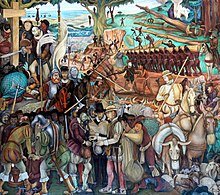
"The Conquest, or the Arrival of Hernán Cortés at Veracruz," 1951, National Palace, Mexico City. Diego Rivera's political murals depict a modern interpretation of the Black Legend .
Limited hangout
A method used by professionals working in the clandestine world: when the veil of their secrecy falls and they can no longer rely on a false cover story to misinform the public, they resort to admitting — sometimes even voluntarily — part of the truth, while managing to conceal the key and compromising facts of the matter.
Loaded language
Certain words and phrases with strong emotional connotations are used to influence the audience, for example the word " reforms" instead of a more neutral word such as " changes."
Love bombing Milieu control
Used to recruit members of a cult or ideology, whereby a group of people deprives an individual of his existing social support and completely replaces it with members of the group, who deliberately bombard the individual with affection in an attempt to isolate him from his former beliefs and value system.
Lying and deception
Lying and deception can underlie many propaganda techniques, including Ad Hominem arguments, the Big Lie, defamation, door-in-the-face, half-truth, Bad-obczyk, or any other technique based on dishonesty or deceit. For example, many politicians have been found to frequently exaggerate or violate the truth.
Managing the news
According to Adolf Hitler, "The most brilliant propagandist technique will yield no success unless one fundamental principle is borne in mind constantly and with unflagging attention: it must confine itself to a few points and repeat them over and over." [ 26 ] [ 27 ] This idea is consistent with the principle of classical conditioning, as well as with the idea of "staying on message."
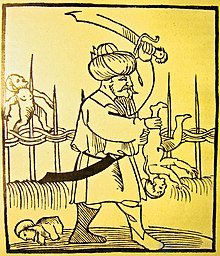
Anti-Muslim propaganda in Germany, created during the Ottoman wars in Europe , 16th century.
Milieu control
An attempt to control the social environment and ideas through social pressure.
Minimization
Minimization is the opposite of exaggeration. It is a type of deception , involving denial coupled with rationalization in situations where complete denial is implausible.
Name-calling
Propagandists use the name-calling technique to evoke fears and prejudices in their listeners, intending that bad names will cause listeners to form a negative opinion of a group or set of beliefs or ideas that the propagandist wants the listeners to condemn. The method is designed to provoke conclusions on an issue without resorting to an impartial examination of the facts. Name-calling is thus a substitute for rational, fact-based arguments against an idea or belief on its own merits.
Non sequitur
A type of logical fallacy in which a conclusion is drawn from an argument that does not justify it. All invalid arguments can be seen as special cases of non sequitur.
Obfuscation , intentional vagueness, confusion
Generalities are deliberately vague so that the audience can supply its own interpretations. The goal is to move the audience by using indefinite phrases, without analyzing their validity or trying to determine their reasonableness or applicability. The goal is to get people to make their own interpretations rather than simply presenting them with an explicit idea. In trying to "make sense" of the propaganda, the audience refrains from judging the ideas presented. Their validity, reasonableness and applicability can still be considered.
Operant conditioning
Operant conditioning involves learning through imitation. For example, watching an attractive person buy products or support positions teaches a person to buy the product or support the position. Operant conditioning is the fundamental principle underlying ad nauseam, slogans and other public relations campaigns based on repetition.
Oversimplification
Favorable generalities are used to provide simple answers to complex social, political, economic or military problems.
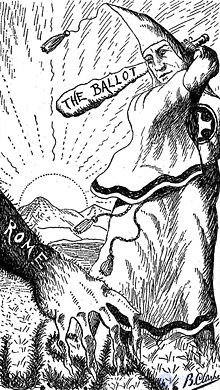
An illustration of the Reverend Branford Clarke from Heroes of the Fiery Cross by Bishop Alma White , published by the Pillar of Fire Church in 1928 in Zarephath, New Jersey.
Paltering
The active use of selectively true statements with the aim of misleading.
Pensée unique (single thought)
Forcibly cutting short discussion by using oversimplified phrases or arguments (for example, "There is no alternative to war").
Quotes taken out of context
Selective editing of quotations, which can change their meaning. Political documentaries intended to discredit an opponent or an opposing political viewpoint often use this technique.
Rationalization
Individuals or groups may use favorable generalities to justify questionable actions or beliefs. Vague and pleasant phrases are often used to justify such actions or beliefs.
Red herring
Presenting data or issues that, although persuasive, are irrelevant to the argument under consideration, and then claiming that they support that argument.

In 1807, William Cobbett wrote of how he used red herrings to lay a false trail when training hunting dogs — an apocryphal story that probably formed the basis of the idiom.
Repetition
This is the repetition of a certain symbol or slogan so that the audience remembers it. It can take the form of a jingle or an image placed on almost the entire picture/scene. It also includes the use of subliminal phrases, images or other content in propaganda material. [ 24 ]
Scapegoating
Assigning blame to an individual or group of people, which allows those responsible to ease their feelings of guilt and/or to divert attention from the need to address the problem for which the blame is assigned.

The nationalist slogan "Brazil , love it or leave it," often used during the Brazilian military dictatorship (1964–1985)
Semantic satiation
This technique can be used to reduce the impact of a damaging headline or sound bite. For example, if an upcoming story about receiving a "bribe" would be damaging, then repeatedly using the word "bribe" for trivial accusations can cause the word itself to become more normalized and easier to ignore when it is encountered.
Slogans
A slogan is a brief, striking phrase that may include labeling and stereotyping. Although slogans may be enlisted in support of valid ideas, in practice they tend to act only as emotional appeals. Opponents of the US invasion and occupation of Iraq use the slogan "blood for oil" to suggest that the invasion and its human toll were carried out to gain access to Iraq's oil wealth. On the other hand, supporters who argue that the US should continue fighting in Iraq use the slogan "cut and run" to suggest that withdrawing troops is cowardly or weak. Similarly, the names of military campaigns, such as " Enduring Freedom " or " Just Cause ," can also be considered slogans devised to influence people.
Smears
A smear is an attempt to damage or call into question someone's reputation by spreading negative propaganda. It can be applied to individuals or groups.
Stereotyping , labeling or pigeonholing
This technique attempts to arouse prejudices in an audience by labeling the object of the propaganda campaign as something the target audience fears, hates, despises or finds undesirable. For example, a report on a foreign country or social group may focus on the stereotypical traits the reader expects, even if they are far from representative of the whole country or group; such reports often focus on anecdotal evidence. In graphic propaganda, including war posters, this may involve depicting enemies with stereotyped racial features.
Straw man
A straw man argument is an informal fallacy based on misrepresenting an opponent's position. To "attack a straw man" is to create the illusion of refuting a proposition by replacing it with a superficially similar proposition (the "straw man") and refuting that, without actually refuting the original position.
Testimonial Flawed quotation
Testimonials are quotations, in context or out of context, especially cited to support or reject a particular policy, action, program or personality. The reputation or role (expert, respected public figure, etc.) of the person making the statement is exploited. A testimonial places the official sanction of a respected person or authority on the propaganda message. This is done in an attempt to get the target audience to identify with the authority figure or to accept the authority's opinions and beliefs as their own.
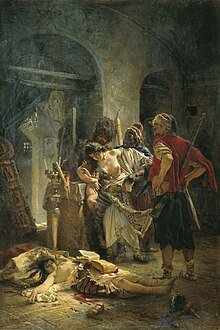
"The Bulgarian Martyresses," an 1877 painting by the Russian artist Konstantin Makovsky , depicting the rape of Bulgarian women by Ottoman troops during the suppression of the April Uprising a year earlier, served to mobilize public support for the Russo-Turkish War (1877–1878), which was fought with the declared aim of liberating the Bulgarians.
Third-party technique Soft power
Works on the principle that people are more likely to accept an argument from a seemingly independent source of information than from someone who has a stake in the outcome. It is a marketing strategy commonly used by public relations (PR) firms, which involves placing a pre-planned message in the "mouth of the media." The third-party technique can take various forms, from hiring journalists to cover an organization in a favorable light to using scientists within the organization to present their possibly biased findings to the public. Astroturf groups or front groups are often used to deliver the message.
Thought-terminating cliché
A frequently used phrase, sometimes passed off as folk wisdom, applied to suppress cognitive dissonance .
Transfer
Also known as association , this is a technique of projecting the positive or negative qualities (praise or blame) of one person, entity, object or value onto another, in order to make the second more acceptable or to discredit it. It evokes an emotional response that prompts the target to identify with recognized authorities. Often a very visual technique, it frequently uses symbols (for example, the swastikas used in Nazi Germany, originally a symbol of health and prosperity) superimposed on other visual images.
Unstated assumption
This technique is used when a propaganda concept seems less plausible if stated explicitly. Instead, the concept is repeatedly assumed or implied.
Virtue words Transfer (propaganda)
These are words within the value system of the target audience that create a positive image when associated with a person or issue. Peace, hope, happiness, security, wise leadership, freedom, "Truth," etc. are virtue words. Many consider religiosity a virtue, making associations with this quality effectively beneficial.
Whataboutism
Whataboutism is a variant of the tu quoque logical fallacy, which attempts to discredit an opponent's position by charging them with hypocrisy without directly refuting or disproving their arguments, and which is particularly associated with Soviet and Russian propaganda. When criticism was directed at the Soviet Union, the Soviet response was "What about...," followed by an event in the Western world.
With the "plain folks" technique, an attempt is made to persuade the public that the speaker is a person whom the given audience can trust and that the speaker is fighting for its interests. To do this, the speaker uses in his speech the typical style of the given target audience.
The "bandwagon" and "inevitable victory" techniques are attempts to persuade the target audience to join the group on whose behalf the propagandist speaks and to act "the way everyone acts." With the "inevitable victory" technique, the audience is urged to join those who are already on the road to certain victory. Those who have already joined the promoted group are further reinforced in the belief that they are acting correctly. The "join the crowd" technique is used to convince the audience that the propagandized statement is an expression of the will of an irresistible mass movement, and that it is in their own interest to join that movement.
A glittering generality is a term used by propaganda researchers to describe words that characterize an object positively but contain no specific information. These characterizations are so vague that they can be applied to any object, and they cannot be refuted or called false. This phenomenon is known as the "Barnum effect," in which the vagueness of a characterization does not raise doubts about its validity.
Everyday narration - this technique is used to accustom a person to clearly negative information. For example, if people need to be made used to violence, blood and murder, a television presenter with a calm face and an even voice reports the most serious crimes every day. After some time, such information ceases to evoke strong emotions in the population.
Loyalty - the goal of this technique is to persuade people to support a particular point of view so that they do not look like traitors or cowards in the eyes of society.
Stop, thief - this method consists of, when accused of something, blending in with the pursuers and starting to repent before them yourself. The goal is to confuse the pursuers and win their trust.
Good words - the use of words that evoke positive emotions in the audience toward the object being described, such as peace, happiness, security, freedom, truth, stability, "young promising leader" and others.
Verbal flooding - a method used to reduce the relevance of a phenomenon or to provoke a negative reaction to it. It involves praising the opponent continuously to the point where it begins to irritate the audience. It is also used to create "information noise" in order to hide important events or problems behind a stream of secondary messages.
Playing with scale - changing the scale of events to minimize or exaggerate their importance. It includes:
Hyperbole - exaggeration (for example, calling a small fight a "bloodbath").
Litotes - understatement (for example, calling serious election violations "minor").
Grotesque - depicting people and phenomena in a fantastic, hideously comic form.
Gradation - arranging words or expressions in order of increasing or decreasing significance (for example, "ruthless, cruel, bloody").
Linguistic propaganda is the use of various rhetorical devices and tropes to distort information and/or to influence the audience emotionally.
Rhetorical questions, exclamations and appeals: Expressing statements in the form of a question to attract attention and strengthen the emotional impact. For example: "What is to be done? Is it for Americans to talk about the norms of law! Citizens,…".
Pathos: A style of expressing feelings characterized by emotional elevation and inspiration.
Removal of the actor: Using passive constructions to hide the subject of the action. For example: "they were attacked".
Metaphors and epithets: The figurative meaning of words, based on similarity.
Occasionalisms: Individual, author-coined word formations.
Oxymoron: A combination of words with opposite meanings. For example: "peacekeeping war".
Violation of cause and effect is a logical fallacy in which the temporal sequence of events is mistakenly taken for a causal link. For example, the statement "a serial killer was fond of postage stamps from childhood, therefore philately turns people into ruthless killers" is such a violation. Here it is assumed that one event (an interest in stamps) causes another event (turning into a killer), although in reality it may be merely a coincidence with no causal connection.
Hatred is a powerful means of manipulation, because an evil and ruthless enemy will never arouse sympathy in the audience. It is enough for the manipulator to provoke hatred of the opponent in order to obtain universal approval of his actions.
These techniques make it possible to manipulate the audience's perception, creating certain emotional and cognitive effects.
Propaganda and upbringing (education) do have some similar features, but they mainly differ in goal, methods and content:
Goal of influence: Both phenomena aim to influence people and their beliefs, behavior or worldview.
Methods: Various methods of influence are used, such as information, persuasion and motivation.
Goal:
Propaganda: The goal of propaganda is to spread a particular ideology or opinion, often in order to mobilize the masses or achieve political goals.
Upbringing: Upbringing is aimed at forming the personality, developing a person's moral, ethical and social qualities, and preparing them for life in society.
Content:
Propaganda: Usually contains one-sided information, which may be distorted or manipulative.
Upbringing: Based on a comprehensive and objective presentation of information, and on the principles of ethics and morality.
Methods:
Propaganda: Uses more aggressive and intrusive methods, such as slogans, advertising, mass media and social networks.
Upbringing: Based on dialogue, personal example, mentoring and pedagogical methods.
To recognize propaganda, it is important to know the common methods that propagandists use. The absolute antidote to any propaganda can be expressed in the phrase: "People matter more than ideas." This simple truth reminds us that human life, dignity and well-being must always come first. No ideologies, beliefs or goals can justify harm done to people. Above all, it is important to remain humane, to respect others and to place their interests above abstract ideas and doctrines. Here are the main ones:
Loaded language: Emotionally charged words and phrases, designed to provoke strong reactions or associations, are often used to manipulate feelings and cloud judgment.
Emotional appeals: Be attentive to messages that rely heavily on emotions such as fear, anger or compassion rather than on logical arguments or objective facts.
Selective presentation of facts: Pay attention to cases where only certain facts are presented in support of a particular argument, while contradictory or inconvenient information is omitted or downplayed.
Repetition: Frequently repeated slogans, phrases or images can be used to reinforce a message and increase its memorability and persuasiveness.
Appeals to authority: Be skeptical of endorsements or statements by influential figures, celebrities or "ordinary people" that are used to lend credibility to a message or product. Keep in mind that these people may have hidden motives or may themselves be misinformed.
Developing critical thinking skills will help you evaluate the reliability of information. For example, challenge assumptions, consume news from different sources, check facts and be aware of your biases. This will allow you to remain impartial when evaluating information and to resist propaganda.
Developing critical thinking skills is important for assessing the reliability and accuracy of information, as well as for recognizing propaganda methods. Here are some strategies for this:
Questioning assumptions: Challenge the basic assumptions and premises of a message or argument. Consider alternative points of view and check whether the evidence presented supports the conclusions drawn.
Diversity of information sources: Consume news and information from different sources in order to see a wide range of viewpoints and opinions, including those that challenge your existing beliefs.
Fact-checking and verifying claims: Check the accuracy of statements and claims by comparing them with reliable sources or by using fact-checking websites.
Awareness of your own biases and emotions: Recognize that all of us have personal biases and emotions that can influence our judgment. Strive to be aware of them and to remain impartial when evaluating information.

Comments