
Lecture
Piston effect refers to the forced flow of air inside a tunnel or shaft caused by moving vehicles. It is one of the many phenomena that engineers and designers must take into account when developing various structures.
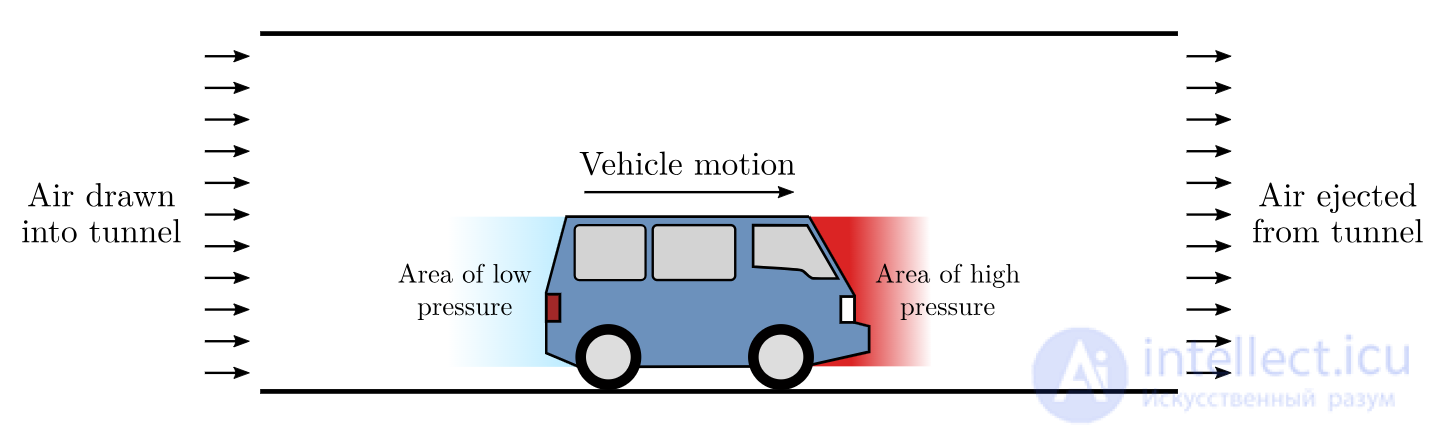
Diagram demonstrating the piston effect as a car moves through a tunnel.
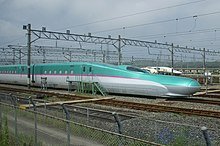
The elongated nose of the Shinkansen E5 series train in Japan is designed to counteract the piston effect.
Outdoors, when a vehicle moves, the air pushed aside can move in any direction except into the ground. Inside a tunnel, the air is confined by the tunnel walls to move along the tunnel. Behind a moving vehicle, as the air is pushed away, suction is created and air is drawn into the tunnel. In addition, due to the viscosity of the fluid, the surface of the vehicle drags air along to flow with the vehicle, a force experienced by the vehicle as surface drag. This movement of air by the vehicle is analogous to the operation of a mechanical piston, such as inside a piston compressor of a gas pump, hence the name «piston effect». The effect is also similar to the pressure fluctuations inside drainage pipes when wastewater pushes air ahead of it.
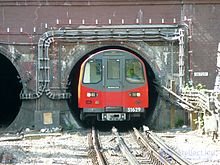
The gap between the train and the tunnel is often small. A London Underground train exiting a tunnel.
The piston effect is very pronounced in railway tunnels, since the cross-sectional area of trains is large and in many cases almost completely fills the cross-section of the tunnel. The wind felt by passengers on underground railway platforms (which do not have platform screen doors installed) as a train approaches is the airflow from the piston effect. The effect is less pronounced in tunnels for road vehicles, since the cross-sectional area of a vehicle is small compared to the total cross-sectional area of the tunnel. Single-track tunnels experience the maximum effect, but the gap between the rolling stock and the tunnel, as well as the shape of the front of the train, affect its strength.
The airflow caused by the piston effect can exert large forces on installations inside the tunnel, so these installations must be carefully designed and properly installed. Backdraft dampers are sometimes required to prevent this airflow from stalling fans.
Of particular importance for natural ventilation is the influence of the piston effect of transport units passing through the tunnel. Under favorable conditions, the piston effect can create an airflow velocity sufficient to ventilate the tunnel, while under unfavorable conditions it can — counterbalance the natural draft or reverse the direction of air movement.
In railway tunnels, the piston effect is especially noticeable, since the train occupies a large part of the cross-section of a single-track tunnel and has a length comparable to the length of the tunnel.
When a train moves in a tunnel, excess air pressure is created in front of the locomotive and rarefaction behind the last car. These factors help overcome the resistance of the tunnel as an air duct and create a head that provides for the movement of air in the tunnel.
The velocity v of the airflow caused by the piston effect of the train is directly proportional to the velocity v0 of its motion. Fresh air entering the tunnel behind the train moves somewhat slower than the train and therefore lags behind the rear car (Fig. 43, a). After the train exits the tunnel, the piston effect disappears and the movement of air toward the exit portal continues under the influence of the kinetic energy of the mass of air located in the tunnel (Fig. 43, b).
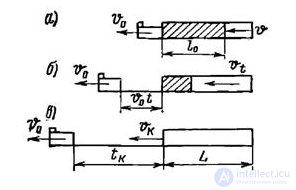
If this energy is insufficient to overcome the resistance of the tunnel as an air duct, the fresh air will not be able to completely displace the air containing combustion products, and under unfavorable conditions this mixture may spread in the direction opposite to the movement of the train over a significant length of the tunnel.
The magnitude of the lag of the fresh air flow behind the rear car of the train at the moment of exiting the tunnel
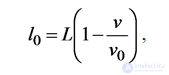 ,
,where L — length of the tunnel;
v0 — speed of the train;
v — speed of air movement in the tunnel, established as a result of the combined action of the piston effect and natural draft.
Using the theorem on the change in kinetic energy of a system, one can find the time tk of free movement of the airflow through the tunnel and the value of the exit velocity vk of the air, which must be sufficient to overcome random factors acting in the opposite direction (natural draft head, traffic movement):
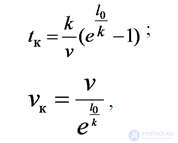 ;
;where
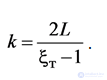
The total resistance coefficient of the tunnel as an air duct, included in the last expression
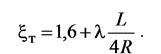
The condition for the possibility of ventilating the tunnel by means of the piston effect of trains is compliance with the following inequalities (Fig. 43, c):
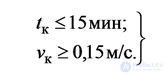
The following measures help enhance the influence of the piston effect on tunnel ventilation:
1. Increasing the air resistance, which can be achieved with greater filling of the tunnel cross-section by the train and increased travel speed. Therefore, it is advisable to build two single-track tunnels instead of one double-track tunnel and to lay the tunnels on gentle gradients. This simultaneously reduces the locomotive's fuel consumption when passing through the tunnel and, consequently, the emission of harmful gases.
2. Reducing the resistance of the tunnel as an air duct, which can be achieved by reducing the coefficient of air friction against the tunnel walls and reducing local resistance at the entrance and exit by rounding the edges of the portal openings. Of greatest importance is reducing the roughness of the inner surface of the tunnel. For this purpose, it is advisable to use reusable metal formwork during concreting, or to carefully plaster the surface with subsequent iron trowelling.
3. Forcing air through the shaft of a shallow mine into the tunnel in the direction of train movement at points where the ventilating action of the piston effect ceases, which shortens the ventilation time of the tunnel and increases the exit velocity of the airflow.
In automobile tunnels, the influence of the piston effect is not as great as in railway tunnels, due to the significantly smaller filling of the tunnel cross-section by transport units. However, here too one must reckon with the possibility of a steady airflow arising, especially when columns of cars move with minimal intervals between them. Therefore, it is advisable to build separate tunnels for one-way traffic, in which the airflows from the piston effect of cars can be used for natural ventilation. Such a solution is acceptable in the case of short tunnels (up to 400 m in length). In this case, it is mandatory to switch off internal combustion engines when vehicles stop in the tunnel.
The piston effect is used in tunnel ventilation. In railway tunnels, the train pushes air ahead of itself toward the nearest ventilation shaft ahead and draws air into the tunnel from the nearest ventilation shaft behind it. The piston effect can also contribute to ventilation in tunnels for road transport.
In underground rapid transit systems, the piston effect contributes to ventilation and in some cases provides sufficient air movement to make mechanical ventilation unnecessary. At wider stations with multiple tracks, air quality remains the same and may even improve when mechanical ventilation is switched off. However, on narrow platforms with a single tunnel, air quality deteriorates when the piston effect alone is used for ventilation. This still allows for potential energy savings by using the piston effect instead of mechanical ventilation where possible.
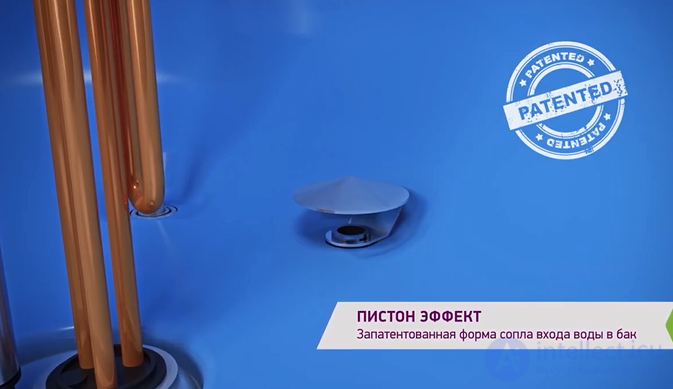
In domestic water heaters (boilers), the PISTON effect of a unique stainless steel nozzle creates a piston effect that slows the mixing of cold and hot water inside the water tank. Up to 15% more hot water than similar products with a conventional nozzle
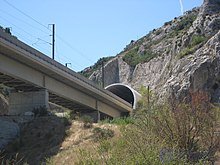
A tunnel on the French TGV high-speed rail network with a canopy at the entrance to mitigate tunnel boom.
Tunnel boom is a loud rumble that high-speed trains sometimes create when exiting tunnels. These shock waves can disturb nearby residents and damage trains and nearby structures. People perceive this sound similarly to the sonic boom of a supersonic aircraft. However, unlike a sonic boom, tunnel boom is not caused by trains exceeding the speed of sound. Instead, tunnel boom occurs because the structure of the tunnel prevents the air around the train from escaping in all directions. As the train passes through the tunnel, it creates compression waves ahead of itself. These waves combine into a shock wave, which generates a loud boom when it reaches the tunnel exit. The strength of this wave is proportional to the cube of the train's speed, so the effect is much more pronounced for faster trains.
Tunnel boom can disturb residents near tunnel portals, and it is exacerbated in mountain valleys, where the sound is reflected as an echo. Reducing this disturbance is a significant challenge for high-speed lines such as the Shinkansen in Japan, the TGV in France, and the AVE in Spain. Tunnel boom has become a major limitation on increasing train speeds in Japan, where mountainous terrain requires frequent use of tunnels. Japan has enacted a law limiting noise to 70 dB in residential areas, which include many tunnel exit zones.
Methods of reducing tunnel boom include creating a highly aerodynamic profile for the train, adding hoods to tunnel entrances, installing perforated walls at tunnel exits, and drilling ventilation holes in the tunnel (similar to installing a suppressor on a firearm, but on a much larger scale). The HS2 project in the United Kingdom has developed «porous portal» tunnel hoods to mitigate tunnel boom for residents, as well as to minimize auditory discomfort for passengers, which can arise from changes in air pressure inside the train.
Passengers and crew may experience ear discomfort when a train enters a tunnel due to rapid pressure changes. [13]

Comments