
Lecture
Ether (luminiferous ether, from Ancient Greek αἰθήρ, upper layer of air; Lat. aether) — a hypothetical all-pervading medium , whose oscillations manifest themselves as electromagnetic waves (including visible light). The concept of the luminiferous ether was put forward in the 17th century by René Descartes and received detailed justification in the 19th century within the framework of wave optics and Maxwell's electromagnetic theory. The ether was also regarded as a material analogue of Newton's absolute space. Other variants of ether theory also existed.
At the end of the 19th century, insurmountable difficulties arose in ether theory, forcing physicists to abandon the concept of the ether and to recognize the electromagnetic field as a self-sufficient physical object, not requiring an additional carrier. The absolute frame of reference was abolished by special relativity. Repeated attempts by individual scientists to revive the concept of the ether in one form or another (for example, linking the ether to the physical vacuum) were unsuccessful.
From the few surviving works of ancient Greek scholars, it can be understood that the ether was then understood as a special celestial substance, a «filler of the void» in the Cosmos . Plato, in the dialogue «Timaeus», states that God created the world from ether. Lucretius Carus, in his poem «On the Nature of Things», mentions that «the ether nourishes the constellations», meaning that the heavenly bodies consist of condensed ether. Anaxagoras conceived of the ether differently — in his opinion, it resembles earthly air, only hotter, drier, and more rarefied .
Democritus and other atomists did not use the term ether; their system of the world included only atoms and the void .
A somewhat more detailed picture is presented in the works of Aristotle. He too believed that the planets and other celestial bodies consist of ether (or quintessence), which is the «fifth element» of nature, and which, unlike the other four (fire, water, air, and earth), is eternal and unchanging. Aristotle wrote: «The Sun does not consist of fire; it is a vast accumulation of ether; the heat of the Sun is caused by its action on the ether during its revolution around the Earth». The ether also fills the whole of extraterrestrial space, starting from the sphere of the Moon; from this quotation it can be concluded that Aristotle's ether transmits light from the Sun and stars, as well as heat from the Sun. The Aristotelian understanding of the term was adopted by medieval scholastics; it persisted in science until the 17th century.
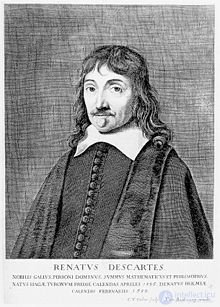
A detailed hypothesis for the existence of a physical ether was put forward in 1618 by René Descartes and first set out in his work «The World, or Treatise on Light» (1634), and later developed and published in «Principles of Philosophy» (1644). Descartes himself hardly used the term «ether», perhaps because he ascribed to it properties radically different from the ancient ether: «The Earth and the heavens are made of one and the same matter» .
Descartes was the first to clearly assert that the world ether possessed the ordinary mechanical properties of matter, thereby reviving in the new physics the notion of ether in the spirit of Anaxagoras (in place of the by-then discredited Aristotelian ether as a «celestial» element). The notion of the world ether in Descartes' interpretation persisted until the beginning of the 20th century.
In accordance with his (Cartesian) natural philosophy, Descartes regarded the entire Universe as indefinitely extended matter, taking on various forms under the action of motion inherent in it .
Descartes denied the existence of the void and believed that all of space was filled with primal matter or its derivatives. He conceived of primal matter as an absolutely dense body, each part of which occupies a portion of space proportional to its size: it is incapable of expansion or compression and cannot occupy the same place as another part of matter. This matter is capable of being divided into parts of any shape under the action of an applied force, and each of its parts can possess any admissible motion . Particles of matter retain their shape as long as they possess acquired motion. Upon losing motion, particles are capable of merging . He supposed that under the action of an applied force, the particles of primal matter wore down their corners in various circular motions. The resulting spheres formed vortices, and the fragments filled the gaps between them.
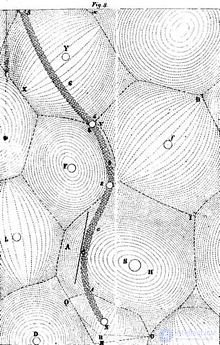
Descartes' invisible ether filled all space in the Universe free of matter, yet offered no resistance to the motion of material bodies within it. Descartes divided the «ethereal matters» by their properties into three categories .
The mechanical properties of the ether, namely the absolute hardness of the particles of the second element and their tight mutual adherence, contribute to the instantaneous propagation of changes among them. When impulses of change reach the Earth, we perceive them as heat and light[10].
Descartes applied the system of the world he had set out to explain not only optical but other phenomena as well. He saw the cause of gravity (which he considered inherent only to earthly objects) in the pressure of the ethereal particles surrounding the Earth, which move faster than the Earth itself[11]. Magnetism is caused by the circulation around a magnet of two opposing streams of minute screw-shaped particles with opposite threading, which is why two magnets can not only attract but also repel one another. Electrostatic phenomena are similarly caused by ribbon-shaped particles[12]. Descartes also constructed an original theory of color, according to which different colors arise from different rotational speeds of particles of the second element[13][14].
Descartes' teaching on light was significantly developed by Huygens in his «Treatise on Light» (Traité de la lumière, 1690). Huygens regarded light as waves in the ether and developed the mathematical foundations of wave optics.
At the end of the 17th century, several unusual optical phenomena were discovered that had to be reconciled with the model of the luminiferous ether: diffraction (1665, Grimaldi), interference (1665, Hooke), double refraction (1670, Erasmus Bartholin, studied by Huygens), an estimate of the speed of light (1675, Rømer)[15]. Two variants of the physical model of light emerged:
It is interesting to note that the Descartes—Huygens concept of the luminiferous ether soon became generally accepted in science and did not suffer from the disputes between Cartesians and atomists that unfolded in the 17th—18th centuries[17] [18], nor from those between supporters of the emission and wave theories. Even Isaac Newton, who leaned more toward the emission theory, admitted that the ether also took part in the effects mentioned[19]. In Newton's works, the ether is mentioned very rarely (mainly in early works), although in personal letters he sometimes allowed himself to «frame hypotheses» about the possible role of the ether in optical, electrical, and gravitational phenomena. In the final paragraph of his main work, «Mathematical Principles of Natural Philosophy», Newton writes: «It now remains to add something concerning a certain most subtle spirit which pervades and lies hid in all gross bodies». He goes on to list the roles assumed at the time for the physical role of the ether:
The particles of bodies mutually attract one another at very small distances, and cohere, when contiguous; and electric bodies operate at greater distances, as well repelling as attracting the neighboring corpuscles; and light is emitted, reflected, refracted, inflected, and heats bodies; and all sensation is excited, and the members of animal bodies move at the command of the will, namely by the vibrations of this spirit, mutually propagated along the solid filaments of the nerves, from the outward organs of sense to the brain, and from the brain into the muscles.
Newton, however, offers no comment on these hypotheses, limiting himself to the remark: «But these are things that cannot be explained in few words, nor are we furnished with that sufficiency of experiments which is required to an accurate determination and demonstration of the laws by which this electric and elastic spirit operates»[20].
Thanks to Newton's authority, the emission theory of light became generally accepted in the 18th century. The ether was regarded not as the carrier but as the transporter of light particles, and refraction and diffraction of light were explained by changes in the density of the ether — near bodies (diffraction) or upon the transition of light from one medium to another (refraction)[21]. On the whole, the ether as part of the system of the world receded into the background in the 18th century, though the theory of ethereal vortices survived, and there were unsuccessful attempts to apply it to explain magnetism and gravity[22].
At the beginning of the 19th century, the wave theory of light, which regarded light as waves in the ether, won a decisive victory over the emission theory. The first blow to the emission theory was struck by the English polymath Thomas Young, who in 1800 developed the wave theory of interference (and introduced the term itself) based on the principle of superposition of waves that he formulated. From the results of his experiments, he quite accurately estimated the wavelength of light in various color ranges.
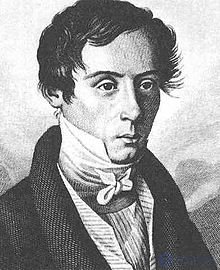
At first, Young's theory was met with hostility. It was precisely at this time that the phenomenon of double refraction and polarization of light had been thoroughly studied and was perceived as decisive evidence in favor of the emission theory. But then, in support of the wave model (knowing nothing of Young), came Augustin-Jean Fresnel. Through a series of ingenious experiments, he demonstrated purely wave effects, wholly inexplicable from the standpoint of corpuscular theory, and his memoir, containing a comprehensive study from the wave standpoint and a mathematical model of all the then-known properties of light (except polarization), won the competition of the Paris Academy of Sciences (1818). Arago describes a curious episode: at a meeting of the academicians' commission, Poisson spoke out against Fresnel's theory, since it followed from it that under certain conditions a brightly lit spot could appear at the center of the shadow of an opaque disc. At one of the following meetings, Fresnel and Arago demonstrated this effect to the members of the commission, which came to be known as the «Poisson spot»[23].
Young and Fresnel initially regarded light as elastic (longitudinal) oscillations of a rarefied but extremely elastic ether, similar to sound in air. Any source of light sets off elastic oscillations of the ether, which occur at a gigantic frequency, nowhere else observed in nature, thanks to which they propagate at colossal speed[24]. Any material body attracts the ether, which penetrates inside the body and condenses there. The refractive index of light depended on the density of the ether within a transparent body[25].
It remained to understand the mechanism of polarization. As early as 1816, Fresnel discussed the possibility that the light oscillations of the ether were not longitudinal but transverse. This would easily explain the phenomenon of polarization. Young arrived at the same idea around this time. However, transverse oscillations had previously been observed only in incompressible solid bodies, whereas the ether was considered close in properties to a gas or liquid. In 1822—1826, Fresnel presented memoirs describing new experiments and a complete theory of polarization, which retains its significance to this day.
Interest and confidence in the concept of the ether increased sharply in the 19th century. The following (post-1820s) nearly hundred years were marked by the triumphant success of wave optics in all fields. Classical wave optics was completed, while at the same time raising the most difficult question: what exactly is the ether?
When it became clear that light oscillations were strictly transverse, the question arose as to what properties the ether must possess in order to allow transverse oscillations while excluding longitudinal ones. Henri Navier obtained the general equations for the propagation of disturbances in an elastic medium in 1821. Navier's theory was developed by A. L. Cauchy (1828), who showed that, generally speaking, longitudinal waves must also exist[26].
Fresnel put forward the hypothesis that the ether is incompressible but allows for transverse shear. Such an assumption is difficult to reconcile with the complete permeability of the ether with respect to matter. G. G. Stokes explained the difficulty by supposing that the ether resembles pitch: under rapid deformations (the emission of light) it behaves like a solid, while under slow ones (say, in the motion of the planets) it is plastic. In 1839, Cauchy improved his model, creating a theory of the compressible (labile) ether, later refined by W. Thomson.
For all these models not to be regarded as purely speculative, it was necessary to formally derive from them the principal effects of wave optics. However, such attempts had little success. Fresnel supposed that the ether consists of particles whose size is comparable to the wavelength of light. With this additional assumption, Cauchy managed to account for the phenomenon of dispersion of light. However, attempts to link, for example, Fresnel's theory of the refraction of light with any model of the ether proved unsuccessful[27].
Faraday was skeptical of the ether and expressed doubt about its existence[28]. With Maxwell's discovery of the equations of classical electrodynamics, ether theory acquired new content.
In his early works, Maxwell used hydrodynamic and mechanical models of the ether, but emphasized that they served only to provide illustrative analogy. It must be kept in mind that vector analysis did not yet exist at the time, and Maxwell needed the hydrodynamic analogy primarily to clarify the physical meaning of differential operators (divergence, curl, etc.). For example, in the article «On Faraday's Lines of Force» (1855), Maxwell explained that the imaginary fluid used in the model «is not even a hypothetical fluid... it is merely a collection of imaginary properties which may be employed for establishing certain theorems in pure mathematics in a way more intelligible to many minds and more applicable to physical problems than that in which algebraic symbols alone are used»[29]. Later (from 1864 onward), Maxwell excluded reasoning by analogy from his works[30]. Maxwell did not develop specific models of the ether and did not rely on any properties of the ether other than its ability to support displacement current, that is, the propagation of electromagnetic oscillations in space.
When H. Hertz's experiments confirmed Maxwell's theory, the ether came to be regarded as the common carrier of light, electricity, and magnetism. Wave optics became an organic part of Maxwell's theory, and hope arose of constructing a physical model of the ether on this foundation. The leading scientists of the world engaged in research in this field. Some of them (for example, Maxwell himself, Umov, and Helmholtz), although they wrote about the properties of the ether, in fact studied the properties of the electromagnetic field. Others (for example, G. G. Stokes, W. Thomson) attempted to uncover the nature and properties of the ether itself — to estimate the pressure within it, the density of its mass and energy, and to connect it with atomic theory.
In the works of D. I. Mendeleev, this question is directly related to his understanding of the physical causes of periodicity. Since the properties of elements are in periodic dependence on atomic weights (mass), the scientist proposed using these regularities to solve the problem at hand — by determining the causes of gravitational forces through the study of the properties of the medium that transmits them.[31]
As already noted, it was assumed that the «ether» filling interplanetary space was the medium transmitting light, heat, and gravity. Within the framework of such ideas, the study of highly rarefied gases seemed a possible way to determine this substance, since the properties of «ordinary» matter would no longer be able to conceal the properties of the «ether»[31].
In one of his hypotheses, D. I. Mendeleev was guided by the idea that a specific state of highly rarefied air gases might turn out to be the «ether» or some unknown inert gas of very small weight, that is, the lightest chemical element. The scientist wrote on a proof from «Osnovy Khimii» (Principles of Chemistry), on a 1871 sketch of the periodic system: «Ether is lighter than all, by millions of times»; in a 1874 notebook he expressed his thinking more clearly: «At zero pressure, air has a certain density — this is the ether!». However, these thoughts were not reflected in his publications of that period. The discovery of inert gases at the end of the 19th century made the question of the chemical nature of the world ether relevant again. At the suggestion of William Ramsay, Mendeleev included in the periodic table a zero group, leaving room for elements lighter than hydrogen. In Mendeleev's opinion, the group of inert gases could be supplemented by coronium and by the lightest, as yet unknown element, which he named newtonium, and which constitutes the world ether[32]
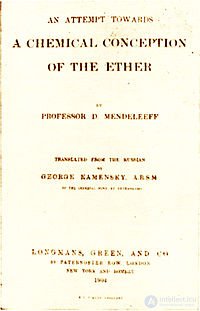
He set forth his views in detail in April 1902 in the essay «An Attempt at a Chemical Understanding of the World Ether» (published in English in 1904, and in Russian in 1905). In the concluding part of this work, D. I. Mendeleev writes
Representing the ether as a gas possessing the indicated features and belonging to the zero group, I strive above all to extract from the periodic law what it can give, to actually explain the materiality and universal distribution of the ethereal substance everywhere in nature, and its ability to penetrate all substances — not only gaseous or vaporous, but also solid and liquid — since the atoms of the lightest elements of which our ordinary substances are composed are nevertheless millions of times heavier than the ethereal atoms and, as one must think, will not greatly change their relations from the presence of atoms as light as the ethereal ones. It goes without saying that a whole host of questions then arises for me as well, that it seems impossible for me to answer most of them, and that in setting forth my attempt I did not intend either to raise them or to try to answer those of them that seem resolvable to me. I did not write my «attempt» for this purpose, but only in order to speak out on a question that many, I know, think about, and about which it is time to begin speaking.
Even in his early works, D. I. Mendeleev arrived at methodological principles and propositions that were further developed in his subsequent research. He strives to approach the solution of one or another question by following these general principles, creating a philosophical concept within which the analysis of specific data would be conducted. This is also characteristic of research concerning the present topic, which resulted in findings not directly related to it.[34] Driven by the idea of detecting the ether, D. I. Mendeleev began experimentally studying rarefied gases, and, in working on this subject, formulated or confirmed propositions of the kinetic theory and thermodynamics, and theoretically substantiated the behavior of compressed gases[35]: he obtained the ideal gas equation containing the universal gas constant he derived, and obtained virial expansions that are in full agreement with the first approximations in the equations for real gases known today. Very valuable, though somewhat premature, was D. I. Mendeleev's proposal to introduce a thermodynamic temperature scale[31].
Between 1892 and 1904, Hendrik Lorentz developed the theory of the «electron-ether», in which he introduced a strict separation between matter (electrons) and the ether. In his model, the ether is completely stationary and is not set in motion by ponderable matter. Unlike earlier electronic models, the electromagnetic field of the ether acts as an intermediary between electrons, and changes in this field cannot propagate faster than the speed of light.
A fundamental concept of Lorentz's theory in 1895 was the «theorem of corresponding states» for terms of order v/c[A 1]. This theorem states that an observer moving relative to the ether makes the same observations as an observer at rest (after an appropriate change of variables). Lorentz noted that it was necessary to change the space-time variables when switching reference frames, and introduced two concepts:
This led to the formulation of the so-called Lorentz transformations by Larmor (1897, 1900) and by Lorentz (1899, 1904), , in which (as was noted by Larmor) the full formulation of local time is accompanied by a certain time dilation of electrons moving in the ether. As Lorentz later noted (1921, 1928), he considered the time indicated by clocks at rest in the ether to be the «true» time, whereas local time was regarded by him as a heuristic working hypothesis and a purely mathematical device . Therefore, Lorentz's theorem is regarded by modern authors as a mathematical transformation from the «real» system at rest in the ether to a «fictitious» system in motion
Lorentz's work was mathematically substantiated and improved by Henri Poincaré, who formulated a universal Principle of Relativity and attempted to reconcile it with electrodynamics. He declared simultaneity to be nothing more than a convenient convention that depends on the speed of light, whereby the constancy of the speed of light would be a useful postulate for making the laws of nature as simple as possible. In 1900 and 1904 he physically interpreted Lorentz's local time as the result of synchronizing clocks by means of light signals. In June and July of 1905[A 11][A 12] he declared the principle of relativity to be a general law of nature, including gravitation. Poincaré corrected some of Lorentz's errors and proved the Lorentz invariance of the equations of electrodynamics. Nevertheless, he used the concept of the ether as a real but completely undetectable medium, and distinguished between apparent and real time, which is why most historians of science believe that Poincaré failed to create special relativity[ B 1][B 4][B 2].
During the 17th—19th centuries, numerous attempts were made to link the ether with gravitation and to provide a physical basis for Newton's law of universal gravitation. Historical reviews mention more than 20 such models of varying degrees of elaboration. The following ideas were expressed most often
All these models were subjected to well-reasoned criticism and failed to achieve wide scientific recognition[37].
This model was first published in a list of problems and questions that Newton placed at the end of his work «Opticks» (1704). Newton himself never once spoke in support of such an approach, limiting himself to the well-known statement: «I have not as yet been able to discover the cause of these properties of gravity from phenomena, and I frame no hypotheses». This idea never received any significant development[37].
Another version of this model was proposed by Robert Hooke: attraction is caused by the oscillations of atoms transmitted from body to body through the ether. This idea was further developed in the 19th century in the form of «pulsation» theories[37].
Among the «pulsation» theories, a prominent place is occupied by the model of the Norwegian physicist Carl Bjerknes, who was one of the first to attempt to create a unified theory of all fields. Bjerknes's publications (1870s) developed the following idea: bodies in the ether behave like synchronously pulsating bodies in an incompressible fluid, between which, as is known, an attraction arises that is inversely proportional to the square of the distance. Bjerknes's concept was supported by the English physicists Frederick Guthrie (Frederick Guthrie) and William Hicks (William Mitchinson Hicks), the latter theoretically describing «negative matter», whose atoms oscillate in antiphase, and antigravity. In 1909 Bjerknes's theory was further developed by Charles Burton (Charles V. Burton), who attributed the pulsations to electrons inside bodies[39].
The «pulsation» models were subjected to sharp criticism, and the following objections were raised against them[39].
The main authors of this group of models were the English scientists Karl Pearson (later a famous statistician) and George Adolphus Schott[en]. Pearson, who was seriously engaged in hydrodynamics in the 1880s, at first supported the pulsation theories, but in 1891 he proposed a model of the atom as a system of ethereal streams, with the help of which he hoped to explain both electromagnetic and gravitational effects[40][41]:
The primary substance is a fluid, non-rotating medium, and atoms or elements of matter are streams of this substance. Where these streams came from in three-dimensional space cannot be said; in terms of the possibility of knowing the physical universe, the theory is limited to their existence. Perhaps their origin is connected with a space of higher dimensionality than our own, but we can know nothing about it — we are dealing only with flows into our medium, with streams of ether, which we have proposed to call «matter».
Mass, according to Pearson, is determined by the average velocity of the ethereal streams. From these general considerations Pearson succeeded in deriving Newton's law of gravitation. Pearson did not explain where the ethereal streams flow from and to. Schott attempted to clarify this aspect, suggesting that the radius of the electron increases over time, and that this «swelling» is the source of the motion of the ether. In Schott's version, the gravitational constant changes over time[40].
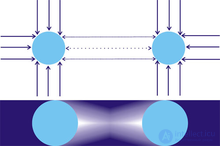
The idea of this ingenious mechanical model of gravitation appeared as early as Newton's time (Nicolas Fatio de Duillier, 1690), but the author of the developed theory was the Swiss physicist Georges-Louis Le Sage, whose first publication appeared in 1782[42]. The essence of the idea is shown in the figure: space is filled with certain rapidly and chaotically moving ethereal corpuscles, and their pressure on a single body is balanced, while the pressure on two nearby bodies is unbalanced (due to partial shielding by the bodies), which creates an effect of mutual attraction. An increase in the mass of a body means an increase in the number of atoms making up this body, which proportionally increases the number of collisions with corpuscles and the magnitude of the pressure from them, so the force of attraction is proportional to the mass of the body. From this, Le Sage derived Newton's law of gravitation[43].
Critics of Le Sage's theory noted many of its weak points, especially from the standpoint of thermodynamics. James Maxwell showed that in Le Sage's model, energy would inevitably be converted into heat and would quickly melt any body. In the end, Maxwell concluded[44]:
We have devoted more space to this theory than it seems to deserve, because it is ingenious, and because it is the only theory of the cause of gravitation that has been so elaborately worked out that it is possible to discuss the arguments for and against it. It does not seem able to explain to us why the temperature of bodies remains moderate, while their atoms are subjected to such bombardment.
Henri Poincaré calculated (1908) that the velocity of the corpuscles would have to be many orders of magnitude greater than the speed of light, and their energy would incinerate all the planets[43]. Insurmountable logical difficulties were also noted[37]:
George Darwin's attempt to replace the corpuscles with waves in the ether also proved unsuccessful[45]. In a 1910 review, the Le Sage model is confidently characterized as untenable[43].
In 1728, the English astronomer Bradley discovered the aberration of light: all stars trace small circles in the sky with a period of one year. From the standpoint of the ether theory of light, this meant that the ether was stationary, and its apparent displacement (as the Earth moves around the Sun), by the principle of superposition, deflects the images of the stars. Fresnel, however, allowed that inside moving matter the ether is partially dragged along. This viewpoint seemed to find confirmation in the experiments of Fizeau.
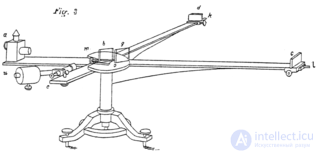
In 1868 Maxwell proposed a scheme for a decisive experiment, which, after the invention of the interferometer, was carried out in 1881 by the American physicist Michelson. Later, Michelson and Edward Morley repeated the experiment several times with increasing precision, but the result was consistently negative — the «ether wind» did not exist.
In 1892, H. Lorentz and, independently of him, G. FitzGerald suggested that the ether is stationary, while the length of any body contracts in the direction of its motion, which makes the «ether wind» harder to detect. It remained unclear, however, why the length contracts to exactly the degree needed to make the detection of the ether (more precisely, of motion relative to the ether) impossible. At the same time, the Lorentz transformations were discovered, which were at first considered specific to electrodynamics. These transformations explained the Lorentz contraction of length, but were incompatible with classical mechanics, which is based on the Galilean transformations. Henri Poincaré showed that the Lorentz transformations are equivalent to the principle of relativity for the electromagnetic field; he believed that the ether exists but fundamentally cannot be detected.
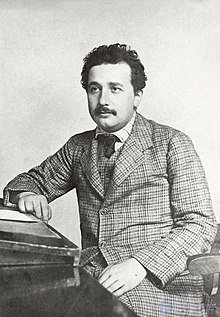
The physical essence of the Lorentz transformations was revealed after Einstein's work. In his 1905 paper, Einstein considered two postulates: the universal principle of relativity and the constancy of the speed of light. From these postulates followed directly the Lorentz transformations (now not only for electrodynamics), the contraction of length, and the relativity of the simultaneity of events. In this same paper, Einstein pointed out the unnecessity of the ether, since it had not been possible to attribute any reasonable physical attributes to it, and everything that had been considered to be dynamical properties of the ether was absorbed by the kinematics of special relativity (SR). From this moment on, the electromagnetic field came to be regarded not as an energetic process in the ether, but as an independent physical object.
The new views did not prevail immediately; for several decades after 1905 a number of physicists still made attempts to restore confidence in the ether model. In 1924 Dayton Miller announced that he had detected an «ether wind». Miller's result was not confirmed, and much more precise measurements (using various methods) again showed that there is no «ether wind»[47]. Other physicists tried to use the Sagnac effect to prove the existence of the ether, but this phenomenon is fully explained within the framework of the theory of relativity[48]. Possible limits of applicability of the theory of relativity are also being investigated[49].
The main reason the physical notion of the ether was rejected was the fact that, after the development of special relativity, this notion turned out to be superfluous. Among other reasons one may cite the contradictory attributes ascribed to the ether — imperceptibility to matter, transverse elasticity, and a speed of propagation of oscillations that is inconceivable compared to gases or liquids, among others. An additional argument was the proof of the discrete (quantum) nature of the electromagnetic field, which is incompatible with the hypothesis of a continuous ether.
In his article «The Principle of Relativity and Its Consequences in Modern Physics» (1910), Albert Einstein explained in detail why the concept of the luminiferous ether is incompatible with the principle of relativity. Consider, for example, a magnet moving across a closed conductor. The observed picture depends only on the relative motion of the magnet and the conductor and includes the appearance of an electric current in the latter. However, from the point of view of ether theory, the picture is substantially different in different reference frames. In the reference frame associated with the conductor, as the magnet moves, the strength of the magnetic field in the ether changes, and as a result an electric field with closed field lines is created, which in turn creates a current in the conductor. In the reference frame associated with the magnet, no electric field arises, and the current is created by the direct action of the changing magnetic field on the electrons of the moving conductor. Thus the reality of the processes in the ether depends on the point of observation, which is inadmissible in physics[50].
Later, after the creation of the general theory of relativity (GTR), Einstein proposed reviving the use of the term, changing its meaning — namely, understanding the ether to mean the physical space of GTR[51]. Unlike the luminiferous ether, physical space is not substantial (for example, one cannot ascribe to points of space their own motion and self-identity), so for space, unlike the Lorentz–Poincaré ether, no difficulties arise with the principle of relativity[52]. However, most physicists preferred not to return to using a term that had already been abolished.
Some scientists continued to support the concept of the luminiferous ether even after 1905; they put forward various alternative hypotheses and tried to prove them experimentally. However, it invariably turned out that the theory of relativity and theories based on it are in agreement with the results of all observations and experiments,[53][54] while no competitive ether theory capable of describing the entire body of experimental facts has appeared.
In modern scientific articles the term «ether» is used almost exclusively in works on the history of science[55]. Nevertheless, from time to time proposals appear to revive this notion as useful for physics.
Some of these opinions are more terminological in nature. As already mentioned above, Einstein himself proposed calling physical space the ether, to emphasize that it possesses not only geometric but also physical attributes. Whittaker later wrote: «It seems to me absurd to retain the name „vacuum“ for a category possessing so many physical properties, whereas the historical term „ether“ suits this purpose perfectly»[56]. The Nobel Prize laureate in physics Robert B. Laughlin spoke as follows about the role of the ether in modern theoretical physics:
It is ironic that Einstein's most creative work, the general theory of relativity, should be so misunderstood as to be the very reason we deny the reality of the ether, for his original premise, special relativity, requires no such reality… The word «ether» has extremely negative connotations in theoretical physics because of its past association with opposition to relativity. This is unfortunate, because, stripped of these connotations, it rather nicely captures the way most physicists actually think about the vacuum… Relativity actually says nothing about the existence or non-existence of matter pervading the universe… but we do not speak of this, for it is taboo.[57]
These proposals have not received significant support[58][59][60]. One reason for this is that the ether is associated with mechanical models, which are characterized by the velocity of the medium at each point (a three- or four-dimensional vector), whereas known physical fields have no such properties — for example, the metric field is tensorial rather than vectorial, and the gauge vector fields of the Standard Model have additional indices.
The term ether is occasionally used in scientific works when creating new terminology. For example, in a paper by A. de Gouvêa[61], the «CPT-violating ether» refers merely to certain kinds of terms in the potential of the neutrino Lagrangian.
More radical constructions, in which the ether acts as a substance (medium), come into conflict with the principle of relativity[53]. Such an ether, owing to a very weak interaction with the ordinary world, can lead to certain phenomena, the main one being a weak violation of the Lorentz invariance of the theory. References to some of these models can be found on the stanford.edu website[62].
However, to date no observable physical phenomena have been found that would justify reviving the concept of a substantial ether in any form. In the bulletin «In Defense of Science», published by the Commission for Combating Pseudoscience and Falsification of Scientific Research under the Presidium of the Russian Academy of Sciences, the theory of the ether is characterized as pseudoscience[63].
Radio appeared long before the term ether fell out of scientific use, and a good number of expressions related to the ether have taken root in the professional terminology of the media industry: the program went on the air (v efir), live broadcast (pryamoy efir), and the like. The term «broadcast (peredacha v efir)» is used in a number of articles of the Civil Code of the Russian Federation concerning copyright and related rights. The English version of the term (Ether) is present in many terms in electronics (for example, «Ethernet»), although with respect to radio communication and radio broadcasting the word air is used.

Comments