
Lecture
In optics, a caustic or caustic network is the envelope of light rays that have been reflected or refracted by a curved surface or object, or the projection of that envelope of rays onto another surface. A caustic is a curve or surface tangent to each of the light rays, defining the boundary of the envelope of rays as a curve of concentrated light. In some cases, caustics can be regarded as patches of light or their bright edges, shapes that often exhibit cusp features.
In the English-language literature, a caustic (Caustic) formed by reflected rays is called a catacaustic (Catacaustic), and a caustic formed by refracted rays is called a diacaustic (Diacaustic).
In differential geometry, a caustic is the envelope of rays reflected or refracted by a manifold. It is related to the concept of a caustic in geometric optics. The source of a ray may be a point (called a radiant) or parallel rays from a point at infinite distance, in which case a direction vector for the rays must be specified.
More generally, especially with regard to symplectic geometry and singularity theory, a caustic is the set of critical values of a Lagrangian map ( π ○ i ) : L ↪ M ↠ B ; where i : L ↪ M is a Lagrangian immersion of a Lagrangian submanifold L into a symplectic manifold M , and π : M ↠ B is a Lagrangian fibration of the symplectic manifold M . A caustic is a subset of the base space of the Lagrangian fibration B .
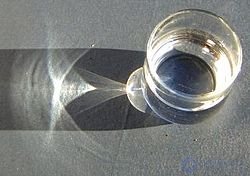
Caustics from a glass of water
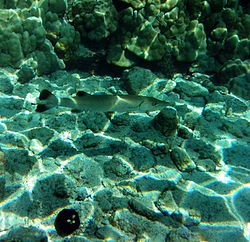
Caustics forming on the surface of water
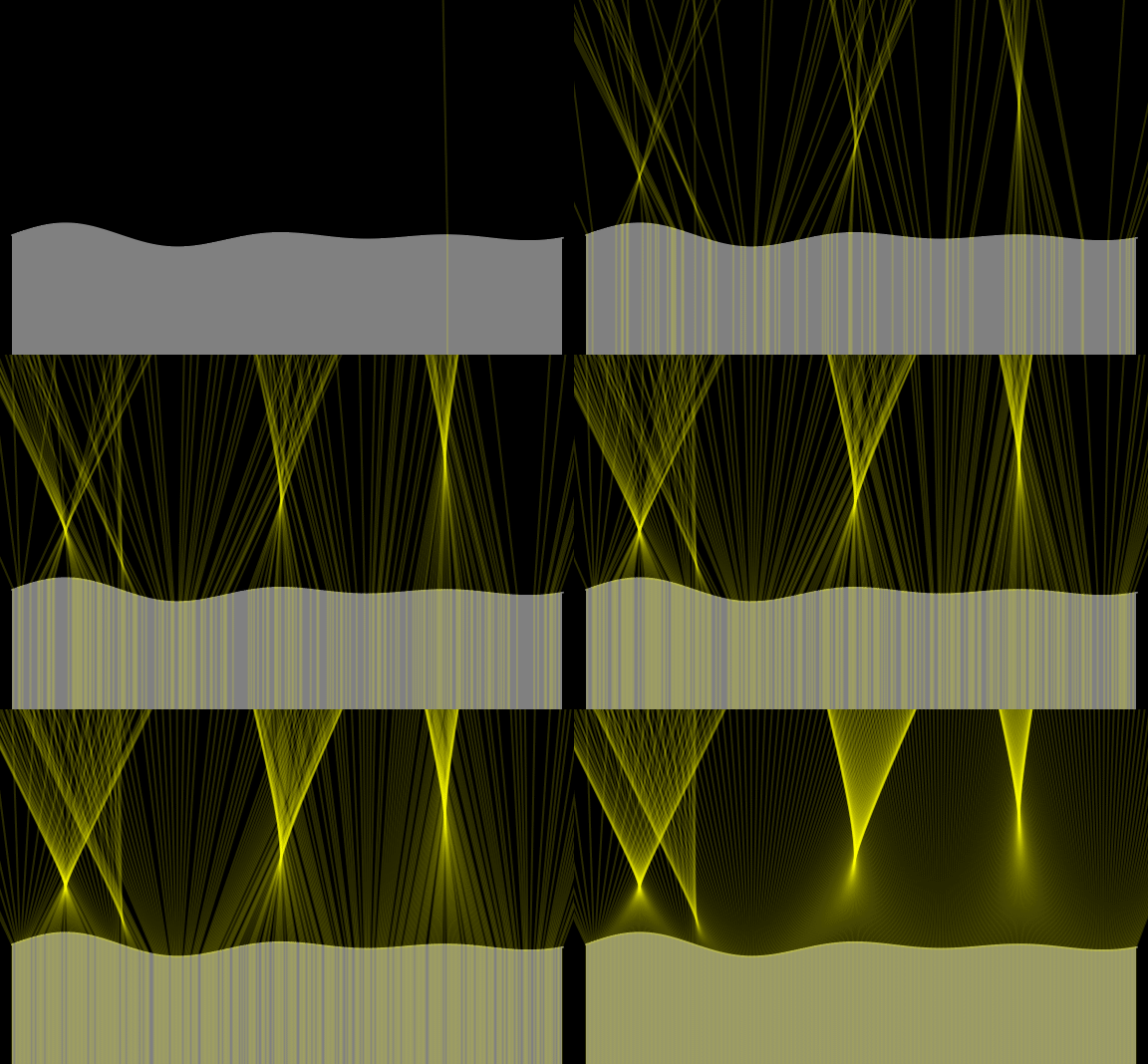
Rays, refracting from an uneven surface, form caustics where many of them intersect.
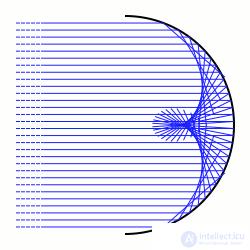
A reflective caustic created from a circle and parallel rays. On one side, each point is contained in three light rays; on the other side, each point is contained in one light ray.
Concentration of light, especially sunlight , can burn. The word caustic , in fact, comes from the Greek καυστός, burnt, through the Latin causticus , burning.
A common situation in which caustics are visible is when light falls on a drinking glass. The glass casts a shadow, but also produces a curved region of bright light. Under ideal conditions (including perfectly parallel rays, as if from a point source at infinity), a patch of light in the shape of a nephroid can be obtained. Rippling caustics usually form when light passes through waves on a body of water.
Another well-known caustic is the rainbow . The scattering of light by raindrops causes waves of different lengths to be refracted into arcs of different radii, forming a rainbow.
Concentration of light, especially sunlight , can burn. The word caustic , in fact, comes from the Greek καυστός, burnt, through the Latin causticus , burning.
A common situation in which caustics are visible is when light falls on a drinking glass. The glass casts a shadow, but also produces a curved region of bright light. Under ideal conditions (including perfectly parallel rays, as if from a point source at infinity), a patch of light in the shape of a nephroid can be obtained. Rippling caustics usually form when light passes through waves on a body of water.
Another well-known caustic is the rainbow . The scattering of light by raindrops causes waves of different lengths to be refracted into arcs of different radii, forming a rainbow.
A catacaustic is the reflective case.
In the case of a radiant, it is the evolute of the radiant's orthotomic .
Case of a flat parallel source of rays: suppose the direction vector equals  and the mirror curve is parameterized as
  . The normal vector at the point equals
 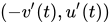 ; the reflection of the direction vector (the normal requires special normalization)

Having the components of the found reflected vector, we treat it as a tangent

Using the simplest form of the envelope




which may not be elegant, but  gives a linear system
  and so obtaining a parameterization of the catacaustic is elementary. Cramer's rule will work.
Let the direction vector be (0,1), and the mirror be  Then
Then




has the solution ; that is, light entering a parabolic mirror parallel to its axis is reflected through the focus.
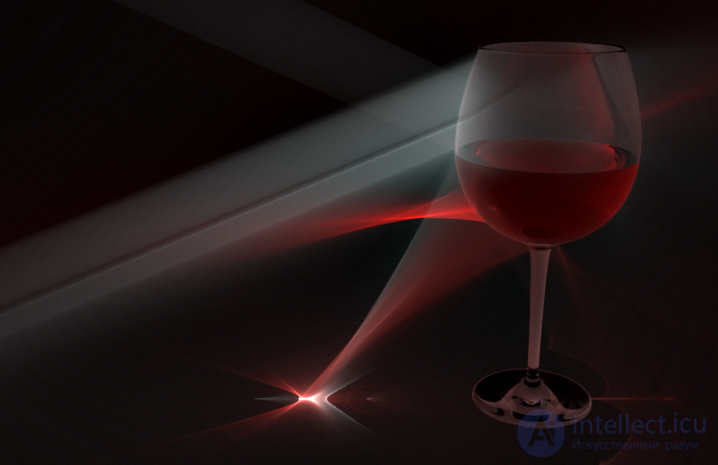
Computer visualization of a wine glass caustic
In computer graphics, most modern rendering systems support caustics. Some of them even support volumetric caustics. This is achieved by tracing rays along possible paths of the light ray, taking refraction and reflection into account. Photon mapping is one implementation of this. Volumetric caustics can also be obtained by volumetric path tracing . Some computer graphics systems operate on the principle of "forward ray tracing," in which photons are modeled as originating from a light source and bouncing off the surrounding environment according to certain rules. A caustic forms in regions where a sufficient number of photons strike a surface, making it brighter than the average area in the scene. "Backward ray tracing" works in reverse order, starting from the surface and determining whether there is a direct path to the light source. Some examples of 3D ray-traced caustics can be found here .
The focus of most computer graphics systems is aesthetics rather than physical accuracy . This is especially true when it comes to real-time graphics in computer games , where instead of physically correct calculations, generic precomputed textures are mostly used.
Caustic engineering describes the process of solving the inverse problem of computer graphics . That is, given a specific image, determining the surface whose refracted or reflected light forms that image.
In the discrete version of this problem, the surface is divided into a number of microsurfaces, which are assumed to be smooth, i.e. the light reflected/refracted by each microsurface forms a Gaussian caustic. A Gaussian caustic means that each microsurface obeys a Gaussian distribution . The position and orientation of each of the microsurfaces are then obtained using a combination of Poisson integration and simulated annealing .
There have been many different approaches to solving the continuous problem. One approach uses an idea from transport theory called optimal transport , to find a mapping between the incoming light rays and the target surface. Once such a mapping is obtained, the surface is optimized by iteratively adapting it using Snell's law of refraction .
Controlling the caustic pattern is a fairly difficult task, since even minor changes to the surface will significantly affect the quality of the pattern, since the directions of the light rays can be interfered with by other light rays as they intersect with the material and are refracted through it. This will lead to a scattered, discontinuous pattern. To solve this problem, one of the existing proposed methods for controlling the caustic pattern is the optimal transport method, which allows redirecting the directions of light as it propagates through the surface of a particular transparent material . This is done by solving an inverse optimization problem based on optimal transport . [ 13 ] [ 14 ] Given a reference image of the object/pattern, the goal is to formulate a mathematical description of the material surface through which light is refracted and converges to a pattern similar to the reference image. This is done by redistributing/recalculating the initial light intensity until a minimum of the optimization problem is reached.
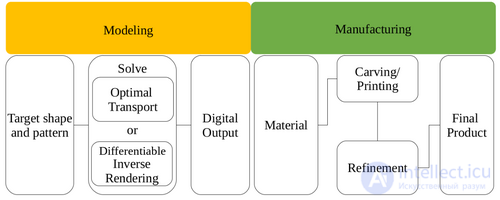
Design and production process
After the caustic pattern has been computationally designed, the processed data is sent to the production stage to obtain the final product. The most common approach is subtractive manufacturing ( machining ).
Depending on the desired quality, labor costs, and available production method, various materials may be used.
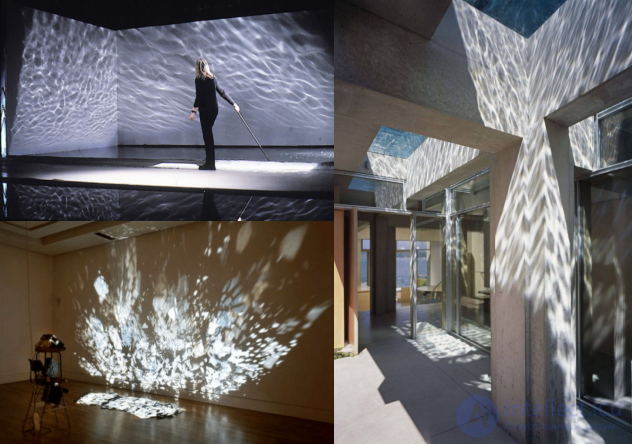
Architecture
Designing caustic patterns has many real-world applications, for example:
Bright, oddly shaped light curves appear on a lit table on which a glass of water is placed. Moving caustics can be seen on the bottom of a shallow body of water whose surface is disturbed. A rainbow is a multicolored caustic that arises from the refraction of sunlight in raindrops. Caustics arise not only in the propagation of light, but also in a number of other wave phenomena. Ship wakes can be considered a caustic of gravity waves on water. In the work of Ya. B. Zel'dovich, it was shown that due to gravitational instability, mass initially distributed almost uniformly throughout the Universe concentrates on caustics, leading to the formation of a filamentary large-scale structure of the universe. In astronomy, optical caustics can be used to determine the geometry of a compact dark object — a gravitational lens.
Within geometric optics, caustics represent lines and surfaces of infinitesimally small thickness. Geometrically, a caustic is the evolute of a wavefront; the wavefront is the involute of the caustic. Taking into account the wave properties of light, caustics must have some thickness, certainly not less than the wavelength of light. Near monochromatic caustics, characteristic interference fringes are observed, whose intensity is described by the Airy function. The theory of caustics is directly related to one of the branches of modern mathematics — catastrophe theory. In differential equations, caustics correspond to the overturning of solutions.
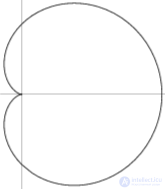
| Curve | Light source | Caustic |
|---|---|---|
|
Circle |
On the plane |
Cardioid
|
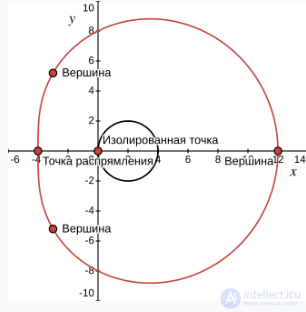
| Circle | Not on the plane |
Limaçon of Pascal |
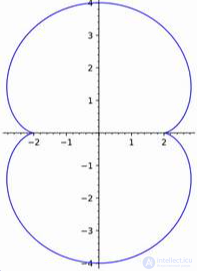
| Circle | Infinity |
Nephroid
|
|
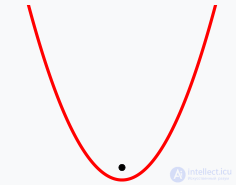
Parabola |
Rays parallel to the directrix |
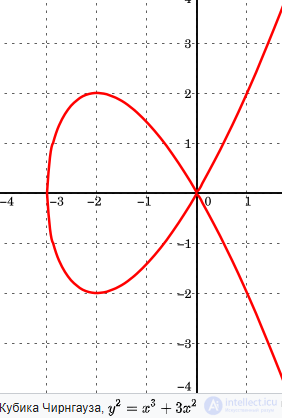
Tschirnhausen cubic
|
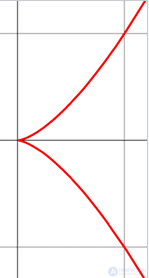
| Tschirnhausen curve | Focus |
Semicubical parabola
|
|
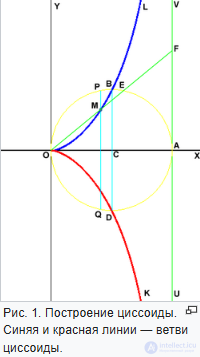
Cissoid of Diocles |
Focus | Cardioid |
| Cardioid | Cusp | Nephroid |
| Quadrifolium | Center |
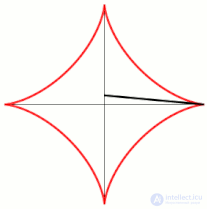
Astroid |
|
Deltoid
|
Infinity | Astroid |
| Logarithmic spiral | Center |
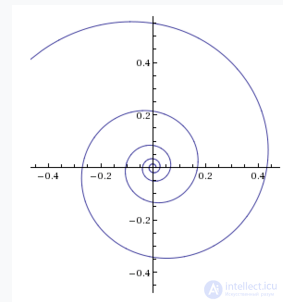
Logarithmic spiral |
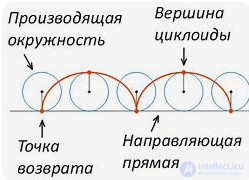
| Cycloid within a single arch | Rays parallel to the perpendicular of its axis |
2 arches (arcs) of a cycloid |
| Cycloid | Rays perpendicular to the line through the cusps | Half a cycloid |
|
Ellipse |
Any of its points | Unnamed curve |
|
Logarithmic curve |
Rays perpendicular to the asymptote |
Catenary (chain line) |


Comments