
Lecture
Introduction. Nowadays, fuzzy logic is increasingly used to describe complex control objects, such as human society with its system of economic, political, and social relations, making it possible to formalize fuzzy concepts and provide effective processing of semantic information. The set of decision-making problems is usually divided into two classes: well-structured and poorly structured.
Decision-makers involved in strategic planning and management typically deal with poorly formalized problems and therefore base their decisions on personal experience and intuition. Decision support systems, which include a database and a knowledge base, prove very useful to them. The database contains information about the control objects, while the knowledge base represents a mathematical model for processing information and arriving at the necessary decision. The combination of a database and a knowledge base with fuzzy logical inference forms one of the models of cybernetic systems. Let us consider models of the emergence of the simplest information and cybernetic systems at the earliest stages of evolutionary development [1]. Scientists such as M. Eigen, F. Crick, F. Dyson, and F. Anderson developed a number of interesting mathematical and computer models that make it possible to represent possible schemes of evolution leading to the emergence of self-replicating molecular-genetic systems of the simplest cellular organisms. Interest in such modeling was driven by the powerful achievements of molecular biology
. When developing intelligent decision-making systems, whose knowledge representation models are often built as situational-frame networks, as well as when developing global intelligent systems that use hybrid knowledge models to represent conceptual notions, it is necessary to be able to quickly assess the influence of various factors on the system's behavior in its surrounding environment. For the forecasting and assessment of the system's behavior to be effective, it is desirable for the knowledge base of such a system, besides the usual logical inference, to also have an accelerated inference that allows the influence of various factors on the system's behavior to be assessed quickly, albeit approximately.
Problem statement.
Fuzzy express inference can be constructed based on fuzzy analogy. Analogy is understood as similarity between objects, phenomena, or concepts in a certain respect, that is, it is a form of reasoning in which, based on the similarity of two objects, phenomena, or concepts in a certain respect, a logical conclusion is drawn about their similarity in another respect. Fuzzy analogy is understood as follows [2]. Suppose there is a model of the original knowledge base, given in the form of a fuzzy graph, and there are one or more fuzzy homomorphic images of it. Then, in order to carry out inference based on a linear-type fuzzy analogy, it is necessary to establish a fuzzy isomorphism between the original graph of the system model and its fuzzy isomorphic image, that is, to find fuzzy substitutions that transform one model into the other, and to find paths of equal length from the initial vertex to the final vertex in both the isomorphic and the original model graphs, which correspond to the logical inference by fuzzy linear analogy. The essence of fuzzy nonlinear analogy is as follows. A fuzzy homomorphic image of the fuzzy graph is constructed, that is, a mathematically correct compression of the original fuzzy graph into its fuzzy epimorphic image is carried out, in which the logical inference is performed. This is a fast but comparatively rough express inference based on the homomorphic image of the system. If this does not satisfy the required accuracy, an effective direction for refining the logical inference in a certain region of the original knowledge base is proposed. The refinement procedure can be repeated as many times as necessary.
rocedure of refinement can be repeated the necessary number of times. Comparative analysis of inference methods. By logical inference in this case one may understand various methods, for example: inference based on the compositional rule of inference, inference based on generalized modus ponens and modus tollens rules following from conditional fuzzy inference, or inference based on the recognition of fuzzy reference situations. In implementing fuzzy inference in systems of fuzzy implicative rules and fuzzy descriptions of situations, the stage of logical inference is preceded by a stage of identifying the input fuzzy situation, at which, if required, quantitative information is converted into its qualitative description, that is, the semantics of the situation is determined. In other words, a transition is made from the numbers characterizing the parameters of the decision-making object to the corresponding fuzzy sets. The fuzzy sets obtained as a result of fuzzy logical inference can be interpreted, depending on the established requirements, either through their linguistic approximation, that is, a description in terms of linguistic variables, or through conversion to specific numbers characterizing the parameters of the decision made. In either case, a number of special operations and transformations on fuzzy sets must be performed. Operations on fuzzy sets have a special character, due, on the one hand, to the need to perform mass transformations on collections of their vector representations, and on the other hand – to their relative simplicity (the most frequently used operations reduce to the pairwise application, to the elements of two fuzzy sets, of the operations of taking the maximum and minimum). The use of the inference method based on fuzzy homomorphism makes it possible to significantly enhance the intelligent capabilities of existing and newly developed hybrid and global intelligent decision-making systems. The language of crisp and fuzzy directed graphs and hypergraphs is the most convenient form both for representing knowledge and for the mathematically correct solution of the problem of semantic compression of information under fuzzy analogy based on fuzzy homomorphism of a general type, which includes as special cases fuzzy monomorphism, fuzzy epimorphism, and fuzzy bijective homomorphism, or isomorphism, of systems. In this connection, the following statements (theorems) for fuzzy homomorphisms of fuzzy relations are of both theoretical and practical interest [2–5].
Theorem 1. If a fuzzy correspondence Γ=(X,Y,F) and its inverse 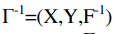 are fuzzy homomorphisms of fuzzy relations with respect to some operation, then Γ and Γ-1 are fuzzy isomorphisms with respect to this operation.
Proof. Since Γ – is a fuzzy homomorphism, then Γ – is a fuzzy mapping of X into Y and, by definition, it is a fuzzy functional and fuzzy everywhere-defined correspondence. It is known that if Γ – is a fuzzy functional and everywhere-defined correspondence, then its inverse 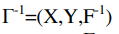 possesses the properties of fuzzy injectivity and fuzzy surjectivity. From this, and from the fact that Γ and Γ-1 – are fuzzy homomorphisms, it follows that Γ and Γ-1 – are simul-
taneously fuzzy functional, fuzzy injective, fuzzy everywhere-defined and fuzzy surjective, i.e. fuzzy bijective correspondences. Consequently, Γ and Γ-1 – are fuzzy isomorphisms.
Theorem 2. If the fuzzy correspondences Γ=(X,Y,F) and Δ=(Y,Z,P) are fuzzy homomorphisms with respect to the operation ٭ and  – their composition, then B=(X,Z,Q) is a fuzzy homomorphism of fuzzy relations with respect to the operation ٭ .
Proof. Since the correspondences Γ and Δ – are fuzzy homomorphisms of fuzzy relations, then Γ and Δ – are fuzzy mappings of the sets X into Y and Y into Z respectively, and therefore they possess the properties of fuzzy functionality and fuzzy everywhere-definedness. It can be shown, using the law of contraposition of fuzzy logical formulas, the definition of the composition operation of fuzzy correspondences, and the basic properties of fuzzy correspondences, that the composition of arbitrary fuzzy functional or fuzzy injective correspondences possesses the property of fuzzy functionality or fuzzy injectivity, while the composition of fuzzy everywhere-defined, fuzzy surjective, and fuzzy bijective correspondences possesses these properties only when the domain of departure of the fuzzy correspondence Δ coincides with the domain of arrival of the fuzzy correspondence Γ. Since the domain of arrival of Γ coincides with the domain of departure of Δ, their composition B=Γ๐ Δ also possesses the property of fuzzy functionality and fuzzy everywhere-definedness, that is, it is a fuzzy mapping of the set X into Z. Therefore, for the composition the fuzzy equality holds
: 
where φ and ψ — are arbitrary fuzzy relations, since the fuzzy mapping B possesses the same properties as the fuzzy mappings Γ and Δ, for which the relation holds by the condition of the theorem. Consequently, the mapping B is a fuzzy homomorphism of fuzzy relations with respect to the operation ٭ . By analogy with Theorem 2, the following theorem can be formulated and proved.
milar theorem. Theorem 3. If the fuzzy correspondences Γ=(X,Y,F) and Δ=(Y,Z,P) are fuzzy monomorphisms (fuzzy epimorphisms or fuzzy isomorphisms) of fuzzy relations with respect to the operation ٭ and the fuzzy correspondence B=Γ๐ Δ – is their composition, then B=(X,Z,Q) is a fuzzy monomorphism (fuzzy epimorphism or fuzzy isomorphism) of fuzzy relations with respect to the operation ٭ . The theorems presented make it possible, by repeatedly applying the composition operation of fuzzy homomorphisms, to construct, for the original graph, various homomorphic images that strengthen or weaken the existing fuzzy characteristics, properties, and types of the original graphs in the fuzzy multicompositional homomorphic images. Establishing the dependencies most interesting from theoretical and practical points of view may be the subject of further research.
Conclusion.
Successful applications of fuzzy logic and fuzzy algorithms lie in the area of building decision-making and control systems for complex technological and organizational processes. Since these systems are human-machine systems, their response time to a user request is strictly limited by the psychological characteristics of the dialogue. Control of technological processes must naturally take place in real or accelerated time [6–8]. For practical problems, the volume of fuzzy information processed is usually quite significant, and among the main operators for processing fuzzy information are memory access and the checking of logical conditions. In this connection, cases are possible in which the software implementation of fuzzy algorithms does not satisfy the requirements for comfortable user operation, or the requirements of the technological process regarding decision time, and must be supported in hardware [9–11]. Studies conducted in the area of fuzzy information processing have shown that the basic operations of fuzzy logic used to transform fuzzy sets possess natural parallelism, since they are performed on each element of the fuzzy set independently of the others. Moreover, in fuzzy algorithms, the operations applied to all elements of the fuzzy set at each particular step are in most cases the same or of the same type.
Finally, regardless of the basis of operations used, more complex operations are formed as a combination of several simple operations. For hardware support of decision inference in systems referred to as situational systems, it is proposed to use the ideology of vector or matrix processors, used either independently or as a coprocessor. Decision inference in such systems is based on fuzzy recognition of the input information by comparing its description with the descriptions of reference fuzzy situations characterizing the state of the decision-making object. Fuzzy situational decision inference is fairly simple to implement and, at the same time, has a number of advantages over compositional inference, namely:
The parallel fuzzy inference processor can process fuzzy information given directly on the verbal scale, bypassing the first (object) level of processing. At the same time, a variant is allowed in which the fuzzy processor is used in a single-level inference scheme that does not use the verbal scale of feature values [12–15]
Compared with existing fuzzy compositional decision-inference processors, the speed of fuzzy logical situational inference in the parallel fuzzy processor increases threefold for a two-level inference scheme and by an order of magnitude for a single-level inference scheme. The same time ratios are preserved when fuzzy compositional decision inference is implemented on the fuzzy processor. Moreover, the volume of the set of reference situations used by the fuzzy processor is limited only by the technological capabilities of its manufacturer, since the reference situations are stored in external memory and do not affect the processor's timing characteristics.
The basis of fuzzy logical operations, unlike known processors, is not of significant importance for the architecture of a parallel fuzzy logical inference processor. When the basis of fuzzy logical operations changes, only the architecture of the elementary processor changes. The fuzzy inference coprocessor can be used for hardware support of decision-making systems. It is also possible to use it as a fuzzy controller for complex technical objects, technological processes and robotic systems, and as an accelerator for expert and predictive systems operating on the basis of fuzzy logi
REFERENCES
1. Redko V.G. Evolution, Neural Networks, Intelligence: Models and Concepts of Evolutionary Cybernetics. – M.: Knizhny Dom «LIBROKOM», 2011. – 224 p.
2. Melikhova O.A. Methods for Constructing Intelligent Systems Based on Fuzzy Logic: Scientific Publication. – Taganrog: TRTU Publishing House, 2007. – 92 p.
3. Melikhova O.A., Melikhova Z.A. The Use of Fuzzy Mathematics in Modeling Artificial Intelligence Systems. In 2 volumes. Vol. 2. – M: Fizmatlit, 2009. – P. 728-742.
4. Kureichik V.M. Mathematical Support for Design Engineering and Process Engineering Using CAD. – M.: Radio i Svyaz, 1990. – 352 p.
5. Kureichik V.M., Lebedev B.K. Artificial Intelligence in CAD: Lecture Notes. – Taganrog: TRTI, 1989. – 48 p.
6. Kureichik V.M., Lebedev B.K., Nuzhnov E.V. Application of Expert Systems in Engineering Practice: Textbook. – Taganrog: TRTU, 1996. – 135 p
. 7. Kureichic V.M., Lebedev B.K., Nuzhnov E.V. Approach to genetic switch box gridles routing // Izvestiya TRTU. – 1999. – № 3 (13). – P. 89-96.
8. V.M. Kureichic, B.K. Lebedev, E.V. Nuzhnov. Approach to genetic switch box intellectual maze routing // Izvestiya TRTU. – 1999. № 3 (13). – P. 9-13.
9. Gladkov L.A., Kureichik V.V., Kureichik V.M. Genetic Algorithms / Edited by V.M. Kureichik. – M.: Fizmatlit, 2006. – 320 p.
10. Kureichik V.V., Kureichik V.M., Emelyanov V.V. Theory and Practice of Evolutionary Modeling. – M.: Fizmatlit, 2003. – 115 p.
11. Zadeh L. The Role of Soft Computing and Fuzzy Logic in Understanding, Constructing and Developing Information-Intelligent Systems // News of Artificial Intelligence. – 2001. – № 2. – P. 7-11.
12. Malgorzata Marek-Sadowska. Electrical and Computer Engineering Department. – Santa Barbara: University of California. – USA, 2005. – 254 p.
13. Klir G. Fuzzy Sets, Uncertainty and Information / G. Klir, T. Folger // Prentice Hall. New Jersey. – 1988. – P. 233-249.
14. Tikhonov A.N., Tsvetkov V.Ya. Methods and Systems for Decision Support. – M.: MAKS Press, 2001. – 251 p. 15. Petrovsky A.B. Decision Theory. – M.: Izd. dom «Akademiya», 2009. – 293 p.

Comments