E-state — a way of implementing the informational aspects of government activity, based on the use of ICT systems, and also a new type of state based on the use of this technology. E-state implies ICT-based support for the activities of both the executive branch («e-government»), the legislative bodies («e-parliament»), and the judicial bodies («e-justice»). E-government offers new opportunities for more direct and convenient citizen access to government authority, as well as for the state to provide services directly to citizens . In e-state systems, government operations are supported by web services. It involves the use of information technologies, in particular the Internet, to facilitate communication between the state and its citizens .
E-government (from the English e-Government) — a package of technologies and a set of accompanying organizational measures and regulatory support for organizing digital interaction between government authorities of various branches of power, citizens, organizations and other economic actors. It implies an efficient way of providing information about the activities of government authorities, delivering government services to citizens, business, other branches of government, and government officials, in which personal interaction between the state and the applicant is minimized and the capabilities provided by information technologies, mobile technologies, and the Internet are used to the fullest extent.
E-government is based on a distributed information and telecommunications infrastructure (e-government infrastructure) deployed at the national scale. Its core is an electronic document management system, a system for automating public administration built on the automation of the entire set of management processes nationwide, and serving the goal of substantially increasing the efficiency of public administration and reducing the costs of social communications for every member of society. National programs for building e-government envisage the phased construction of a nationwide distributed system of public administration that implements the solution to the full range of tasks related to document management and document-processing .
E-government is part of the measures of administrative reform and digital transformation set by the principles of the electronic economy and the digital economy.
In Russia, work on building the «e-state» is carried out under the Federal Target Program Electronic Russia and is aimed at improving the quality of public administration.
The concept of «e-state» corresponds most closely to the English concept of e-government. In some cases it is translated as «e-government» in the narrower sense. Such a translation is acceptable, but it is only one of its meanings. In modern international legal documents, in particular in the rulings of the European Court of Human Rights, the term government is used to denote the state as a whole. Similarly, in the expression «three branches of government», the reference is to the three branches of the state as a whole, not only to the executive branch — the government .
E-state is a subject of the electronic economy.
Other definitions of «e-state»
- «E-state» represents the use of information and communication technologies to transform government in order to make it more accessible to citizens, more efficient, and more accountable. However, this definition by no means implies that the transition to «e-government» should be marked by an increase in the number of computers in officials’ offices. On the contrary, according to this definition, it should lead to a change in the relationship between civil servants and the rest of the citizens (director of the Center for Democracy and Technology (Center for Democracy and Technology, CDT) James Dempsey ).
- «E-government is a system of public administration based on electronic means of processing, transmitting, and disseminating information» .
- «E-state» is an objective reality reflecting the emergence and self-development of electronic government institutions arising in the information society. The development of electronic government institutions is acquiring an unconditional character today and is aimed at satisfying the social needs and well-being of members of society. The cause-and-effect relationships and virtual reality generated on the basis of «e-state» find practical realization through electronic economic networks. This leads to the emergence of a new form of social development, relying on the extensive use of intangible assets (above all, personal qualities, knowledge, and information), as well as on crisis-free development, implemented through the creation of a non-market, post-scarcity type of economy based on socially controlled electronic management of needs.
History
The United States was one of the pioneers in the development of e-government – the term itself was first officially introduced by US Vice President Al Gore [Trakhtenberg 2013: 101–109; Dyakova 2013: 94–101]. It emerged in the context of the public administration reform carried out in the 1990s, which envisaged improving feedback between the government and society, increasing the efficiency of bureaucratic agencies, and broader involvement of the population in political decision-making. The main documents defining the directions and features of e-government development in the United States were the «E-Government Act» of 2002 and the Digital Government Strategy
The next strategic step in this direction was the signing, in 2000 at the G8 summit, of the Okinawa Charter on Global Information Society. In accordance with the Charter, the obligations of the G8 countries were defined to promote the spread of ICT and overcome the digital divide, which threatened to multiply the existing social and economic inequality.
To analyze current trends in the implementation of e-government tools, the UN developed a methodology that is actively used by states to organize their own efforts in this area. The E-Government Development Index, proposed by the UN Department of Economic and Social Affairs, has become one of the most authoritative indicators of the effectiveness of national ICT policy. In its 2014 survey report (hereinafter also – the 2014 UN Survey), e-government is defined as «the use and application of information technology by government bodies in public administration to optimize and integrate processes and procedures for the effective management of data and information, improve the quality of public service delivery, and expand communication channels for engaging people in the process of political decision-making»1 .
Methodology
The Russian methodology for building e-state has not yet been adopted at the government level and is being implemented within pilot projects of the Federal Target Program Electronic Russia. The main documents that define the methodology for building «e-state» are the following:
- The Concept for the Integration of Administrative Reform and the Federal Target Program «Electronic Russia», setting out the basic principles for the use of ICT in the public sector;
- The Report on Improving Public Administration through the Use of Information and Communication Technologies (ICT), outlining the main elements of the approach proposed by «Electronic Russia»;
- The Concept of State Accounting, proposing regulation of activities for collecting and storing information in the public sector;
- The Concept of Citizens’ Access to State Information, proposing mechanisms for providing citizens with information without the need to submit a request processed by an official;
- The Concept of Information Auditing of State ICT Systems, providing for verification that the operation of state ICT systems complies with the requirements of the «e-state» methodology
- The Concept of Standardizing the Formal Representation of Administrative Processes, defining standards for the use of ICT to model the activities of government bodies;
- The Concept of Software Standardization, defining mandatory requirements for software products procured and used in the public sector;
- The Concept of Information Regulation, defining the categories of access to information collected and stored by the state.
Models of E-government
By 2017, four models of e-government were known and applied worldwide:
- Continental European model
- Anglo-American model
- Asian model
- Russian model
Continental European model. This model is characterized by the presence of supranational institutions whose recommendations must be implemented by all EU countries; a high degree of integration, manifested in a single currency, a unified information space, the preparation of a new common Constitution, etc.; and legislation regulating information relations within the European information space. The application of technology in this model is primarily oriented toward the needs of citizen-users.
Anglo-American model. This model is widely used in the United States, Canada, and the United Kingdom. In the United States, information superhighways have been built that provide citizens with access to information about public administration. All services are open and transparent, and the government bears greater responsibility to the public. In the United Kingdom’s program, called «Electronic Citizens, Electronic Business, Electronic Government. A Strategic Concept for Serving Society in the Information Age», emphasis is placed on solving the following problems: expanding the range of services provided, making the most effective use of social information, and creating conditions for full coverage. The main goal for the United Kingdom is to free civil servants from performing routine work.
Asian model. This model is characterized by a specific type of governance. The main emphasis is on meeting the information needs of the population and introducing information technologies into the system of culture and education. Creating a unified information space across the entire country not only strengthens the state’s position but also puts into practice the fundamental principle of democracy: the people are the source and bearer of power.
Russian model. The main goals of the program are to increase the efficiency of the economy, state and local governance, and to create conditions for free access to information and the necessary services. In total, the program envisages development along nine directions, the main ones being ensuring openness in the activities of government bodies and improving the operation of state authorities and local self-government
To the shortcomings of e-government models, especially at the early stages of their construction, one should add the overly «mechanical» way of converting traditional state and municipal services into electronic form. Converting government services into electronic form usually does not include identifying inefficient and outdated regulatory documents, or taking measures to repeal, correct, and develop new laws, orders, and regulations — since this requires organizing a complex process of coordinating expert work and rule-making, and takes time to carry out. Working groups for building e-government are mostly funded from the budget, are dominated by civil servants, and the search for compromise with other ecosystem participants is either not envisaged or occurs with difficulty. Such a technocratic approach to automating government services, while undoubtedly increasing the convenience of their use for citizens and organizations, ultimately does not substantially improve the business climate or change the substance of interaction between the parties. In the course of providing a number of government services, since it is not possible to formally abolish the traditional «paper» workflow, there is duplication of traditional paper-based and electronic document workflow, which leads to increased budgetary costs for supporting both processes and raises questions among experts about the economic efficiency and state expediency of this approach to automation.
Therefore, the search for new models of e-government continues, which is reflected in the emergence of new paradigms, such as the information society.
Objectives of E-government
E-government:
- creating new forms of interaction between government bodies;
- optimizing the provision of government services to the public and businesses;
- supporting and expanding self-service opportunities for citizens;
- increasing the technological awareness and skills of citizens;
- increasing the degree of participation of all voters in the processes of leading and governing the country;
- reducing the impact of geographic location;
E-government provides:
- efficient and less costly administration;
- a fundamental change in the relationship between society and government;
- improving democracy and increasing the accountability of the authorities to the people.
With the development of information and communication technologies, the electronic provision of all spheres of government activity is in demand among citizens and organizations of various forms of ownership. The relevance of this area is underscored by the dynamic development of such spheres as the social sphere (the Social Insurance Fund, the Pension Fund, the Federal Migration Service), the legal sphere (advocacy, notarial services, judicial proceedings), the economic sphere (budget, finance, taxes), the cultural sphere (science, education), the medical sphere, the municipal sphere (housing and utilities), etc.
«Project management» is the development, formulation, implementation, coordination, and execution of projects, strategies, and programs for informatization and communications within executive government bodies and their subordinate organizations, in order to meet the needs of the population, government bodies, local self-government bodies, and organizations for access to communication services, information resources, and information interaction.
The main tasks of a project manager:
- implementing programs for the development of informatization and communications, including the «e-government» system;
- coordinating and advancing the introduction of the latest technologies in informatization and communications within executive government bodies;
- optimizing and regulating the processes of planning, monitoring, and adjusting project plans;
- tracking the progress of target programs implemented by the Ministry;
- analyzing results and generating reports on the implementation of measures in the field of informatization and communications development;
- preparing project documentation for participation in federal competitions.
Purpose
E-government is not a supplement to or an analogue of traditional government, but merely defines a new way of interaction based on the active use of information and communication technologies (ICT) to improve the efficiency of public service delivery.
In the future, «one-stop-shop» e-government will become more relevant than it is today. This trend will be a consequence of the development of web 2.0 social networks. These technologies significantly expand the possibilities of political communication and make it possible to achieve new forms of integration between government, business, and citizens .
At present, there is no single unified concept of e-government. There is only a set of general requirements that citizens and business are entitled to expect from the government of the information society. Various categories of consumers are united by a common desire to obtain more effective means of accessing information in order to reduce transaction costs and make interaction with government bodies simpler, faster, and more comfortable."
Thus, e-government (EG) has the following main objectives:
- optimizing the provision of government services to the public and businesses;
- increasing the degree of participation of all voters in the processes of leading and governing the country;
- supporting and expanding self-service opportunities for citizens;
- increasing the technological awareness and skills of citizens;
- reducing the impact of geographic location.
Thus, the creation of EG should provide not only more efficient and less costly administration, but also a fundamental change in the relationship between society and government. Ultimately, this will lead to the improvement of democracy and increased accountability of the authorities to the people.
Types of interaction
- Between the state and citizens (G2C, Government-to-Citizen);
- Between the state and business (G2B, Government-to-Business);
- Between different branches of government (G2G, Government-to-Government);
- Between the state and government employees (G2E, Government-to-Employees).
-
Example of the structure of e-government

Fig. 1 Architecture of the e-government of the Russian Federation, 2016.
Infrastructure of e-government
Data centers
Practically the entire federal segment of Russia’s e-government is located in two Rostelecom data centers in Moscow — on Suschevsky Val (the northern part of the Third Transport Ring) and on Goncharnaya Street (near the «Taganskaya» metro station). The information systems and equipment are partly owned by the Ministry of Telecom and Mass Communications and partly leased from Rostelecom.
The hardware and software infrastructure of the key e-government systems — the Unified Public Services Portal (EPGU) and the Interdepartmental Electronic Interaction System (SMEV) — was procured in two stages, according to the current state contract between the Ministry of Communications and Rostelecom. In 2009, more than 20 HP servers, several Cisco routers, and Hitachi storage systems together with the Oracle DBMS were purchased for EPGU. SMEV used four blade servers and a Sun tape library, an HP server, a Hitachi disk array, and a Brocade switch. An Oracle solution was purchased as the software bus.
In 2010, computing capacity expanded, this time mostly through IBM equipment. The EPGU infrastructure required 26 new servers, and SMEV needed five. In addition, starting in 2010 IBM equipment came into use in the infrastructure of the GAS «Upravlenie» state automated system, the state procurement portal, and the departmental informatization management system. Coincidentally, the post of deputy communications minister was taken in 2010 by Ilya Massukh, who had previously spent 13 years at IBM (his last position being director of the public-sector sales department). From 2010 to 2012, Massukh oversaw e-government at the Ministry of Communications.
Rostelecom says that the equipment listed in the contract was supplied in 2009–2010 under technical specifications from the Ministry of Communications and is not limited to IBM alone. «The choice of specific equipment brands was made by the contractors performing the work, based on vendors’ ability to meet the required technical characteristics, delivery times, volumes and other parameters set by the customer,» the company adds.
Leasing "e-government" for the regions
The Regional E-Government Infrastructure (RIEP) is not owned by either the Ministry of Communications or the regional authorities. According to the contract, it belongs to Rostelecom and is provided to all 83 constituent entities as a comprehensive service under the SaaS model.
The «standard instance of the comprehensive service» includes:
«Regional Public Services Portal» — a clone of EPGU hosted on the same subdomain (for example, 45.gosuslugi.ru for the Kurgan Region) containing the services of a specific region;
«Regional Interdepartmental Electronic Interaction System» — ensures interaction between agencies within the constituent entity;
«Standard Interdepartmental Interaction Solution» — automates the receiving and processing of requests via SMEV from federal government bodies, as well as the preparation of requests to them and the receiving of responses;
the «Provision of Data for Federal Executive Bodies» service — ensures the provision of data from regional government bodies to federal ones;
the «Request for Data from Federal Executive Bodies» service — ensures the receiving of data from federal government bodies by regional ones.
«The rights to all services and hardware and software resources used in providing the standard comprehensive service belong to the contractor,» the state contract between the Ministry of Communications and "Rostelecom" states.
A CNews source close to the new team at the Ministry of Communications believes this is an arrangement between the previous team and Rostelecom. «Under Federal Law No. 210, regions may have their own RSMEV, yet the criteria for certifying regional buses with RSMEV status were never formally defined, — he says. — Rostelecom, as the operator, very deftly tied the official terminology (RSMEV) to an inseparable part of the architecture — the regional buses.»
A former Rostelecom employee who worked on e-government says that regions always had a choice — either lease infrastructure for 15 million rubles a year, or build their own for 150–350 million rubles depending on the region, and the leasing model turned out to be more attractive for them. «It's like communication channels and services, — he adds. — Nobody builds their own communication channels; everyone just consumes the services. It's the same with e-government infrastructure. MTS or VimpelCom could have provided a similar service too, if they had invested in building their own RIEP.» He estimates the funds needed to create such a solution at 1 billion rubles.
According to UEC president Alexei Popov, who previously served as director of the government's IT department, there is no problem with regions leasing someone else's RIEP (even from a commercial company), but it is important that the regions have a genuine ability to choose. At the same time, if a system offers no alternative, it should belong to the state, the expert adds.
The federal e-government infrastructure is also not entirely owned by the state, the Ministry of Communications had previously told CNews. For example, Rostelecom owns the system of automated workstations at Sales and Customer Service Centers (ARM TSPOK). It is used to issue activation codes to citizens registered on the public services portal through the operator's offices.
Rostelecom notes that activation codes are issued in various ways, with the main delivery method being mailings from the Russian Post. «Rostelecom's service of issuing activation codes at a TSPOK visit is an additional, not the primary, delivery method. It exists solely for the convenience and choice of users,» the operator explains. «Similar services can, if necessary, be provided by other organizations designated by the state. For this, either Rostelecom's solutions can be used or an organization's own product can be created,» the company says.
In Rostelecom's view, e-government cannot in principle consist exclusively of information systems owned by the state. «Utility services, payment of duties, fines, etc. are handled by non-state organizations. Without the use of the information systems of billing providers and banks, e-government cannot function in full, — the operator believes. — In this sense, additional services from other organizations that do not replace but complement the capabilities of state systems should be welcomed in every way. Naturally, the connection of such services must be carried out by decision of the state customers.»
The risks of outsourcing state IT systems recently materialized in Ukraine, where the Ministry of Justice's attempt to abandon the services of a commercial contractor led to key registries being shut down and, as a result, to the operations of a number of agencies being blocked. In any case, the further strategy of the Ministry of Communications is to ensure the independence of e-government infrastructure from the operator, Alexei Kozyrev, director of the ministry's e-government development department, said at a recent CNews round table. However, no specific steps in this direction are known yet.
Unified Data Transmission Network (ESPD)
The Unified Data Transmission Network (ESPD) is a set of backbone data-transmission channel networks with access nodes in the administrative centers of the constituent entities of the Russian Federation. The network is an integral part of the e-government infrastructure and is also intended for the transmission of information by federal executive authorities. The ESPD is designed to improve the quality (speed, availability, reliability) of telecommunication services provided to federal executive authorities, and to create conditions ensuring digital equality in the quality and quantity of telecommunication and electronic public services for citizens of the Russian Federation across the entire territory of the country, by transforming the process of procuring communication channels.
Gosoblako
Gosoblako, the State Unified Cloud Platform (GEOP)
The «Gosoblako» project will unite the information systems of Russian government authorities. It is planned to enter mass operation at the end of 2017.
Gostech
Gostech (an IT platform being built by Sberbank for the government)
State Data Architecture
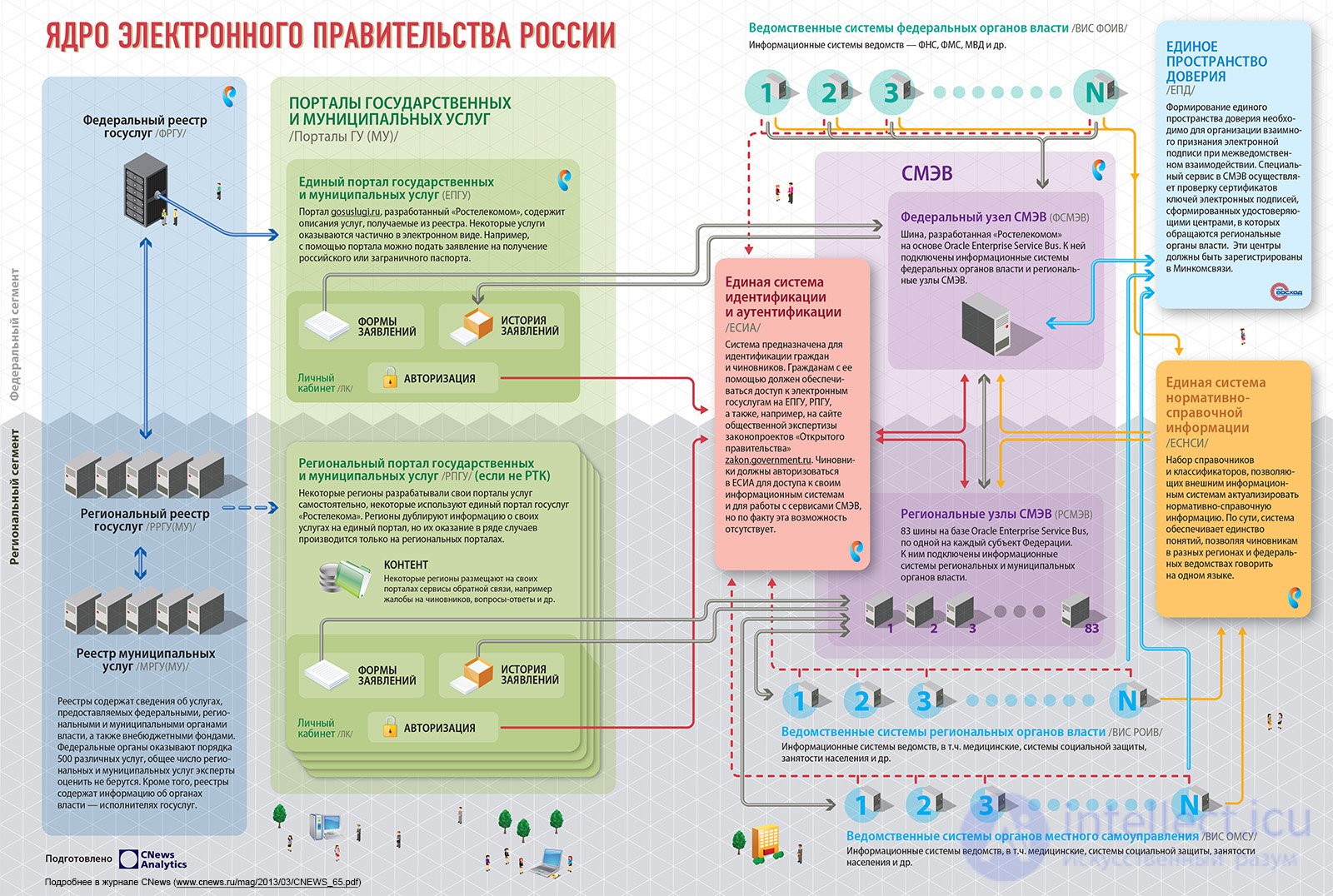
Fig. 2 the core of the state government
2019: Ministry of Economic Development proposes separating «state» and «municipal» data
On October 18, 2019, TAdviser learned that the Ministry of Economic Development of the Russian Federation had proposed a number of amendments to the Federal Law «On Information, Information Technologies and the Protection of Information». Among the proposed changes, notable is the proposal to introduce such concepts as «state» and «municipal data», and, in addition to them, the concepts of «harmonization», «systematization» and «anonymization of information». In addition, it is proposed to supplement the law with two articles regulating the creation of the so-called «Unified Information Platform» and «Unified System of Regulatory Reference Information».
Ministry of Economic Development
State or municipal data is understood to mean «data contained in state (municipal) information systems, or data managed by state authorities (local self-government bodies), including in paper form».
The Unified Information Platform will have to include a register of types of state and municipal data, as well as the official portal of the national data management system on the internet and «other state information resources determined by the Government of the Russian Federation.
Information in this unified information system will be publicly available, except for data whose access is restricted by current laws, but it is assumed that for some data «anonymization" will be mandatory, that is, it is intended to make it impossible «to determine, without using additional information, that the information belongs to a specific person, object or process».
As for «harmonization» — the description speaks of bringing data into conformity with one another «by applying the methods of such alignment established by this Federal Law»".
Further in the text of the bill it is explained that the «harmonization» process itself is carried out in three ways: either by full or partial copying of "reference state (municipal) data», or by using pointers to reference data, or by using a correspondence table between the identifiers of one set of state (municipal) data and the identifiers of another set of state (municipal) data. A combined method of such harmonization may also be used.
At the same time, persons whose rights and freedoms are affected by the harmonized data have the right to learn about this harmonization and to demand that the operator cancel it.
As for «reference» data, it is proposed that their composition be determined by regulatory acts of the Government of the Russian Federation or a federal executive authority authorized by it, as well as by the highest executive authorities of the constituent entities of the Russian Federation and local self-government bodies.
Evidently, as of October 2019 no such laws or legal acts yet exist.
«Ideally, all state and municipal information systems in the country should be brought to a fully uniform representation of data, both in terms of content and in terms of format. Technically this can and should be achieved through the competent use of metadata. From the proposed amendments to the law it follows that the composition of «reference» data may be defined differently at different levels, and this is fraught with problems for the unification of data in the future. On the other hand, one should first see the draft laws that regulate in more detail the procedure for harmonizing and systematizing data in state and municipal information systems, believes Dmitry Gvozdev, general director of the company «Information Technologies of the Future" »
Systematization of data in state and municipal information systems, according to the description, implies ordering them by the similarity or difference of their inherent characteristics and unifying structural elements. In other words, bringing them to a single representation format.
The Unified System of Regulatory Reference Information, in turn, will include all Russia-wide classifiers of technical, economic and social information, as well as «federal information resources... used as reference information (directories and classifiers) for other state (municipal) information resources».
All reference information included in this unified system will be regarded as reference state data.
The text of the draft law is available on the Federal Portal of Draft Regulatory Legal Acts.
In art
1) ASGU (Automatic System of State Governance), also known as OGAS (National Automated System for Accounting and Processing of Information) — ASGU (OGAS) is a strong artificial intelligence built on an embedded theory of control, uniting and closing upon itself the entire communications network, including the Russian internet, FidoNet, and remote means of controlling satellites, drones, combat drones, escalators, nuclear missile silos, cash registers, alarm clocks, industrial robots and Pokemon. It carries out the economic planning of the USSR 2.0 and the development of peacekeeping bombing missions beyond its borders.
The warranty period of ASGU ends in 2032, after which the system will need comprehensive treatment from psychiatrists.
ASGU is a virtual-technical character from Victor Argonov's opera «2032: The Legend of the Unrealized Future», on the basis of which the imageboard iichan.ru (Ychan) created the fantastical techno-mascot ASGU-tyan (or simply ASGU), representing her moe anthropomorphization. ASGU exists in an alternate history where the USSR survived as a technical superpower and is in effect governed by an artificial intelligence under the control of the general secretary. An attempt to destroy the USA, proposed by ASGU due to an error in calculations (or due to ASGU's own troubled feelings), leads to a retaliatory nuclear strike, and a worldwide nuclear winter sets in. ASGU most likely perishes.

ASGU's avatar on the central monitor of the USSR government
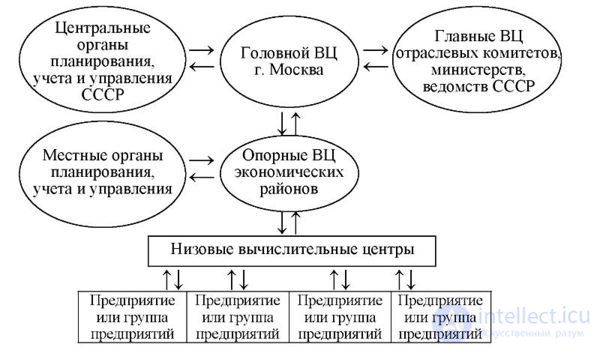
A dull vertical power hierarchy has been built for ASGU
2) 1984 (novel) Oceania is a state with a cruel totalitarian system. Its inhabitants are deprived of civil rights and individuality. In the party's society, besides the cult of personality of Big Brother and unquestioning obedience to the authorities, everyone is required to hold puritanical views, and all young people are encouraged to join the so-called Junior Anti-Sex League, where they are instilled with a revulsion for sexual relations and love. Love is a thoughtcrime, and marriages are contracted solely for reproductive purposes. However, the party plans over time to eliminate this remaining scrap of personal space as well, having developed a medical method of eliminating the human's physiological need for amorous intimacy, with a subsequent transition to conception via artificial insemination.
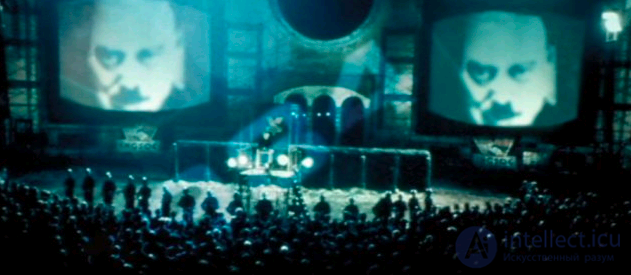
Telescreens in Victory Square. Still from the film «1984»
In Oceania a strict social hierarchy prevails. The population of Oceania numbers approximately 300 million people, of whom only 45 million are Party members. There is no parliament or government; all power is concentrated in the hands of the Ingsoc party, which is divided into the Outer Party and the Inner Party. The highest social caste is the Inner Party, which includes the senior officials of the ministries and the rest of Oceania's top leadership. All the power and wealth of Oceania is concentrated in the hands of the Inner Party. Unlike the almost destitute members of the Outer Party, members of the Inner Party receive higher salaries and have access to such rare goods as tea, white bread and sugar, as well as to items the Outer Party members have no access to at all, such as milk, real coffee, wine and fruit. Inner Party members make up approximately 2% of all Oceania's inhabitants. The middle caste is the Outer Party, which included countless nomenklatura workers and lower-ranking Party members. Members of the Outer Party live in poverty and are constantly under the surveillance of the Thought Police. Outer Party members make up approximately 13% of all Oceania's inhabitants.
Telecran (also monitor or telescreen) — a device combining a single-channel television with a video camera that cannot be switched off. In every room ever visited by Party members there was a dedicated telecran, through which broadcasts were transmitted around the clock and people were kept under surveillance. Telecrans were almost entirely absent from the homes of proles (non-Party members), while in the homes of Inner Party members, although mandatory, they were fitted with a switch that could be used for no more than half an hour a day.
See also
- [[b4271]]
- [[b8711]]
- [[b9468]]
- E-economy
- E-government
- Electronic money
- Expert Center for Electronic State
- Bitnation
- E-economy
- E-state
- Electronic money
- Single window
- Information society
- Public Services Portal of the Russian Federation
- E-Government Portal of the Republic of Kazakhstan
- Social rating in China
- Digital dictatorship
- Social credit system
See also


Comments