
Lecture
At the first stage of computer-based modelling — building the conceptual model of the system S and its formalisation — the model is formulated and its formal scheme is constructed, i.e. the principal purpose of this stage is the transition from a substantive description of the object to its mathematical model, in other words, the process of formalisation. Modelling of systems on a computer, at the present time, — is the most universal and effective method for evaluating the characteristics of large systems. The most critical and least formalised aspects of this work are drawing the boundary between the system
S and the external environment E, simplifying the description of the system, and first constructing
the conceptual model and then the formal model of the system. The model must be
adequate, otherwise it is impossible to obtain positive modelling results, i.e. studying the operating process of the system on an inadequate
model loses all meaning entirely. By an adequate model we shall understand a model which, to a certain degree of approximation at the level of the model developer's understanding of the system S being modelled, reflects the process of its operation in the external environment E.
Transition from the description to the block model. It is most rational to build the model of the system's operation on the block principle. Here, three autonomous groups of blocks of such a model can be distinguished:
the blocks of the first group represent a simulator of the actions of the external environment E on the system S;
the blocks of the second group are themselves the model of the process
of the operation of the system S under study;
the blocks of the third group — are auxiliary and serve for the computer implementation of the blocks of the first two groups, as well as for recording and
processing the modelling results.
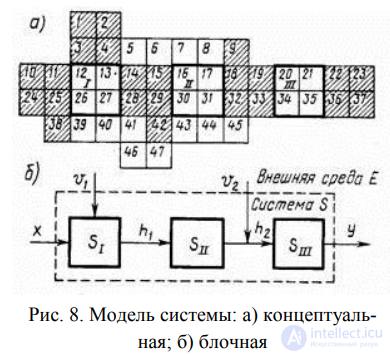
Let us consider the mechanism of the transition from a description of the operating process of some hypothetical system to a model of that process. For the sake of clarity, let us introduce a representation of the description of the properties of the operating process
of the system S, i.e. of its conceptual
model as a set of certain
elements, conventionally depicted
as squares, as shown in Fig. 8
a. These squares represent
a description of certain subprocesses of the operating process of the system S under study, of the actions of the external
environment E, etc. The transition from the description of the system to its model, in this interpretation, reduces to excluding certain secondary elements of the description from consideration (elements 5 — 8, 39 —
41,43 — 47).
It is assumed that they do not have a significant effect on the course
of the processes studied with the aid of the model. Some of the elements (14, 15, 28, 29,
42) are replaced by passive links
1 h , reflecting the internal properties of the system (Fig. 8 b). Some of the elements (1 — 4, 10, 11, 24, 25) are replaced
by input factors
x
and the actions of the external environment
υ1
. Combined replacements are also possible: elements 9, 18, 19, 32, 33 are replaced by the passive link
2 h
and the action of the external environment E. Elements 22, 23,36,37 reflect the action
of the system on the external environment
y .
The remaining elements of the system S are grouped into blocks SI
, SII, SIII, reflecting the operating process of the system under study. Each of these
blocks is autonomous, which is expressed in the minimal number of links between
them. The behaviour of these blocks must be well studied, and for each of
them a mathematical model must be built, which in turn may contain a number of subblocks. The block model of the operating process
of the system under study is intended for the analysis of the characteristics of this proFig. 8. Model of the system: a) conceptual; b) block
cess, which can be carried out through the computer implementation of the resulting
model.
Mathematical models of processes. After the transition from the description of the system S being modelled to its model M, built on the block principle,
it is necessary to build mathematical models of the processes occurring in
the various blocks. A mathematical model is a set of
relations that determine the characteristics of the operating process of the system S as a function of the structure of the system, the algorithms of its behaviour, the parameters of the system, the actions of the external environment E, the initial conditions, and time.
A mathematical model is the result of the formalisation of the operating process of the system under study, i.e. of constructing a formal (mathematical) description of the process to the degree of approximation
to reality required within the scope of the study being conducted.
To illustrate the possibilities of formalisation, let us consider the process
of the operation of some hypothetical system S, which can be divided into m subsystems with characteristics
y (t) y (t) y (t) nY
, , ..., 1 2
with parameters
nH
h1
, h2
, ..., h
in the presence of input actions
nX
x , x , ..., x 1 2
and actions of the external environment
nV
υ1
,υ2
, ...,υ . Then the mathematical model of the process can be given by
a system of relations of the form
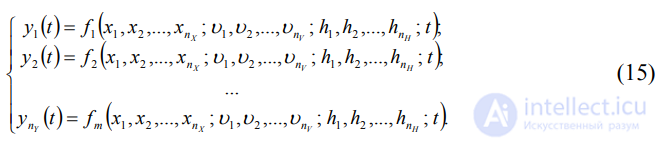
If the functions
m
f , f , ..., f
1 2
were known, then relations (15) would be an ideal mathematical model of the operating process of the system S. In practice, however, obtaining a model of a sufficiently simple form is
most often impossible for large systems, so the operating process of the system S is usually broken down into a number of elementary subprocesses. Here
the breakdown into subprocesses must be carried out in such a way that building the models of the individual subprocesses is elementary and does not cause difficulties in
formalisation. Thus, at this stage the essence of the formalisation of the subprocesses consists in selecting standard mathematical schemes. For example,
for stochastic processes these may be the schemes of probabilistic automata
(P-schemes), queueing schemes (Q-schemes), etc., which describe with sufficient accuracy the main features of the real phenomena making up
the subprocesses, from the point of view of the applied problems being solved.
Thus, the formalisation of the operating process of any system S must be preceded by a study of the phenomena that make it up. As a result, a substantive description of the process is obtained, which represents
the first attempt to clearly set out the regularities characteristic of the process under study, and the statement of the applied problem. The substantive description is the source material for the subsequent stages of formalisation:
building a formalised scheme of the operating process of the system and
the mathematical model of this process. To model the operating process of the system on a computer, it is necessary to convert the mathematical model of the process into a corresponding modelling algorithm and computer program.
Sub-stages of the first stage of modelling. Let us consider in more detail
the main sub-stages of building the conceptual model M of the system and its formalisation (see Fig. 7).
1.1. Statement of the problem of computer-based modelling of the system. A
clear formulation is given of the problem of studying a specific system S, and the main
attention is paid to such questions as: a) recognising the existence of the problem and
the need for computer-based modelling; b) choosing the method for solving the problem
taking into account the available resources; c) determining the scale of the problem and the possibility
of breaking it down into subproblems.
It is also necessary to answer the question of the priority of solving the various subproblems, and to evaluate the effectiveness of the possible mathematical methods
and software and hardware tools for solving them. Careful working-through of these
questions makes it possible to formulate the research problem and proceed to its imple-
mentation. In doing so, a revision of the initial statement of the problem is possible in the course of modelling.
1.2. Analysis of the system modelling problem. Carrying out an analysis of the problem helps to overcome difficulties that arise later in its
solution by the modelling method. At this second stage under consideration, the main
work consists precisely in carrying out the analysis, including: a) choosing the criteria
for evaluating the effectiveness of the operating process of the system S; b) determining
the endogenous and exogenous variables of the model M; c) choosing the possible methods
of identification; d) carrying out a preliminary analysis of the content of the second
stage of algorithmisation of the system model and its computer implementation; e) carrying out a preliminary analysis of the content of the third stage of obtaining and interpreting the results of system modelling.
1.3. Determining the requirements for the initial information on the object
of modelling and organising its collection. After the modelling problem for the system S has been stated, the requirements are determined for the information from which are obtained
the qualitative and quantitative initial data necessary for solving
this problem. This data helps to gain a deep understanding of the essence of the problem and the methods for solving it. Thus, at this sub-stage the following is carried out: a) selecting the necessary information about the system S and the external environment E; b) preparing a priori
data; c) analysing the available experimental data; d) choosing the methods and
means of preliminary processing of information about the system.
It must be remembered that it is precisely the quality of the initial information about the object of modelling on which the adequacy
of the model and the reliability of the modelling results substantially depend.
1.4. Putting forward hypotheses and adopting assumptions. Hypotheses, when
building the model of the system S, serve to fill the «gaps» in the understanding
of the problem by the researcher. Hypotheses are also put forward regarding the possible
results of modelling the system S, the validity of which is verified
in carrying out a computer experiment. Assumptions presuppose
that certain data are unknown or cannot be obtained. Assumptions may
be put forward regarding known data that do not meet the requirements for solving the problem posed. Assumptions make it possible to carry out simplifications of the model in accordance with the chosen level of modelling.
When putting forward hypotheses and adopting assumptions, the following are taken into account:
factors: a) the amount of information available for solving the problems; b) the subproblems
for which the information is insufficient; c) constraints on the time resources for
solving the problem; d) the expected results of the modelling.
Thus, in the process of working with the model of the system S, repeated return to this sub-stage is possible, depending on the modelling results obtained and new information about the object.
1.5. Determining the parameters and variables of the model. Before proceeding to the description of the mathematical model, it is necessary to determine the parameters
of the system
hk
, nH
k =1,
, the input and output variables
i
x , nX
i =1, ,
j
y , nY
j =1, ,
the actions of the external environment
υ l
, V
l =1, n . The ultimate goal of this sub-stage is preparation for building the mathematical model of the system S operating in the external environment E, for which it is necessary to consider all the parameters and variables of the model and to assess the degree of their influence on the operating process of the system as a whole. The description of each parameter and variable
must be given in the following form: a) a definition and brief description;
b) the notation symbol and unit of measurement; c) the range of variation; d) the place
of application in the model.
1.6. Establishing the basic content of the model. At this sub-stage
the basic content of the model is determined and the method of building the system model is chosen; these are developed on the basis of the hypotheses and assumptions adopted. In doing so, the following features are taken into account: a) the formulation of the system modelling problem; b) the structure of the system S and the algorithms of its behaviour, the actions of the external environment E; c) the possible methods and means for solving
the modelling problem.
1.7. Justification of the criteria for evaluating the effectiveness of the system. To
evaluate the quality of the operating process of the system S being modelled, it is neces-
sary to choose a certain set of criteria for evaluating effectiveness, i.e. in the
mathematical formulation the problem reduces to obtaining a relation for
evaluating the effectiveness as a function of the parameters and variables of the system. This
function represents a response surface in the region of variation of the parameters and variables under study, and makes it possible to determine the response of the system.
The effectiveness of the system S can be evaluated using integral or partial criteria, the choice of which depends on the problem under consideration.
1.8. Determining the approximation procedures. To approximate the real processes taking place in the system S, three types of
procedures are usually used: a) deterministic; b) probabilistic; c) determining mean
values.
With the deterministic procedure, the modelling results are uniquely determined by a given set of input actions, parameters, and variables of the system S. In this case there are no random elements
affecting the modelling results. The probabilistic procedure is applied when random elements, including the actions of the external environment E, affect the characteristics of the operating process of the system S, and when it is necessary to obtain information on the distribution laws of the output variables. The procedure for determining mean values is used when
in modelling the system, interest lies in the mean values of the output variables in the presence of random elements.
1.9. Description of the conceptual model of the system. At this sub-stage of building the system model: a) the conceptual model is described in abstract terms and concepts; b) a description of the model is given using standard mathematical schemes; c) the hypotheses and assumptions are finally adopted; d) the choice of the procedure for approximating the real processes in building the model is justified. Thus, at this sub-stage
a detailed analysis of the problem is carried out, the possible methods for solving it are considered, and
a detailed description of the conceptual model is given, which is then used
at the second stage of modelling.
1.10. Verifying the validity of the conceptual model. After the
conceptual model has been described, it is necessary to verify the validity of certain concepts of the model before moving on to the next stage of modelling the system S. Verifying the validity of the conceptual model is fairly difficult, since the process of building it is heuristic, and such a
model is described in abstract terms and concepts. One of the methods for verifying the model — the use of reverse-transition operations, which makes it possible to analyse the model, return to the accepted approximations and, finally, again consider the real processes taking place in the system S being modelled.
Verifying the validity of the conceptual model must include: a) checking
the concept of the model; b) evaluating the reliability of the initial information; c) reviewing the statement of the modelling problem; d) analysing the approximations adopted;
e) examining the hypotheses and assumptions.
Only after a thorough verification of the conceptual model should one proceed to the stage of computer implementation of the model, since errors in the model do not
allow reliable modelling results to be obtained.
1.11. Preparing the technical documentation for the first stage. At the
end of the stage of building the conceptual model and its formalisation, a technical report on the stage is drawn up, which includes: a) a detailed statement of the problem of modelling the system S; b) an analysis of the system modelling problem; c) the criteria for evaluating the effectiveness of the system; d) the parameters and variables of the system model; e) the hypotheses and assumptions adopted in building
the model; f) a description of the model in abstract terms and concepts; g) a description
of the expected results of modelling the system S.

Comments