
Lecture
At present, the systems approach has developed for the analysis and synthesis of complex (large) systems. It differs from the classical (or inductive) approach in that it considers the system by moving from the particular to the general and synthesises (constructs) the system by merging its components, which are developed separately. In contrast, the systems approach presupposes a sequential transition from the general to the particular, in which the consideration is based on a goal, and the object under study is separated out from the surrounding environment.
Let us introduce the following definitions. System S is a goal-directed set of interrelated elements of any nature. External environment E is a set of elements of any nature existing outside the system that influence the system or are under its influence. Depending on the aim of the study, different relationships between the object S itself and the external environment E may be considered. Depending on the level at which the observer is situated, the object of study may be delimited in different ways, and various interactions of this object with the external environment may take place.
The object itself is continuously becoming more complex, and it has already become common to speak of the object of study as a certain complex system consisting of various components interrelated with one another. Therefore, in considering the systems approach as the basis for building large systems and as the foundation for creating a methodology for their analysis and synthesis, it is first of all necessary to define the very concept of the systems approach.
The systems approach — an element of the doctrine on the general laws of the development of nature and one of the expressions of dialectical doctrine. Various definitions of the systems approach can be given, but the most correct one is that which makes it possible to assess the cognitive essence of this approach when applied to such a method of investigating systems as modelling. Therefore, it is very important to identify the system S itself and the external environment E from objectively existing reality, and to describe the system from general systems positions.
In the systems approach to modelling systems, it is necessary first of all to clearly define the aim of the modelling. Since it is impossible to fully model a really functioning system (the original system, or the first system), a model (the model-system, or the second system) is created for the problem posed. Thus, with respect to modelling questions, the aim arises from the required modelling tasks, which makes it possible to approach the choice of a criterion and to assess which elements will be included in the model M being created. Therefore, it is necessary to have a criterion for selecting individual elements for inclusion in the model being created.
Important for the systems approach is the definition of the structure of the system — the set of connections between the elements of the system, reflecting their interaction. The structure of the system may be studied from the outside, from the point of view of the composition of individual subsystems and the relations between them, and also from the inside, when individual properties are analysed that allow the system to achieve a given goal, i.e. when the functions of the system are studied. In accordance with this, a number of approaches to studying the structure of the system together with its properties have emerged, among which the structural and functional approaches should be included.
In the structural approach, the composition of the identified elements of the system S and the connections between them are revealed. The set of elements and the connections between them makes it possible to judge the structure of the system. The latter, depending on the aim of the study, may be described at different levels of consideration. The most general description of the structure — is the topological description, which makes it possible to determine the constituent parts of the system in the most general terms and which is well formalised on the basis of graph theory. Less general is the functional description, in which individual functions, i.e. the algorithms of the system's behaviour, are considered, and the functional approach is implemented, evaluating the functions performed by the system, a function being understood as a property that leads to the achievement of the goal.
It should be noted that the model M being created, from the point of view of the systems approach, is also a system, i.e. S' = S'(M), and may be considered in relation to the external environment E. The simplest in representation are models in which a direct analogy of the phenomenon is preserved. Models are also used in which there is no direct analogy, but only the laws and general regularities of the behaviour of the elements of system S are preserved. A correct understanding of the relationships both within the model M itself and of its interaction with the external environment E is largely determined by the level at which the observer is situated. A simple approach to studying the relationships between individual parts of the model involves considering them as a reflection of the connections between individual subsystems of the object. This classical approach can be used in creating sufficiently simple models. The process of synthesising the model M on the basis of the classical (inductive) approach is shown in Fig. 1 (a).
The real object to be modelled is broken down into individual subsystems, i.e. the initial data D for modelling are selected, and goals G are set, reflecting individual aspects of the modelling process. For a given set of initial data D, the aim of modelling a particular aspect of the system's functioning is set, and on the basis of this aim, a certain component C of the future model is formed. The set of components is combined into the model M.
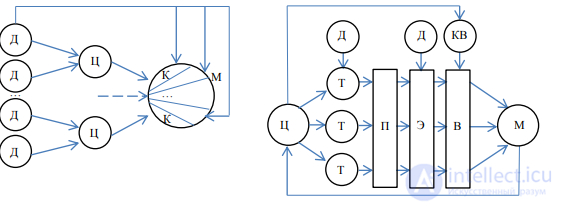
a) classical b) systems
Fig. 1. The process of model synthesis based on different approaches
Thus, developing the model M on the basis of the classical approach means summing individual components into a single model, with each of the components solving its own particular tasks and being isolated from the other parts of the model. Therefore, the classical approach can be used to implement comparatively simple models in which it is possible to separate and independently consider individual aspects of the functioning of the real object. For a model of a complex object, such disjointedness of the tasks being solved is unacceptable, since it leads to considerable expenditure of resources when implementing the model using specific software and hardware. Two distinctive features of the classical approach can be noted: there is movement from the particular to the general, and the model (system) being created is formed by summing its individual components, without taking into account the emergence of a new system effect. The systems approach makes it possible to solve the problem of building a complex system, taking into account all factors and possibilities in proportion to their significance, at all stages of studying the system S and building the model M.
The systems approach means that every system S is an integrated whole even when it consists of separate, disjointed subsystems. Thus, the systems approach is based on considering the system as an integrated whole, and this consideration, in the course of development, begins with the main thing — the formulation of the goal of functioning. The process of synthesising the model M on the basis of the systems approach is shown schematically in Fig. 1 (b). On the basis of the initial data D, which are known from the analysis of the external system, the constraints imposed on the system from above, or arising from the possibilities of its implementation, and on the basis of the goal of functioning, the initial requirements
R to the model of system S are formulated. On the basis of these requirements, certain subsystems P and elements El are approximately formed, and the most complex stage of synthesis is carried out — the selection V of the system's components, for which special selection criteria SC are used. When modelling, it is necessary to ensure maximum efficiency of the system model. Efficiency is usually defined as a certain difference between some indicators of the value of the results obtained from operating the model, and the costs that were invested in its development and creation. Modelling is based on the theory of similarity, which asserts that absolute similarity can occur only when one object is replaced by another exactly identical to it. In modelling, absolute similarity does not occur, and the aim is for the model to reflect sufficiently well the aspect of the object's functioning under study. As one of the first criteria for classifying types of modelling, the degree of completeness of the model can be chosen, and models can be divided according to this criterion into complete, incomplete and approximate.
Complete modelling is based on complete similarity, which manifests itself both in time and in space. Incomplete modelling is characterised by incomplete similarity of the model to the object under study. Approximate modelling is based on approximate similarity, in which some aspects of the functioning of the real object are not modelled at all. A classification of the types of modelling of systems S is given in Fig. 2.
Depending on the nature of the processes being studied in the system S, all types of modelling can be divided into deterministic and stochastic, static and dynamic, discrete, continuous and discrete-continuous. Deterministic modelling reflects deterministic processes, i.e. processes in which the absence of any random influences is assumed; stochastic modelling reflects probabilistic processes and events. In this case, a series of realisations of the random process is analysed, and average characteristics are evaluated, i.e. a set of homogeneous realisations.
Static modelling serves to describe the behaviour of an object at a particular moment in time, while dynamic modelling reflects the behaviour of an object over time. Discrete modelling serves to describe processes that are assumed to be discrete; correspondingly, continuous modelling makes it possible to reflect continuous processes in systems, while discrete-continuous modelling is used in cases where it is desired to highlight the presence of both discrete and continuous processes. Depending on the form of representation of the object (system S), mental and real modelling can be distinguished. Mental modelling is often the only way of modelling objects that are either practically unrealisable within a given time interval, or exist outside conditions possible for their physical creation. For example, on the basis of mental modelling, many situations in the microworld that do not lend themselves to physical experiment can be analysed. Mental modelling can be implemented in the form of visual, symbolic and mathematical modelling. In visual modelling, on the basis of a person's conceptions of real objects, various visual models are created, reflecting
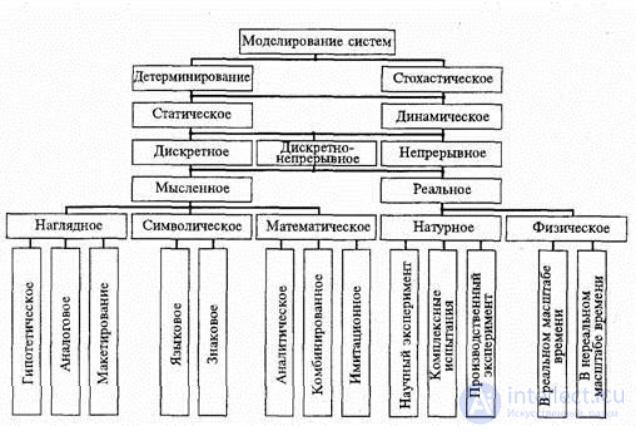
Fig. 2. Classification of types of modelling of systems phenomena and processes occurring in the object.
The basis of hypothetical modelling is a certain hypothesis, formulated by the researcher, about the regularities of the process occurring in the real object, which reflects the researcher's level of knowledge about the object and is based on cause-and-effect relationships between the input and output of the object under study.
Hypothetical modelling is used when knowledge about the object is insufficient for building formal models. Analogue modelling is based on the application of analogies of various levels. The highest level is full analogy, which occurs only for sufficiently simple objects. As the object becomes more complex, analogies of subsequent levels are used, in which the analogue model reflects several, or only one, aspect of the object's functioning. Mock-up construction occupies a significant place in mental visual modelling. A mental mock-up can be used in cases where the processes occurring in the real object do not lend themselves to physical modelling, or it may precede the carrying out of other types of modelling. The construction of mental mock-ups is also based on analogies, but these are usually based on cause-and-effect relationships between phenomena and processes in the object. If conventional designations for individual concepts, i.e. signs, are introduced, together with certain operations between these signs, then sign (symbolic) modelling can be implemented, and by means of signs a set of concepts can be represented — forming individual chains of words and sentences.
Using the operations of union, intersection and complementation from set theory, a description of some real object can be given in individual symbols. Linguistic modelling is based on a certain thesaurus. The latter is formed from a set of constituent concepts, and this set must be fixed. It should be noted that there are fundamental differences between a thesaurus and an ordinary dictionary. A thesaurus — is a dictionary that has been purged of ambiguity, i.e. in it each word can correspond to only a single concept, whereas in an ordinary dictionary one word may correspond to several concepts. Symbolic modelling is an artificial process of creating a logical object that replaces the real one and expresses the essential properties of its relations by means of a particular system of signs or symbols.
In order to study the characteristics of the operating process of any system S by mathematical methods, including computer-based ones, this process must be formalised, i.e. a mathematical model must be constructed. By mathematical modelling we shall understand the process of establishing a correspondence between a given real object and a certain mathematical object, called a mathematical model, and the study of this model, which makes it possible to obtain the characteristics of the real object under consideration. The type of mathematical model depends both on the nature of the real object and on the objectives of studying the object and the required reliability and accuracy of solving this problem. Any mathematical model, like any other, describes the real object only with a certain degree of approximation to reality. Mathematical modelling for studying the characteristics of the operating process of systems can be divided into analytical, simulation and combined modelling. Analytical modelling is characterised by the fact that the operating processes of the elements of the system are written in the form of certain functional relations (algebraic, integro-differential, finite-difference, and so on) or logical conditions. An analytical model can be studied by the following methods: a) analytical, when the aim is to obtain explicit dependences in general form for the required characteristics; b) numerical, when, being unable to solve the equations in general form, the aim is to obtain numerical results for specific initial data; c) qualitative, when, without an explicit solution, some properties of the solution can be found (for example, assessing the stability of the solution). The most complete study of the system's operating process can be carried out if explicit dependences are known that relate the required characteristics to the initial conditions, parameters and variables of the system S.
However, such dependences can be obtained only for comparatively simple systems. As systems become more complex, studying them by the analytical method encounters considerable difficulties, which are often insurmountable. Therefore, wishing to use the analytical method, one resorts in this case to a substantial simplification of the original model, in order to be able to study at least the general properties of the system. Such a study of the simplified model by the analytical method helps to obtain approximate results for determining more precise estimates by other methods. Compared with the analytical method, the numerical method makes it possible to study a wider class of systems, but the solutions obtained are then of a particular character. The numerical method is especially effective when using a computer. In certain cases, the conclusions that can be drawn using a qualitative method of analysing the mathematical model may also be satisfactory for studying the system. Such qualitative methods are widely used, for example, in the theory of automatic control for assessing the effectiveness of various variants of control systems.
At present, methods of computer-based implementation for studying the characteristics of the operating process of large systems are widespread. To implement a mathematical model on a computer, a corresponding modelling algorithm must be constructed. In simulation modelling, the algorithm implementing the model reproduces the operating process of the system S over time, with the elementary phenomena making up the process being simulated while preserving their logical structure and the sequence of their occurrence in time, which makes it possible, from the initial data, to obtain information about the states of the process at particular moments in time, allowing the characteristics of the system S to be assessed. The main advantage of simulation modelling compared with analytical modelling is the possibility of solving more complex problems. Simulation models make it fairly simple to take into account such factors as the presence of discrete and continuous elements, non-linear characteristics of the system's elements, numerous random influences, and so on, which often create difficulties in analytical studies.
At present, simulation modelling — is the most effective method for studying large systems, and often the only practically available method of obtaining information about the behaviour of a system, especially at the design stage. Combined (analytical-simulation) modelling in the analysis and synthesis of systems makes it possible to combine the advantages of analytical and simulation modelling. In constructing combined models, a preliminary decomposition of the object's operating process into constituent sub-processes is carried out, and for those of them where it is possible, analytical models are used, while for the remaining processes simulation models are built. Such a combined approach makes it possible to cover qualitatively new classes of systems that cannot be studied using analytical or simulation modelling alone. Real modelling makes use of the possibility of studying various characteristics either on the real object as a whole, or on part of it. Such studies can be carried out both on objects operating under normal conditions and by organising special modes for assessing the characteristics of interest to the researcher (with other values of variables and parameters, on a different time scale, and so on). Real modelling is the most adequate, but its possibilities, given the peculiarities of real objects, are limited. For example, carrying out real modelling of an enterprise ACS (automated control system) will require, firstly, the creation of such an ACS, and secondly, conducting experiments with the controlled object, i.e. the enterprise, which in most cases is impossible. Let us consider the varieties of real modelling. Full-scale modelling is the term used for carrying out a study on the real object with subsequent processing of the experimental results on the basis of the theory of similarity.
When the object functions in accordance with the goal set, it becomes possible to identify the regularities governing the course of the real process. It should be noted that such varieties of full-scale experiment as the production experiment and complex trials possess a high degree of reliability. With the development of technology and the penetration deeper into the processes occurring in real systems, the technical equipment of modern scientific experiments is increasing. It is characterised by the widespread use of automation tools, the application of a great variety of information-processing tools, and the possibility of human intervention in the course of the experiment, and in accordance with this a new scientific direction has emerged — the automation of scientific experiments. The difference between an experiment and the real course of the process lies in the fact that individual critical situations may arise in it, and the limits of stability of the process can be determined. In the course of the experiment, new factors and disturbing actions are introduced into the process of the object's functioning. One of the varieties of experiment — complex trials, which can also be classed as full-scale modelling, in which, as a result of the repeated testing of products, general regularities regarding the reliability of these products, their quality characteristics, and so on, are revealed. In this case, modelling is carried out by processing and generalising data occurring within a group of homogeneous phenomena.
Alongside specially organised trials, full-scale modelling can also be realised by generalising the experience accumulated during the production process, i.e. one can speak of a production experiment. Here, on the basis of the theory of similarity, statistical material on the production process is processed and its generalised characteristics are obtained. Another type of real modelling is physical modelling, which differs from full-scale modelling in that the study is carried out on installations that preserve the nature of the phenomena and possess physical similarity. In the course of physical modelling, certain characteristics of the external environment are specified, and the behaviour of either the real object or its model is studied under given or artificially created external-environment influences. Physical modelling can proceed on a real or unreal (pseudo-real) time scale, and can also be considered without regard to time. In the latter case, the so-called «frozen» processes, which are fixed at a certain moment in time, are the subject of study. The greatest complexity and interest, from the point of view of the accuracy of the results obtained, is presented by physical modelling on a real time scale. From the point of view of the mathematical description of the object, and depending on its nature, models can be divided into analogue (continuous), digital (discrete) and analogue-digital (combined) models. An analogue model is understood to be a model that is described by equations relating continuous quantities. A digital model is understood to be a model that is described by equations relating discrete quantities represented in digital form. An analogue-digital model is understood to be a model that can be described by equations relating both continuous and discrete quantities.

Comments