
Lecture
The essence of computer-based modelling of a system consists in carrying out on
a computing machine an experiment with a model, which represents
a certain software package describing, formally and (or) algorithmically, the behaviour of the elements of system S in the process of its operation, i.e.
their interaction with each other and with the external environment E. Computer-based modelling is successfully applied in cases where it is difficult to clearly formulate
a criterion for evaluating the quality of the system's operation and its purpose does not lend itself
to full formalisation, since it allows combining the software and hardware
capabilities of a computer with a person's ability to think in informal categories.
User requirements for the model. The main requirements imposed on the model M of the operating process of system S are given below.
1. The completeness of the model must give the user the ability
to obtain the necessary set of estimates of the system's characteristics with the required
accuracy and validity.
2. The flexibility of the model must make it possible to reproduce various situations when varying the structure, algorithms and parameters of the system.
3. The duration of the development and implementation of the model of a large system
should be as short as possible, taking into account the constraints on the available resources.
4. The structure of the model must be modular (block-based), i.e. it must allow for
the replacement, addition and removal of certain parts without reworking the whole model.
5. The information support must provide the possibility
of the model working efficiently with the database of systems of a certain class.
6. Software and hardware must ensure an efficient (in terms of speed and memory) computer implementation of the model and convenient interaction between the user and the model.
7. Provision must be made for conducting purposeful (planned) computer experiments with the model of the system, using an analytical-simulation approach when computational resources are limited.
Taking these requirements into account, let us consider the main principles that
hold true when modelling systems S on a computer, as well as their subsystems and
elements. In computer-based modelling of system S, the characteristics of the process of
its operation are determined on the basis of a model M, built taking into account
the available initial information about the object being modelled. When new information about the object is obtained, its model is revised and refined with
regard to the new information, i.e. the modelling process, including the development and
computer implementation of the model, is iterative. This iterative
process continues until a model M is obtained that
can be considered adequate for solving the given problem of researching and designing system S.
Computer-based modelling of systems can be used in the following cases:
a) to study system S before it has been designed, in order
to determine the sensitivity of a characteristic to changes in the structure, algorithms and parameters of the object being modelled and of the external environment;
b) at the design stage of system S, for the analysis and synthesis of various
variants of the system and for selecting, among the competing variants, the one that
would satisfy the given criterion for evaluating the system's effectiveness under
the accepted constraints;
c) after the completion of the design and implementation of the system, i.e. during its
operation, to obtain information supplementing the results of full-scale
Fig. 7. Interrelation of the stages of system modelling
tests (operation) of the real system, and to obtain forecasts of the evolution (development) of the system over time.
There are general principles that apply to all of the aforementioned
cases of computer-based modelling. Even in cases where the specific
methods of modelling differ from one another and there are various modifications of models, for example in the area of the computer implementation of modelling
algorithms using specific software and hardware, in
the practice of system modelling it is possible to formulate general principles that can form the basis of a methodology for computer-based modelling.
Stages of system modelling. Let us consider the main stages of modelling system S, which include:
• construction of a conceptual model of the system and its formalisation;
• algorithmisation of the model of the system and its computer implementation;
• obtaining and interpreting the results of system modelling.
The interrelation of the listed stages of system modelling and their components (sub-stages) can be represented as a network diagram, shown in Fig. 7.
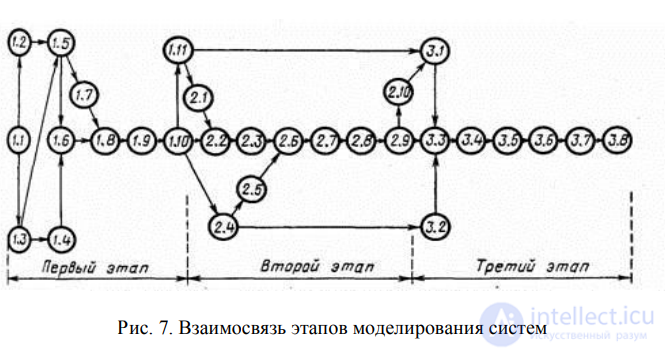
The decoding of the numerical designations is given below.
1.1 — formulation of the problem of computer-based modelling of the system;
1.2 — analysis of the system modelling problem;
1.3 —determination of the requirements for the initial information about the object being modelled and organisation of its collection;
1.4 — putting forward hypotheses and accepting assumptions;
1.5 — determination of the parameters and variables of the model;
1.6 — establishing the main content of the model;
1.7 — justification of the criteria for evaluating the effectiveness of the system;
1.8 — determination of approximation procedures;
1.9 — description of the conceptual model of the system;
1.10 — verification of the validity of the conceptual model;
1.11 — preparation of technical documentation for the first stage;
2.1 — construction of the logical scheme of the model;
2.2 — derivation of mathematical relations;
2.3 — verification of the validity of the model of the system;
2.4 — selection of tools for modelling;
2.5 — drawing up a plan for carrying out the programming work;
2.6 —specification and construction of the program flowchart;
2.7 — verification and validation of the program flowchart;
2.8 — carrying out the programming of the model;
2.9 — verification of the validity of the program;
2.10 — preparation of technical documentation for the second stage;
3.1 — planning the computer experiment with the model of the system;
3.2 — determination of the requirements for computing facilities;
3.3 — carrying out the working calculations;
3.4 — analysis of the results of system modelling;
3.5 — presentation of the modelling results;
3.6 — interpretation of the modelling results;
3.7 — summarising the modelling results and issuing recommendations;
3.8 — preparation of technical documentation for the third stage.
Thus, the process of modelling system S comes down to performing the listed sub-stages, grouped into three stages. At the stage of
constructing the conceptual model and formalising it, a study of the object being modelled is carried out from the point of view of identifying the main components of
the process of its operation; the necessary approximations are determined, and
a generalised scheme of the model of system S is obtained, which is converted into a computer model at the second stage of modelling through the sequential algorithmisation and programming of the model. The last, third, stage of system modelling comes down to carrying out, according to the resulting plan of working
calculations on the computer, using the selected software and hardware
facilities, obtaining and interpreting the results of modelling system S, taking
into account the influence of the external environment E. It is obvious that in constructing the model and
implementing it on a computer, when new information is obtained, a revision of previously made decisions is possible, i.e. the modelling process is iterative.

Comments