
Lecture 62 min.
In our course we are gradually moving from the simple to the complex. So far we have dealt mainly with the behavior of a single particle in various force fields and with the properties of those fields. But real physical systems consist of an unimaginably large number of particles, so even the most powerful computers cannot follow the motion of each of them. This entire part of the course is devoted to such (macroscopic) systems.
As is most often the case in physics, and not only in physics, at this point, at the very beginning, we cannot formulate a criterion for the macroscopic nature of a system. For example, the nucleus of the main isotope of uranium contains 238 nucleons; is that macroscopically many or not? Modern supercomputers can solve the dynamical problem (based on the equations of quantum mechanics) of the behavior of that many particles in a reasonable time. But what if there are NA = 6·1023 particles, as in one mole of an ideal gas? It is easy to estimate how much time a multiprocessor supercomputer with a speed of 1015 operations per second (a speed of 1 teraflop) would need to calculate the total kinetic energy of translational motion of the molecules of this gas by the formula
 .
.
Calculating each term requires two multiplications and one division; neglecting the differences in the duration of these operations, we will assume that there are simply three of them. Then the total number of operations needed to calculate this sum is about 1.8·1024, which would take 1.8·109 seconds, that is, more than 50 years. And this is despite the fact that, if the temperature of the gas is known and equal to T, the answer, with a relative error of no more than 10–10 %, has the form
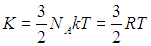
where R is the universal gas constant. It remains to find out what temperature is, where such a small error comes from, whether it is always this small, and many other questions to which this part of the course is devoted.
Science has developed two methods for studying the properties of matter and the physical phenomena associated with changes in the properties of macroscopic bodies: the molecular-kinetic and the thermodynamic. The two methods complement each other. In this part we will concentrate on the molecular-kinetic approach.
The molecular-kinetic approach. Molecular physics rests on two basic postulates:
In the first postulate, besides electrically neutral atoms and molecules, electrically charged particles — ions — are mentioned as particles of which matter can consist. First of all, this is the very important case of the plasma state of matter. According to available estimates, about 95 % of the visible matter in the Universe is in the plasma state. In addition, in solutions — for example, of table salt  in water — the dissolved substance exists in the form of ions
  and
and  ; furthermore, metals are a collection of positive ions oscillating about their equilibrium positions (the sites of the crystal lattice) and free electrons forming an electron gas. In what follows, the main attention will be paid to the "ordinary" state of matter, in which its constituent particles are electrically neutral. Plasma, as a special state of matter, solutions, and metals will be considered separately. The second postulate states: "in random, chaotic motion, which in the absence of external forces has no preferred direction". We note the following in this regard: in anisotropic crystals there are preferred directions, caused by the interaction of the particles making up the crystal and not related to external force fields. Consideration of such situations is beyond the scope of this chapter.
Molecular-kinetic theory sets itself the goal of interpreting those properties of matter that are directly observed in experiment (viscosity, thermal conductivity, etc.) as the total result of the action of molecules. In doing so it uses the statistical method, being interested not in the motion of each individual molecule, but only in those average quantities that characterize the motion and interaction of the whole collection of molecules. Molecular-kinetic theory here employs the fundamental laws of physics acting at the microscopic level — the laws of classical mechanics, electrodynamics, and so on. Therefore it is able to predict the values of many physical parameters of a system on the basis of what are called first principles. In this chapter we will derive the well-known laws for ideal gases on the basis of molecular-kinetic theory.
State of a system. In any branch of physics, the study of phenomena begins with singling out a collection of bodies, which is called a system.
|
A system is a definite, singled-out collection of physical bodies. The surroundings — everything else: all the bodies that are not part of the system but can influence its properties and behavior. |
Consider, for example, a gas (the system) in a closed cylinder under a piston (the surroundings), Fig. 1.1.
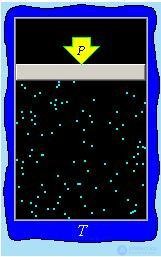
Fig. 1.1. Gas in a closed cylinder under a piston
Video 1.1. Gas pressure: welcome!
Video 1.2. The pressure of a gas on the wall of a vessel is due to collisions of molecules with the wall.
Changing the position of the piston or the temperature of the cylinder walls changes the state of the system.
|
The parameters of a system are the quantities that characterize the state of the system. |
The state of such simple systems as a gas is characterized by the following macroscopic parameters: volume  , pressure
  , and temperature
  . Naturally, parameters that define the system itself are also needed — its mass m, the relative molecular mass M (or the molar mass m).
In total, four quantities: volume  , pressure
  , temperature
  , and mass
  . Or, given the molar mass of the substance of the system
  , the number of moles
  . If the system is a mixture of different substances, then the relative concentrations of the components of the mixture must be added:
 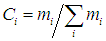 , where
  is the mass of substance number
  . Obviously, in the latter case there are more than four parameters.
Recall that
|
The relative molecular mass M is a dimensionless quantity equal to the ratio of the mass of a molecule of the given substance to 1/12 of the mass of a carbon atom 12C. |
|
A mole is the amount of a given substance whose mass, expressed in grams, is numerically equal to its relative molecular mass. |
Another — equivalent — definition of the mole states:
|
A mole is the amount of substance of a system that contains as many particles as there are atoms in 0.012 kilograms of carbon-12. |
Note that the modern definition of Avogadro's number states that Avogadro's number  is equal to the number of atoms of the isotope 12C contained in 0.012 kilograms of carbon-12. Thus, the mole can also be defined as follows:
|
A mole is the amount of substance that contains Avogadro's number
|
|
The molar mass (mass of a mole m) has the SI dimension kg/mol. |
When solving problems, the values of the relative molecular mass M of the elements are taken from the periodic table. The molar mass is easily calculated:
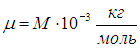
For example, for gold
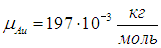
For compound substances one needs to perform simple arithmetic; for example, for carbon dioxide  :
:

In general, such parameters of a system as pressure, temperature, and density of the substance 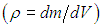 can have different values at different points of it. In this case definite values of these parameters cannot be assigned to the system as a whole; the system is in a nonequilibrium state. Experience shows, however, that if the external conditions are unchanged, then over time the system arrives at an equilibrium state: the pressures and temperatures of its individual parts equalize, so that the parameters of the system take definite values that remain constant for arbitrarily long times. The external conditions must be such that there is no transfer of matter, energy, momentum, etc. in the system.
For simplicity, consider a system whose total mass is constant, and whose composition and the relative concentrations of its constituent substances are also constant. This is the case, for example, when no chemical reactions occur in the system. In a more general formulation: there are no processes of creation and annihilation of its constituent particles in the system. For example, the reaction of formation of water molecules from oxygen and hydrogen molecules

can be regarded as a process of annihilation of the particles  and
and  and creation of the particles
  . In a number of cases, for example in a photon gas (thermal radiation), the presence of processes of creation and annihilation of particles is of fundamental importance.
Additional information
http://www.femto.com.ua/articles/part_2/4471.html — Physical Encyclopedia. Chemical potential: a physical quantity needed to describe the properties of thermodynamic systems with a variable number of particles;
http://www.femto.com.ua/articles/part_1/0017.html — Physical Encyclopedia. Avogadro's law;
http://marklv.narod.ru/mkt/mkt.htm — A school lesson with pictures on the molecular-kinetic hypothesis;
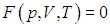
As will be seen later, only three parameters are sufficient for a complete description of the equilibrium state of such a system:  . Moreover, if the state is an equilibrium one, then a relation exists among these three parameters: any two given parameters of the system (for example, its temperature and volume) uniquely determine the third (in this case, the pressure). Mathematically this relation can be expressed by the equation of state of the system
 ,
,
where the specific form of the function F depends on the properties of the system. Examples are the Clapeyron–Mendeleev equation for an ideal gas and the van der Waals equation for a nonideal gas (these equations will be considered later).
Thus, for an equilibrium system with constant mass, composition, and relative concentrations of its constituent substances — in what follows we will not specify this each time — there are only two independent parameters, and its equilibrium state can be represented graphically by a point on a plane (Fig. 1.2), on whose axes any two of the three parameters are plotted —  ,
,  or
or  :
:
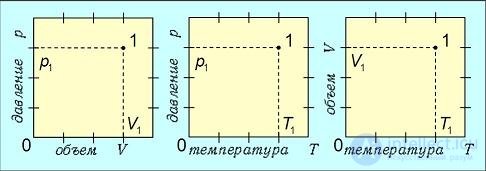
Fig. 1.2. Equilibrium states of a system on the (p, V), (p, T), and (V, T) diagrams
|
A process is any transition of a system from one state to another. |
A process is always associated with a violation of the thermodynamic equilibrium of the state of the system. For now, by a thermodynamically equilibrium state it is sufficient to understand a state in which all possible processes of energy exchange are absent: 1) no subsystem of the system does work on other subsystems; 2) no subsystem of the system exchanges heat with other subsystems of the system; 3) no subsystem of the system exchanges particles with other subsystems of the system. As will be seen later, there are no other kinds of energy exchange in ordinary systems (those in which there are no processes of creation and annihilation of particles). This ultimately implies that specifying just three independent parameters (for example: the number of particles, the volume, and the internal energy) is sufficient to describe the thermodynamically equilibrium state of a single-component system.
If the state of a system changes with time, then some process is taking place in the system. The converse, generally speaking, is not true: the state of a system may not change even though a process is going on in it — a stationary but nonequilibrium state of the system. For example, in a stationary process of heat transfer the state of the system is nonequilibrium, although it remains unchanged in the sense that the distributions of temperature, pressure, density, etc. over the volume of the system do not change.
If a process proceeds infinitely slowly, the state of the system can be considered to be in equilibrium at each given moment of time. Physically this means that the characteristic time of the process  is much greater than the time for equilibrium to be established in the system
  , which is also called the relaxation time. Such a process is called an equilibrium process.
|
An equilibrium process is an infinitely slow process in which, at each given moment of time, the state of the system is thermodynamically in equilibrium. |
Obviously, an equilibrium process is yet another idealization. For a process to be considered equilibrium — with some finite accuracy — the following inequality must hold

and the better it holds, the closer the process is to an equilibrium one.
An equilibrium process can be imagined as a sequence of equilibrium states. In what follows, only equilibrium processes will be studied (unless otherwise specifically stated).
Since the state of a system is represented by a point on a diagram, and a process is a sequence of equilibrium states, such a process is represented on the diagram by a line. Each point on the line is a conditionally equilibrium intermediate state of the system. An equilibrium process is a reversible process, that is, it can proceed in the reverse direction, passing through the same intermediate states in reverse order, with no changes remaining in the surrounding bodies.
|
A reversible process is a process that can proceed in the reverse direction, passing through the same intermediate states in reverse order, with no changes remaining in the surrounding bodies. |
Naturally, no forces similar to friction forces must then act in the system. Below we will become acquainted with diagrams describing some characteristic processes in thermodynamic systems.
Knowing the state of a system, we can find various state functions — physical characteristics that depend only on the state of the system, that is, they take the same values every time the system is in the given state, regardless of its history.
|
A state function is a physical characteristic that depends only on the state of the system and does not depend on how the system arrived at that state. |
Temperature. Any system possesses a certain store of internal energy, not associated with the position or motion of the system as a whole relative to the external environment. We will talk about internal energy in more detail later, but for now an intuitive understanding is enough: by throwing an egg at some speed we will not cook it, although the kinetic energy of the egg will increase. To make a soft-boiled egg, it must not be thrown but heated.
To characterize internal energy quantitatively, the concept of temperature is introduced. Temperature occupies a special place among physical quantities. Experience shows that it characterizes the state of thermal equilibrium of bodies. If two bodies with different temperatures are brought into contact, then as a result of interactions between molecules these bodies will exchange energy. After some time the temperatures will equalize and the transfer of heat will cease; a state of thermal equilibrium will set in. The state of thermal equilibrium is precisely the state into which any isolated system passes over time.
The usual methods of determining temperature are based on the dependence on it of a number of properties of bodies (volume, pressure, etc.). This requires choosing a thermometric body and calibrating the temperature scale. The most widespread is the centigrade scale (the Celsius scale, Fig. 1.3).
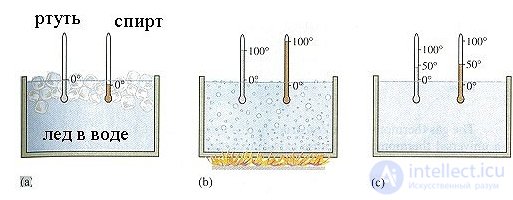
Fig. 1.3. The centigrade Celsius scale
The interval of this scale between the freezing point (crystallization of water or, equivalently, melting of ice) and the boiling point of water at normal atmospheric pressure is divided into 100 equal parts. Such a part is called a degree Celsius (denoted t °C). Thus, the crystallization point of water corresponds to 0 °C, and the boiling point to 100 °C. Let us stress that both of these hold at a normal pressure of 760 mm Hg. In the USA the Fahrenheit scale (denoted t °F). is also used. As the zero of his scale Fahrenheit chose the lowest temperature he could reproduce in his laboratory — the melting point of a mixture of salt and ice. The freezing point of water on this scale corresponds to 32 °F, and the boiling point to 212 °F. This interval is divided not into one hundred but into 180 parts (similar to angular degrees). Therefore a degree Fahrenheit is smaller than a degree Celsius (by a factor of 100/180 = 5/9). The relation between temperatures on these two scales is given by the formulas
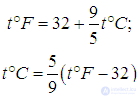
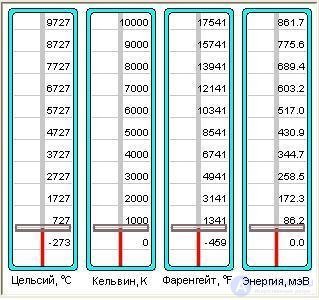
Fig. 1.4. Correspondence between the scales
In physics the thermodynamic scale of temperature (old name: absolute) is used  (the Kelvin scale), which does not depend on the thermometric body but is established on the basis of the laws of thermodynamics.
At present one kelvin is defined as follows: the kelvin is the unit of thermodynamic temperature equal to the  part of the thermodynamic temperature of the triple point of water. The triple point of water was chosen instead of its boiling point because the temperature of the triple point does not depend on pressure and is determined more accurately. On the Celsius scale the triple point of water corresponds to a temperature of
  . The size of one kelvin (denoted K) coincides with the size of a degree Celsius. Taking into account the indicated difference of 0.01 kelvin, for the relation between temperatures on the thermodynamic scale and on the centigrade Celsius scale we obtain
|
|
|
(1.1) |
Thus, absolute zero of temperature  corresponds on the centigrade scale to the temperature
 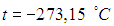 . As the second law of thermodynamics shows, a state with a temperature equal to absolute zero is experimentally unattainable, so zero on the Kelvin scale is the result of extrapolation.
Examples of characteristic temperatures in nature are shown in Fig. 1.5.
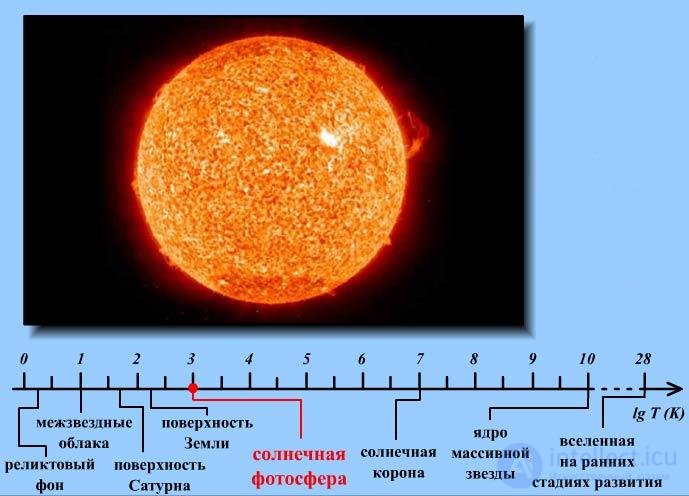
Fig. 1.5. Temperatures of various physical processes
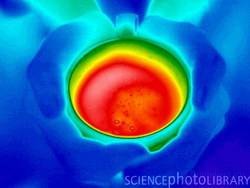
Fig. 1.6. Thermogram of a cup of hot tea
In this section we become acquainted with the equation of state of an ideal gas.
|
An ideal gas is a gas so rarefied that the interaction between its molecules can be neglected. |
Experiments have shown that under conditions not too different from normal (a temperature of the order of hundreds of kelvins, a pressure of the order of one atmosphere) the properties of real gases are close to those of an ideal gas.
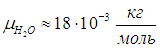
Example. Using water vapor as an example, let us show that under ordinary conditions the properties of real gases are close to those of an ideal gas. From the periodic table one can determine the molar mass of H2O:
The density of water in the liquid state
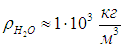
From this we can find the volume of one mole of water:
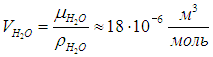
One mole of any substance contains the same number of molecules (Avogadro's number):
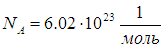
From this we obtain the volume V1 per water molecule:
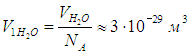
In the condensed state the molecules are packed tightly against one another, so in essence V1 is the volume of a water molecule, from which follows an estimate of its linear size (diameter):

On the other hand, it is known that the volume Vm of one mole of any gas under normal conditions is equal to
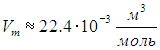
Therefore the volume per molecule of water vapor is
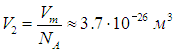
This means that the gas can be mentally cut into cubes with edge length

and each such cube will contain one molecule. In other words, L is the average distance between water vapor molecules. We see that L exceeds the molecular size D by an order of magnitude. Similar estimates are obtained for other gases, so with good accuracy one can assume that the molecules do not interact with one another, and under normal conditions the gas is ideal.
As already said, an equation of state of this form allows one thermodynamic parameter to be expressed in terms of two others. The specific form of this equation depends on which substance, and in which state of aggregation, is being considered. The equation of state of an ideal gas unites a number of experimentally established particular gas laws. Each of them describes the behavior of a gas provided that only two parameters change.
1. Boyle's Law — Mariotte. Describes a process in an ideal gas at constant temperature.
|
An isothermal process is a thermodynamic process that takes place at constant temperature. |
Boyle's law (also known as the Boyle–Mariotte law) states:
|
For a given mass of gas at constant temperature T = const, the product of the gas pressure and the volume it occupies is a constant quantity
|
An isothermal process is shown graphically in various coordinates in Fig. 1.7.
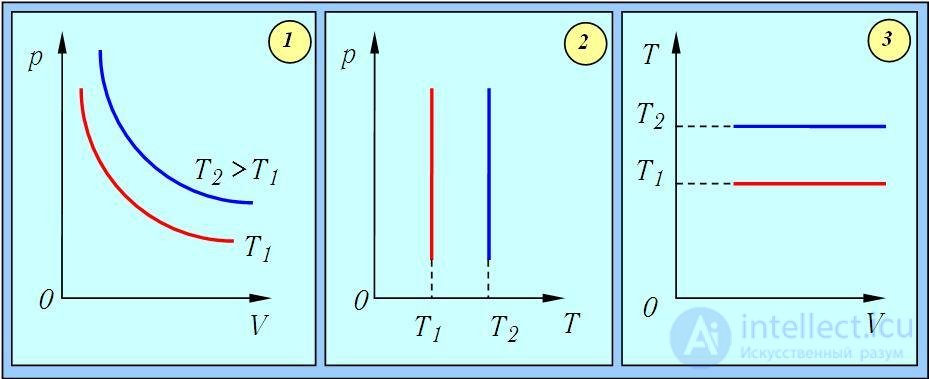
Fig. 1.7. Isothermal process in an ideal gas: 1 — in p – V coordinates; 2 — in p-T coordinates; 3 — in T – V coordinates
The curves shown in Fig. 1.7-1 are hyperbolas

which lie higher the higher the gas temperature is.
Video 1.3. Thermal explosion: isochoric heating of a gas is accompanied by a rise in pressure.
An experimental study of the Boyle–Mariotte law can be carried out with the apparatus shown in Fig. 1.8. In a cylinder kept at constant temperature (as seen from the thermometer reading), the gas volume changes as the piston is moved. The gas pressure is measured with a pressure gauge. The results of the pressure and volume measurements are plotted on a p = p(V) diagram.
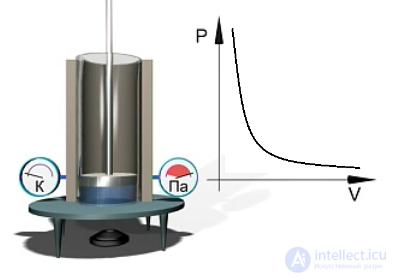
Fig. 1.8. Experimental study of an isothermal process in a gas
2. Gay-Lussac's law. Describes the thermal expansion of an ideal gas at constant pressure.
|
An isobaric process is a process that takes place at constant pressure. |
Gay-Lussac's law states:
|
The volume of a given mass of a particular gas at constant pressure is proportional to its absolute temperature
|
An isobaric process is shown graphically in various coordinates in Fig. 1.9.
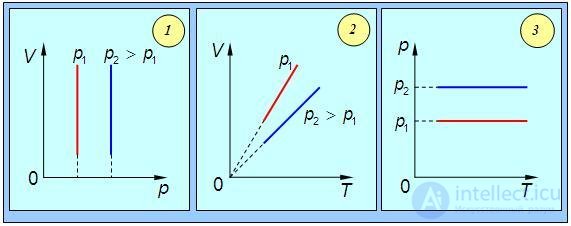
Fig. 1.9. Isobaric process in a gas: 1 — in p – V coordinates; 2 — in V – T coordinates; 3 — in P – T coordinates
An experimental study of Gay-Lussac's law can be carried out with the apparatus shown in Fig. 1.10. In a cylinder, the gas is heated with a burner. The gas pressure remains constant during heating, as seen from the pressure gauge reading. The gas temperature is measured with a thermometer. The results of the measurements of gas pressure and temperature are plotted on a V = V(T) diagram.
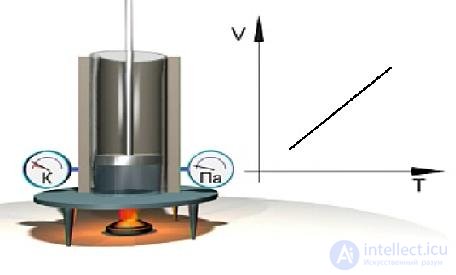
Fig. 1.10. Experimental study of an isobaric process in a gas
3. Charles's law. Describes the change in the pressure of an ideal gas with increasing temperature at constant volume.
|
An isochoric process is a process that takes place at constant volume. |
Charles's law states:
|
The pressure of a given mass of a particular gas at constant volume is proportional to its thermodynamic temperature
|
An isochoric process is shown graphically in various coordinates in Fig. 1.11.
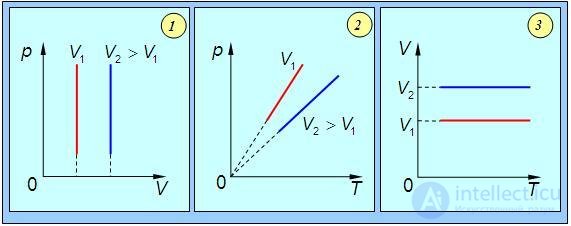
Fig. 1.11. Isochoric process in a gas: 1 — in p – V coordinates; 2 — in p – T coordinates; 3 — in V – T coordinates
An experimental study of Charles's law can be carried out with the apparatus shown in Fig. 1.12. In a cylinder, the gas occupies a constant volume (the piston is fixed). On heating, the gas pressure increases, and on cooling it decreases. The pressure is measured with a pressure gauge, and the gas temperature with a thermometer. The results of the measurements of gas pressure and temperature are plotted on a p=p(T) diagram.
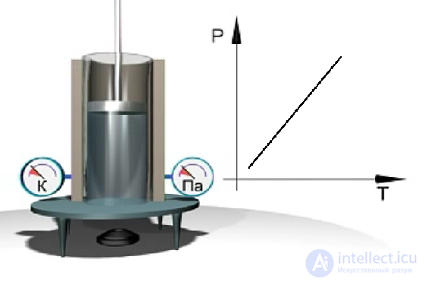
Fig. 1.12. Experimental study of an isochoric process in a gas
If we combine the particular gas laws considered above, we obtain the equation of state of an ideal gas (for one mole)
|
|
|
(1.5) |
which contains the universal gas constant R = 8.31 J/(mol· K). For the same values of the volume and temperature of the system, the gas pressure is proportional to the number of moles of the substance

Therefore, for an arbitrary mass of gas m the equation of state of an ideal gas (1.6) takes the form
|
|
|
(1.6) |
This equation is called the Clapeyron — Mendeleev equation.
In this section we move on to the molecular-kinetic description of an ideal gas.
In deriving the basic equation of the molecular-kinetic theory of gases, we will regard molecules as small hard spheres that, on average, are reflected perfectly elastically and specularly from the walls of the vessel. Interaction forces arise only when molecules collide with one another or with the walls of the vessel. Let us assign each molecule a number i (i = 1, 2, ..., N), where N — is the total number of molecules in the system.
Before proceeding directly to the calculation, let us explain why on average we not only may, but — under conditions of thermodynamic equilibrium — must regard the collisions of molecules with the wall as perfectly elastic and specular. "Perfectly elastic" means that, on average, the speed of a molecule after a collision with the wall equals its speed before the collision. "Specular" means that the angle of reflection of the molecule from the wall equals the angle of incidence of the molecule on the wall (the angles of incidence and reflection are defined as in optics: they are the angles between the normal to the wall and the velocity vector of the molecule). This is easily proved by contradiction. Earlier, the equilibrium state was defined, in particular, as one in which there are no flows of energy, momentum, angular momentum, etc. Consequently, if the gas and the wall of the vessel are in thermodynamic equilibrium with each other, there must be no flow of energy from the gas to the wall or from the wall to the gas. It is easy to see that if a gas molecule on average rebounds from the wall with a lower (higher) speed than it approached with, then the wall receives energy from the gas (gives energy to the gas), which is impossible at equilibrium. A contradiction does not arise only when, on average, these speeds are equal, that is, on average the collision is perfectly elastic (Fig. 1.13).
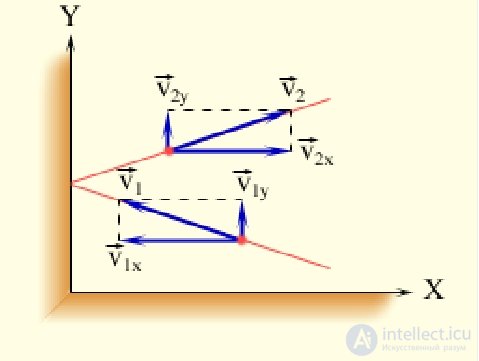
Fig. 1.13. Perfectly elastic collision of a molecule with a wall"
Let us emphasize that an exchange of energy between the gas and the vessel does not contradict the law of conservation of energy: whatever the gas received, the wall gave up, and vice versa. As will be seen later, such an energy exchange contradicts the second law of thermodynamics. The equality of the angles of incidence and reflection is proved in a similar way. If they are not equal, then angular momentum will be exchanged between the vessel and the gas. More simply, one can say this: the gas will spin itself up in one direction, and the vessel — with an angular momentum of equal magnitude — in the other, which is also not forbidden at all by the law of conservation of angular momentum, but contradicts the second law of thermodynamics. Since the second law of thermodynamics has not yet been formulated at this point, let us note that no one has ever seen such processes in experiment, and since there are no experimental grounds to doubt the validity of the second law of thermodynamics, no one ever will.
Above we have constantly emphasized: on average. This is because the "fate" of a particular individual molecule when it collides with the wall of the vessel can be anything. To understand this, one must "descend" from the macroscopic to the microscopic level of considering the process of collision of a gas molecule with the "wall". When we say the word "wall", we mean the interface between the gas (a rarefied state of matter, particle concentration ~1019 per cm3) and the wall (a dense — condensed — state of matter, particle concentration ~1022 per cm3).
Video 1.5. The behavior of a Brownian particle proves that collisions of molecules with the wall are perfectly elastic and specular only on average
Claiming only a purely qualitative description of far from all the processes occurring in the interaction of a gas molecule with a solid or liquid surface, let us consider just two possible cases.
Suppose, for example, that the vessel is made of iron; then iron ions oscillate about their equilibrium positions (the nodes of the crystal lattice). Suppose the vessel contains air, and let us follow some nitrogen molecule approaching the "wall". It will collide not with the wall "in general", but with a specific iron ion in the wall, at a certain stage of its oscillation. The velocity of the molecule relative to the wall is its velocity relative to the nodes of the crystal lattice — the equilibrium positions of the iron ions. If at the moment of collision the particular ion with which our molecule collides was moving toward it, then the relative velocity of the molecule and the ion will be greater than that of the molecule and the wall. Let us allow ourselves the following language: it will "give it a kick", and the molecule will fly off the wall with a speed greater than it approached with. Conversely, if at the moment of collision the particular ion with which our molecule collides was moving away from it, then the relative velocity of the molecule and the ion will be less than that of the molecule and the wall. In this case the molecule will fly off the wall with a speed less than it approached with. Obviously, in a state of thermodynamic equilibrium, collisions accompanied by an increase and by a decrease in the speed of the molecules leaving the wall must occur — on average over a sufficiently long time — equally often.
Finally, a molecule approaching the wall may land in an "interstice" — the space between neighboring nodes of the crystal lattice — become embedded in the crystal lattice and get stuck in it so firmly that only sufficiently strong heating of the wall can "drive" it out. For example, in installations of the "Tokamak" type, designed for research on high-temperature plasma, provision is made for heating the walls in order to "degas" them — to free them from air molecules that have adhered to the walls.
Now consider the molecule with number i, which approaches a wall of the vessel perpendicular to the axis OX, with velocity  and momentum
  . For perfectly elastic and specular reflection of the molecule from the wall, the sign of the projection of its momentum on the axis OX is reversed
  , so that the increment of the projection of the molecule's momentum on the axis OX is equal to

and the increment of the wall's momentum, in other words, the momentum transferred to the wall, is equal to

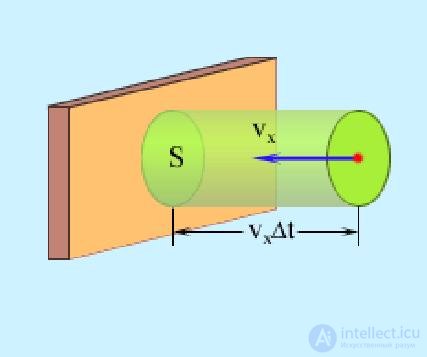
Fig. 1.14. Reflection of a molecule from a wall
Assuming that the molecules do not collide with one another, we can assert that after reflection the molecule will reach the opposite wall, be reflected again, and approach the same wall the next time (Fig. 1.14) after a time

where  is the distance between the walls perpendicular to the x axis. Since the momentum
  is transferred to the wall every
  seconds, an average force acts on the wall from a single molecule
|
|
|
(1.7) |
(Let us note for the future that we will denote average values of quantities by angle brackets).
If N molecules are contained in the vessel, then the total average force F is obtained by summing expression (1.8) over all molecules:
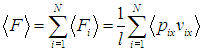
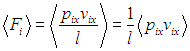
Here, since all directions are equivalent and, on average, the molecules are reflected in exactly the same way from all walls of the vessel, then, first, the sum of the products of momenta and velocities can be represented in the form
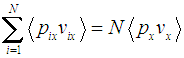
where on the right is written the average, which is the same for all molecules. And, second:

On the other hand, the average value of the product of a molecule's momentum and its velocity is defined as

Therefore
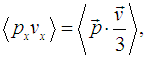
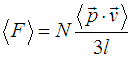
and the expression for the total average force acting on the wall from the gas takes the form
|
|
|
(1.8) |
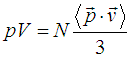
Dividing the total average force by the area of the wall  , we obtain, by the definition of pressure, an expression for the gas pressure
  on the wall. Replacing the product
  by the volume of the vessel
  , we arrive at the equation
|
|
|
(1.9) |
Let us now use the fact that the speed of molecular motion, even at temperatures of thousands of kelvins, when most substances have already passed into the plasma state, is only a few kilometers per second, so there is no need to speak of relativistic effects in atomic and molecular gases; therefore the momentum of a molecule is  , where
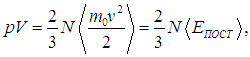
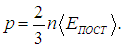
  is the mass of the molecule. Then from (1.9) two relations follow (in essence they are one relation), each of which is called the basic equation of the molecular-kinetic theory of gases:
|
|
|
(1.10) |
or
|
|
|
(1.11) |
Here  is the concentration of molecules, <Etr> is the average kinetic energy of translational motion per molecule. The product N<Etr> is the total kinetic energy of translational motion of all the gas molecules in the given volume V.
Perhaps at first glance it is hard to recognize in relations (1.10–1.11) a similarity to the familiar Clapeyron — Mendeleev equation

so let us slightly transform the latter. Let us introduce a new quantity — the Boltzmann constant
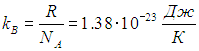
The importance of this physical constant is determined by the fact that it establishes a relation between energy and temperature, as is already evident from its dimensions. Next we use the fact that

is the number of moles of substance in the system, and NA is the number of molecules in one mole, so that nNA equals the total number of particles in the system. We then arrive at the following form of the Clapeyron — Mendeleev equation:
|
|
|
(1.12) |
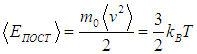
Comparing (1.10) with (1.12), we see that in essence we are dealing with an analogous equation if we define the absolute temperature by the relation
|
|
|
(1.13) |
Such a definition of temperature is suitable only for systems consisting of particles with only three translational degrees of freedom, first, and only if the translational motion of these particles is accurately described by the laws of classical, in this case "classical" meaning non-quantum, mechanics. For example, it is not applicable to describe the vibrational motion of nuclei in oxygen and nitrogen molecules (the main components of air) at room temperature, nor to describe the translational motion of electrons in metals at any temperature, because both of these motions are quantum in nature and are not described by the laws of classical mechanics.
A general definition of temperature, valid in all cases, will be given later on the basis of the first and second laws of thermodynamics, and for now let us note the following.
Temperature is a measure of the intensity of thermal motion. Temperature increases with an increase in the average energy of thermal motion. As will be seen later, this increase does not necessarily have to be a proportional increase, as in relation (1.13).
Video 1.6. A classical model of a gas with increasing temperature.
Example. In an underground cavity of radius 100 m, an underground test of a nuclear weapon with a yield of 50 kilotons is conducted. Let us estimate the gas pressure in the cavity and the minimum depth of the test shaft so that the explosion products do not break out to the surface.
To solve the problem as stated, we do not yet have enough data. First we must find the total energy of the gas formed in the explosion. A hint at its magnitude is contained in the specification of the so-called
продолжение следует...
Часть 1 1. The Ideal Gas: Equation of State and Kinetic Theory
Часть 2 1.4. Distribution of energy among the degrees of freedom of
 of particles.





Comments