
Lecture 62 min.
Это окончание невероятной информации про идеальный газ.
...
TNT equivalent. By tradition, the energy of an explosion is compared with the explosion energy of TNT. The explosion energy W of a 50-kiloton bomb is equivalent to the explosion energy of 5⋅104 t = 5⋅107 kg of TNT. From a handbook we find that the explosion energy of 1 kg of TNT is equal to 4.2 MJ. Thus, the explosion of this bomb releases an energy 
Since the explosion occurs in a cavity, we will assume that all of this energy has been converted into the kinetic energy of the explosion products. Since we know the volume of the cavity
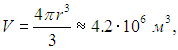
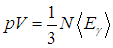
we find the pressure from the basic equation of the molecular-kinetic theory of gases (1.12)
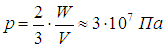
Let us now obtain the answer to the second question of the problem. The gases will not break out if the external pressure of the rock above the cavity exceeds the pressure of the explosion products. The external pressure can be estimated from the well-known formula of hydrostatics
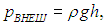
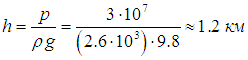
where ρ is the density of the rock. Let us stress that this formula is valid for gases and liquids. Applied to a solid, it can be used as an estimate. In a handbook we find, for example, the density of granite ρ = 2600 kg/m3, which can be taken as the basis for the estimate. From the equality

we find the minimum depth of the shaft h:
In conclusion of this section, let us make a remark. We deliberately did not assume from the very beginning the classical dependence of a particle's momentum on its velocity. Therefore equation (1.9) has a wider range of applicability than (1.10). For example, electromagnetic radiation can be represented as a collection of special particles (photons), moving at the speed of light. Therefore for photons
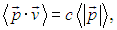
where c — is the speed of light. On the other hand, the energy of photons Eg is related to their momentum by the relation

so that equation (1.9) takes in this case the form
|
|
|
(1.14) |
We see that the equation of state of an ideal gas of photons differs by a numerical factor on the right-hand side from the corresponding equation for a gas of ordinary particles.
To understand the relation between temperature and internal energy, let us recall the concept introduced earlier in mechanics — the number of degrees of freedom.
|
The number of degrees of freedom of a mechanical system is the minimum number of independent scalar quantities whose values must be specified to determine the configuration of the system unambiguously. |
In § 1.3 it was shown that the gas pressure is numerically equal to the momentum transferred per unit time to a unit area of the wall as a result of molecular impacts on it, so the pressure is determined by the average energy of only the translational motion of the molecules.
The translational motion of any system "as a whole" is completely determined by the motion of a single point: its center of mass. In particular, the total momentum  of any nonrelativistic system equals the product of the mass
  of this system and the velocity
  of its center of mass. The energy of translational motion of the system "as a whole" is equal to
 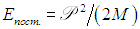 . Therefore, for a complete description of the translational motion of any system in three-dimensional space it is necessary and sufficient to specify the values of the three coordinates of the center of mass. Thus, translational motion, however the system is constructed, always corresponds to three translational degrees of freedom:
  .
.
One can also put it this way: "from the point of view of translational motion" any system can be represented exactly, not approximately, as a single material point coinciding with the center of mass of the system and having a mass equal to the mass of the system (Fig. 1.15).
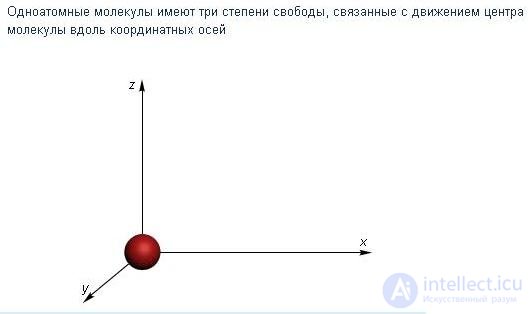
Fig. 1.15. A monatomic molecule
As for the total internal energy of the gas U, it is made up, generally speaking, of many components corresponding to all possible kinds of motion in the molecule and the energy of interaction of the molecules with one another. When considering an ideal gas, the energy of interaction of the molecules is neglected.
Let us begin with a noble gas, for example helium  . The point is that all noble gases are monatomic, and of them helium is the lightest and, accordingly, of the simplest structure. A helium atom (meaning the main isotope
  ) is a positively charged nucleus of 2 protons and 2 neutrons and an electron shell of 2 negatively charged electrons. That makes 6 particles in all; if each of them is regarded as a material point, that is 18 degrees of freedom. But things are not so dismal after all — quantum mechanics comes to the rescue. Without going into "quantum" details, let us point out that to change the state of the electron shell of a helium atom, namely, to transfer it from the ground state with the lowest possible energy to an excited state with higher energy, a minimum energy of about 20 eV is required. More precisely, for example, when the electron shell of a helium atom is excited, a transition requiring 19.8198 eV is possible. The energy spectrum of atoms is discrete: a helium atom simply cannot accept less energy; that is how it is built. In a collision of a helium atom with an electron of lower energy, the helium atom will remain in the initial — ground — state with the lowest possible internal energy, whose value depends only on the choice of the energy reference point and is most often simply taken equal to zero. Such a collision will be perfectly elastic. Let us note that

Therefore, an energy of 20 eV corresponds to a temperature of the order of  kelvins. It is not hard to see that even at a temperature of
  K the fraction of helium atoms moving so fast that the energy of their relative motion is 100 times its average value is negligibly small. But then collisions accompanied by a change in the internal energy of one of the colliding atoms will be extremely rare; consequently, the possible presence of atoms with an excited electron shell can be neglected, and one can approximately assume that all atoms have their electron shells in the same ground state with the minimum possible energy. It is not so important that the electron shells of all atoms have the minimum possible energy as that this energy is the same for all atoms and does not change even when the gas is strongly heated. Then the total energy of the electron shells of all atoms is simply a constant equal to
  , where N is the number of atoms in the gas and
  is the energy of the electron shell of each atom. For a fixed total number of atoms, this quantity does not depend on any parameters of the state of the gas. It remains only to recall once again that energy is always defined up to an additive constant, and to discard this constant by changing the zero of the energy scale.
Changing the state of atomic nuclei requires energies of hundreds of thousands of eV, which is "by gas standards" monstrously large. The corresponding temperatures are found only in the interiors of stars. Therefore there is no question of a change in the internal state of nuclei during collisions in a gas (we mean stable nuclei; the possible decay of unstable nuclei has nothing to do with the parameters of the state of the gas).
What remains, then? What remains is the translational motion of the atom as a whole, that is, three translational degrees of freedom. This justifies the use of the following model:
|
An atom in a gas is a material point. |
Just in case, we note that at the moment we are not interested in the processes by which thermodynamic equilibrium is established in a gas. Equilibrium is established precisely as a result of the interaction of gas particles in their collisions, so the "atom — material point" model does not describe such processes.
The situation with the electron shell does not change if the atoms are part of a polyatomic molecule. The minimum energy needed to change the state (excite) the electron shell of a molecule is about the same as that needed to excite the electron shells of atoms. The figure characteristic of the atomic-molecular world is of the order of 10 eV, which corresponds to a temperature of the order of a hundred thousand kelvins. At such temperatures a gas is no longer a gas but a low-temperature plasma. Therefore, as long as a gas remains a gas, in the overwhelming majority of cases one can assume with excellent accuracy that the electron shells of all gas molecules are in the same state, and that their total energy is a constant independent of the parameters of the state of the gas, which can be dropped. Of course there are exceptions that require some caution. For example, the oxygen molecule  has — by atomic-molecular standards — a very long-lived excited state, to transfer to which the molecule needs only 0.982 eV. It is in this state that the oxygen molecule is extremely chemically active; this is a very important exception, interesting for its consequences, but an exception that absolutely must be taken into account in the relevant problems, for example, in calculating the rates of chemical reactions involving this molecule.
Thus, even as part of a molecule, an atom can be regarded as a material point.
|
Even as part of a molecule in a gas, an atom is a material point. |
Let us dwell separately on counting the numbers of rotational and vibrational degrees of freedom of polyatomic molecules. We begin by considering the rotational degrees of freedom of a diatomic molecule. All diatomic molecules are linear for the simple reason that two distinct points determine a straight line; in other words, two points always lie on one straight line (Fig. 1.16). There are also more complex but linear molecules; for example, the carbon dioxide molecule  is linear: in the ground state (with the lowest possible energy) all three of its atoms lie on one straight line.
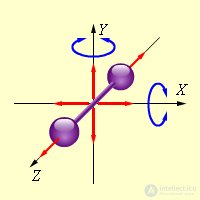
Fig. 1.16. A diatomic molecule
Usually, when calculating the internal energy of a gas, the rotation of a linear molecule is taken into account only about its two principal axes, which pass through the center of mass and are perpendicular to the axis of the molecule; rotation of the molecule about its symmetry axis is not considered, which is perfectly correct. But on this basis it is claimed that a linear molecule has only 2 rotational degrees of freedom, which is categorically wrong. Nevertheless, below we too will write it that way, which, of course, requires an explanation. That there are only two rotational degrees of freedom is obviously wrong for the following reason. A linear molecule is a spatial object with finite dimensions in all three directions. For example, the distance between the nuclei  in the molecule
  is
is  meters, and the gas-kinetic radius
  (the radius in the model "molecule is a small sphere") is
  meters. The radii of nitrogen nuclei are of the order of
  meters. Given that
  , a legitimate question arises: "Why shouldn't it also spin about its own axis?" Again quantum mechanics is "to blame". A quantum-mechanical calculation shows that the energy needed to excite rotation about a given axis is inversely proportional to the moment of inertia about that axis. Therefore the excitation of rotation of the nuclei is out of the question — the radius of these "little spheres" is too small and, accordingly, the minimum energy needed to set them into rotation is too large. Again this is hundreds of kiloelectronvolts: the so-called rotational energy levels of nuclei. One option remains: to "spin" the electron shell of the molecule about its axis, but any change in the state of the electron shell requires an energy of the order of 10 eV. Specifically, to "spin" the molecule
  about its axis, that is, to transfer the molecule
  to the first rotationally excited state, requires 7.35 eV, which corresponds to a temperature exceeding seventy thousand degrees. Thus, at "gas" temperatures, that is, at temperatures at which a gas is still a gas and not a plasma (below a few thousand degrees), the number of linear molecules rotating about their own axis will be negligibly small.
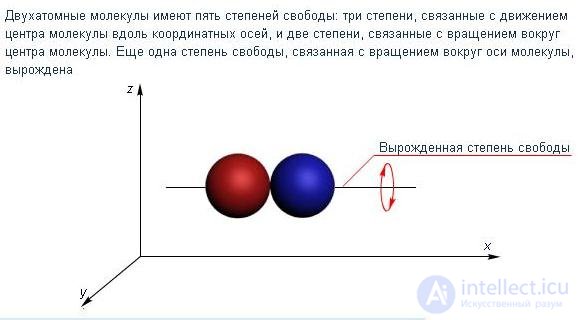
Fig. 1.17. A linear molecule
The general situation is as follows. The apparent absence of certain degrees of freedom in a molecule is a consequence of the fact that the energy needed to excite the corresponding types of motion is, for quantum reasons, too large (not small!, Fig. 1.17). Molecules in which these types of motion are excited as a result of collisions between molecules either do not exist at all (in reasonable amounts of gas), or they exist but in such a small relative number that the contribution of these types of motion to the internal energy of the gas is negligible. This applies to all those degrees of freedom that are associated with the electrons of the molecule's electron shell. It is for this reason that both an isolated atom and an atom in a molecule can be regarded as a material point (Fig. 1.18).
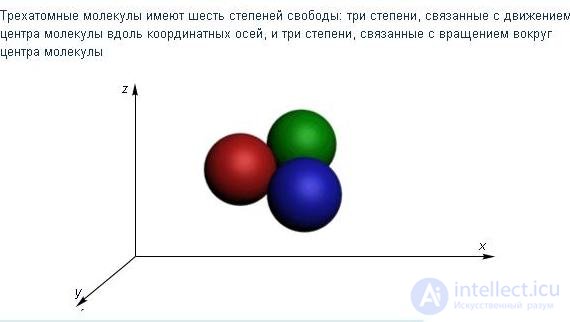
Fig. 1.18. A triatomic molecule
In view of the above, determining the number of degrees of freedom of a molecule within the model "atom — material point" reduces to the following.
If a molecule consists of  atoms — material points — the degrees of freedom are:
total —  , of which:
translational — 3 always,
rotational — 3 (spatial molecule) or 2 (linear molecule),
vibrational —  or
or  for a spatial (linear) molecule, respectively.
We strongly recommend counting the degrees of freedom in exactly this order: total, translational, rotational, and what is left — vibrational. One should not rely on structural chemical formulas: they show chemical bonds, not the possibilities of various vibrational motions of groups of nuclei or of individual nuclei of the atoms making up the molecule. For example, the possibility of torsional vibrations is not reflected at all. Using these formulas most often leads to errors in counting the number of vibrational degrees of freedom. About the structure of the molecule one needs to know only one thing: whether it is linear or not.
Let us give three examples of counting the number of degrees of freedom for the molecules 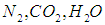 . First we introduce the "classical number
  ", which we denote as
  ; it will be needed later:
 ,
,
here  is the number of translational degrees of freedom,
  is the number of rotational degrees of freedom, and
  is the number of vibrational degrees of freedom. Because of the factor of two in front of
  , this number is not at all equal to the total number of degrees of freedom of the molecule and should not be called that.
Table 1.4.1.
|
Molecule / Degrees of freedom; |
linear |
planar |
linear |
planar or spatial |
|
Total |
6 |
9 |
9 |
24 |
|
Translational |
3 |
3 |
3 |
3 |
|
Rotational |
2 |
3 |
2 |
3 |
|
Vibrational |
1 |
3 |
4 |
18 |
|
Number |
7 |
12 |
13 |
42 |
 The ethane molecule has two equilibrium configurations: in one case all eight atoms lie in one plane; in the other equilibrium configuration, the planes in which the "left" quadruple
  and the "right" quadruple
  lie are mutually perpendicular. In both equilibrium configurations, torsional vibrations of these planes with their atoms about their equilibrium positions are possible. Vibrations of atoms, or more precisely of the nuclei of atoms that make up a polyatomic molecule, are internal motion in the molecule, so it is most convenient to consider this motion in the center-of-mass frame of the molecule.
To understand why the triatomic water molecule has three vibrational degrees of freedom while the likewise triatomic carbon dioxide molecule has four, let us consider the normal modes of vibration of the nuclei in the molecule  .
.
The four vibrational modes of this molecule are as follows. Symmetric mode: all three nuclei remain on one straight line, the carbon nucleus is at rest, and the two oxygen nuclei oscillate in antiphase, that is, for half a period they approach each other and the carbon nucleus, moving toward it from two opposite sides; for the other half of the period they, still in antiphase, move away from each other and from the carbon nucleus. Asymmetric mode: all three nuclei remain on one straight line, and the two oxygen nuclei, as a single whole (with the distance between them unchanged), oscillate in antiphase with the carbon nucleus. Doubly degenerate bending mode: the nuclei do not remain on one straight line; at the moment when they leave their equilibrium positions, which lie on the straight line  , they (all three) move in directions perpendicular to this line. If, loosely speaking, the axis of the molecule is horizontal and the carbon nucleus moves up, then both oxygen nuclei move down. That is, the two oxygen nuclei oscillate in phase with each other and in antiphase with the carbon nucleus. This is understandable: otherwise the center of mass of the molecule would not remain at rest.
The two strictly equal natural frequencies of the doubly degenerate bending mode correspond to the motion of the nuclei in two mutually perpendicular planes. If vibrations of only one of the two bending modes are excited, then all three nuclei remain in a plane fixed in space. If vibrations in both mutually perpendicular planes (both modes) are excited, then the trajectories of all three nuclei, as the result of superposing two mutually perpendicular vibrations with strictly equal frequencies, are ellipses, and for equal amplitudes and a phase shift of  — circles. Moreover, if the carbon nucleus moves along its ellipse "clockwise", then both oxygen nuclei move along their identical ellipses "counterclockwise". The words "clockwise" and "counterclockwise" are in quotation marks for an obvious reason: they are conventional, since they depend on which side one looks from.
Thus, only three different frequencies correspond to the four vibrational degrees of freedom of the molecule  , since the bending mode is doubly degenerate.
Any diatomic molecule within the model "atom — material point" has one vibrational degree of freedom, which corresponds to a very simple motion: the distance between its two nuclei oscillates. However, quite often the macroscopic characteristics of a diatomic gas, for example its heat capacities at constant volume  and constant pressure
  , their ratio — the adiabatic index
  — and others, have (to within a percent!) such values as if these molecules had no vibrational degree of freedom. We emphasize that this "curiosity" occurs, first, not for all molecules and, second, only at not too high temperatures, not exceeding several hundred kelvins. This situation occurs, for example, for air (roughly 80 % nitrogen
  and 20 % oxygen
  ) at room temperatures
 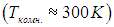 . It is perfectly obvious that the number of degrees of freedom of a molecule cannot depend on the parameters of the state of the gas of which it is a part. This number is determined by the three-dimensionality of space and by the model "atom — material point". The question is: "What is going on?"
To excite vibrations of the nuclei in a nitrogen molecule, it must be given an energy not less than  ; for the oxygen molecule the "vibrational quantum", as it is called in such cases,
  is somewhat smaller, namely:
  . Anticipating the quantum-mechanical calculation itself, we report its results.
At room temperature 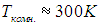 the fraction of vibrationally excited nitrogen molecules out of their total number is approximately
 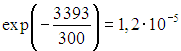 ; for oxygen this fraction is approximately
 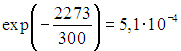 . Thus, in every cubic centimeter of air at room temperature there will be more than
  vibrationally excited nitrogen molecules and of the order of
  vibrationally excited oxygen molecules. Under these conditions it is hardly possible to say that these molecules are "rigid" and have only five degrees of freedom because they have no vibrational degree of freedom. All the more so since already at a temperature of 1000 K the fractions of vibrationally excited molecules will be about 3 % for nitrogen and about 10 % for oxygen. As one more example we give the molecule
  , for which the minimum energy needed to excite vibrations of the nuclei is only
  . Already at room temperature the fraction of vibrationally excited molecules
  is approximately 20 %. Vibrations of the nuclei in this molecule cannot be neglected even at room temperature.
It is hardly reasonable to say that the presence or absence of a vibrational degree of freedom in a diatomic molecule depends on the type of molecule and the temperature of the gas. This is an attempt to "stuff" the vibrational motion of nuclei, which is quantum in nature, into the framework of a classical (non-quantum) description that is inadequate in this case. A diatomic molecule always has a vibrational degree of freedom, but the contribution of the vibrational motion of the nuclei in such a molecule to the internal energy of the gas, to the heat capacities  and
and  , to the adiabatic index
  and to other characteristics of the gas can be negligibly small if the inequality holds
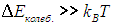
where  is the Boltzmann constant introduced above. When the opposite inequality holds

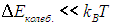
the vibrational motion of the nuclei can by no means be neglected. A classical (non-quantum) description of the vibrational motion of nuclei in molecules is possible only when the excitation energy of the vibrational motion is small and the temperature is sufficiently high, namely when the inequality holds
 ,
,
which in practice is satisfied only in rare exceptional cases such as the molecule  . In the air that we can breathe relatively comfortably, the vibrations of nuclei in
  and
and  molecules are not described by classical mechanics.
Let us now return to the ideal gas. We have seen that the average kinetic energy of translational motion of molecules is equal to
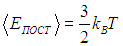
and that three degrees of freedom correspond to translational motion. Hence, in the state of thermodynamic equilibrium, the average energy per degree of freedom is

In the classical (non-quantum) description all types of motion are equivalent. Molecules collide, and in doing so it can easily happen that the energy of translational motion passes into the energy of rotational motion. Therefore each rotational degree of freedom must have, on average, the same amount of energy —

This statement is known as Boltzmann's law of equipartition of energy among degrees of freedom. In a similar way, collisions of molecules can also give rise to vibrational motions of the nuclei in them, so the classical equipartition law applies to the vibrational degrees of freedom of molecules as well. But there is one subtlety here. Whereas translational and rotational motions correspond only to kinetic energy, a harmonic oscillator (one vibrational degree of freedom) has, on average, strictly equal kinetic and potential energies. Therefore, on average, in the state of thermodynamic equilibrium, under conditions where the classical description of vibrational motion is applicable, the energy per vibrational degree of freedom is twice as large

If we introduce the effective number  by the same formula as the
  introduced above, namely
|
|
|
(1.15) |
with the fundamental difference that the parameter  is no longer the nominal number of vibrational degrees of freedom of a polyatomic molecule, then the average energy of one molecule will be
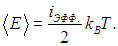
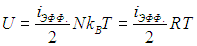
Hence the total internal energy U of the gas will be N times greater (N — the number of gas molecules):
|
|
|
(1.16) |
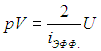
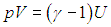
The Clapeyron — Mendeleev equation can be written as
|
|
|
(1.17) |
or in a somewhat different form
|
|
|
(1.18) |
With the so-called adiabatic index
|
|
|
(1.19) |
we will become acquainted in the next chapter, where the meaning of this term will become clear. As shown above, the vibrational motion of nuclei in molecules is excited only when sufficiently high temperatures are reached (T > 1000 K), so their contribution to the internal energy of the gas for most molecules at ordinary (close to room) temperatures is negligible; we will not take it into account, that is, unless stated otherwise we will assume that
 ,
,
where  and
and  are equal to the nominal numbers of translational (always 3) and rotational (3 or 2) degrees of freedom, respectively, according to the structure of the molecule.
Example. A room of volume 75 m3 contains a diatomic gas (air) at a temperature t = 12 °C (T = 285 K). A heater is turned on and raises the air temperature to t2 = 22 °C (T2 = 295 K). Since the room is not sealed, the gas pressure remains constant at 100 kPa throughout. Let us find the change in the internal energy of the gas in the room and determine how much energy was spent on heating the surroundings.
The answer is somewhat unexpected: according to (1.19), the internal energy of the gas in the room has not changed, since both its pressure and its volume remained the same. On the other hand, part of the gas left the room: if initially it contained
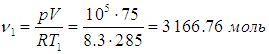
of substance, then after heating only

remained. The amount that went out into the street is

of air, or
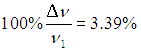
of its initial amount.
Let us calculate how much energy went into "heating" the street. We conditionally divide the whole process into two stages (in reality they occur simultaneously, but this does not change the essence). In the first stage we heat a sealed room. The initial internal energy of the gas is determined by the formula

Taking into account that for a diatomic gas
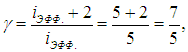
we obtain
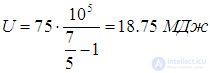
Since the internal energy is proportional to the absolute temperature, after the sealed room is heated we find that

that is, the energy received from the stove is

In the second stage we remove 3.39% of the heated air from the room, and with it the same fraction of the energy. The energy removed

is exactly equal to the energy received from the stove. By another route we have again arrived at the same conclusion.
So it is now finally clear that the air that escaped outside carried away all the energy received from the stove. What, then, is the role of the stove? Was it worth turning on at all if it only heats the street? The useful effect of the stove is that at a temperature of 12 degrees a person's heat loss to the surrounding air is so great (even though, presumably, the person is dressed) that the body's thermoregulation system barely manages to maintain a normal temperature and signals this: the person feels cold, uncomfortable! At a temperature of 22 degrees the heat loss is substantially smaller, the load on the thermoregulation system is lower, and the person feels quite comfortable and has no desire to turn on a heater.
A natural question arises: what equations describe mixtures of ideal gases? After all, we rarely encounter pure gases in nature. For example, our natural habitat, air, consists of nitrogen N2 (78.08%), oxygen O2 (20.95%), inert gases (0.94%), and carbon dioxide CO2 (0.03%).
Suppose that a volume V at some temperature T contains a mixture of gases (which we will number
by the index i ). We will characterize the role of each component of the mixture by its mass fraction:
|
|
|
(1.20) |
where mi — is the mass of the i-th component. Our task — is to write an equation similar to the Clapeyron — Mendeleev equation, and to work out the effective number of degrees of freedom of the mixture, which may contain both monatomic and polyatomic molecules.
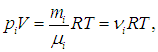
First of all, note that we are considering ideal gases. The molecules do not interact with one another, and therefore each component does not prevent any other from "living" in the same common vessel. Different gases in a vessel, by virtue of their assumed ideality, simply "do not notice" one another. Therefore the same Clapeyron — Mendeleev equation holds for each of the components:
|
|
|
(1.21) |
where ni — is the number of moles of the substance in the i -th component. The total number n of moles in the mixture is equal to the sum of the numbers of moles ni in each of the components:

Similarly, the total mass of the mixture is equal to the sum of the masses of each of the components

and it is natural to define the molar mass of the mixture m as the mass of one mole of the mixture:
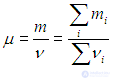
Let us introduce a quantity called the partial pressure.
|
Partial pressure pi is the pressure exerted by the i-th component of a gas mixture. |
Dalton's law holds for a gas mixture:
|
The total pressure of a gas mixture is equal to the sum of all the partial pressures
|
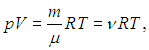
Summing the left- and right-hand sides of (1.21), we arrive at the standard form of the Clapeyron — Mendeleev equation
|
|
|
(1.23) |
where m, μ, n are determined from the conditions of the specific problem. For example, if the mass fractions of the components are given, then the molar mass of the mixture is found from the relation
|
|
|
(1.24) |
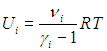
The internal energy Ui of the i-th component of the mixture is determined in accordance with formulas (1.16) and (1.19):
|
|
|
(1.25) |
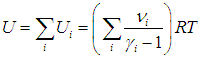
On the one hand, the total internal energy of the mixture is equal to the sum of the energies of each component:
|
|
|
(1.26) |
On the other hand, let us write the standard expression of the form (1.25)
|
|
|
(1.27) |
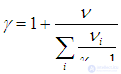
Comparing (1.26) and (1.27), we obtain the formula for the adiabatic exponent of the mixture
|
|
|
(1.29) |
Having found the molar mass and the adiabatic exponent of the mixture, we can use all the formulas obtained earlier for "pure" ideal gases.
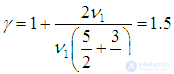
Example. Given a mixture of oxygen O2 (component 1) and argon Ar (component 2), where the amounts of substance of both components are the same, n1 = n2. Let us find the adiabatic exponent of the mixture.
The adiabatic exponent of diatomic oxygen is

and that of monatomic argon is

Therefore, for the gas mixture, on the basis of (1.29) we obtain
Часть 1 1. The Ideal Gas: Equation of State and Kinetic Theory
Часть 2 1.4. Distribution of energy among the degrees of freedom of









Comments