
Lecture 45 min.
In this chapter we continue our study of the thermodynamic properties of systems. Our main goal now is to understand how heat can be converted into the work of machines. As we have seen, thermal energy is ultimately the energy of the chaotic motion of molecules. The useful work extracted from various devices, however, is ordered in character. Heat engines turn the generators at power plants and set vehicles in motion. How, then, do conversions of one form of energy into another take place? It is intuitively clear that different forms of energy differ in some way, even though they all obey the law of conservation of energy, or the first law of thermodynamics. Indeed, it is very easy to turn mechanical work into heat: it is enough to rub two wooden blocks against each other, and they will warm up (it is said that one can even light a fire this way). The ordered periodic motion of the blocks is converted into the chaotic motion of the molecules that make them up. But could you make the heated blocks spend part of their thermal energy on exciting ordered periodic motion? In short, in this chapter we will take up the question of how efficiently order can be organized out of chaos.
Among all possible thermodynamic processes shown on state diagrams, processes corresponding to closed curves hold a special place (Fig. 5.1). In these processes the physical system passes through a series of states and returns to the initial one. This is what makes closed processes (cycles) important.
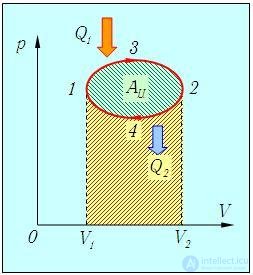
Fig. 5.1. Example of an idealized closed cycle (the direction of the process is shown by arrows). The area under the upper curve equals the work done by the system, and the area under the lower curve equals the work done on the system by external forces (shown by brown hatching). The difference of the areas (shown by green hatching) equals the net work done by the system over the cycle
Let us examine the process in Fig. 5.1 in more detail. When the gas expands along the "path" 1-3-2 from the minimum (V1) to the maximum (V2) volume, the system does positive work A132, numerically equal to the area under the upper curve. When the system returns to its initial state along the other path 2-4-1 work A241 is done on the system. The work done by the system is negative and is equal in absolute value to the area under the lower curve. The algebraic sum of these works

is the net work done by the system over the cycle. Its numerical value equals the difference of the areas mentioned, that is, the area enclosed between the upper and lower curves. In other words, the net work over a cycle equals the area bounded by the given cycle on the (p, V) diagram, if the process proceeds clockwise; otherwise the net work is negative, but its magnitude is still equal to this area.
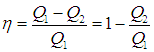
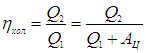
During the cycle the system interacted with its surroundings, receiving and releasing heat. If we denote by Q1 the quantity of heat received by the system, then the heat engine efficiency (thermal efficiency)  is naturally defined as the ratio
|
|
|
(5.1) |
where Acyc — is the work per cycle.
The efficiency is often also expressed as a percentage, for which the quantity must be multiplied by 100 %. If we denote by Q2 > 0 the quantity of heat returned by the system to the surroundings, then the difference Q1 – Q2 equals the work done Acyc. This follows from the first law of thermodynamics and from the fact that when the system returns to its initial state its internal energy also returns to its initial value, that is

Then the efficiency of a heat engine is written as
|
|
|
(5.2) |
It is evident from this that the efficiency of a heat engine cannot exceed unity. This statement can be formulated as the impossibility of a perpetual motion machine of the first kind:
|
It is impossible to build a periodically operating heat engine that would perform useful work in an amount exceeding the energy received from outside. |
The existence of such an engine would contradict the law of conservation of energy. Since neither the quantity of heat nor the work done by the system is a state function, the efficiency depends on the particular cycle on which the heat engine operates.
Until now we have considered the process corresponding to the operation of a heat engine. If we reverse the process (run it counterclockwise in Fig. 5.1), we obtain a model of a refrigerator. All the arrows in this figure change to the opposite direction; the system receives from the cold reservoir a quantity of heat Q2, and, owing to the work of an external force (an electric motor), transfers a larger quantity of heat Q1 to the hot reservoir. The law of conservation of energy (the first law of thermodynamics) requires that the equality

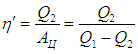
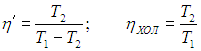
hold. The effectiveness of a refrigerator can be defined analogously to the efficiency of a heat engine. One only has to take into account that the useful quantity now is the heat removed Q2, for which we do the work Acyc. Therefore the literature often defines the coefficient of performance ' as the ratio of the heat removed to the work done in the process:
|
|
|
(5.3) |
Note that the coefficient of performance can be greater than unity. If we wish to use the familiar efficiency, then for a refrigerator it is natural to define it as the ratio of the heat removed to the heat transferred to the surroundings:
|
|
|
(5.4) |
Such a definition corresponds to the traditional view of the efficiency of machines. Indeed, in a refrigerator with 100 % efficiency (if one were possible) all the heat removed would be transferred to the surroundings without any work being done. Then we would have Q2 = Q1 and ref = 1. Conversely, when we do some work but remove no heat, then Q2 = 0 and ref = 0.
For any heat engine to operate on a closed cycle, an external environment is needed, which can conventionally be pictured as two bodies — a heater (hot reservoir) at temperature Tmax, and a cooler (cold reservoir) at temperature Tmin (Tmin < Tmax). It is assumed that in contact with our system the temperatures of the heater and the cooler do not change. In contact with the heater the system receives heat; in contact with the cooler it gives it up.
In thermodynamics there is the Carnot theorem (Fig. 5.2):
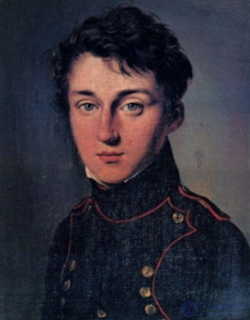
Fig. 5.2. Léonard Sadi Carnot (French physicist and military engineer)
|
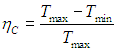
For given temperatures of the heater and the cooler, the maximum possible efficiency of a heat engine does not depend on the nature of the engine's working substance and is determined by the formula
|
The maximum possible efficiency is achieved in the so-called Carnot cycle, in which an ideal gas goes through a closed cycle made up of two adiabats and two isotherms (Fig. 5.3).
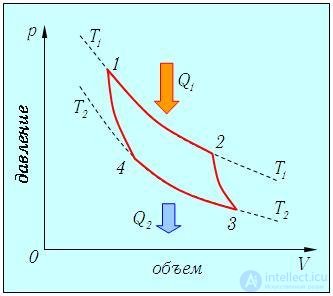
Fig. 5.3. The Carnot cycle (traversed clockwise) — a combination of two isotherms 1-2, 3-4 and two adiabats 2-3 and 4-1; heat exchange with the surroundings takes place on the isothermal segments of the cycle: on segment 1-2 the gas receives heat Q1, and on segment 3-4 it gives up heat Q2
Let us verify that the closed process shown really has an efficiency corresponding to formula (5.5). The temperature of the system is T1 at points 1, 2 and T2 at points 3, 4. The values of the remaining thermodynamic parameters (p, V) will carry as a subscript the number of the corresponding point on the diagram. We need to calculate the quantities of heat received Q1 and released Q2 , find the work done by the gas Acyc = Q1 – Q2 and determine the efficiency of the cycle. We note at once that on segments 2-3 and 4-1 the system does not exchange heat with the surroundings. Consequently, the gas receives heat Q1 on segment 1-2, and releases heat Q2 on segment 3-4. Let us examine the various segments of the cycle in more detail.
See the animation "Carnot Cycle"
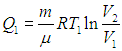
Isotherm 1-2. On this segment the gas is in contact with the heater and undergoes isothermal expansion from volume V1 to volume V2. The temperature T1 does not change, hence the internal energy does not change, and all the heat received is spent on the gas doing work:
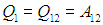
We have already calculated the work done by a gas in an isothermal process earlier, so, taking formula (2.13)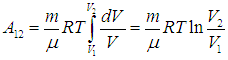 into account, we find
|
|
|
(5.6) |
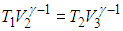
Adiabat 2-3. Here the system is disconnected from the heater and does not exchange heat with the surroundings: Q23 = 0. The gas continues to expand, but now adiabatically. The work is done at the expense of the internal energy of the gas, and its temperature falls to the value T2. On this segment of the cycle we need the information supplied by the adiabat equation:
|
|
|
(5.7) |
Isotherm 3-4. The system is connected to the cooler, and the gas begins to be compressed. The internal energy remains unchanged, work is done on the gas (A34 < 0), and the heat released
heat
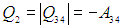
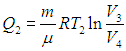
is transferred to the cooler. By analogy with (5.6) we have
|
|
|
(5.8) |
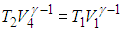
Adiabat 4-1. The system is cut off from the surroundings and continues to be compressed, now adiabatically, which raises its temperature to T1. In the end the system returns to its original state. Since points 4 and 1 lie on an adiabat, we obtain a relation between volumes and temperatures similar to (5.7):
|
|
|
(5.9) |
From equations (5.7) and (5.9) we find the volume ratios
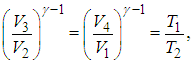
from which it follows that
|
|
|
(5.10) |
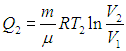
Therefore the heat Q2 given up to the cooler (see equation (5.8)) can be written as
|
|
|
(5.11) |
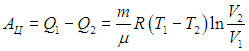
Using expression (5.6) for the heat received by the system, we find the work done during the cycle
|
|
|
(5.12) |
It also follows from the analysis that the maximum temperature in the cycle is Tmax = T1, and the minimum is Tmin = T2. If we divide (5.12) by (5.6), we immediately obtain expression (5.5) for the efficiency of the Carnot cycle, from which all parameters drop out except the temperatures of the cooler and the heater.
Example 1. The boiler of a thermal power plant operates at a temperature of about t1 = 550 °C. The waste heat is discharged to a river at a temperature of about t2 = 20 °C. Let us find the maximum possible efficiency of this plant (Fig. 5.4).
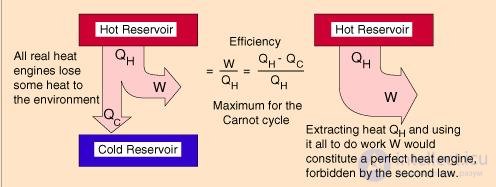
Fig. 5.4. Diagram of the operation of a Carnot heat engine
Since absolute temperatures are used in the formula for the efficiency of the Carnot cycle, we must go from the Celsius scale to the Kelvin scale: T1 = 550 + 273 = 823 K, T2 = 20 + 273 = 293 K. Now we find the efficiency of the power plant:
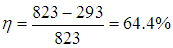
Of course, the real efficiency of the plant is noticeably lower.
If the Carnot cycle is carried out in the reverse direction, that is, counterclockwise in Fig. 5.2, then to determine the effectiveness of a refrigerator we must use formulas (5.3), (5.4) and expressions (5.6), (5.11). We then obtain
|
|
|
(5.13) |
It is sad, but the lower the temperature of the surroundings T1, the less we need a refrigerator, and the more efficiently it works.
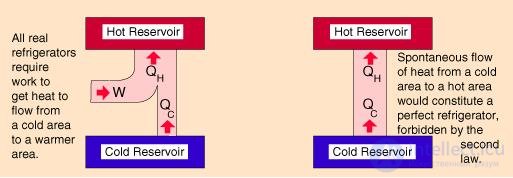
Fig. 5.5. Diagram of the operation of a refrigerator
Let us give a numerical example. If an air conditioner maintains a room temperature of t2 = 20 °C, and the outdoor air temperature is t1 = 30 °C, then for the coefficient of performance we have
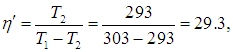
and for the efficiency of the refrigerator
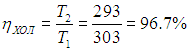
Of course, in reality the temperature of the heat-releasing element is higher than the outdoor temperature by 20–30 degrees, so that the temperature difference can reach 30–40 degrees, which leads to the values

Recall that we are speaking of ideal units operating on the Carnot cycle. A real, typical air conditioner consumes a power of 750 W, pumping about 5 MJ of thermal energy per hour. This means that each second the air conditioner does work A = 750 J and removes from the air in the room the heat
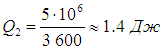
From this we find

We see that a real air conditioner is far less efficient than an ideal Carnot refrigerator.
Example 2. Suppose the temperature in a household refrigerator is maintained at t2 = –3 °C (T2 = 270 K), and the temperature in the kitchen is t1 = 27 °C (T1 = 300 K). Suppose further that the refrigerator motor consumes a power N = 200 W. Assuming that the refrigerator operates on the Carnot cycle and that the heat-releasing element is at the temperature of the surrounding air, let us determine the power of the flow of thermal energy pumped from the refrigerator compartment into the kitchen.
In a time t the motor will do work

The efficiency of the refrigerator is
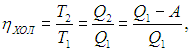
from which we find the quantity of heat entering the kitchen per unit time:

Note that the refrigerator works as a very effective room heater . We need only pay for the power of 200 W consumed by the motor, while the kitchen receives 10 times more energy, 90 % of which is pumped out of the refrigerator compartment (90 % is the efficiency of the refrigerator in this example). Curiously, if a heater of the same power were switched on instead of the refrigerator, it would warm the room 10 times less.
Our numerical estimates can be regarded as an example of the thermal pollution of the environment characteristic of a technological civilization.
Of course, comparing the Carnot cycle with just two other cycles cannot prove that the Carnot cycle is the most efficient. But even if we went through all conceivable cycles, we still would not obtain the proof we seek. After all, the Carnot cycle uses an ideal gas as its working substance. Perhaps, if some other substance were made to work, we could surpass the efficiency of the Carnot cycle? Let us imagine that such a heat engine X is possible in principle, and see what consequences this would lead to. Using this hypothetical heat engine with efficiency x, we will build a new device: we connect engine X to a Carnot refrigerator and attach both to the same heater (at temperature T1) and cooler (at temperature T2). The layout of the device is shown in Fig. 5.6.
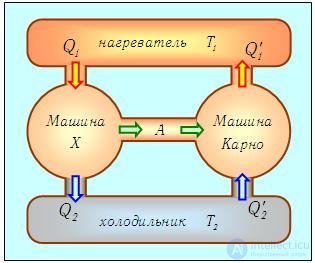
Fig. 5.6. A hypothetical heat engine that allows one to demonstrate the impossibility of a perpetual motion machine of the second kind
How will our assembly work? Engine X takes heat Q1 from the heater, converts part of it into useful work

and the remainder
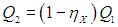
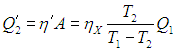
it transfers to the cooler. All the useful work A (it is assumed that energy losses are excluded) is used to drive the Carnot refrigerator, whose efficiency is

and whose coefficient of performance is

(see expressions (5.13)). This means that the Carnot device takes from the cooler the heat
|
|
|
(5.14) |
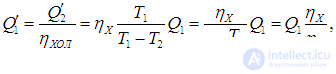
and transfers to the heater the heat
|
|
|
(5.15) |
where, recall, C — is the efficiency of the Carnot heat engine.
The net result of the operation of the assembly of two machines is as follows. No work has been produced, since all the work from the operation of heat engine X has been spent on driving the Carnot refrigerator . The quantity of heat removed from the cooler is
|
|
|
(5.16) |
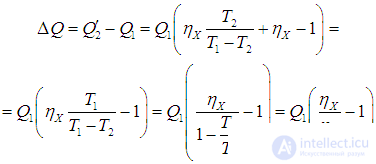
Exactly the same quantity of heat is transferred to the heater: as follows from (5.15),
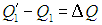
So everything is in order with the law of conservation of energy, but if X > C, then

This means that our assembly, without any work by external forces, has transferred some quantity of heat from the cooler to the heater. It might seem that there is nothing to worry about, since the law of conservation of energy is not violated. But no one in nature has observed such processes of heat transfer from cold bodies to hot ones in which no changes occurred in the surroundings. Ultimately, on the basis of experimental facts, the second law of thermodynamics was formulated:
|
Thermodynamic processes are impossible whose only result would be the transfer of heat from a less heated body to a more heated body. |
One should not think that the second law of thermodynamics forbids the transfer of heat from a cold body to a hot one. Not at all; this is exactly what happens in a refrigerator. But the key word in the formulation of the second law is the word only. The transfer of heat from a cold body to a hot one is not the only result of the operation of a refrigerator; it is connected with an external source, at the expense of whose work it functions.
Numerous experiments and observations led to the second law of thermodynamics and to the understanding that it is a fundamental law of nature. Since this is so, the second law implies the conclusion that the efficiency of any hypothetical heat engine X does not exceed the efficiency of a Carnot engine operating in the same temperature interval:

The latter means that the minimum temperature of the working substance of engine X is not lower than the temperature of the cooler of the Carnot engine, and the maximum temperature of the working substance of engine X is not higher than the temperature of the heater of the Carnot engine. If these inequalities are not satisfied, then the relation between the efficiencies of the two engines can be arbitrary. This circumstance is explicitly taken into account in the combined machine shown in Fig. 5.3: engine X and the Carnot engine share a common heater and cooler.
The second law of thermodynamics has another formulation as well:
|
It is impossible to carry out a periodic process whose only result would be the production of work at the expense of heat taken from a single source. |
In other words, one cannot build a device in which all the heat Q1, received from the heater would be converted into useful work Acyc = Q1. The efficiency of such a device (called a perpetual motion machine of the second kind) would be equal to unity and would exceed the efficiency of the Carnot cycle. Thus the second law of thermodynamics forbids the existence of a perpetual motion machine of the second kind: some amount of the heat received must necessarily be transferred to other bodies (the cooler). Inventors can only regret this. How wonderful it would be if we could use the enormous thermal energy stored, say, in the world's oceans! Alas, we are forced to burn fuel, which leads to the depletion of natural resources, to the emission of carbon dioxide and other combustion products, and to the thermal pollution of the environment, owing to the fundamental necessity of discharging part of the heat into the atmosphere or bodies of water that play the role of the cooler.
The question of the efficiency of heat engines is closely connected with the problem of the reversibility of thermodynamic processes.
|
A reversible process is a thermodynamic process that can be carried out in the reverse direction through the same sequence of equilibrium states as in the forward direction; in this case no changes will occur in the surroundings. |
Reversibility of processes in thermodynamics is akin to the absence of friction in mechanics. Just as in mechanics the best mechanism is a frictionless one, so here the best heat engine is a reversible engine. To show this, let us turn again to our assembly in Fig. 5.3. We did not assume that engine X is reversible, but we found that its efficiency cannot exceed the efficiency of the Carnot heat engine working in tandem with it in the reverse direction:

Now let engine X be reversible. Let us run our assembly in the reverse direction: the Carnot engine produces useful work, and it is used to run engine X as a refrigerator. But then, with the same arguments, we obtain the opposite inequality

From the two opposite inequalities the only conclusion follows: the efficiencies of both engines are equal:

Thus all reversible heat engines have the same efficiency, coinciding with the efficiency of the Carnot engine. Irreversible engines have a lower efficiency.
Which machines can be reversible in principle? We have seen that heat can flow only from hotter bodies to colder ones. This is what makes such processes irreversible and nonequilibrium. There are two exceptions. In an adiabatic process no heat transfer occurs at all. By slowly compressing a gas with a piston in a thermally insulated vessel, we do work and thereby heat the gas. If we release the piston, the gas expands adiabatically, cooling to its original temperature and performing the same amount of work at the expense of its internal energy. We are dealing with a reversible process. Another reversible process is the transfer of heat from one body to another when the two bodies are at the same temperature. Then, too, there is no preferred direction for the transfer of thermal energy, and such an (isothermal) process will also be reversible; it must proceed infinitely slowly and will therefore be an equilibrium process. Thus, adiabatic and isothermal processes, and any cycle built from such processes, can be reversible. We are already familiar with one of them, the Carnot cycle.
But if heat is transferred between contacting bodies at different temperatures, and even more so if there is friction or other energy loss in the system, or if shock waves, vortices, turbulence, etc. arise in the gas, the process will be nonequilibrium and irreversible. Thus, the explosion of gasoline vapor in the cylinder of a car engine is not a reversible process: moving the piston in the opposite direction never causes the products of the explosion to recombine back into gasoline vapor.
A consequence of the second law of thermodynamics is the statement:
|
All real processes are nonequilibrium and irreversible.
|
In classical mechanics and electrodynamics we are used to the fact that the impossibility of some process is, as a rule, related to some conservation law (of energy, momentum, electric charge, etc.). Why, then, is a perpetual motion machine of the second kind impossible? It would seem not to violate any conservation laws. To understand this, we must turn to one more state function of the system — entropy.
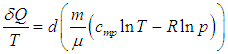
The path to this new state function is short: we need to take the equation of the first law of thermodynamics

and divide both sides by the temperature. First, note that
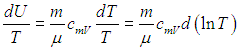
Next, in the formula for the elementary work

let us express the volume in terms of pressure and temperature from the equation of state (1.7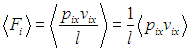 ) of an ideal gas:
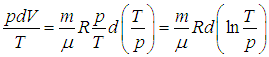
Using Mayer's relation between the molar heat capacities
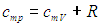
we finally obtain the following expression
|
|
|
(5.17) |
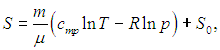
The right-hand side of (5.34) is the differential of some state function S of the system:
|
|
|
(5.18) |
where S0 — is a constant of integration that does not depend on the thermodynamic parameters of the system (pressure, volume, temperature). This function S is called the entropy. It turns out that the quantity dQ, which is not the differential of any state function, becomes one when divided by T:

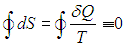
In a closed reversible cycle, the change of any state function (in particular, of entropy) is zero:
|
|
|
(5.19) |
The circle on the integral sign means that the integration is carried out over a closed contour.
Let us check that (5.19) holds for the Carnot cycle. Since in this cycle the system receives and gives up heat only on the isotherms (T1,2 = const), the temperature can be taken out from under the integral sign, and the integration then gives simply the quantity of heat divided by the temperature at which it is received or given up. Indeed, it was found above that on the isothermal branches of the cycle, at temperature T1 the gas receives heat
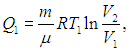
and at temperature T2 — gives up heat
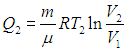
The validity of the equality
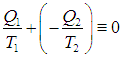
is now obvious. Recall that the heat received has a positive sign and the heat given up a negative one; we defined Q2 earlier as the absolute value of the heat given up, which is why the "–" sign appears in the formula.
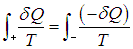
Let us now carry out similar calculations for an arbitrary reversible cycle. We single out two parts in it: we use the "+" sign to denote those stages of the process in which the system receives heat, and the "–" sign for the stages in which the system gives up heat. Since the total integral is equal to zero, the analogous integrals over the two parts of the cycle are equal to each other:
|
|
|
(5.20) |
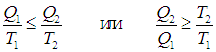
If we denote by T1 the maximum temperature in the first part of the cycle, then the inequality T < T1 implies the inequality
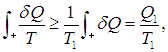
where Q1 as before denotes the total quantity of heat received by the system. If we introduce the minimum temperature T2 in the second part of the cycle, then T > T2 implies
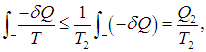
where Q2 — is the quantity of heat given up by the system. From these inequalities and relation (5.20) it follows that
|
|
|
(5.21) |
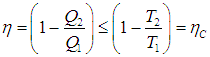
Finally, we obtain the inequality for the efficiency of the cycle
|
|
|
(5.22) |
Using the concept of entropy, we have obtained the same result by a different route: the efficiency of any cycle does not exceed the efficiency of a Carnot cycle whose hot-reservoir temperature equals the maximum temperature of the working substance and whose cold-reservoir temperature equals the minimum temperature of the working substance of the cycle under consideration. In what follows we will omit the reminder that we are comparing the efficiencies of heat engines operating in the same temperature interval.
Thus, we have seen that the new state function — entropy — is related to the second law of thermodynamics. Until now we have restricted ourselves to equilibrium (reversible) processes. Let us consider an example of a nonequilibrium process. Suppose that in the initial state there are two identical ideal gases with equal masses m at the same temperature T, but at different pressures p1 and p2. Let us determine the change in entropy  when the vessels containing the gas are connected.
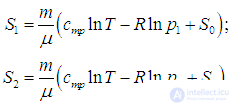
At the first moment after the vessels are connected, when the gases have not yet mixed, the entropy of the system is equal to the sum of the entropies of the gases in the separate vessels:
|
|
|
(5.23) |
Now let us find the volumes of the vessels:
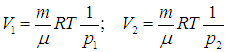
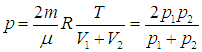
After the vessels are connected, the mass of the gas becomes 2m, and the volume becomes V = V1 + V2. Hence the pressure p after the vessels are connected is
|
|
|
(5.24) |
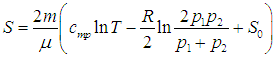
Therefore, the entropy of the gas after the vessels are connected is
|
|
|
(5.25) |
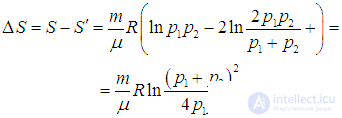
The entropy increment is found from (5.23) and (5.25):
|
|
|
(5.26) |
The quantity under the logarithm sign is always greater than unity. Hence the entropy has increased: > 0.
The purpose of this example is, first of all, to demonstrate on a particular case how the law of increase of entropy works:
|
If a closed system is in a nonequilibrium state at some moment in time, then the processes occurring in it lead to an increase of entropy, which reaches a maximum when the system comes to equilibrium. |
After we connected the vessels and thereby made mixing of the gases possible, we obtained a nonequilibrium state with an entropy equal to the sum of the entropies; the gases began to mix, the pressures equalized, and the system passed into an equilibrium state with a greater entropy than before. As a result of the transition (owing to internal processes in the system) from the initially nonequilibrium state to the final equilibrium state, the entropy of the system increases.
The law of increase of entropy is another formulation of the second law of thermodynamics. As we shall now see, its meaning amounts to the statement that a system tends toward a more probable state. Let us recall the problem of mixing gases at different pressures. In general, one can imagine the reverse process: the gas in the vessel spontaneously separates into two parts, so that the pressures in the two parts differ. No conservation law contradicts such a process, but it never occurs in reality, since its probability is negligibly small. The law of increase of entropy is related to the fact that a given macroscopic state of the system (determined by the parameters T, p, V) can be realized in a multitude of ways by different microscopic states (determined by the positions and velocities of the molecules). It is clear that one can exchange the momenta or positions of some pair of molecules, and we obtain a different microscopic state, but thermodynamically the system does not change. The number of microscopic states corresponding to a given macroscopic state determines the probability of the latter: the greater the number of ways in which it can be realized, the more probable it is. The increase of entropy, as already said, means only that the system tends to pass into a more probable state, which is realized by a larger number of microscopic states.
To make sure that entropy is indeed related to probability, let us consider one more nonequilibrium process. Suppose there is a vessel of volume V, divided into right and left halves by an impermeable partition. Let an ideal gas of N molecules be contained in the left half of the vessel, while the right half is free of molecules. The partition is made permeable, so that the gas can expand adiabatically into a vacuum, as in the Joule–Thomson effect. Let us determine the change in entropy of the gas. Since no work against an external force is done in expansion into a vacuum, and no heat comes in from outside because of the adiabatic condition, the ideal gas does not change its temperature. Doubling the volume occupied by the gas molecules leads to a twofold decrease of its pressure from the initial value p1 to the final value p2 = p1/2. Therefore, the entropies of the gas before and after the expansion are, respectively:
|
|
|
(5.28) |
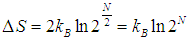
and the entropy increment is given by the expression
|
|
|
(5.29) |
What is the origin of the factor 2N under the logarithm sign? Let us follow some particular molecule. With the impermeable partition it could be only in the left half of the vessel, and then both halves became accessible to it. The number of ways of placing the given molecule doubled, and so on for each of the N molecules. Therefore, the total number of ways of placing the molecules increased by a factor of 2N. The probability of the state of a gas uniformly occupying the entire volume of the vessel is greater by the same factor than the probability of the state in which, with the partition permeable, all the molecules gather in the left half, leaving the right half empty. This does not contradict any conservation laws, but for N = NA = 6.02·1023 molecules (one mole of substance) the probability of such an event is fantastically, staggeringly, unimaginably small  .
.
Here is one more example on the same theme. Take the same vessel, and let each of its halves contain an equal number N/2 of molecules at the same temperature and pressure. Let us mentally mark the molecules of the left half black and those of the right half white, and suppose that the molecules on the left and on the right differ in nothing else. After this we connect the vessels and determine the entropy increment . After mixing, the temperatures of the gases will not change, while their partial pressures will decrease by a factor of two, so that the total pressure, equal to the sum of the partial pressures, will remain the same. Therefore, the mixing process is akin to the expansion of the gases of black and white molecules into a vacuum, and we can use the result (5.29), taking into account that the number of molecules of each color is now N/2. Adding then the entropy increments of both gases, we obtain
|
|
|
(5.30) |
(N now runs over even values only). Let us make sure that in this case, too, 2N describes the increase in the number of ways of distributing the molecules over the vessel.
Consider Fig. 5.7. Suppose we have just one molecule in each of the vessels (N = 2). Previously the yellow molecule could be only in the left vessel, and after mixing both parts of the joined vessel became accessible to it. Similarly, the possibilities expanded for the blue molecule, which had previously been confined in its movements to the right vessel.
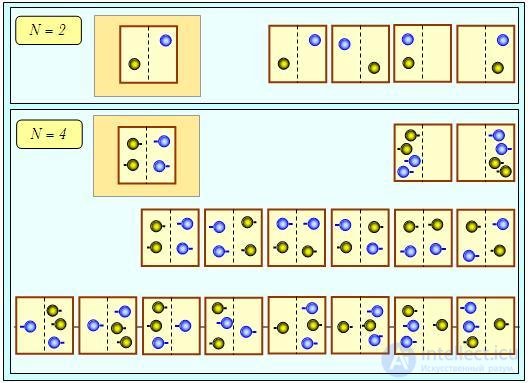
Fig. 5.7. Increase of entropy on mixing identical portions of gas: when counting the different ways of distributing the molecules over the parts of the joined vessel, each yellow and each blue molecule must be distinguished, for which they are equipped with "tails" sticking out to the left or to the right
So, after mixing, the molecules wander freely through the vessels and we have four (22) times as many ways of placing them (see the upper part of Fig. 5.7). If we have N = 4 molecules, then after joining the vessels they gain 24 = 16 times as many possibilities of distributing themselves over the volume of the system (lower part of the figure). It is clear that in the general case of N molecules the number 2N is indeed nothing other than the factor by which the number of ways of distributing the molecules over the volume of the system increases.
A statistical definition of entropy can be given:
|
|
|
(5.31) |
where W is the number of microscopic ways in which a given macroscopic state can be realized. Calculating the probabilities of macroscopic states and substituting them into this formula leads to the previous expressions for the entropy of an ideal gas. The use of the logarithm in the definition of entropy makes it possible to reduce the multiplication of probabilities to the addition of entropies. In our examples, the entropy per molecule increased by

The two under the logarithm is the doubling of the free space available to a molecule. The entropy of an ideal gas of N molecules is N times greater:

In classical statistics, entropy is defined up to an additive constant S0. In quantum statistics, which deals with discrete energy levels, this constant can be determined. From this, in particular, follows Nernst's theorem (Fig. 5.8), sometimes called the third law of thermodynamics:
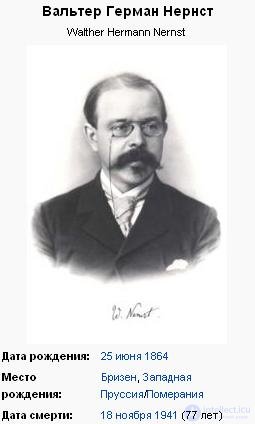
Fig. 5.8. Walther Hermann Nernst
|
As the temperature tends to absolute zero, the entropy also tends to zero. |
Indeed, at absolute zero all thermal motion ceases and all molecules are in the state of lowest energy. Therefore there is only one way of realizing such a state (W = 1), so that S = 0. (This is not true for systems that have several lowest energy states.)
Imagine that we are filming the mixing of molecules in the vessels. At first we have yellow molecules on the left and blue ones on the right. The molecules collide, travel through the vessels, and eventually mix uniformly (their mixture gives, so to speak, a more or less even green color). Such behavior of a system of a large number of particles corresponds to our experience. Now let us run the film backwards. In each individual frame, that is, in a specific act of molecular collision, we will see nothing special. The laws of mechanics will not be violated on our screen, since they are reversible. But the final outcome of the "reversed" film is truly miraculous: seemingly random collisions of molecules have led to the separation of the green color into yellow on the left and blue on the right. In such a process the entropy decreases, and the system goes from disorder to order. In fact, each molecule had exactly such velocities and positions, and underwent exactly those collisions and not others, in order to end up in the half of the vessel where it did. Such an event is highly improbable, although it does not contradict the microscopic laws of physics. The law of increase of entropy states that, with time, a system tends to pass into a less ordered state. As the saying goes, "entropy increases, and the world tends toward chaos." The question of self-organization of matter, of the emergence of order from chaos, is the subject of a completely different science, synergetics.
|
A heat engine is a periodically operating device in which thermal energy is converted into mechanical work. |
Heat engines are diverse in design and purpose. They include steam engines, internal combustion engines, jet engines, etc. (see Fig. 5.9).
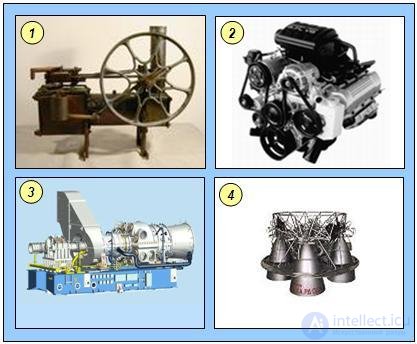
Fig. 5.9. Heat engines: 1 — steam engine; 2 — internal combustion engine; 3 — gas turbine; 4 — rocket engine
Despite this variety, practically all heat engines are based on a common principle — the principle of cyclic operation. The main parts of any heat engine are: the heater (hot reservoir), the working substance, and the cooler (cold reservoir).
As an example, let us consider the operation of a four-stroke internal combustion engine. In this engine a high temperature is reached by burning the working mixture (gasoline with air) inside the engine cylinder; the mixture is ignited by a spark. Let us list the main stages of operation of a four-stroke internal combustion engine:
The operation of a four-stroke internal combustion engine is shown in Fig. 5.10.
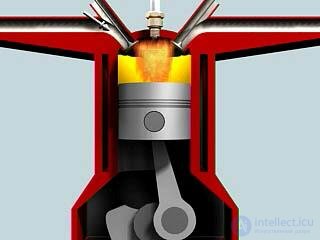
Fig. 5.10. Operation of a four-stroke internal combustion engine
Let us consider an idealized process (the Otto cycle) close to the one used in a four-stroke internal combustion engine. The Otto cycle is shown in Fig. 5.11.
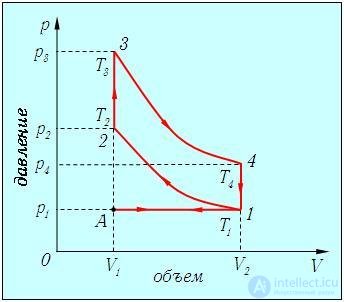
Fig. 5.11. Idealized cycle of a four-stroke internal combustion engine (Otto cycle)
As usual, the thermodynamic parameters carry as a subscript the number of the corresponding point in the figure (here one must remember that V3 = V2; V4 = V1).
Isobar A-1. The first stroke of the cycle. Owing to the motion of the piston, fuel is drawn into the cylinder. Approximately, we can assume that this occurs at atmospheric pressure p1. The volume increases from V1 to V2.
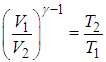
Adiabat 1-2. The second stroke of the cycle. There is no heat exchange with the surroundings. The piston moves in the opposite direction, adiabatically compressing the mixture from volume V1 to volume V2. The pressure rises, and the temperature increases from T1 to T2. The relation between the temperatures and volumes at the beginning and end of the adiabatic part of the cycle is given by
|
|
|
(1) |
Isochore 2-3. The beginning of the third stroke. Under the action of the electric spark the combustible mixture explodes: the pressure rises almost instantaneously to the value p3, while the volume has no time to change. The temperature rises from T2 to T3 owing to the heat released in the explosion. No work is done, and the quantity of heat received is expressed by the formula
|
|
|
(2) |
Adiabat 3-4. The continuation of the third stroke. There is no heat exchange with the surroundings. The gas expands adiabatically to the maximum cylinder volume V1, and the temperature and pressure fall. The relation between the temperatures and volumes at the beginning and end of the adiabat is given by the equation
|
|
|
(3) |
Isochore 4-l. The end of the third stroke. The valve opens, and the pressure falls to atmospheric at constant volume. The temperature also falls to the value T1.
|
|
|
(4) |
Isobar 1-A. The fourth stroke. The piston pushes the exhaust gases out of the cylinder, and the system returns to its initial state. Since the segment A-1 is traversed twice in opposite directions, the corresponding contributions to the work and to the heat cancel and can be disregarded.
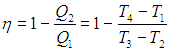
Thus, we obtain for the efficiency of the cycle
|
|
|
(5) |
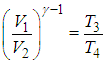
From equations (1) and (3) follows the equality of the ratios

from which we find
|
|
|
(6) |
Substituting (6) into (5), we arrive at the final expression for the efficiency of the cycle
|
|
|
(7) |
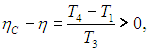
It turns out to be very similar to the formula for the efficiency of the Carnot cycle, but note that here the maximum temperature is the temperature at point 3 (Tmax = T3), and the minimum is the temperature at point 1 (Tmin = T1). Therefore, the efficiency of a Carnot cycle operating between such temperatures would be

The difference between these two expressions is nonzero:
|
|
|
(8) |
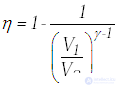
since T4 > T1. We have thus seen for ourselves that the efficiency of the cycle considered is lower than that of the Carnot cycle. Note also that the efficiency of the Otto cycle can be expressed in terms of the volume ratio:
|
|
|
(9) |
The quantity V1/V2 is called the compression ratio. It follows that the efficiency of the cycle considered is determined only by the compression ratio of the fuel mixture and the adiabatic index.
Besides the Carnot cycle and the practical cycles used in various engines, the so-called endoreversible heat engine is of interest (the meaning of the name will become clear later). The point is that the maximum efficiency, corresponding to the Carnot cycle, is never reached in practice. Moreover, even if it were possible, it is far from obvious that such an engine would be worth building. Besides efficiency, in real life simplicity of design and control, the cost of the installation, its reliability, its speed of operation, and similar requirements also play an important role, and these often conflict with one another. In the Carnot cycle, the working substance makes contact with the heat reservoirs at the same temperature. This means that heat flows infinitely slowly, which is, of course, very impractical. An idea of the real performance of the plants in use can be obtained by considering the endoreversible heat engine.
Suppose again that we have two heat reservoirs at temperatures Tmax and Tmin. Suppose also that the work is done by a Carnot cycle operating at a hot-reservoir temperature T1 and a cold-reservoir temperature T2. This means that the following chain of inequalities holds: Tmax > T1 > T2 > Tmin. In other words, we are considering a process that is irreversible as a whole, inside which there is a reversible cycle. Heat is supplied to the working substance at a constant temperature difference Tmax – T1 and is removed from it at a constant temperature difference T2 – Tmin (see the diagram in Fig. 5.13).
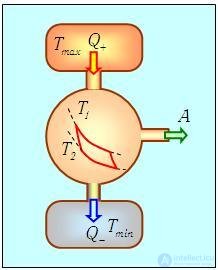
Fig. 5.13. The cycle of an endoreversible heat engine, imitating real power plants
This is the main difference from the standard ideal Carnot cycle, where the corresponding temperature differences are zero.
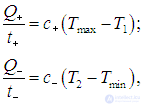
Suppose that the rate of heat exchange between the working substance and the heat reservoirs is proportional to the temperature difference between them:
|
|
|
(1) |
where Q+, t+ are the amount of heat received and the time of its transfer to the working substance in contact with the hot reservoir, and Q-, t– — are the amount of heat given up to the cold reservoir and the time of this process. The quantities c+ and c– — are the corresponding heat transfer coefficients. Then the total heat exchange time t is
|
|
|
(2) |
The time the engine spends on the inner Carnot cycle is determined by the time needed to establish equilibrium in the working substance, which is much shorter than the heat transfer time t. Therefore t can be taken as the time to complete the full cycle.
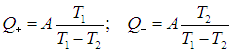
As usual, we assume that there are no heat losses due to friction and similar processes. The amounts of heat Q+ and Q–, as well as the work done A , are related by the relations we found when studying the Carnot cycle:
|
|
|
(3) |
Substituting (3) into (2), we find the following expression for the time to carry out the cycle
|
|
|
(4) |
The power of the engine under consideration is A/t. Imagine that we are designing such an engine. We are free to choose optimally the temperatures T1, T2 at which the inner Carnot cycle operates. Choosing them equal to Tmax and Tmin, respectively, we would achieve the maximum efficiency. But formula (4) implies that in this case

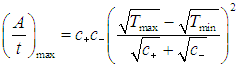
and the output power of the engine tends to zero. It is more practical to choose the temperatures so that the output power reaches its maximum. Setting to zero the derivatives with respect to T1 and T2 of expression (4) for t/A, we obtain the equations for these temperatures. Omitting the details, we give only the final result: the maximum output power under these conditions is
|
|
|
(5) |
This value is reached at the following temperatures of the inner Carnot cycle
|
|
|
(6) |
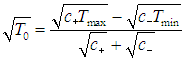
where the parameter T0, which has the meaning of a certain mean temperature of the system, is defined by the relation
|
|
|
(7) |
Obviously, the efficiency of our engine equals the efficiency of the inner Carnot cycle

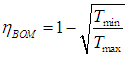
Since the ratio of the temperatures of the inner cycle equals the square root of the ratio of the hot-reservoir and cold-reservoir temperatures, we find the efficiency of the endoreversible engine:
|
|
|
(8) |
It is easy to verify that this efficiency is lower than the maximum possible one
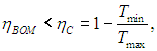
but in return we have gained in output power. Interestingly, the efficiency of the power-optimized endoreversible engine does not depend on the coefficients c+ and c–: as in the Carnot cycle, it is determined only by the ratio of the hot-reservoir and cold-reservoir temperatures. The authors of the endoreversible engine concept (F.L. Curzon and B. Ahlborn, Amer. J. Phys. 43, 22, 1975) give the following table comparing several large power plants. It can be seen that formula (8) agrees much better with practice than the efficiency of the ideal Carnot cycle does.
Table
Comparison of the observed efficiencies of several power plants of different types with the efficiency of the Carnot cycle hC and of the endoreversible engine cycle hEE
|
Location and type of power plant |
Tmin, °C |
Tmax, °C |
hC |
hEE |
Observed efficiency |
|
West Thurrock, UK (coal-fired) |
25 |
565 |
0.64 |
0.40 |
0.36 |
|
CANDU, Canada (nuclear) |
25 |
300 |
0.48 |
0.28 |
0.30 |
|
Larderello, Italy (geothermal) |
80 |
250 |
0.33 |
0.18 |
0.16 |
In conclusion of this section, we give a numerical example.
Example. Let the heat transfer coefficients c+ be equal and such that, for a temperature difference ΔT = 10 K, the power of the heat flow between the heat reservoirs and the working substance is 1 kW. In other words,
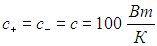
Let the reservoir temperatures further be Tmax = 50 °C = 823 K and Tmin = 20 °C = 293 K. Let us find the maximum output power of the endoreversible heat engine and the temperatures T1 and T2 at which the working substance, which uses the Carnot cycle, must operate.
From formula (5.29) it follows that when the heat conductivity coefficients are equal, the "mean" temperature T0 is determined as
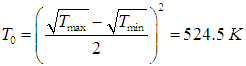
Using relations (5.28), we find the optimal temperatures
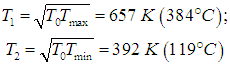
The efficiency of such a plant is hEE = 0.403 (cf. hC = 0.644). With the working-substance temperatures chosen in this way, the maximum output power is reached, determined by formula (5):
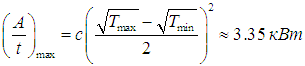













Comments