
Lecture
The Beetle in a Box is a thought experiment by Ludwig Wittgenstein, presented in his work «Philosophical Investigations» . In it, Wittgenstein reflects on the individuality of language and consciousness. This experiment demonstrates a person's inability to see the world through another person's eyes. Ludwig Wittgenstein discusses the subjectivity of people's experiences. He turns to pain as a specific phenomenon of the private sphere of human experience. If everyone knows what pain is only from their own experience, how can we use this concept for generalization? It is important to speak of pain only through the lens of one's own experience.
He was a German philosopher who worked in the field of analytic philosophy (the most prominent and useful movement in modern philosophy). He considered the critique of the language spoken by humans to be his most important task. Indeed, his ideas underlie the modern understanding that we acquire our knowledge through the lens of a vague and ambiguous symbolic system, and that the very organization of this system can substantially influence both the methods of cognition and the process of cognition itself.
Alan Turing proposed that the criterion for machine intelligence should be the ability to successfully play the linguistic imitation game. This criterion derives its reliability from a certain understanding of the connection between language and thought, although this connection can hardly be called obvious. In particular, the question of the nature of mental terms remains unclear.
The question of the status of mental concepts has roots going back to antiquity and gains particular relevance in the work of Thomas Hobbes. In his epistemology, Hobbes develops a conventionalist theory of language, in which the meanings of mental concepts, like the meanings of mathematical and physical terms, acquire the status of established conventions regarding their use. Without mutual communication among people, words would not be signs, existing only at the level of markers created by memory for internal, individual use. Language, and with it science, are the result of a complex system of communicative conventions. At the same time, truth, being the meaning of statements, can only be relative in nature, since language itself is conventional. In other words, Hobbes arrives at the conclusion that a private language is impossible, and also rejects absolute truth and metaphysics.
Let us imagine that everyone has a box, the contents of which we shall call a «beetle» . No one is allowed to look into another person's box. Each person can judge what a «beetle» is only by what is in their own box. It may be that something completely different is in other people's boxes. Or there may be nothing in them at all. It turns out that everyone means something different by the word «beetle». Wittgenstein draws a parallel between the box and the mind: we think we mean the same thing when we talk about love, pain, fear, and so on. But this is not the case, because different people carry different experience in their heads.
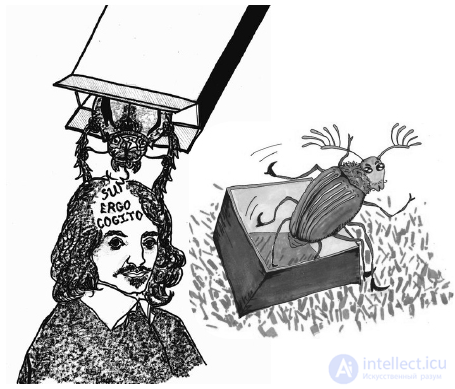
The idea proposed by Wittgenstein prompted reflection on the very nature of language. Each person has their own picture of the world. And when one person voices a thought, their interlocutor relates it to their own picture of the world. This is how a private language is born. This idea is reflected in John Locke's An Essay Concerning Human Understanding and Jerry Fodor's Language of Thought Hypothesis. Wittgenstein argues that all languages serve a social function. This also influences other areas of philosophical and psychological research. If a person has no such private language, there is no point in speaking of personal emotions and experiences.
Using this experiment, the author tried to show how much the description of perceived reality depends on the language we use (here one might also recall the Sapir—Whorf hypothesis). We are in principle unable to explain our internal subjective phenomenal states. And while we can still agree about beetles by matching the objects of the external world designated by words, when it comes to qualitative things, such as the perception of colors and other basic sensations, agreement is in principle impossible — even if I internally perceive red the same way you perceive blue, we will never know this, because under any circumstances we will always use the same word to denote the perceived color.
The «beetle in a box» experiment is presented in the work «Philosophical Investigations». It consists of numbered remarks. The idea of a private language appears in remark 243, but its essence is revealed in remark 256 and beyond.
An example of a private language would be a situation in which a person speaks a language that no one else understands . This is not simply a language that has not yet been translated. It cannot in principle be translated into an ordinary language, because our private experience is inaccessible to others . According to Wittgenstein, each of us speaks our own private language.
There is a possibility that a person will simply forget the contents of their box. This means the person no longer has a rigid criterion for defining the concept of a «beetle» . And we can no longer say that the contents of our box can be called by this concept. But such skepticism has been criticized as applying equally to public language. If one person can forget, several people can forget too. Therefore, criticism related to memory can just as well be applied to the definitions of public language. For example, Igor and Mikhail agree to call a certain book «R». But after some time, they forget which book they gave that name to. If they relied only on their memory, without writing it down or telling anyone else, they face the same problems that a single person who arbitrarily named the book «R» would face. So in this case, the argument against a private language can also be applied as an argument against public language.

Comments