
Lecture
The Ship of Theseus, or the Theseus paradox, is a paradox that can be stated as follows: «If all the component parts of an original object have been replaced, does the object remain the same object?»
The Ship of Theseus is a classic philosophical paradox that arose in ancient Greece. It concerns the identity of things, their change, and their persistence.
According to the Greek myth retold by Plutarch, the ship on which Theseus returned from Crete to Athens was preserved by the Athenians down to the time of Demetrius of Phalerum, and every year it was sent with a sacred embassy to Delos. Before each voyage the ship was repaired, and some of its planks were replaced, so that after a while all of them had been replaced, which led philosophers to argue about whether it was still the same ship or already a different, new one ? There is also a further question: if all the replaced planks had been kept and a ship built from them, which of the two ships would be the real one?
The story of the Ship of Theseus is this: in ancient Athens a ship was built that gradually deteriorated and required repair. As its parts wore out, they were replaced with new, sturdier ones. In time all the parts of the ship had been replaced, and the question arose — was it still the same Ship of Theseus, or an entirely different ship?
There are also modern variants of this paradox.
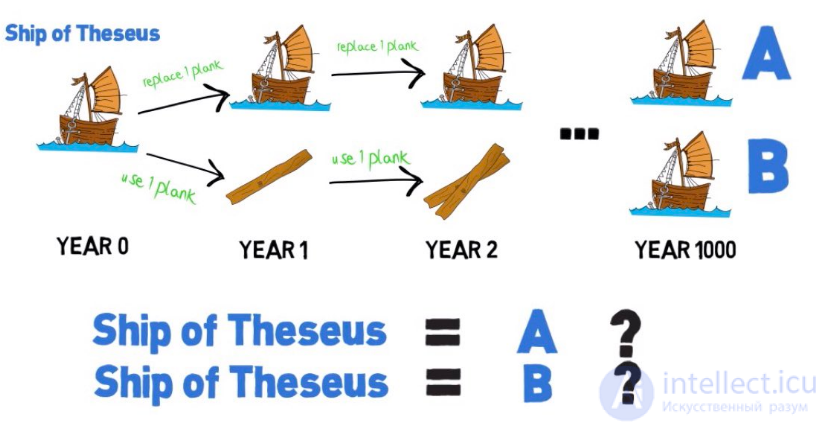
The key to the paradox lies in the ambiguity of the notion of «the same». Depending on how it is defined, the answers will differ. One can only discuss which definitions correspond to which notions of identity.
This theory holds that two ships, though identical in every other respect, are not identical if they exist at two different times. Each moment in time is a unique «event». Thus, even without any parts being replaced, the ships in the harbor differ from one another at any given time. This theory is extreme in its rejection of the everyday concept of identity that most people rely on in ordinary use.
The concept of identity could then be replaced by some other metaphysical device to perform its role. For example, we might regard the «Ship of Theseus» as a property or class that applies to all the events in the harbor, including the events of the reconstructed ship.
This solution was first introduced by the Greek philosopher Heraclitus, who tried to resolve the paradox by putting forward the idea of a river being replenished by water. Arius Didymus quoted his words: «On those who step into the same rivers, ever different waters flow». Plutarch disputed Heraclitus's claim that he had stepped into the same river twice, pointing out that this is impossible because «it disperses, gathers again, approaches and recedes».
According to Aristotle's philosophical school, there are several causes that describe an object: its form, its matter, and its essence (which, in Aristotle's teaching, is its most important characteristic). According to this philosophy, the ship remained the same, since its essence did not change — only the worn-out matter did.
The Ship of Theseus served the same purposes: mythically, it carried Theseus, and politically, it convinced the Athenians that Theseus had once been a living man, even though its material cause would change over time. The efficient cause concerns how and by whom a thing is produced — for example, how craftsmen make and assemble something; in the case of the Ship of Theseus, the workers who built the ship in the first place could have used the same tools and methods to replace the planks on the ship.
According to Aristotle, «what a thing is» is its formal cause, so the Ship of Theseus is «the same» ship because its formal cause, or design, does not change, even though the matter used to «build it» may change over time. In the same way, for Heraclitus's paradox, the river has the same formal cause, even though its material cause (the particular water in it) changes over time, as does the person who steps into the river.
In this theory, both the reconstructed and the restored ships lay claim to identity with the original, since each can trace its history back to it. As such, they are both identical to the original. Since identity is a transitive relation, the two ships are therefore also identical to each other and constitute a single ship existing in two places at once.
The basic principle of logical atomism is that the facts of the world exist independently of one another. Only if we reject this principle can we assert the following: the restored ship requires continuity of parts with the original over time, and therefore, absent other arguments, lays claim to identity with the original. However, once the reconstructed ship is completed and unveiled to the world, it makes a stronger claim to continuity, which changes the status of the restored ship and causes it to lose its identity with the original. As a theory of observer-independent reality this is hard to accept; it involves both action at a distance and a violation of logical atomism. It is, however, more acceptable to Kantian-style metaphysicians, who treat their subject as a theory of psychology rather than of reality, since it describes what biological humans are likely to believe in practice. (For example, if these were real ships put on public display for a fee, it is quite likely that the public would pay to see the reconstructed ship rather than the restored one.)
According to this solution, things can be «the same» quantitatively and/or qualitatively. In that case, after a plank is replaced, the Ship of Theseus would be quantitatively the same but qualitatively already a different ship. The trouble with this solution is that introducing too many characteristics eliminates any possibility of identity (for example, the same ship, without any planks replaced, could be considered a «different» ship merely by changing its position in space).
As the parts of the ship are replaced, the ship's identity gradually changes, since the name «Ship of Theseus» is a truthful description only for as long as there is a historical memory of Theseus's use of the ship — his physical contact with it and control over it. Its essence is exact. For example, a museum curator, before any restoration, can truthfully say that the bed in the captain's cabin is the very bed in which Theseus himself once slept; but once the bed has been replaced, this is no longer true, and in that case the claim becomes deceptive, because a different description would be more accurate, namely «A Replica of Theseus's Bed». The new bed will be just as foreign to Theseus as an entirely new ship. This holds for any other part of the original boat. As parts are replaced, the new boat becomes exactly that: a new boat. The restored boat proposed by Hobbes, built from the original parts, would become the original ship, since its parts are the actual pieces of matter that took part in Theseus's voyages.
Ships do not exist. «Ship» is a label for a particular arrangement of matter and energy in space and time. The old «ship» is merely a concept in the human mind. In the same way, the new «ship» (all of whose parts have been replaced) is another concept in the human mind. If these two concepts were completely identical, the human mind would not be able to compare them — there would be nothing to compare. It follows that the old ship and the new ship need not coincide, for the simple reason that people are able to compare these two concepts with each other.
In Europe, several independent tales and stories tell of knives whose blades and handles have been changed several times, yet they are still used and considered to be one and the same knife. France has the knife of Jeannot; in Spain the knife of Jeannot is used as a proverb, although it is referred to simply as the «family knife», and in Hungary there is the «pocket knife of Lajos Kossuth». Several variants or alternative formulations of the basic problem are known, including grandfather's axe and Trigger's broom , in which an old broom or axe has had its head and handle replaced, leaving none of the original components.
In Japan, the Great Shrine of Ise is rebuilt every twenty years entirely from «new wood». Continuity across the centuries is considered spiritual and comes from the source of the timber, which is gathered in a neighboring forest considered sacred.
The ancient Buddhist text Da zhidu lun contains a similar philosophical riddle: the story of a traveler who encountered two demons at night. As one demon tore off the traveler's body parts one by one, the other demon replaced them with parts from a corpse, and the traveler no longer understood who he was.
In «The Three Basic Facts of Existence», Piyadassi Thera draws on the teaching of the Dharma to suggest that nothing in the universe is ever the same.
The French critic and essayist Roland Barthes mentions the fully rebuilt ship on at least two occasions: in the preface to his « Critical Essays » (1971) and later in « Roland Barthes by Roland Barthes» (1975); in the latter, the permanence of the ship's form is treated as a key structuralist principle. He calls this ship the Argo, on which Theseus is said to have sailed with Jason; he may have confused the Argo (mentioned in passing in Plutarch's « Theseus », 19.4) with the ship that sailed from Crete ( «Theseus», 23.1).
The paradox of the Ship of Theseus is mentioned in Terry Pratchett's book «The Fifth Elephant». It concerns an axe that regularly gets new handles or blades. The characters in the book believe that this axe cannot be considered physically the same axe, but can be considered emotionally the same axe.
The cruiser Aurora can practically be considered the very same Ship of Theseus — since during its 1984-1987 restoration only a few fragments of the original conning tower remained from the original ship, the entire underwater hull and most of the above-water hull were replaced with new construction, and the ship's guns had already been lost during the Great Patriotic War.
In the children's book «The Wonderful Wizard of Oz», an enchanted axe cut off the woodcutter's limbs one by one, and each time a blacksmith forged him a new one, until the woodcutter had been entirely transformed into the Tin Woodman. The book «The Tin Woodman of Oz» tells a similar story about the Tin Soldier (Captain Fyter), as well as about Chopfyt — a man made from the severed body parts of the Woodman and the Soldier. The author's solution is as follows: both the Woodman and Captain Fyter are considered «the originals», while Chopfyt is considered «new».
In the prologue of David Wong's book «John Dies at the End», the paradox of Theseus is likewise illustrated using an axe. The hero beheaded a man with the axe, and on the final blow the handle broke. It was later replaced with a new one. The same axe is then used to kill a strange creature resembling a giant slug that suddenly appeared in the hero's kitchen one rainy evening. This time the axe head breaks and is in turn replaced. Some time later, the previously killed man, risen from the dead, finds our hero standing in the kitchen with that very same axe, and shouts at him: «That's the axe you killed me with!». The question is: is he right?
In the first episode of the eighth season of the television series «Doctor Who», the Twelfth Doctor encounters clockwork androids that have spent hundreds of years abducting people and replacing their own parts with human organs. The Doctor argues that by this point nothing of the original androids remains, drawing an analogy with a broom: if the handle and the brush are replaced again and again, is it still the same broom?
A mention of the Ship of Theseus appears in the 9th episode of the series «WandaVision» (2021), during an argument between two versions of the synthezoid Vision, one of which is largely a material embodiment of his past self, while the other is an embodiment of an illusion.
This paradox has become the subject of philosophical debate concerning the identity of things over time and their changes. Some philosophers argue that an object remains the same even if all of its components have been replaced. Others hold that an object ceases to be the same if all of its components have been replaced.
The Ship of Theseus has become one of the examples used to explain the philosophical concept of identity, which concerns an object retaining its identity under different conditions. Today this paradox is also used in the context of artificial intelligence and robotics, where questions of the identity of things and of their qualities and properties become extremely important.

Comments