
Lecture
The Myth of the Cave — a famous allegory used by Plato in Book VII of the dialogue «the Republic» to explain his theory of Forms. It is considered a cornerstone of Platonism and objective idealism as a whole. It is presented in the form of a dialogue between Socrates and Plato's brother Glaucon.
Let us consider not exactly a thought experiment, but a very well-known metaphor — the Cave of Shadows (the Myth of the Cave). This cave of shadows was described by one of the greatest thinkers of Ancient Greece, Plato, in his treatise "the Republic." Since all the ancient Greek philosophers considered it beneath their dignity to concern themselves with the mess of everyday existence, they occupied themselves only with pure intellectual reasoning and reflection on the structure of the world and similar matters, and that is why I count Plato's description of the cave among philosophical thought experiments.
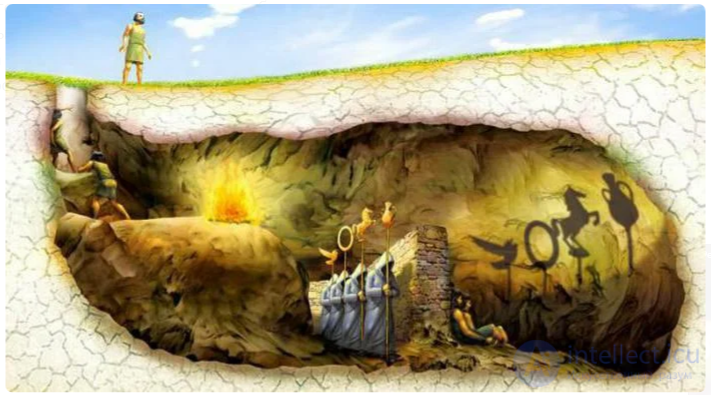
Plato wrote:
Imagine that people live, as it were, in an underground dwelling like a cave, with a wide opening running along its entire length. Since childhood their legs and necks have been bound by chains, so that they cannot move from the spot and can see only what is directly in front of them, unable to turn their heads because of these fetters. Their backs are turned to the light coming from a fire burning far above them, and between the fire and the prisoners runs a raised path, bordered by a low wall, like the screen behind which puppeteers place their assistants when they show their puppets above it. Behind this wall other people carry various objects, holding them so that they show above the wall; they carry statues and all sorts of figures of living beings, made of stone and wood. And, as usual, some of those carrying these things talk, while others are silent.
—…You can compare our human nature, with respect to enlightenment and its absence, to a condition like this… Imagine that people live, as it were, in an underground dwelling like a cave, with a wide opening running along its entire length. Since childhood their legs and necks have been bound by chains, so that they cannot move from the spot and can see only what is directly in front of them, unable to turn their heads because of these fetters. Their backs are turned to the light coming from a fire burning far above them, and between the fire and the prisoners runs a raised path, bordered, imagine, by a low wall, like the screen behind which puppeteers place their assistants when they show their puppets above it.
— That much I can imagine, — said Glaucon.
— Then imagine also that behind this wall other people are carrying various objects, holding them so that they show above the wall; they carry statues and all sorts of figures of living beings, made of stone and wood. And, as usual, some of those carrying these things talk, while others are silent.
— What a strange picture you are drawing, and strange prisoners!
— Much like ourselves. First of all, do you think that, being in such a position, people would see anything of themselves or of one another, other than the shadows cast by the fire on the wall of the cave facing them?
— How could they see anything else, if all their lives they are forced to keep their heads still?
— And what of the objects carried past there, behind the wall? Isn't it the same with them?
— How do you mean?
— If the prisoners were able to talk with one another, don't you think they would believe that they were giving names to the very things they see?
— They certainly would .
Actually, this passage makes everything clear. Plato is describing how we, as human beings, are held captive by our own perceptions. We look at the world through a «sphere of perception», and we can never come to know the true essence of things. Moreover, this is denied to us even by means of thought experiments like this one, since they too are carried out through a system of symbols that is itself grounded in perception. There are no symbols that simply arose in our heads on their own — every one of them has a corresponding intension in objective reality.
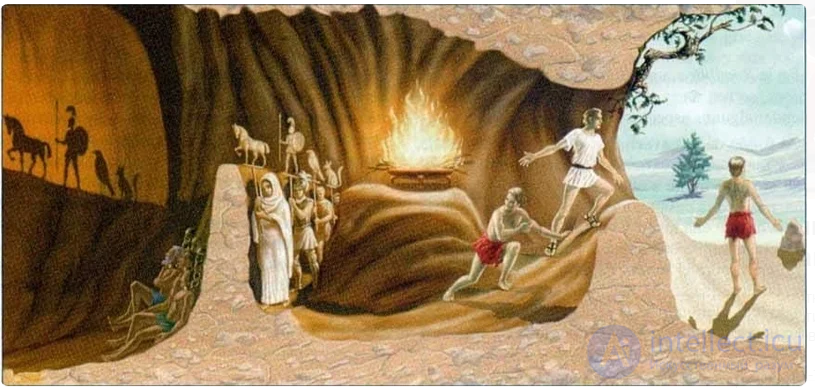
Can one break free from the cave of shadows? Hardly...
But is it really true that there are no such symbols? There is a view that fundamental mathematics is precisely the area of human thought that is directly connected to the absolute world of pure ideas. One can escape the fetters of the sphere of perception only through mathematics, though this liberation leads only to a direct understanding of abstract mathematical entities.
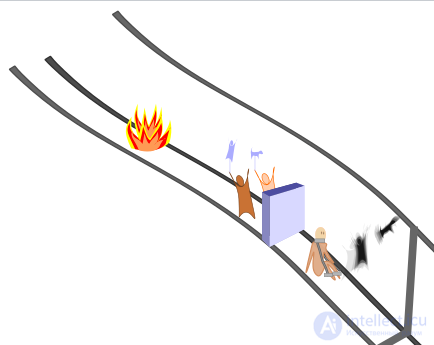
A visual illustration of the situation of the cave dwellers
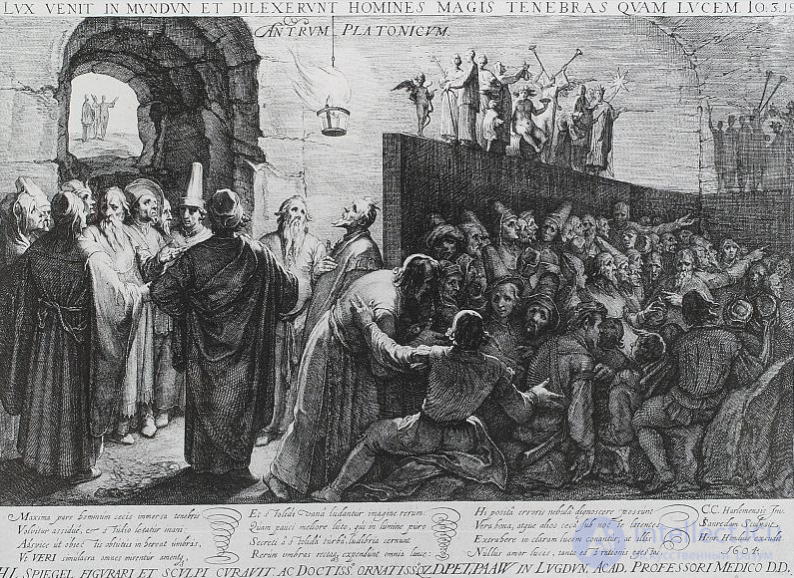
A copper engraving, "The Platonic Cave," by Jan Saenredam after an oil painting by Cornelis van Haarlem.
The comparison of a person to a prisoner in a cave who forms an idea of the world from shadows, with reference to Plato, is mentioned in Arthur C. Clarke's science fiction novel "A Fall of Moondust" (1961), where the author reflects on which is more real: the crescent of the Earth observed from the Moon with the naked eye, or its image in infrared light .
The Myth of the Cave served as the starting point for the novel "The Cave" (2000) by the Portuguese writer José Saramago, winner of the Nobel Prize in Literature.
The Spanish writer José Carlos Somoza partly draws on Plato's allegory of the cave and develops Plato's theory of the world of ideas in his work "The Athenian Murders," which in 2002 received the Gold Dagger Award for best detective novel.
The idea of Plato's myth of the cave is played out in Denis Herber's science fiction short story "None of Us Belong Here."
The concept of Plato's cave is used in Neal Stephenson's novel "Anathem."
Martin Heidegger's critique of the Platonic conception of truth was based on the allegory of the cave. He set out his conception in the essays On the Essence of Truth: On Plato's Allegory of the Cave and the Theaetetus [23] and Plato's Doctrine of Truth [24]. Heidegger gave an etymological interpretation of the Greek word alḗtheia («truth») as «unconcealment», meaning that this unconcealment lies in the matter itself. Plato did not look for it there, but instead transferred it to human cognition and turned it into a relation between the knowing subject and the known object. Truth was no longer defined as the self-disclosure of things, but as the correspondence of a statement to its object. The allegory of the cave marks a turning point toward a new conception of truth, one that has shaped our understanding of truth ever since. Heidegger regarded this turning point as regrettable and wanted to reverse it, because he saw in it the beginning of decadence. His interpretation provoked a sharp, at times highly critical, response. The assumption of a development from an earlier to a later understanding of truth is refuted by the textual evidence: it can be shown that the meanings Heidegger assigned to the different eras were present in the Greek language from the very beginning. [25]
In his work Höhlenausgangs (Cave Exits) (1989) Hans Blumenberg uses the cave metaphor as a starting point for a wide range of philosophical reflections. He believes that the cave myth visualizes the helplessness of the dialogical process, a dialogical impasse. This is shown by the fact that the person who has ascended to knowledge and then returned to the cave meets fierce resistance from the cave dwellers, who resolve to commit murder: Nothing is harder than making the offer of freedom acceptable. (…) The means available to the returnee are not enough to awaken the desire to understand liberation, because dialogue by its very nature cannot do so. The returnees fail because they want to carry out their task in the Socratic manner. A Socratic dialogue, in which the interlocutor becomes entangled in contradiction, is bound to fail in this phantom world, since there are no contradictions there, only a sequence of appearances, a predictability that gives the cave dweller pleasure. [26] In the cave there is neither curiosity about outward appearances nor any inclination to learn.
The individual phases of the ascent from the shadows in the cave to the sight of the sun are debated and disputed in scholarly research. In particular, the question is whether these phases correspond to the four segments of the line in the allegory of the line and to the four types of knowledge assigned to those segments. Related to this is the question of how to map the stages of the freed cave dweller's habituation onto the stages of the philosophical path of cognition and the classes of philosophical objects of knowledge. Another topic of research is the relationship between the ascent in the allegory and Plato's educational program. [28]
Many researchers consider it plausible that the four phases of the cave allegory correspond to the four types of knowledge in the line allegory, but some see no analogy between the cave and the lower segment of the line in the line allegory. [29] The views of those who accept the analogy differ in the details of how they assign the phases of the ascent to the segments (types of knowledge) and to the classes of objects of cognition. One interpretation, based on the analogy between the cave allegory and the line allegory, comes from Rudolf Rehn. According to him, the phantom world of the cave corresponds, epistemologically, to conjecture (eikasía), which in the line allegory relates to mere shadows and mirror images. The objects that cast the shadows in the cave allegory correspond to the perceived material objects that stand for belief (pístis) in the line allegory. The natural objects of the cave allegory, whose images are the objects that cast the shadows, symbolize the mathematical objects to which, in the line allegory, the cognitive method of conceptual thought (diánoia) is assigned. Perception of the sky in the allegory of the cave corresponds, in this scheme, to rational cognition (nóēsis) of the line allegory. [30] Other researchers have proposed distribution schemes that differ from this one in their details. [31]
That the sun in the cave allegory symbolizes the idea of the good, and that the liberated cave dweller truly saw this sun, is not in doubt from Plato's text. The Platonic Socrates, however, admits that he himself has not attained this goal. In scholarship this has been interpreted in various ways. The interpretation according to which Plato considered the goal to be in principle unattainable, and at best only approximately reachable, is not supported by the text of the allegory. The Politeia offers nothing regarding Plato's own self-assessment of his level of knowledge. [32]
In scholarship, the question of the liberated prisoner's return to the cave is frequently discussed. It symbolizes the philosopher's willingness to place himself at the service of society and thereby accept great inconvenience, even though a purely contemplative life would be far more pleasant for him. The philosopher acts this way because he wants to be just in the sense of Plato's conception of justice. Here there seems to be a contradiction with Plato's claim that honest behavior always serves the agent's own (rightly understood) interests. However, the philosopher cannot refuse to be part of the community, since by such behavior he would commit an injustice. In doing so he would lose the fundamental virtue of justice and would diminish his relation to the world of ideas, which is his standard of orientation — that would affect him, that is, do him serious harm. That is not in his interest. Thus he too acts in his own interest when he gives up a more comfortable life in favor of a harder one. However righteous he may be, he has no alternative to justice

Comments