
Lecture 11 min.
In computing, ambient intelligence ( AMI ) refers to an electronic environment that is sensitive and responsive to the presence of people. Ambient intelligence is a projected future of consumer electronics , telecommunications and computing , originally developed in the late 1990s by Eli Zelkha and his team at Palo Alto Ventures for the period from 2010 to 2020. This concept is designed to let devices work together with people in carrying out their everyday activities, tasks and rituals in an intuitive way, using information and intelligence hidden in the network connecting these devices (for example, the Internet of Things ) . . It is theorized that as these devices become smaller, more connected and more integrated into our environment, the underlying technological infrastructure will disappear into our surroundings until users are left perceiving only the user interface.
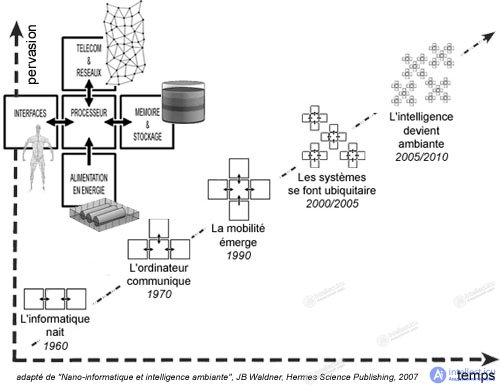
The paradigm of ambient intelligence builds on pervasive computing , ubiquitous computing , profiling , context awareness and the design of human-centered computer interaction. It is characterized by systems and technologies that are:
A typical context for an ambient intelligent environment is the home, but it can also be extended to workspaces (offices, coworking spaces), public spaces (based on technologies such as smart street lighting ) and hospital environments.
Overview
Ambient intelligence is of interest primarily because of its connection to, and the development of, sensor technologies and sensor networks. Interest in user experience grew in the late 1990s as a result of the increasing volume and importance of digital products and services that were difficult to understand or use. In response to this, there emerged user experience design to create new technologies and media based on users' personal experience. Ambient intelligence is influenced by user-centered design , where the user is at the center of the design activity, and is asked to provide feedback through specific user evaluations and tests, in order to improve the design or even create the design together with the designer (co-design) or with other users (end-user development).
The existence of ambient intelligence requires a number of key technologies. These include unobtrusive, user-friendly hardware, such as miniaturization , nanotechnology and smart devices, as well as human-centered computer interfaces ( intelligent agents , multimodal interaction , context awareness and so on). These systems and devices operate through a seamless mobile/fixed communication and computing infrastructure characterized by interoperability , wired and wireless networks and service-oriented architecture .
To implement dynamic and widely distributed networks of ambient-intelligence devices that are easy to monitor and program (for example, service discovery , autoconfiguration , end-user programmable devices and systems, etc.), these systems and devices must also be reliable and secure, which can be achieved through self-testing and self-healing software and technologies that ensure privacy .
History and invention
In 1998, the Philips Board of Management commissioned a series of presentations and internal workshops organized by Eli Zelkha and Brian Epstein of Palo Alto Ventures. Zelkha, together with Simon Birrell coined the term «ambient intelligence» to explore various scenarios that could transform the large-scale 1990s consumer electronics industry — which they described as «feature-fragmented» — into an industry in which user-friendly devices would support pervasive information, communication and entertainment by 2020. In developing the concept of ambient intelligence, Palo Alto Ventures prepared a keynote speech for Roel Pieper of Philips at the Digital Living Room Conference in 1998. The team included Eli Zelkha, Brian Epstein, Simon Birrell, Doug Randall and Clark Dodsworth. These plans continued to develop throughout the 1990s, and in 2000 plans were drawn up to build a workable and convenient facility intended for exploring the environment. This home lab officially opened on April 24, 2002. In 2005, Philips joined the Oxygen Alliance, an international consortium of industry partners within the MIT Oxygen project [10] , aimed at developing technologies for 21st-century computers.
Alongside the development of this vision at Philips, a number of parallel initiatives were launched aimed at studying ambient intelligence in more detail. Following the advice of the Information Society Technologies Advisory Group ( ISTAG ), the European Commission used its vision to launch its Sixth Framework Programme (FP6) for Information Society Technologies (IST), with a supplementary budget of €3.7 billion. The European Commission played a decisive role in further developing the AmI concept. As a result of many initiatives, the AmI vision gained support. Several major initiatives have been launched in recent years. The Fraunhofer Society has started several activities in various fields, including multimedia, microsystems design, and augmented space. The Massachusetts Institute of Technology established an ambient intelligence research group within its Media Lab. [11] Several more research projects were launched in various countries, such as the United States, Canada, Spain, France and the Netherlands. Since 2004, the European Symposium on Ambient Intelligence (EUSAI) has been held, along with numerous other conferences devoted to specific AmI topics.
Criticism
Because the dissemination of information about personal presence is getting out of control, the vision of ambient intelligence has been criticized (for example, David Wright, Serge Gutwirth, Michael Friedewald et al., Safeguards in a World of Ambient Intelligence, Springer, Dordrecht, 2008). Any immersive, personalized, context-aware and anticipatory features raise social, political and cultural concerns about the loss of privacy . The scenario example given above shows both the positive and negative possibilities of ambient intelligence. Ambient intelligence applications do not necessarily have to reduce privacy in order to work. [12] [13] [14]
The concentration of power in large organizations, a fragmented, increasingly less private society, and a hyperreal environment in which the virtual is indistinguishable from the real are the main themes of the criticism. [15] Several research groups and communities are studying the socio-economic, political and cultural aspects of ambient intelligence.
Social and political aspects
The ISTAG advisory group suggests that the following characteristics will allow society to accept ambient intelligence. Ambient intelligence should:
Business models
The ISTAG group recognizes the following entry points into the AmI business landscape:
Technologies
Various technologies can be used to enable ambient intelligence environments, for example: [16]
Computing
This computing medium ties all the pieces of technology together. It also allows the device to remember past requests. [17]
Use in fiction

Comments